
7 years later, the $4.2 billion largest funding project in history announced its failure

Today, EOS has rebranded to Vaulta.
The ancient public blockchain that made a grand entrance seven years ago with a year-long extravagant fundraising, once hailed as an early "Ethereum killer," has finally abandoned its dream of achieving millions of TPS and announced a shift towards Web3 banking. The grandiosity of its $4.2 billion fundraising, the buzz of 21 super node elections, and the utopian declaration of a million TPS have now been pieced together as the most expensive idealistic experiment in blockchain history.
Seven years later, apart from long-time hodlers, no one mentions this "ancient public blockchain" that now ranks 97th by market capitalization. Going forward, EOS is no longer a high-performance public chain; it has undergone a transformation, attempting to pivot towards Web3 banking business—it has relinquished its once-proud dreams, even forsaking its name.
We use this article to document the most insane product of the ICO era, one that burned so much money, leaving behind a poignant story.
A Tower of Babel Built with Code and Dollars
In 2017, the blockchain industry was experiencing its wildest bull run. Bitcoin surpassed $1,000 in early January and skyrocketed to $20,000 by the year's end. Ethereum's smart contracts completely transformed the crypto world, and ICOs (Initial Coin Offerings) became the hottest fundraising method, with hundreds of projects flooding the market, all striving to build a "decentralized future."
Amidst this capital frenzy, EOS emerged with the banner of "Blockchain 3.0," raising the flag of "Ethereum Killer." Its whitepaper depicted an ideal world: a million TPS (transactions per second) to completely solve Bitcoin and Ethereum's scalability issues; zero transaction fees so that regular users wouldn't have to pay expensive gas fees, making on-chain transactions as smooth as cloud applications; ultra-fast block production, with 21 super nodes responsible for transaction processing, no longer hampered by miner competition; a blockchain supercomputer to make decentralized applications (DApps) a reality.
Founder BM (Dan Larimer) was EOS's biggest asset. For the tech-savvy, he was a genius—suggesting a change to the consensus mechanism to Satoshi Nakamoto just a year after Bitcoin's launch, arguing that PoW (Proof of Work) was not efficient. Later, he created BitShares and Steemit, becoming one of the most well-known engineers in the crypto world. But BM was not just a tech geek; he also had utopian idealism. He believed that blockchain could change everything, and EOS would be the ultimate solution for human societal structure.
With a brilliant CTO and a top-notch marketing team, the ambition of this story was already on the table. On June 26, 2017, EOS began its crowdfunding, planned to last for a year (in contrast, most ICO fundraising periods lasted only weeks to a few months).
Global investors flocked in and raised 185 million USD within 24 hours. In the end, EOS successfully raised 4.2 billion USD, becoming the largest fundraising in the history of the crypto world, far surpassing all projects at the time, including Ethereum's 18.5 million USD.
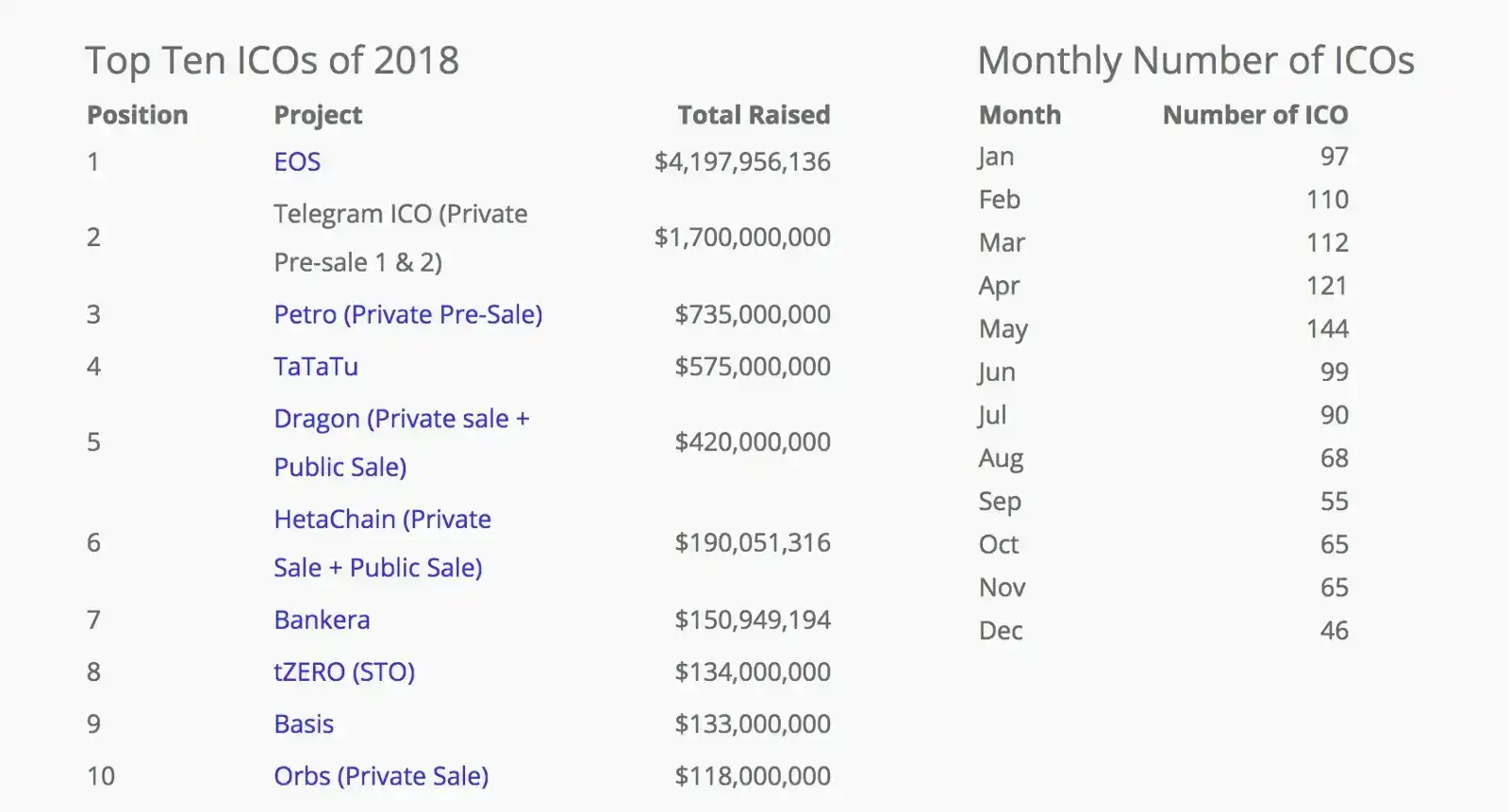
Top 10 ICO Projects of 2018
With 4 billion USD, EOS leaped to become a super capital entity in the crypto world.
In April 2018, EOS's price surged from 5 USD to 23 USD, a 360% monthly increase, propelling its market value into the global top five, second only to Bitcoin, Ethereum, Ripple, and Bitcoin Cash. Media hype escalated, with headlines such as "EOS Will Become the First Trillion-Dollar Cryptocurrency" and "BM Is the Next Satoshi Nakamoto" flooding the scene. Ethereum developers also began to feel anxious, fearing that EOS's rise would lead to Ethereum's decline.
During this year, before the EOS mainnet launch, it had already become the hottest star in the crypto world. Driven by the FOMO (fear of missing out) emotion, EOS was considered the "next-generation Ethereum," with some even predicting it would reach 1,000 USD.
The Super Node election became a global sensation, with key figures like Li Xiaolai, Lao Mao, and other "godfather-level" individuals making high-profile entries. Exchanges, mining pools, Wenzhou Capital, and even traditional funds flocked in — this election was dubbed the "Wall Street IPO of the blockchain." The three countries of China, the U.S., and South Korea engaged in a "crypto country war," with the Korean community chanting, "Not investing means not being Korean." Li Xiaolai's Coin Capital held four nodes, while the Wenzhou group entered with an eight-figure EOS spree.
With a 4 billion USD fundraising, a star-studded project, a dark horse public chain, garnering attention from all quarters, and BM being picked up in a luxury car by the project team at the Hong Kong airport, everything seemed so perfect. However, beneath the grandeur, everything was built on a tower of code and dollars.
EOS's Peak Was Only the Beginning
Amidst fervent enthusiasm, issues had already quietly emerged:
EOS's voting system was questioned for being easily controlled by whales, the decentralization of the Super Nodes was doubted; post mainnet launch, various technical issues arose, developers began to question EOS's stability; deep involvement of exchanges and capital giants made the Super Node election no longer fair, and the community began to have differing voices; after BM launched the mainnet, frequent changes to the governance mechanism caused community turmoil.
However, at that time, the market was still immersed in euphoria, and all doubts were overshadowed by the slogan "EOS is about to change the world." During that golden age, everyone believed that EOS would become the future overlord, even the ultimate form of the blockchain industry. However, reality is often crueler than dreams, and no one anticipated that this once highly anticipated project would fall from grace in just a few years.
Tech Disillusionment: From "Million TPS" to "Distributed Database"
At that time, the biggest problem facing blockchain was scalability, how to process more transactions per second. The Bitcoin network could handle 5 or 6 transactions per second, and Ethereum was a bit better, at roughly 20 transactions per second. However, these numbers were far from sufficient for blockchain's usage requirements.
In this context, EOS's million TPS capability drove everyone crazy. It's worth noting that during Alibaba's Double 11, the peak transaction volume was hundreds of thousands per second.
However, after the EOS mainnet had been live for 4 months, the highest TPS reached was only 3996, far from the promised million.
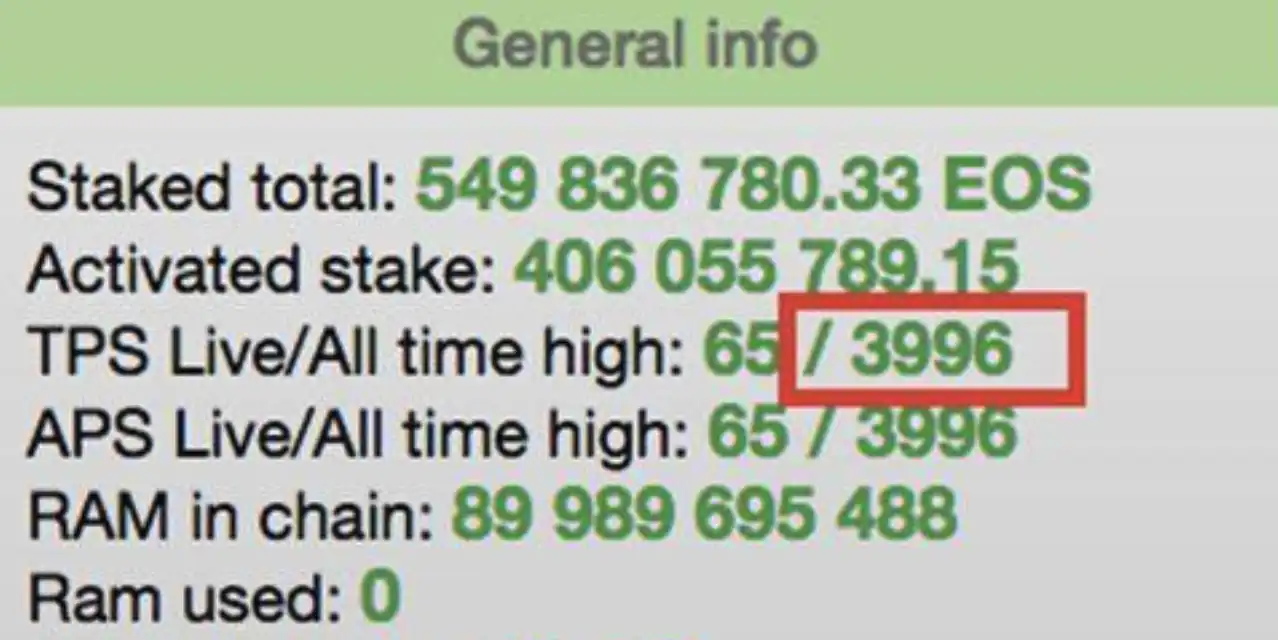
While EOS fell far short of expectations, on the other hand, Ethereum gradually improved its performance through Layer 2 scaling solutions, and competing chains like BNB and Solana quickly rose to prominence, completely erasing EOS's "performance advantage."
People discovered that the so-called "million TPS" was actually a carefully crafted word magic trick—BM quietly added a premise to this number: it must rely on an infinitely scalable sidechain ecosystem. In his vision, if one chain could handle 4000 transactions, 100 parallel sidechains could achieve 400,000 TPS. However, in reality, by 2023, the EOS ecosystem only had 3 sidechains live, with two becoming "ghost chains" due to developer exodus. BM's response to this was to pivot on Twitter, announcing that he was "studying anti-inflation algorithms," while at this point, EOS had fallen out of the top 20 by market cap.
Usability was the core issue with EOS.
Initially, EOS hit a user pain point with free transactions. Users quickly found out that while EOS transactions were feeless, they had to stake tokens to exchange for CPU resources. During network congestion, transferring 10 EOS required staking the equivalent of 5 EOS in CPU resources—essentially a form of freezing user funds. During a DApp traffic peak in 2020, 2000 EOS could only exchange for 1.3 seconds of CPU time; regular users needed to repeat the process more than ten times to complete a transaction.
Furthermore, BM also set a RAM supply limit, which led to RAM speculation in the market, causing RAM prices to skyrocket by 100 times. Developers had to spend a high cost to purchase storage resources. In 2018, some speculators started hoarding RAM, and within a few months, the RAM price surged from 0.01 EOS/KB to 0.9 EOS/KB, severely impacting DApp development, with many new projects directly giving up on EOS.
Ultimately, this resource management model made EOS's user experience even worse than Ethereum's: on Ethereum, users can directly pay Gas fees to complete transactions; but on EOS, users must first learn complex resource staking mechanisms, and even have to spend a hefty price to buy CPU and RAM, leading to a severe hindrance in DApp ecosystem development.
From today's perspective, it is actually difficult to understand how, despite such a poor user experience, EOS had a boom period in late 2018 and early 2019: DApps mainly focused on on-chain gambling were very popular on EOS.
On December 24, 2018, data showed that in the past week, comparing the overall DApp ecosystem of the top three public chains ETH, EOS, and TRON, the following were observed: Total number of users: EOS (75,346) > TRON (45,777) > ETH (33,495); Total number of transactions: EOS (23,878,369) > TRON (13,803,322) > ETH (413,019); Total transaction volume (USD): EOS ($345,489,773) > TRON ($135,201,171) > ETH ($44,272,856);

This indicates that at that time, the EOS community indeed had high expectations, and its ecosystem surpassed ETH and TRON. Perhaps it was this "daydream," which now makes veteran players in the crypto space nostalgic when recalling EOS.
Governance Failure: Vote Buying, Centralization, and Community Division
Of course, when we talk about governance now, it seems we can only smile wryly, but at that time, EOS's governance was highly anticipated. BM firmly believed that under his careful design, 21 nodes would make this network far superior to Ethereum.
He believed this network would have 2/3 good actors, everyone's behavior would be benevolent, and nodes behaving in bad faith would be voted out by the users. It was a perfect utopia. In reality, he was overly naive.
After 3 months since the EOS mainnet went live, node mutual voting has become an unwritten rule. In order to receive EOS block rewards, no one can stop the mutual voting between whales and nodes. What is even more outrageous is that the nodes themselves engage in misconduct.
EOS operates with a mechanism where 21 super nodes take turns producing blocks. At one point, a user had their funds stolen by a hacker. The solution was for the 21 nodes to blacklist the hacker's address to prevent further transfers. This was a normal and simple operation, but one of the nodes did not comply. As a result, the hacker was able to transfer the funds while that particular node was producing blocks, acting as if nothing had happened.
Brendan Blumer (BM) once attempted to regulate these behaviors through an EOS constitution but quickly found that the constitution had no teeth. Since the super nodes themselves benefit from bribery, they have no incentive to enforce the rules outlined in the constitution. The arbitration mechanism is completely ineffective and lacks any real enforceability.
In 2019, BM completely abandoned constitutional governance and announced that the EOS community should evolve freely without interfering with the election of super nodes. By 2020, EOS's super nodes had devolved into a battleground for exchanges, mining pools, and capital conglomerates, rendering the votes of ordinary token holders meaningless. Delegated Proof of Stake (DPoS) was supposed to be a model of decentralized governance but has turned into a version of oligarchic politics in the crypto sphere.
On the governance front, EOS faced a major issue: before the EOS mainnet went live, BM proposed an innovative "EOS Constitution" aiming to use code plus rules to constrain behavior on the network. However, within a few short months, the constitution underwent multiple revisions, leading to growing community discontent. In June 2018, EOS's original constitution allowed super nodes to arbitrate transactions, but due to power abuse, BM decided to amend the constitution weeks later, prohibiting nodes from intervening in transactions. In 2019, BM suddenly suggested abolishing the constitution and switching to "user contract governance," throwing the community into chaos as they were unsure how EOS's governance rules would evolve. This ever-changing governance model caused developers and investors to completely lose trust in EOS.
During this crisis, BM and Block.one (EOS's parent company) gradually shifted their focus from the EOS main chain to the EOSIO software. BM believed that "the future of blockchain lies in enterprise applications," thus starting to promote EOSIO for enabling enterprises to build their own private chains rather than focusing on optimizing the EOS public chain. Core updates to the EOS main chain almost came to a halt, with many crucial upgrades like cross-chain functionality and storage expansion being delayed.
As a result, EOS's developer ecosystem experienced a sharp decline: while the Ethereum community thrived with high activity and the emergence of applications like DeFi and NFTs, the number of DApp developers on EOS gradually decreased. By 2022, EOS was losing nearly 100 developers per month, and some EOS browser and wallet projects even shut down permanently.
External Strangulation: Miner Exodus, Bear Market, and Block.one's Silence
By the end of 2019, the price of EOS had dropped below $5, reaching a low of $1.8 the following year, plummeting over 90% from its all-time high of $23. As super nodes faced a survival crisis, developers fled, and market liquidity dried up, the EOS ecosystem was in desperate need of help from its parent company, Block.one.
As we all know, early on, Block.one raised $4 billion, becoming the largest funding event in crypto history. In theory, this funding could support the long-term development of EOS, support developers, drive technological innovation, and sustain ecosystem growth. When the EOS ecosystem developers begged for assistance, Block.one produced a $50,000 check—a sum of money that wouldn't even cover two months' salary for a Silicon Valley programmer.
"Where did the $4 billion go?" the community asked.
In an email sent on March 19, 2019, by BM to Block.one shareholders, part of the answer was revealed: as of February 2019, Block.one's total assets (including cash and invested funds) amounted to $3 billion.
Of this $3 billion, around $2.2 billion was invested in US government bonds, which in the email were also referred to as "liquid fiat assets."
Some information about the invested funds can be found in public records: game company Forte, NFT platform Immutable, and a vacation hotel in Puerto Rico, among others. In summary, the companies that were invested in all had one thing in common: they had little to do with EOS.
Even before Bullish became a core business, Block.one still held an ace—the social product Voice, deployed based on EOSIO smart contracts, which was the only product related to EOS. To build Voice, Block.one invested $150 million. Additionally, the largest expense was $30 million spent on acquiring a domain name, with the seller being MicroStrategy, the publicly traded company holding the most bitcoin, as mentioned earlier.
However, it seemed to be a curse of fate. The first launch event for Voice lasted half an hour, did not meet expectations, and received much disappointment, causing the price of EOS to drop consequently. Half a year later, on the day Voice's iOS version was launched on the Apple Store, various malfunctions and Bdangsug occurred. The Voice website displayed "Error 1020" and stated the site was "using a security service to protect itself from online attacks." EOS holders were utterly disappointed, and Voice finally announced in September 2023 that it would gradually shut down.
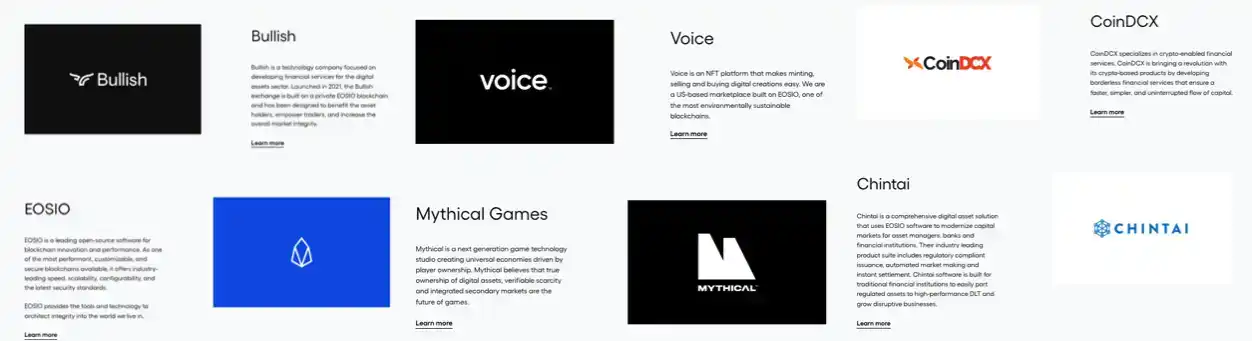
Project Launched by Block.one
The thunder is loud but the rain is sparse, which seems to be Block.one's consistent style when it comes to investment in projects. Since then, Block.one has not made any major investment moves and has fully embraced a low-key approach. Today, Block.one holds 164,000 bitcoins, indicating that its net worth has grown from $3 billion in 2019 to the current $16 billion, a fivefold increase, making it a liquidity management master.
Without any concrete DeFi, NFT, or DApp ecosystem support plans, in stark contrast, the Ethereum Foundation and Solana Foundation have been continuously subsidizing developers to drive technological innovation, while Block.one has done almost nothing.
An early EOS investor expressed anger on Reddit, questioning, "When we invested in EOS, it was because it promised to disrupt the blockchain, not to let Block.one use this money to speculate on Bitcoin!"

Although Block.one currently holds the second-largest amount of Bitcoin after MicroStrategy, with a total of 160,000 BTC worth $16 billion, EOS, which has received no support from these massive funds, continues on a downward trajectory.
The governance chaos at Block.one is even more astonishing. Block.one is increasingly resembling a "family business" centered around CEO BB, with BM not part of this family.
Sister as CMO: CEO Brendan Blumer's sister, Abby, was parachuted in as Chief Marketing Officer, and her only visible "achievement" was to change the EOS brand color from tech blue to a "softer Pantone Cool Gray."
Mother in Venture Capital: Blumer's mother, Nancy, runs the EOSVC venture capital fund, and the social app Voice, which she led, has been online for a year with less than 10,000 users, despite burning through $150 million.
BM's Puppet Show: Founder BM confessed on Twitter that he has "no decision-making power" and can only watch as the team pours resources into the enterprise-grade toolkit EOSIO — a project tailored for giants like Walmart, completely unrelated to the EOS mainnet.
In 2021, the community initiated the "Forking Rebellion" to try to sever Block.one's control. The EOS Foundation, as a community representative, stepped forward to negotiate with Block.one. However, after a month of discussions where various solutions were explored but not agreed upon, the EOS Foundation, in conjunction with 17 nodes, revoked Block.one's power and removed them from the EOS leadership. Without its parent company, EOS started to resemble more and more a DAO.
Following the split between EOS and Block.one, the EOS community engaged in a years-long legal battle over the ownership of the funds raised initially. As of now, Block.one still retains ownership and control over the funds.
Even more ridiculously, since 2024, BM's Twitter content has almost completely veered away from blockchain topics, with the only technical discussion being sporadic mentions of database optimization. Instead, his focus has shifted entirely to theological evangelism, with content heavily concentrated on interpreting the Bible, world-ending prophecies of geopolitical conflicts, and criticisms of mainstream Christianity...
BM's Twitter content
Looking back at this seven-year-long crypto epic, EOS's collapse serves as a stark warning: no matter how high the TPS, how sophisticated the resource model, or how complex the user experience to the point of deterring the average person, it will all be meaningless. The once self-proclaimed "Ethereum Killer" ultimately perished in the quagmire of its own economic model, governance chaos, and technological stagnation.
Seven years ago, EOS raised a whopping $4 billion in crowdfunding, once hailed as the most glorious financing miracle in blockchain history; seven years later, its story has become one of the biggest "jokes" in the crypto world.
In the end, EOS did not kill Ethereum; it killed itself first.
You may also like

Stablecoins Finally Find Real Returns: On-Chain Reinsurance Re Explained | Interview with Re Founder Karan Saroya

The AI gamble of mining companies: Valuations enter a phase of differentiation, and it's hard to turn the tide

A letter from Alliance to entrepreneurs: Written on the occasion of Cursor selling for 60 billion dollars

Will MicroStrategy fall into a death spiral? What will the macro trend be in the second half of the year?

Blockchain Capital Partner: The Core Secret of Arbitrage

STRC unanchored by 11%, can the perpetual motion machine of Strategy still operate?

Bitcoin Market Analysis 2026: Can BTC Reach $150K by Year-End?

Bitcoin ETF Outflows Hit a Record $4.4 Billion: What Are Traders Doing With Their Cash?

WEEX App Just Got Smarter – New Tabs for Faster Trades & Easy Asset Management

WEEX All-New Search Features: Find, Trade & Earn Faster Than Ever

Morning Report | Illinois signs the strictest digital asset tax law in the U.S.; RWA tokenization market size surpasses $43 billion, institutions accelerate the migration of on-chain assets

Full version of the debut Q&A! Federal Reserve Chairman Waller: Sticking to the 2% inflation target, establishing five special working groups, individual did not submit the dot plot

From Disruptor to Shadow Market: The Crypto Market is Becoming a Colony of Traditional Finance
Dalio's important long article: How to position in the current market environment?
OKX Star analyzes Binance's competitive advantages: when regulation levels the playing field, competition has just begun

New gameplay for participating in initial offerings on cryptocurrency exchanges
Why Is Bitcoin Down Today? What the Hawkish FOMC Means for SpaceX, Gold and Nasdaq

DeepSeek Financing Story
Stablecoins Finally Find Real Returns: On-Chain Reinsurance Re Explained | Interview with Re Founder Karan Saroya
The AI gamble of mining companies: Valuations enter a phase of differentiation, and it's hard to turn the tide
A letter from Alliance to entrepreneurs: Written on the occasion of Cursor selling for 60 billion dollars
Will MicroStrategy fall into a death spiral? What will the macro trend be in the second half of the year?
Blockchain Capital Partner: The Core Secret of Arbitrage
STRC unanchored by 11%, can the perpetual motion machine of Strategy still operate?


