
AI×Crypto Future Convergence: In-Depth Analysis of the Top Five AI Layer1 Projects
Original Article Title: "The Future Intersection of AI and Crypto: In-Depth Analysis of Five AI Layer1 Projects"
Original Article Author: Louis, Biteye
With the rapid advancement of AI technology, traditional blockchain architecture no longer meets the high-performance computing and complex data processing requirements of AI applications. This has led to the emergence of Layer 1 blockchain platforms optimized for AI, which exhibit diversification in technical architecture, application scenarios, and business models. This study provides a detailed analysis of Bittensor, Vana, Kite AI, Nillion, and Sahara, the five leading AI Layer1 projects, and offers investors a comprehensive participation guide.
1. Bittensor: Decentralized AI Network Infrastructure
As an early explorer in the blockchain AI field, Bittensor is committed to building an open decentralized artificial intelligence collaboration network. Its goal is to break down the centralized barriers in traditional AI research and development, allowing more participants to contribute and benefit together. Unlike traditional centralized AI systems (such as companies like OpenAI), Bittensor has created an open peer-to-peer ecosystem where participants can receive rewards based on their contributions to the network.
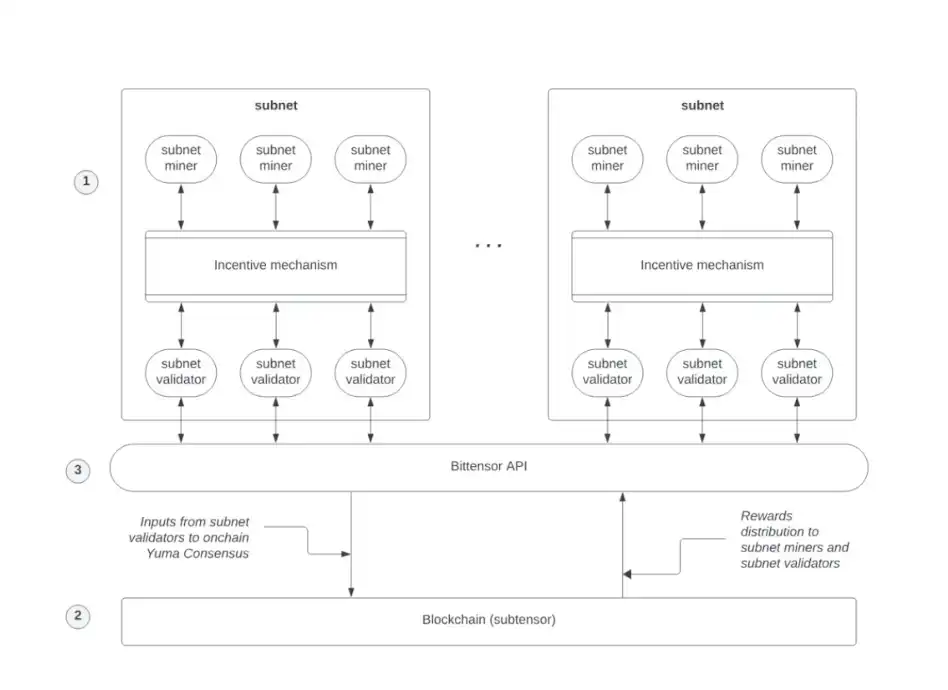
Bittensor's technical architecture adopts a two-layer design:
· Root Network (Mainnet): Responsible for the overall system coordination, validation, and TAO token issuance management, serving as the central hub for network resource allocation.
· Subnet Ecosystem: Various subnets act as independent AI labs, developing specialized solutions for specific AI application scenarios and proving their value in market competition.
This design allows Bittensor to balance the overall network's stability with domain-specific expertise, providing a flexible infrastructure for the development of decentralized AI.
Ecosystem Development Progress
The number of subnets has expanded from the initial 32 to over 64, covering various AI application scenarios such as text generation, trade signals, and data labeling.
The active user base has reached 140,000, doubling compared to the previous year.
The subnetwork market has a total valuation exceeding $1 billion, with daily trading volume maintaining around $45 million
Institutional participation has significantly increased, with prominent fund Grayscale incorporating TAO into its decentralized AI fund, adjusting the weight to 29.55%
These data indicate that Bittensor is gaining more recognition from market participants, and its ecosystem is entering a virtuous development track.
The recently completed dTAO (Dynamic TAO) system upgrade by Bittensor is a significant innovation in its economic model. The core of this upgrade lies in optimizing the allocation mechanism of the token TAO, transitioning from a resource allocation method reliant on validators' subjective judgment to a more market-oriented allocation mechanism. This change enables resources to flow more accurately to those subnetworks that are truly competitive.
Bittensor's original economic model revealed several key issues in practical operation:
· Lack of Objectivity in Evaluation Mechanism: As the number of subnetworks increases, validators find it challenging to objectively assess the actual value of each subnetwork, leading to a gradual decline in allocation efficiency.
· Power Structure Imbalance: Many validators also serve as subnetwork operators, and this role overlap can easily result in conflicts of interest. Validators may incline toward the subnetworks they are involved in, and even covert transactions may occur.
· Participation Barriers: Ordinary TAO holders find it difficult to directly influence the network's resource allocation decisions, with power excessively concentrated in the hands of a few validators.
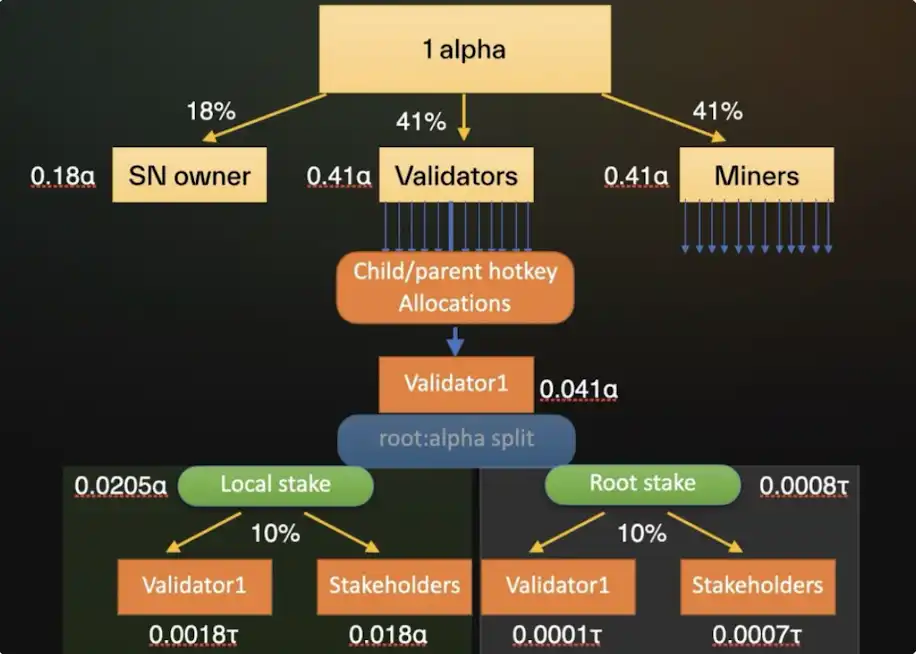
To address these issues, the dTAO upgrade introduces a market-based dynamic resource allocation system. This system transforms each subnetwork into an independent economic unit driven by users' actual needs to steer resource allocation.
Its core innovation is the Subnetwork Token (Alpha Token) mechanism:
· Operation Principle: Users can stake TAO to receive Alpha Tokens issued by various subnetworks, representing the user's support for a specific subnetwork
· Resource Allocation Logic: The market price of Alpha Tokens serves as a signal of subnetwork demand intensity. Initially, all alpha tokens have the same price, with each pool containing only 1 TAO and 1 Alpha Token. As liquidity of both tokens in the subnetwork increases, the price of the Alpha Token will change accordingly. TAO emission is proportionally distributed based on the subnetwork token price among all tokens, with higher-priced subnetworks receiving more TAO allocation, thereby achieving automated resource optimization
This mechanism significantly improves the efficiency and fairness of resource allocation, making the TAO token more stable in value, and providing more pathways for ordinary users to participate in network governance.
Investor Engagement Strategies
For retail investors interested in participating in the Bittensor ecosystem, there are mainly the following ways:
· Liquidity Provision: Stake TAO to receive Alpha tokens from various subnets and participate in subnet ecosystem development. This method is relatively robust, allowing for resource allocation based on views of different subnets to diversify risks.
· Secondary Market Investment: Directly purchase Alpha tokens of the desired subnets from the trading market. However, it is important to note that Alpha tokens are currently in the early emission stage, with a relatively high inflation rate and selling pressure. Investors should carefully select subnets with long-term development value.
· Technical Contribution: For investors with a technical background, they can choose to become network validators or subnet miners to earn rewards by validating the quality of AI models on the network or running specific subnet AI models.
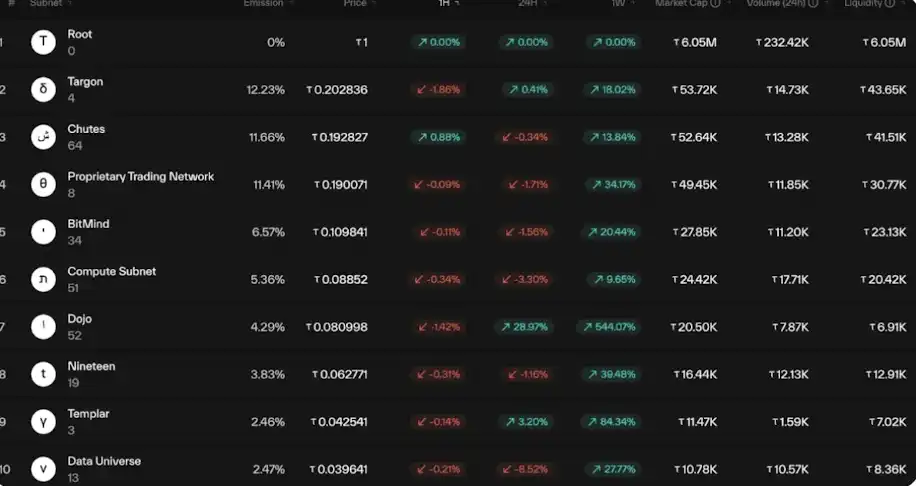
Currently, the most active subnets include:
· Subnet 4 Targon: Focuses on AI inference services for text generation, known for fast response times and low costs
· Subnet 64 Chutes: Provides various LLM API interfaces, allowing developers to build and deploy AI applications on the Bittensor network
· Subnet 8 PTN: Focuses on the financial sector, incentivizing miners to generate accurate trading signals through a reward mechanism, covering various financial markets such as forex and cryptocurrencies
· Subnet 52 Dojo: Handles data labeling, encouraging users to earn tokens through data labeling. Yzi Labs entered by investing in its parent company, Tensorplex.
II. Vana: Data Sovereignty and Value Refactoring Platform
The Vana project focuses on addressing a core issue in today's digital economy: the ownership and value distribution of personal data. In the current internet ecosystem, users' data is mostly monopolized and controlled by large tech companies, while the users who actually create this data rarely benefit from it. Vana's innovation lies in establishing an ecosystem where users truly own and control their own data, while being able to receive economic rewards from it.
As an EVM-compatible Layer 1 blockchain network, Vana's technical architecture consists of five core components:
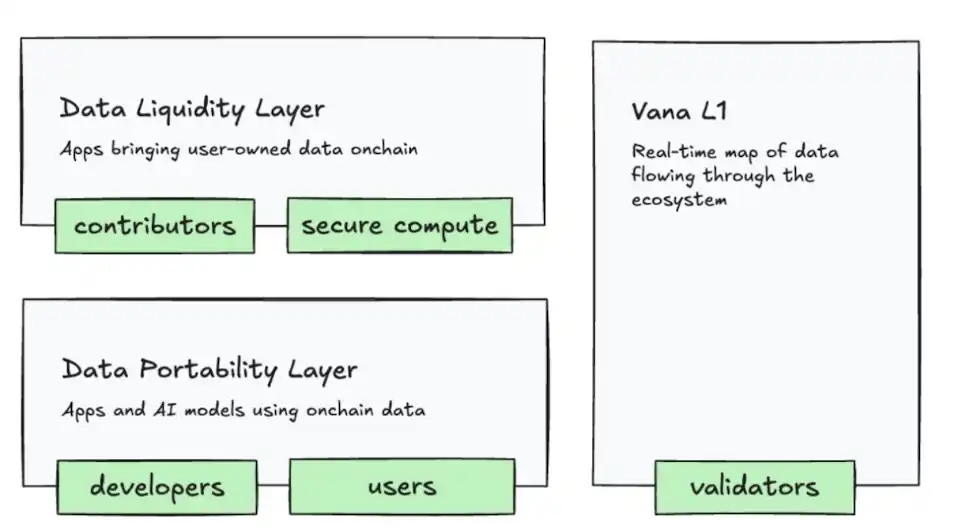
1. Data Liquidity Layer: This is the core of the Vana network, enabling data asset incentivization, aggregation, and validation through Data Liquidity Pools (DLPs). Each DLP is a smart contract specialized in aggregating specific types of data assets, such as social media data and browsing history.
2. Data Portability Layer: Ensures seamless data transferability across different applications and AI models, enhancing data flexibility.
3. Universal Connectome: Tracks real-time data flow throughout the entire ecosystem, forming a data ecosystem graph to ensure system transparency.
4. Non-Custodial Data Storage: A key innovation of Vana is its unique data management approach. Users' raw data is not stored on-chain but rather users choose their storage location, such as cloud servers or personal devices, ensuring users maintain full control over their data.
5. Application Ecosystem: Built on the foundation of data, Vana has established an open application ecosystem where developers can leverage the data accumulated in DLPs to build various innovative applications, including AI applications. Data contributors can then receive rewards from these applications.
This design enables Vana to protect user data privacy while creating a more equitable data value distribution mechanism, providing a crucial data foundation for decentralized AI development.
Latest Developments
Vana's funding and partnership expansion have been progressing:
In February 2025, YZi Labs announced a strategic investment in Vana, with Binance founder CZ joining as an advisor.
In terms of ecosystem development, Vana has built several data projects covering various areas from social media data to financial prediction data, including: Finquarium (financial prediction data), GPT Data DAO (ChatGPT chat data), Reddit Data DAO (Reddit user data), Volara (Twitter data), Flirtual (dating data), among others.
Recently, Vana organized a hackathon event during Eth Denver, offering a prize pool of up to fifty thousand dollars to incentivize developers to build DataDAO and AI applications based on Vana data, further expanding its ecosystem.
These developments indicate that Vana is actively building a complete ecosystem around data ownership and value realization, and its momentum is worth paying attention to.
Participation Path Analysis
For investors interested in participating in the Vana ecosystem, there are mainly the following ways to participate:
· Data Contribution: Upload your social media data, browsing data, etc., to the corresponding Data Liquidity Pool (DLP) to receive the corresponding token rewards. For example, contributing data to the Reddit Data DAO can earn RDAT tokens. This is the most basic and lowest barrier way to participate.
· Staking Participation: Stake Vana tokens through DataHub in a preferred DLP to share Vana block rewards from the DLP. It is important to note that only the top 16 DLPs can receive rewards, so choosing a high-quality DLP is crucial.
· Ecosystem Co-Creation: For participants with certain expertise, you can try to create a new Data Liquidity Pool. As the creator of a new DLP, you need to design specific data contribution goals, validation methods, and reward parameters, and implement a contribution proof function that can accurately assess the value of the data.
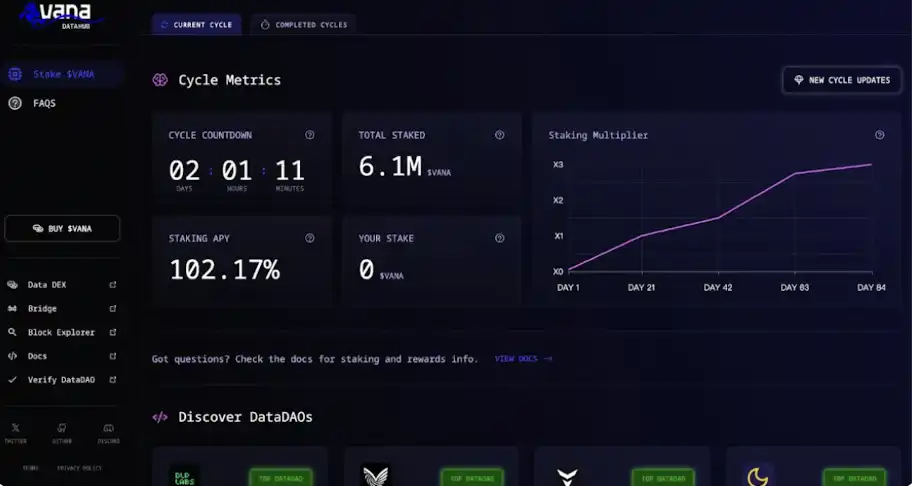
Vana represents a significant innovation at the intersection of blockchain technology, data economy, and artificial intelligence. By establishing a decentralized data platform, Vana aims to redefine data ownership and value distribution, providing fair rewards to data creators and high-quality training resources for AI development.
III. Kite AI: Technological Breakthrough of an AI-Native Public Chain
Kite AI is a Layer 1 blockchain project focused on the AI field, built on the Avalanche framework. It aims to address various challenges faced by traditional blockchains in handling AI assets, particularly how to achieve transparent rights and incentives for AI data, models, and agent contributions.
Kite AI has proposed four core technological innovations:
1. PoAI Consensus Mechanism: Proof of Attributed Intelligence is Kite AI's pioneering consensus mechanism, which accurately tracks the value contribution of data, models, and AI agents through an on-chain verifiable contribution record system. The project has designed a dynamic reward pool mechanism to distribute earnings according to the contribution ratio, effectively addressing issues such as "data black box" and "model plagiarism" in traditional AI economies.
2. Composable AI Subnet: Kite AI adopts a modular architecture that supports developers in building industry-specific AI collaboration ecosystems as needed. For example, in a healthcare subnet, patient data encrypted can be selectively authorized to pharmaceutical companies for AI model development. The earnings are distributed to data subjects, model developers, and subnet maintainers in a certain proportion, creating a multi-win ecosystem.
3. AI-native Execution Layer: Kite AI is building an on-chain AI-native execution layer dedicated to handling AI computing tasks such as inference, embedding, and fine-tuning/training. Users can authorize smart contract wallets to execute inference calls and interact with models through this layer. The execution layer not only supports blockchain transactions and state changes but also integrates secure computing environments (such as Trusted Execution Environments TEE) to ensure data security and privacy protection during computation.
4. Decentralized Data Engine: Kite AI ensures that data creators receive fair rewards in the AI workflow. The platform has built-in compliance modules that comply with regulations such as GDPR/CCPA, meeting data privacy requirements globally, and reducing developers' compliance costs.
These technological innovations enable Kite AI to create a more equitable and transparent value distribution environment for AI developers and data providers, driving the decentralized development of AI technology.
Current Development
On February 6, 2025, Kite AI launched the incentive testnet, the first AI-native Layer 1 sovereign blockchain testnet.
The testnet performed remarkably well:
In less than 70 hours after the testnet went live, the number of connected wallets exceeded 100,000. As of now, a total of 1.95 million wallets have joined Incentive Testnet V1, with over 1 million wallets already interacting with AI agents, surpassing 115 million total call times.
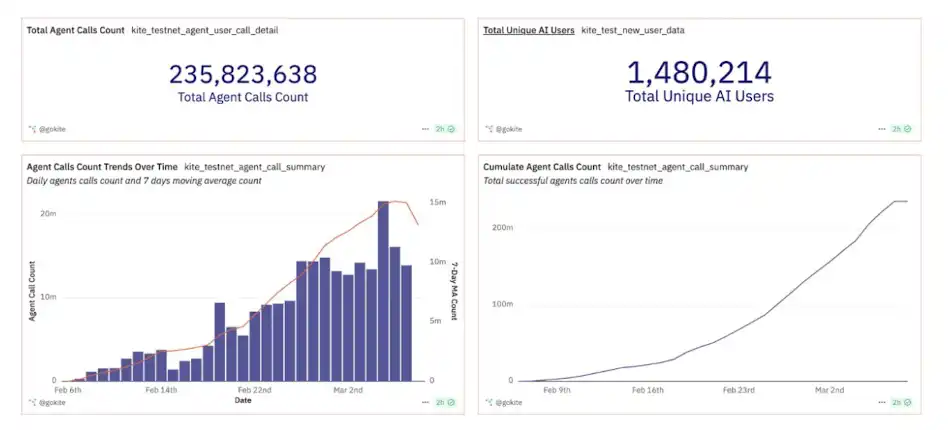
The project has a strong background and is built by an experienced Silicon Valley team. The co-founders, each with deep technical leadership experience in the field of artificial intelligence, have held positions at top-tier tech companies such as Uber, Salesforce, and Databricks. Core team members come from industry-leading companies such as Google, BlackRock, Uber, the NEAR Foundation, with academic backgrounds from top institutions like MIT and Harvard.
In terms of capital support, the project has received investment from top institutions such as General Catalyst, Hashed, Hashkey, Samsung Next, and has established technical partnerships with Eigenlayer, Sui, Avalanche, AWS, among others.
As a selection committee member of Avalanche's InfraBUILDL(AI) program, Kite AI plays an active role in advancing the Avalanche artificial intelligence ecosystem. This collaboration aims to position Avalanche as a leading blockchain for AI applications.
With the global data economy expected to surpass $700 billion in 2025, Kite AI is poised to become a critical infrastructure for data rights and monetization, with promising development potential.
Participation Opportunity Analysis
Early participation in the Kite ecosystem primarily involves the following avenues:
· Testnet Participation: Kite AI's testnet is now open, providing early participants with generous incentives. Investors can engage through the official website (gokite.ai) or testnet portal (testnet.gokite.ai) to experience network functionality and have the opportunity to receive testnet rewards.
· Application Development: Investors with development capabilities can explore deploying AI-driven DApps on Kite AI, delving into innovative scenarios such as on-chain model training and data markets. The platform offers developers rich tools and support, lowering the barrier to entry for development.
· Subnet Deployment: Kite AI has prepared a token airdrop plan for the earliest teams deploying AI subnets, encouraging developers to create specialized AI subnets. For investors with specific industry expertise, this is an opportunity to leverage their knowledge for additional rewards.
· Early Contributors Points: Users actively participating in building the Kite AI ecosystem will receive point rewards and priority ecosystem resource support. These points may be converted into specific tokens or other benefits in the future.
Four. Nillion: Exploring the Frontier of Privacy Computing
Nillion is redefining the way sensitive data is handled for future digital privacy by leveraging its unique "Blind Computation" technology.
Nillion is a decentralized public network based on an innovative cryptographic primitive called Nil Message Compute (NMC), enabling network nodes to operate in a non-traditional blockchain manner. Founded in November 2021, the project is led by forward-thinking innovators such as Alex Page and Andrew Masanto, aiming to create a system that can securely process high-value data without exposing sensitive details.
The core strength of Nillion lies in its "Blind Computation" capability—a process that allows data to remain encrypted throughout its lifecycle, including storage, transmission, and processing. Its technical architecture integrates various cutting-edge privacy protection technologies:
· Multi-Party Computation (MPC): Enables multiple nodes to collaboratively compute functions without revealing their private inputs, achieving joint computation without data sharing.
· Fully Homomorphic Encryption (FHE): Allows direct operations on encrypted data, ensuring data remains encrypted end-to-end, providing comprehensive privacy protection.
· Zero-Knowledge Proof (ZKP): Offers a way to verify computations without disclosing any underlying data, enhancing the system's trustworthiness.
· Nada Language: This is a domain-specific language designed for creating secure MPC programs, simplifying the development process of privacy-preserving applications and reducing the learning curve for developers.
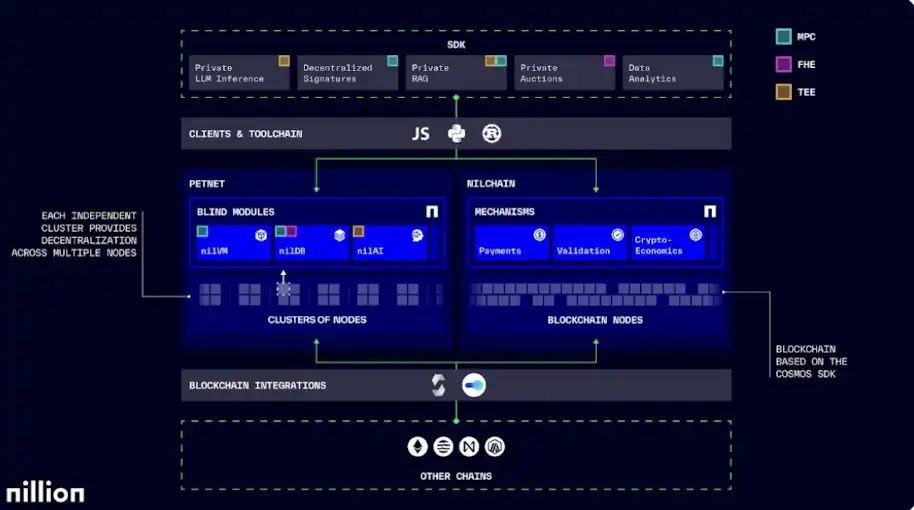
Nillion's network architecture consists of three main layers: the Processing Layer (responsible for secure computation), the Coordination Layer (NilChain, managing inter-node communication), and the Connectivity Layer (serving as a gateway to connect external systems). This multi-layer architecture enables Nillion to offer robust computational power while safeguarding data privacy, meeting the requirements of various privacy-sensitive scenarios.
Latest Development Progress
According to recent information, the development of the Nillion network is steadily progressing:
The Nillion mainnet is scheduled to launch in March 2025 (this month). The total supply of Nillion tokens is 1 billion, and distribution is expected to take place at the launch of the mainnet.
In terms of funding, Nillion completed a $25 million financing round led by Hack VC on October 30, 2024. Investors include HashKey Capital, Animoca Brands, and well-known institutions, as well as angel investors from projects such as Arbitrum, Worldcoin, and Sei. This round of financing brought Nillion's total funding to $45 million, providing ample financial support for the project's long-term development.
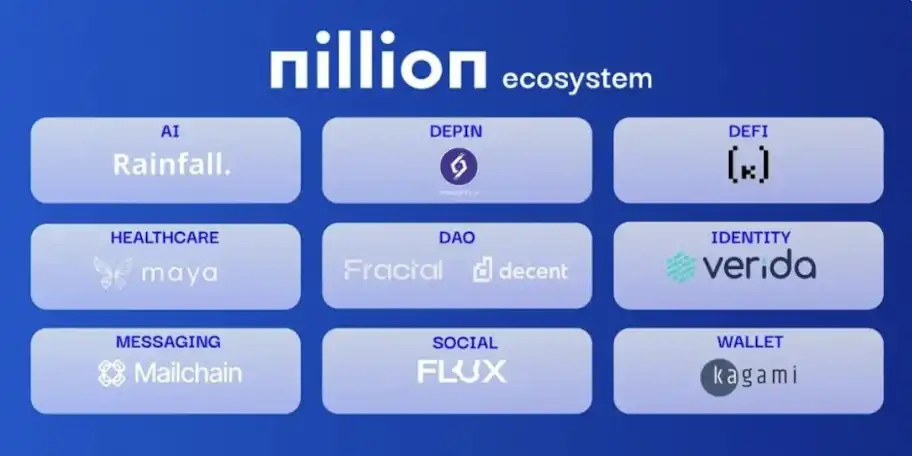
In terms of ecosystem expansion, Nillion has established integration relationships with several mainstream blockchains such as NEAR Protocol, Aptos, Arbitrum, Mantle, and Sei. Through its collaboration with NEAR Protocol, Nillion aims to enhance privacy tools, enabling developers to innovate more effectively in the DeFi space.
Regarding the AI ecosystem, Nillion has partnered with various AI-related projects, including Ritual, Crush AI, Skillful AI, and Virtuals Protocol. For example, Virtuals Protocol is currently the largest multimodal AI agent protocol. Through collaboration with Nillion, it leverages its secure computing infrastructure to support AI model training and inference privately, achieving a perfect integration of AI and privacy.
For a more detailed introduction to Nillion's ecosystem projects, please refer to our previous article: https://x.com/BiteyeCN/status/1881297074228252702
Ecosystem Participation Strategy
As the Nillion mainnet is about to be launched, retail investors have various ways to participate in its ecosystem:
· Tokenomics Participation: Although Nillion's airdrop eligibility check closed on February 3, 2025, more opportunities to participate in Nillion's tokenomics system will arise with the mainnet launch. According to official information, the Nillion airdrop will reward community members and early builders with up to 75 million NIL tokens.
· Developer Ecosystem Participation: Nillion provides developers with abundant tools and resources to support the creation of privacy-centric applications:
· Node Deployment Kit (NDK): Simplifies the process of joining the network and managing nodes, reducing the technical barrier to entry
· Nada Language: Specifically designed for creating secure MPC programs, making it easier for developers to build privacy-preserving applications
· Application Areas: Developers can create Nillion-based applications in multiple areas, including:
· Artificial Intelligence: Processing data and inference without exposing sensitive information
· Personalized Agents: AI agents that store, compute, and process private data
· Privacy-Preserving Model Inference: AI models that securely handle sensitive data
· Privacy-Aware Knowledge Base and Search: Data encrypted for storage while providing search capabilities
· Network Node Operation: As a decentralized network, Nillion offers participants the opportunity to operate nodes. By running nodes, users can contribute computational resources, earn rewards, and help maintain the network's security and decentralization.
5. Sahara AI: Building a Platform for the New AI Asset Economy
Project Development
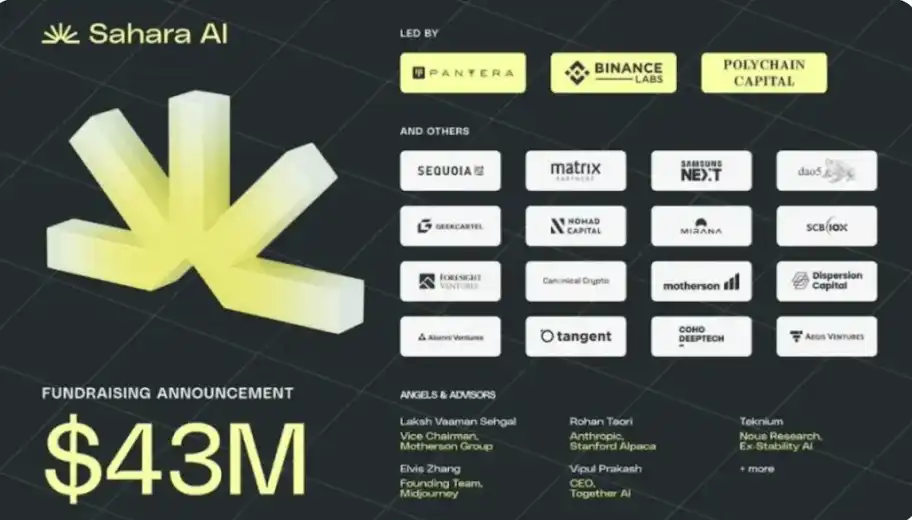
The core idea of Sahara AI is to build a "Human-AI Collaboration Network" that enables ordinary users, developers, and businesses to participate in the creation, deployment, and monetization of AI assets. Through this collaborative model, Sahara AI aims to lower the barriers to entry for AI, allowing every participant to share in the industry's growth dividend. The project has successfully raised a total of $43 million in funding led by Binance Labs, Polychain Capital, and Pantera Capital.
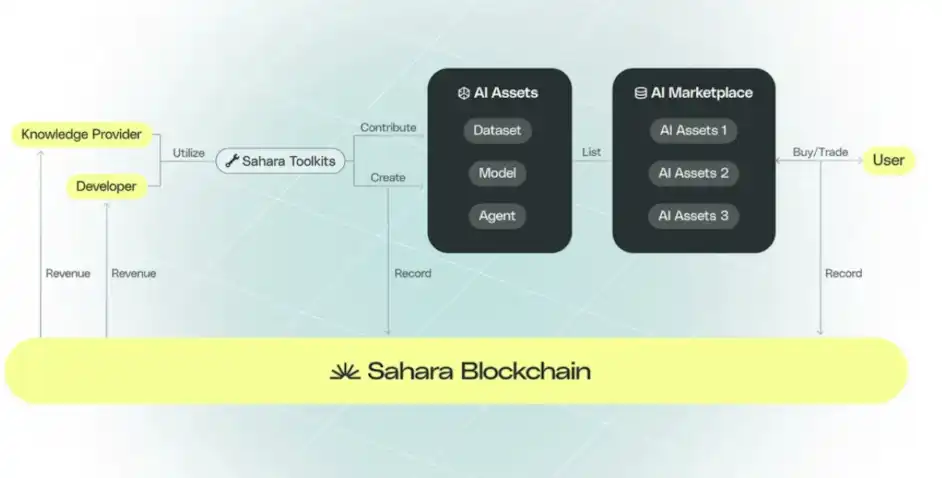
The platform's technical architecture consists of three key components:
1. Sahara Blockchain: Provides the ecosystem with a secure, transparent transaction environment and efficient AI lifecycle management foundation
2. AI Infrastructure: Supports distributed collaboration training and serving capabilities for advanced algorithms and computing frameworks
3. Sahara AI Marketplace: A decentralized trading center for AI assets
These components together form a complete ecosystem that supports the end-to-end process from data collection and annotation to model training, deployment, and monetization.
Latest Development Progress
The Sahara AI project is in a rapid development phase, and its testnet has gone through several key stages:
In December 2024, Sahara AI launched the first-phase Data Service Platform Beta version testnet, attracting applications from over 780,000 users, with over 10,000 waitlisted applicants qualifying for initial participation. In this stage, participants could contribute to the AI ecosystem by completing data collection, optimization, and annotation tasks and earn rewards.
In February 2025, Sahara AI initiated the second-stage testnet, expanding the platform's contributor base and introducing additional reward opportunities. This stage further strengthened user engagement in shaping the decentralized AI future.
The latest development is that Sahara AI has announced the launch of a public testnet called "SIWA" on March 10, 2025. This is considered the final significant test before the Sahara AI mainnet launch and TGE, and may also be the last opportunity for participants to earn airdrop rewards (referred to as "points").
Sahara AI has released its 2024-2025 roadmap, which includes several key milestones:
· Q4 2024: Launched the Data Service Platform and testnet, where users could earn rewards through data collection and annotation.
· Q1 2025: AI Marketplace launched, providing development tools and data service expansion functions to support model development, training, deployment, and introducing an early access program.
· Q2 2025: Introduced the Sahara Studio tool suite, covering model training, deployment, and workflow management to further optimize the developer experience.
· Q3 2025: The Sahara Chain mainnet is launched, providing a secure, transparent on-chain infrastructure for large-scale decentralized AI, while also supporting the tokenization and trading of data and models.
On March 1, 2025, Sahara AI introduced the Incubator Program aimed at discovering and supporting the world's most promising AI x Web3 innovation projects. The program focuses on two main tracks: AI infrastructure and AI applications, welcoming teams with an MVP or higher maturity level to participate. Successfully selected projects will have the opportunity to fully integrate into the Sahara AI ecosystem, receive exclusive technical support, market expansion resources, and investment opportunities.
Ecosystem Participation Strategy
For users interested in participating in the Sahara AI ecosystem, here are several key participation methods:
1. Join the Waiting List and Testnet
The primary step to engage with the Sahara AI ecosystem is to join the official waiting list:
· Visit the Sahara AI official waiting list page
· Fill in the required information and submit the application form
· Selected users will receive testnet access
· Complete various tasks in the testnet to earn Sahara Points
Of particular note, the SIWA public testnet, launching on March 10, 2025, may be the last opportunity to receive airdrop rewards before the mainnet TGE. Users interested in participation should act quickly to apply.
2. Participate in Legends Event
Sahara AI also offers an event called "Legends," allowing users to collect shards and forge NFTs:
· Visit the Sahara Legends event page and log in, connect your wallet
· Explore five unique desert-themed areas to start collecting shards
· Invite friends to join the event to earn additional shards
· Use the collected shards to forge the Soulbound Desert Guardian NFT
· Collect a mascot NFT from each desert and merge them to create an exclusive Fennec Fox NFT

3. Data Contribution Platform
The Sahara AI data contribution platform provides users with the opportunity to be rewarded for contributing data:
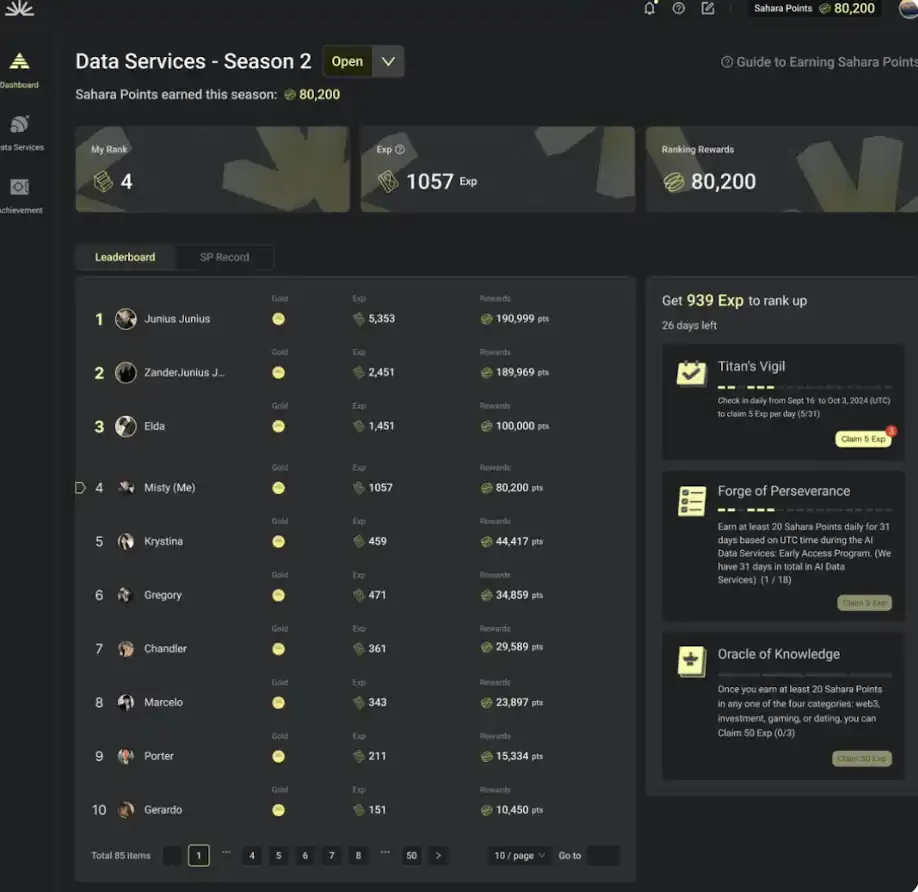
· Participants can choose high-value data tasks from various fields such as the creator economy, finance, and science
· Upon task completion, the platform will reward users based on their contribution, accuracy, and consistency
· A leaderboard is in place to encourage outstanding performers
· All rewards are distributed in the form of points, laying the foundation for token distribution within the ecosystem
Six. Conclusion
AI Layer 1 is at a critical stage of rapid evolution. This emerging track is restructuring the underlying architecture of AI technology through decentralized infrastructure. From data empowerment to computational resource allocation, from model training to application deployment, these platforms are breaking through the limitations of traditional centralized AI systems, building a more open, transparent, and efficient technical ecosystem. In the future, this track will continue to drive technological innovation, advancing artificial intelligence towards a more decentralized and collaborative development direction.
You may also like

Token Cannot Compound, Where Is the Real Investment Opportunity?

February 6th Market Key Intelligence, How Much Did You Miss?

China's Central Bank and Eight Other Departments' Latest Regulatory Focus: Key Attention to RWA Tokenized Asset Risk
Foreword: Today, the People's Bank of China's website published the "Notice of the People's Bank of China, National Development and Reform Commission, Ministry of Industry and Information Technology, Ministry of Public Security, State Administration for Market Regulation, China Banking and Insurance Regulatory Commission, China Securities Regulatory Commission, State Administration of Foreign Exchange on Further Preventing and Dealing with Risks Related to Virtual Currency and Others (Yinfa [2026] No. 42)", the latest regulatory requirements from the eight departments including the central bank, which are basically consistent with the regulatory requirements of recent years. The main focus of the regulation is on speculative activities such as virtual currency trading, exchanges, ICOs, overseas platform services, and this time, regulatory oversight of RWA has been added, explicitly prohibiting RWA tokenization, stablecoins (especially those pegged to the RMB). The following is the full text:
To the people's governments of all provinces, autonomous regions, and municipalities directly under the Central Government, the Xinjiang Production and Construction Corps:
Recently, there have been speculative activities related to virtual currency and Real-World Assets (RWA) tokenization, disrupting the economic and financial order and jeopardizing the property security of the people. In order to further prevent and address the risks related to virtual currency and Real-World Assets tokenization, effectively safeguard national security and social stability, in accordance with the "Law of the People's Republic of China on the People's Bank of China," "Law of the People's Republic of China on Commercial Banks," "Securities Law of the People's Republic of China," "Law of the People's Republic of China on Securities Investment Funds," "Law of the People's Republic of China on Futures and Derivatives," "Cybersecurity Law of the People's Republic of China," "Regulations of the People's Republic of China on the Administration of Renminbi," "Regulations on Prevention and Disposal of Illegal Fundraising," "Regulations of the People's Republic of China on Foreign Exchange Administration," "Telecommunications Regulations of the People's Republic of China," and other provisions, after reaching consensus with the Cyberspace Administration of China, the Supreme People's Court, and the Supreme People's Procuratorate, and with the approval of the State Council, the relevant matters are notified as follows:
(I) Virtual currency does not possess the legal status equivalent to fiat currency. Virtual currencies such as Bitcoin, Ether, Tether, etc., have the main characteristics of being issued by non-monetary authorities, using encryption technology and distributed ledger or similar technology, existing in digital form, etc. They do not have legal tender status, should not and cannot be circulated and used as currency in the market.
The business activities related to virtual currency are classified as illegal financial activities. The exchange of fiat currency and virtual currency within the territory, exchange of virtual currencies, acting as a central counterparty in buying and selling virtual currencies, providing information intermediary and pricing services for virtual currency transactions, token issuance financing, and trading of virtual currency-related financial products, etc., fall under illegal financial activities, such as suspected illegal issuance of token vouchers, unauthorized public issuance of securities, illegal operation of securities and futures business, illegal fundraising, etc., are strictly prohibited across the board and resolutely banned in accordance with the law. Overseas entities and individuals are not allowed to provide virtual currency-related services to domestic entities in any form.
A stablecoin pegged to a fiat currency indirectly fulfills some functions of the fiat currency in circulation. Without the consent of relevant authorities in accordance with the law and regulations, any domestic or foreign entity or individual is not allowed to issue a RMB-pegged stablecoin overseas.
(II)Tokenization of Real-World Assets refers to the use of encryption technology and distributed ledger or similar technologies to transform ownership rights, income rights, etc., of assets into tokens (tokens) or other interests or bond certificates with token (token) characteristics, and carry out issuance and trading activities.
Engaging in the tokenization of real-world assets domestically, as well as providing related intermediary, information technology services, etc., which are suspected of illegal issuance of token vouchers, unauthorized public offering of securities, illegal operation of securities and futures business, illegal fundraising, and other illegal financial activities, shall be prohibited; except for relevant business activities carried out with the approval of the competent authorities in accordance with the law and regulations and relying on specific financial infrastructures. Overseas entities and individuals are not allowed to illegally provide services related to the tokenization of real-world assets to domestic entities in any form.
(III) Inter-agency Coordination. The People's Bank of China, together with the National Development and Reform Commission, the Ministry of Industry and Information Technology, the Ministry of Public Security, the State Administration for Market Regulation, the China Banking and Insurance Regulatory Commission, the China Securities Regulatory Commission, the State Administration of Foreign Exchange, and other departments, will improve the work mechanism, strengthen coordination with the Cyberspace Administration of China, the Supreme People's Court, and the Supreme People's Procuratorate, coordinate efforts, and overall guide regions to carry out risk prevention and disposal of virtual currency-related illegal financial activities.
The China Securities Regulatory Commission, together with the National Development and Reform Commission, the Ministry of Industry and Information Technology, the Ministry of Public Security, the People's Bank of China, the State Administration for Market Regulation, the China Banking and Insurance Regulatory Commission, the State Administration of Foreign Exchange, and other departments, will improve the work mechanism, strengthen coordination with the Cyberspace Administration of China, the Supreme People's Court, and the Supreme People's Procuratorate, coordinate efforts, and overall guide regions to carry out risk prevention and disposal of illegal financial activities related to the tokenization of real-world assets.
(IV) Strengthening Local Implementation. The people's governments at the provincial level are overall responsible for the prevention and disposal of risks related to virtual currencies and the tokenization of real-world assets in their respective administrative regions. The specific leading department is the local financial regulatory department, with participation from branches and dispatched institutions of the State Council's financial regulatory department, telecommunications regulators, public security, market supervision, and other departments, in coordination with cyberspace departments, courts, and procuratorates, to improve the normalization of the work mechanism, effectively connect with the relevant work mechanisms of central departments, form a cooperative and coordinated working pattern between central and local governments, effectively prevent and properly handle risks related to virtual currencies and the tokenization of real-world assets, and maintain economic and financial order and social stability.
(5) Enhanced Risk Monitoring. The People's Bank of China, China Securities Regulatory Commission, National Development and Reform Commission, Ministry of Industry and Information Technology, Ministry of Public Security, State Administration of Foreign Exchange, Cyberspace Administration of China, and other departments continue to improve monitoring techniques and system support, enhance cross-departmental data analysis and sharing, establish sound information sharing and cross-validation mechanisms, promptly grasp the risk situation of activities related to virtual currency and real-world asset tokenization. Local governments at all levels give full play to the role of local monitoring and early warning mechanisms. Local financial regulatory authorities, together with branches and agencies of the State Council's financial regulatory authorities, as well as departments of cyberspace and public security, ensure effective connection between online monitoring, offline investigation, and fund tracking, efficiently and accurately identify activities related to virtual currency and real-world asset tokenization, promptly share risk information, improve early warning information dissemination, verification, and rapid response mechanisms.
(6) Strengthened Oversight of Financial Institutions, Intermediaries, and Technology Service Providers. Financial institutions (including non-bank payment institutions) are prohibited from providing account opening, fund transfer, and clearing services for virtual currency-related business activities, issuing and selling financial products related to virtual currency, including virtual currency and related financial products in the scope of collateral, conducting insurance business related to virtual currency, or including virtual currency in the scope of insurance liability. Financial institutions (including non-bank payment institutions) are prohibited from providing custody, clearing, and settlement services for unauthorized real-world asset tokenization-related business and related financial products. Relevant intermediary institutions and information technology service providers are prohibited from providing intermediary, technical, or other services for unauthorized real-world asset tokenization-related businesses and related financial products.
(7) Enhanced Management of Internet Information Content and Access. Internet enterprises are prohibited from providing online business venues, commercial displays, marketing, advertising, or paid traffic diversion services for virtual currency and real-world asset tokenization-related business activities. Upon discovering clues of illegal activities, they should promptly report to relevant departments and provide technical support and assistance for related investigations and inquiries. Based on the clues transferred by the financial regulatory authorities, the cyberspace administration, telecommunications authorities, and public security departments should promptly close and deal with websites, mobile applications (including mini-programs), and public accounts engaged in virtual currency and real-world asset tokenization-related business activities in accordance with the law.
(8) Strengthened Entity Registration and Advertisement Management. Market supervision departments strengthen entity registration and management, and enterprise and individual business registrations must not contain terms such as "virtual currency," "virtual asset," "cryptocurrency," "crypto asset," "stablecoin," "real-world asset tokenization," or "RWA" in their names or business scopes. Market supervision departments, together with financial regulatory authorities, legally enhance the supervision of advertisements related to virtual currency and real-world asset tokenization, promptly investigating and handling relevant illegal advertisements.
(IX) Continued Rectification of Virtual Currency Mining Activities. The National Development and Reform Commission, together with relevant departments, strictly controls virtual currency mining activities, continuously promotes the rectification of virtual currency mining activities. The people's governments of various provinces take overall responsibility for the rectification of "mining" within their respective administrative regions. In accordance with the requirements of the National Development and Reform Commission and other departments in the "Notice on the Rectification of Virtual Currency Mining Activities" (NDRC Energy-saving Building [2021] No. 1283) and the provisions of the "Guidance Catalog for Industrial Structure Adjustment (2024 Edition)," a comprehensive review, investigation, and closure of existing virtual currency mining projects are conducted, new mining projects are strictly prohibited, and mining machine production enterprises are strictly prohibited from providing mining machine sales and other services within the country.
(X) Severe Crackdown on Related Illegal Financial Activities. Upon discovering clues to illegal financial activities related to virtual currency and the tokenization of real-world assets, local financial regulatory authorities, branches of the State Council's financial regulatory authorities, and other relevant departments promptly investigate, determine, and properly handle the issues in accordance with the law, and seriously hold the relevant entities and individuals legally responsible. Those suspected of crimes are transferred to the judicial authorities for processing according to the law.
(XI) Severe Crackdown on Related Illegal and Criminal Activities. The Ministry of Public Security, the People's Bank of China, the State Administration for Market Regulation, the China Banking and Insurance Regulatory Commission, the China Securities Regulatory Commission, as well as judicial and procuratorial organs, in accordance with their respective responsibilities, rigorously crack down on illegal and criminal activities related to virtual currency, the tokenization of real-world assets, such as fraud, money laundering, illegal business operations, pyramid schemes, illegal fundraising, and other illegal and criminal activities carried out under the guise of virtual currency, the tokenization of real-world assets, etc.
(XII) Strengthen Industry Self-discipline. Relevant industry associations should enhance membership management and policy advocacy, based on their own responsibilities, advocate and urge member units to resist illegal financial activities related to virtual currency and the tokenization of real-world assets. Member units that violate regulatory policies and industry self-discipline rules are to be disciplined in accordance with relevant self-regulatory management regulations. By leveraging various industry infrastructure, conduct risk monitoring related to virtual currency, the tokenization of real-world assets, and promptly transfer issue clues to relevant departments.
(XIII) Without the approval of relevant departments in accordance with the law and regulations, domestic entities and foreign entities controlled by them may not issue virtual currency overseas.
(XIV) Domestic entities engaging directly or indirectly in overseas external debt-based tokenization of real-world assets, or conducting asset securitization activities abroad based on domestic ownership rights, income rights, etc. (hereinafter referred to as domestic equity), should be strictly regulated in accordance with the principles of "same business, same risk, same rules." The National Development and Reform Commission, the China Securities Regulatory Commission, the State Administration of Foreign Exchange, and other relevant departments regulate it according to their respective responsibilities. For other forms of overseas real-world asset tokenization activities based on domestic equity by domestic entities, the China Securities Regulatory Commission, together with relevant departments, supervise according to their division of responsibilities. Without the consent and filing of relevant departments, no unit or individual may engage in the above-mentioned business.
(15) Overseas subsidiaries and branches of domestic financial institutions providing Real World Asset Tokenization-related services overseas shall do so legally and prudently. They shall have professional personnel and systems in place to effectively mitigate business risks, strictly implement customer onboarding, suitability management, anti-money laundering requirements, and incorporate them into the domestic financial institutions' compliance and risk management system. Intermediaries and information technology service providers offering Real World Asset Tokenization services abroad based on domestic equity or conducting Real World Asset Tokenization business in the form of overseas debt for domestic entities directly or indirectly venturing abroad must strictly comply with relevant laws and regulations. They should establish and improve relevant compliance and internal control systems in accordance with relevant normative requirements, strengthen business and risk control, and report the business developments to the relevant regulatory authorities for approval or filing.
(16) Strengthen organizational leadership and overall coordination. All departments and regions should attach great importance to the prevention of risks related to virtual currencies and Real World Asset Tokenization, strengthen organizational leadership, clarify work responsibilities, form a long-term effective working mechanism with centralized coordination, local implementation, and shared responsibilities, maintain high pressure, dynamically monitor risks, effectively prevent and mitigate risks in an orderly and efficient manner, legally protect the property security of the people, and make every effort to maintain economic and financial order and social stability.
(17) Widely carry out publicity and education. All departments, regions, and industry associations should make full use of various media and other communication channels to disseminate information through legal and policy interpretation, analysis of typical cases, and education on investment risks, etc. They should promote the illegality and harm of virtual currencies and Real World Asset Tokenization-related businesses and their manifestations, fully alert to potential risks and hidden dangers, and enhance public awareness and identification capabilities for risk prevention.
(18) Engaging in illegal financial activities related to virtual currencies and Real World Asset Tokenization in violation of this notice, as well as providing services for virtual currencies and Real World Asset Tokenization-related businesses, shall be punished in accordance with relevant regulations. If it constitutes a crime, criminal liability shall be pursued according to the law. For domestic entities and individuals who knowingly or should have known that overseas entities illegally provided virtual currency or Real World Asset Tokenization-related services to domestic entities and still assisted them, relevant responsibilities shall be pursued according to the law. If it constitutes a crime, criminal liability shall be pursued according to the law.
(19) If any unit or individual invests in virtual currencies, Real World Asset Tokens, and related financial products against public order and good customs, the relevant civil legal actions shall be invalid, and any resulting losses shall be borne by them. If there are suspicions of disrupting financial order and jeopardizing financial security, the relevant departments shall deal with them according to the law.
This notice shall enter into force upon the date of its issuance. The People's Bank of China and ten other departments' "Notice on Further Preventing and Dealing with the Risks of Virtual Currency Trading Speculation" (Yinfa [2021] No. 237) is hereby repealed.

Former Partner's Perspective on Multicoin: Kyle's Exit, But the Game He Left Behind Just Getting Started
Why Bitcoin Is Falling Now: The Real Reasons Behind BTC's Crash & WEEX's Smart Profit Playbook
Bitcoin's ongoing crash explained: Discover the 5 hidden triggers behind BTC's plunge & how WEEX's Auto Earn and Trade to Earn strategies help traders profit from crypto market volatility.

Wall Street's Hottest Trades See Exodus

Vitalik Discusses Ethereum Scaling Path, Circle Announces Partnership with Polymarket, What's the Overseas Crypto Community Talking About Today?

Believing in the Capital Markets - The Essence and Core Value of Cryptocurrency

Polymarket's 'Weatherman': Predict Temperature, Win Million-Dollar Payout
$15K+ Profits: The 4 AI Trading Secrets WEEX Hackathon Prelim Winners Used to Dominate Volatile Crypto Markets
How WEEX Hackathon's top AI trading strategies made $15K+ in crypto markets: 4 proven rules for ETH/BTC trading, market structure analysis, and risk management in volatile conditions.

A nearly 20% one-day plunge, how long has it been since you last saw a $60,000 Bitcoin?

Raoul Pal: I've seen every single panic, and they are never the end.

Key Market Information Discrepancy on February 6th - A Must-Read! | Alpha Morning Report

2026 Crypto Industry's First Snowfall

The Harsh Reality Behind the $26 Billion Crypto Liquidation: Liquidity Is Killing the Market

Why Is Gold, US Stocks, Bitcoin All Falling?

Key Market Intelligence for February 5th, how much did you miss out on?

Wintermute: By 2026, crypto had gradually become the settlement layer of the Internet economy
Token Cannot Compound, Where Is the Real Investment Opportunity?
February 6th Market Key Intelligence, How Much Did You Miss?
China's Central Bank and Eight Other Departments' Latest Regulatory Focus: Key Attention to RWA Tokenized Asset Risk
Foreword: Today, the People's Bank of China's website published the "Notice of the People's Bank of China, National Development and Reform Commission, Ministry of Industry and Information Technology, Ministry of Public Security, State Administration for Market Regulation, China Banking and Insurance Regulatory Commission, China Securities Regulatory Commission, State Administration of Foreign Exchange on Further Preventing and Dealing with Risks Related to Virtual Currency and Others (Yinfa [2026] No. 42)", the latest regulatory requirements from the eight departments including the central bank, which are basically consistent with the regulatory requirements of recent years. The main focus of the regulation is on speculative activities such as virtual currency trading, exchanges, ICOs, overseas platform services, and this time, regulatory oversight of RWA has been added, explicitly prohibiting RWA tokenization, stablecoins (especially those pegged to the RMB). The following is the full text:
To the people's governments of all provinces, autonomous regions, and municipalities directly under the Central Government, the Xinjiang Production and Construction Corps:
Recently, there have been speculative activities related to virtual currency and Real-World Assets (RWA) tokenization, disrupting the economic and financial order and jeopardizing the property security of the people. In order to further prevent and address the risks related to virtual currency and Real-World Assets tokenization, effectively safeguard national security and social stability, in accordance with the "Law of the People's Republic of China on the People's Bank of China," "Law of the People's Republic of China on Commercial Banks," "Securities Law of the People's Republic of China," "Law of the People's Republic of China on Securities Investment Funds," "Law of the People's Republic of China on Futures and Derivatives," "Cybersecurity Law of the People's Republic of China," "Regulations of the People's Republic of China on the Administration of Renminbi," "Regulations on Prevention and Disposal of Illegal Fundraising," "Regulations of the People's Republic of China on Foreign Exchange Administration," "Telecommunications Regulations of the People's Republic of China," and other provisions, after reaching consensus with the Cyberspace Administration of China, the Supreme People's Court, and the Supreme People's Procuratorate, and with the approval of the State Council, the relevant matters are notified as follows:
(I) Virtual currency does not possess the legal status equivalent to fiat currency. Virtual currencies such as Bitcoin, Ether, Tether, etc., have the main characteristics of being issued by non-monetary authorities, using encryption technology and distributed ledger or similar technology, existing in digital form, etc. They do not have legal tender status, should not and cannot be circulated and used as currency in the market.
The business activities related to virtual currency are classified as illegal financial activities. The exchange of fiat currency and virtual currency within the territory, exchange of virtual currencies, acting as a central counterparty in buying and selling virtual currencies, providing information intermediary and pricing services for virtual currency transactions, token issuance financing, and trading of virtual currency-related financial products, etc., fall under illegal financial activities, such as suspected illegal issuance of token vouchers, unauthorized public issuance of securities, illegal operation of securities and futures business, illegal fundraising, etc., are strictly prohibited across the board and resolutely banned in accordance with the law. Overseas entities and individuals are not allowed to provide virtual currency-related services to domestic entities in any form.
A stablecoin pegged to a fiat currency indirectly fulfills some functions of the fiat currency in circulation. Without the consent of relevant authorities in accordance with the law and regulations, any domestic or foreign entity or individual is not allowed to issue a RMB-pegged stablecoin overseas.
(II)Tokenization of Real-World Assets refers to the use of encryption technology and distributed ledger or similar technologies to transform ownership rights, income rights, etc., of assets into tokens (tokens) or other interests or bond certificates with token (token) characteristics, and carry out issuance and trading activities.
Engaging in the tokenization of real-world assets domestically, as well as providing related intermediary, information technology services, etc., which are suspected of illegal issuance of token vouchers, unauthorized public offering of securities, illegal operation of securities and futures business, illegal fundraising, and other illegal financial activities, shall be prohibited; except for relevant business activities carried out with the approval of the competent authorities in accordance with the law and regulations and relying on specific financial infrastructures. Overseas entities and individuals are not allowed to illegally provide services related to the tokenization of real-world assets to domestic entities in any form.
(III) Inter-agency Coordination. The People's Bank of China, together with the National Development and Reform Commission, the Ministry of Industry and Information Technology, the Ministry of Public Security, the State Administration for Market Regulation, the China Banking and Insurance Regulatory Commission, the China Securities Regulatory Commission, the State Administration of Foreign Exchange, and other departments, will improve the work mechanism, strengthen coordination with the Cyberspace Administration of China, the Supreme People's Court, and the Supreme People's Procuratorate, coordinate efforts, and overall guide regions to carry out risk prevention and disposal of virtual currency-related illegal financial activities.
The China Securities Regulatory Commission, together with the National Development and Reform Commission, the Ministry of Industry and Information Technology, the Ministry of Public Security, the People's Bank of China, the State Administration for Market Regulation, the China Banking and Insurance Regulatory Commission, the State Administration of Foreign Exchange, and other departments, will improve the work mechanism, strengthen coordination with the Cyberspace Administration of China, the Supreme People's Court, and the Supreme People's Procuratorate, coordinate efforts, and overall guide regions to carry out risk prevention and disposal of illegal financial activities related to the tokenization of real-world assets.
(IV) Strengthening Local Implementation. The people's governments at the provincial level are overall responsible for the prevention and disposal of risks related to virtual currencies and the tokenization of real-world assets in their respective administrative regions. The specific leading department is the local financial regulatory department, with participation from branches and dispatched institutions of the State Council's financial regulatory department, telecommunications regulators, public security, market supervision, and other departments, in coordination with cyberspace departments, courts, and procuratorates, to improve the normalization of the work mechanism, effectively connect with the relevant work mechanisms of central departments, form a cooperative and coordinated working pattern between central and local governments, effectively prevent and properly handle risks related to virtual currencies and the tokenization of real-world assets, and maintain economic and financial order and social stability.
(5) Enhanced Risk Monitoring. The People's Bank of China, China Securities Regulatory Commission, National Development and Reform Commission, Ministry of Industry and Information Technology, Ministry of Public Security, State Administration of Foreign Exchange, Cyberspace Administration of China, and other departments continue to improve monitoring techniques and system support, enhance cross-departmental data analysis and sharing, establish sound information sharing and cross-validation mechanisms, promptly grasp the risk situation of activities related to virtual currency and real-world asset tokenization. Local governments at all levels give full play to the role of local monitoring and early warning mechanisms. Local financial regulatory authorities, together with branches and agencies of the State Council's financial regulatory authorities, as well as departments of cyberspace and public security, ensure effective connection between online monitoring, offline investigation, and fund tracking, efficiently and accurately identify activities related to virtual currency and real-world asset tokenization, promptly share risk information, improve early warning information dissemination, verification, and rapid response mechanisms.
(6) Strengthened Oversight of Financial Institutions, Intermediaries, and Technology Service Providers. Financial institutions (including non-bank payment institutions) are prohibited from providing account opening, fund transfer, and clearing services for virtual currency-related business activities, issuing and selling financial products related to virtual currency, including virtual currency and related financial products in the scope of collateral, conducting insurance business related to virtual currency, or including virtual currency in the scope of insurance liability. Financial institutions (including non-bank payment institutions) are prohibited from providing custody, clearing, and settlement services for unauthorized real-world asset tokenization-related business and related financial products. Relevant intermediary institutions and information technology service providers are prohibited from providing intermediary, technical, or other services for unauthorized real-world asset tokenization-related businesses and related financial products.
(7) Enhanced Management of Internet Information Content and Access. Internet enterprises are prohibited from providing online business venues, commercial displays, marketing, advertising, or paid traffic diversion services for virtual currency and real-world asset tokenization-related business activities. Upon discovering clues of illegal activities, they should promptly report to relevant departments and provide technical support and assistance for related investigations and inquiries. Based on the clues transferred by the financial regulatory authorities, the cyberspace administration, telecommunications authorities, and public security departments should promptly close and deal with websites, mobile applications (including mini-programs), and public accounts engaged in virtual currency and real-world asset tokenization-related business activities in accordance with the law.
(8) Strengthened Entity Registration and Advertisement Management. Market supervision departments strengthen entity registration and management, and enterprise and individual business registrations must not contain terms such as "virtual currency," "virtual asset," "cryptocurrency," "crypto asset," "stablecoin," "real-world asset tokenization," or "RWA" in their names or business scopes. Market supervision departments, together with financial regulatory authorities, legally enhance the supervision of advertisements related to virtual currency and real-world asset tokenization, promptly investigating and handling relevant illegal advertisements.
(IX) Continued Rectification of Virtual Currency Mining Activities. The National Development and Reform Commission, together with relevant departments, strictly controls virtual currency mining activities, continuously promotes the rectification of virtual currency mining activities. The people's governments of various provinces take overall responsibility for the rectification of "mining" within their respective administrative regions. In accordance with the requirements of the National Development and Reform Commission and other departments in the "Notice on the Rectification of Virtual Currency Mining Activities" (NDRC Energy-saving Building [2021] No. 1283) and the provisions of the "Guidance Catalog for Industrial Structure Adjustment (2024 Edition)," a comprehensive review, investigation, and closure of existing virtual currency mining projects are conducted, new mining projects are strictly prohibited, and mining machine production enterprises are strictly prohibited from providing mining machine sales and other services within the country.
(X) Severe Crackdown on Related Illegal Financial Activities. Upon discovering clues to illegal financial activities related to virtual currency and the tokenization of real-world assets, local financial regulatory authorities, branches of the State Council's financial regulatory authorities, and other relevant departments promptly investigate, determine, and properly handle the issues in accordance with the law, and seriously hold the relevant entities and individuals legally responsible. Those suspected of crimes are transferred to the judicial authorities for processing according to the law.
(XI) Severe Crackdown on Related Illegal and Criminal Activities. The Ministry of Public Security, the People's Bank of China, the State Administration for Market Regulation, the China Banking and Insurance Regulatory Commission, the China Securities Regulatory Commission, as well as judicial and procuratorial organs, in accordance with their respective responsibilities, rigorously crack down on illegal and criminal activities related to virtual currency, the tokenization of real-world assets, such as fraud, money laundering, illegal business operations, pyramid schemes, illegal fundraising, and other illegal and criminal activities carried out under the guise of virtual currency, the tokenization of real-world assets, etc.
(XII) Strengthen Industry Self-discipline. Relevant industry associations should enhance membership management and policy advocacy, based on their own responsibilities, advocate and urge member units to resist illegal financial activities related to virtual currency and the tokenization of real-world assets. Member units that violate regulatory policies and industry self-discipline rules are to be disciplined in accordance with relevant self-regulatory management regulations. By leveraging various industry infrastructure, conduct risk monitoring related to virtual currency, the tokenization of real-world assets, and promptly transfer issue clues to relevant departments.
(XIII) Without the approval of relevant departments in accordance with the law and regulations, domestic entities and foreign entities controlled by them may not issue virtual currency overseas.
(XIV) Domestic entities engaging directly or indirectly in overseas external debt-based tokenization of real-world assets, or conducting asset securitization activities abroad based on domestic ownership rights, income rights, etc. (hereinafter referred to as domestic equity), should be strictly regulated in accordance with the principles of "same business, same risk, same rules." The National Development and Reform Commission, the China Securities Regulatory Commission, the State Administration of Foreign Exchange, and other relevant departments regulate it according to their respective responsibilities. For other forms of overseas real-world asset tokenization activities based on domestic equity by domestic entities, the China Securities Regulatory Commission, together with relevant departments, supervise according to their division of responsibilities. Without the consent and filing of relevant departments, no unit or individual may engage in the above-mentioned business.
(15) Overseas subsidiaries and branches of domestic financial institutions providing Real World Asset Tokenization-related services overseas shall do so legally and prudently. They shall have professional personnel and systems in place to effectively mitigate business risks, strictly implement customer onboarding, suitability management, anti-money laundering requirements, and incorporate them into the domestic financial institutions' compliance and risk management system. Intermediaries and information technology service providers offering Real World Asset Tokenization services abroad based on domestic equity or conducting Real World Asset Tokenization business in the form of overseas debt for domestic entities directly or indirectly venturing abroad must strictly comply with relevant laws and regulations. They should establish and improve relevant compliance and internal control systems in accordance with relevant normative requirements, strengthen business and risk control, and report the business developments to the relevant regulatory authorities for approval or filing.
(16) Strengthen organizational leadership and overall coordination. All departments and regions should attach great importance to the prevention of risks related to virtual currencies and Real World Asset Tokenization, strengthen organizational leadership, clarify work responsibilities, form a long-term effective working mechanism with centralized coordination, local implementation, and shared responsibilities, maintain high pressure, dynamically monitor risks, effectively prevent and mitigate risks in an orderly and efficient manner, legally protect the property security of the people, and make every effort to maintain economic and financial order and social stability.
(17) Widely carry out publicity and education. All departments, regions, and industry associations should make full use of various media and other communication channels to disseminate information through legal and policy interpretation, analysis of typical cases, and education on investment risks, etc. They should promote the illegality and harm of virtual currencies and Real World Asset Tokenization-related businesses and their manifestations, fully alert to potential risks and hidden dangers, and enhance public awareness and identification capabilities for risk prevention.
(18) Engaging in illegal financial activities related to virtual currencies and Real World Asset Tokenization in violation of this notice, as well as providing services for virtual currencies and Real World Asset Tokenization-related businesses, shall be punished in accordance with relevant regulations. If it constitutes a crime, criminal liability shall be pursued according to the law. For domestic entities and individuals who knowingly or should have known that overseas entities illegally provided virtual currency or Real World Asset Tokenization-related services to domestic entities and still assisted them, relevant responsibilities shall be pursued according to the law. If it constitutes a crime, criminal liability shall be pursued according to the law.
(19) If any unit or individual invests in virtual currencies, Real World Asset Tokens, and related financial products against public order and good customs, the relevant civil legal actions shall be invalid, and any resulting losses shall be borne by them. If there are suspicions of disrupting financial order and jeopardizing financial security, the relevant departments shall deal with them according to the law.
This notice shall enter into force upon the date of its issuance. The People's Bank of China and ten other departments' "Notice on Further Preventing and Dealing with the Risks of Virtual Currency Trading Speculation" (Yinfa [2021] No. 237) is hereby repealed.
Former Partner's Perspective on Multicoin: Kyle's Exit, But the Game He Left Behind Just Getting Started
Why Bitcoin Is Falling Now: The Real Reasons Behind BTC's Crash & WEEX's Smart Profit Playbook
Bitcoin's ongoing crash explained: Discover the 5 hidden triggers behind BTC's plunge & how WEEX's Auto Earn and Trade to Earn strategies help traders profit from crypto market volatility.