Analyzing How Crypto Projects Handle Revenue and Cash Flow: Evolution of Strategy from Survival to Distribution

By: blockbeats|2025/03/29 16:00:02
0
Share
copy
Original Article Title: When Tokens Burn
Original Article Author: @Decentralisedco
Original Article Translation: zhouzhou, BlockBeats

Editor's Note: This article explores how crypto projects allocate value based on different developmental stages (Explorer, Climber, Titan, Seasonal Project). Explorers should focus on survival, Climbers need to make strategic choices, and Titans should distribute profits. Buybacks and dividends each have their own advantages and disadvantages, with buybacks being more flexible but potentially leading to short-termism. Successful buybacks require strong funding, reasonable valuation, and transparent reporting. Investor relations should be a core infrastructure, helping to build long-term trust and attract institutional capital.

The following is the original content (slightly reorganized for easier reading comprehension):

Zero-Sum Attention Game

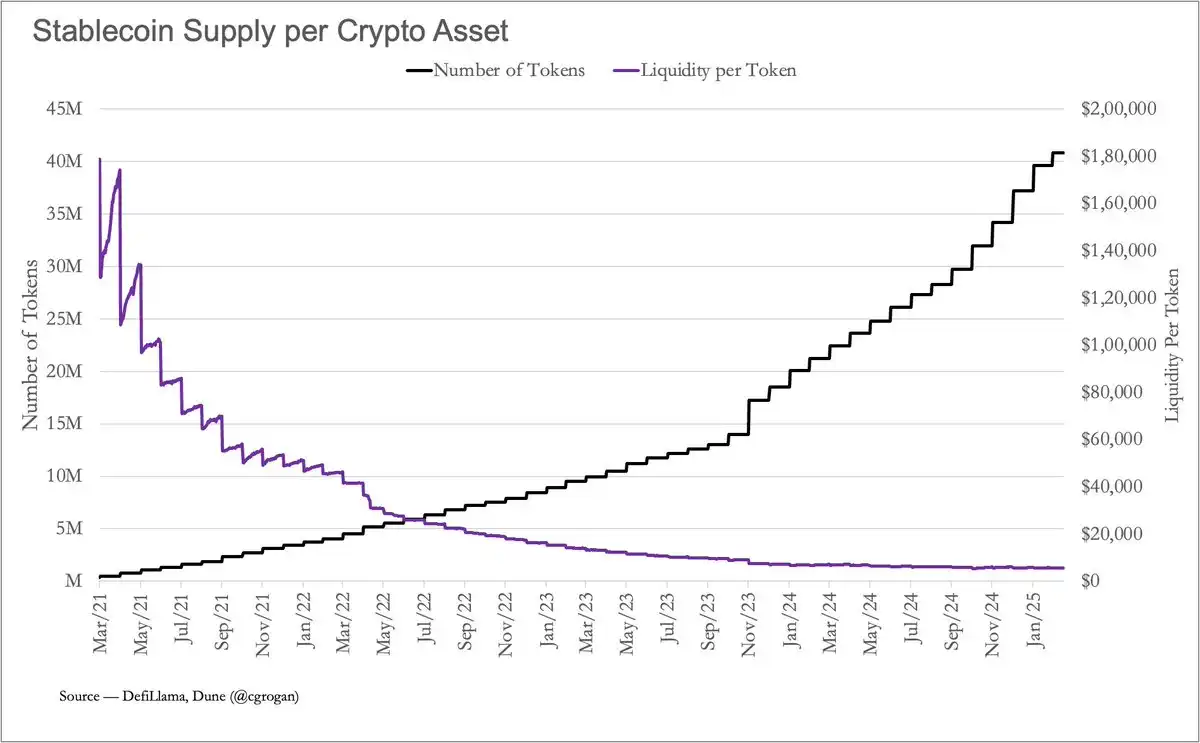
In 2021, each cryptocurrency asset had an average of about $1.8 million in stablecoin liquidity. By March 2025, this number had plummeted to just $5,500.

Analyzing How Crypto Projects Handle Revenue and Cash Flow: Evolution of Strategy from Survival to Distribution

This chart shows the declining average and reveals the zero-sum attention game in the current crypto industry. Despite the number of tokens surging to over 40 million, stablecoin liquidity (roughly representative of funds) remains stagnant. The consequence is brutal—each project receives less capital, communities are thinner, and user engagement rapidly declines.

In this environment, fleeting attention is no longer a growth channel but has become a burden. Without cash flow support, attention is fleeting and unforgiving.

Revenue is the Anchor

Most projects still build communities with a 2021 mindset: create a Discord channel, sprinkle some airdrop incentives, hope users shout "GM" long enough to cultivate loyalty. But the reality is, once users receive the airdrop, they leave—why should they stay?

This is where the value of revenue lies—not just a financial metric, but proof of whether a project has sustainable appeal. A product that can generate revenue means there is demand, and demand determines valuation, which in turn gives the token attractiveness.

Of course, revenue is not the ultimate goal for all projects. But without it, most tokens simply cannot survive to truly establish themselves.

The situation is different for Ethereum, as it has already established a mature and robust ecosystem, therefore not requiring additional revenue support. Ethereum's validator rewards come from around a 2.8% annual inflation, but due to the fee burning mechanism of EIP-1559, this portion of inflation can be offset. As long as the burn and rewards remain balanced, ETH holders will not experience dilution.

However, for new projects, this kind of treatment is a luxury.

When a project only has 20% of the tokens in circulation, the product is still seeking product-market fit, essentially operating as a startup—it must be profitable and prove its ability to sustain profitability in order to survive.

Protocol Lifecycle: From Explorer to Titan

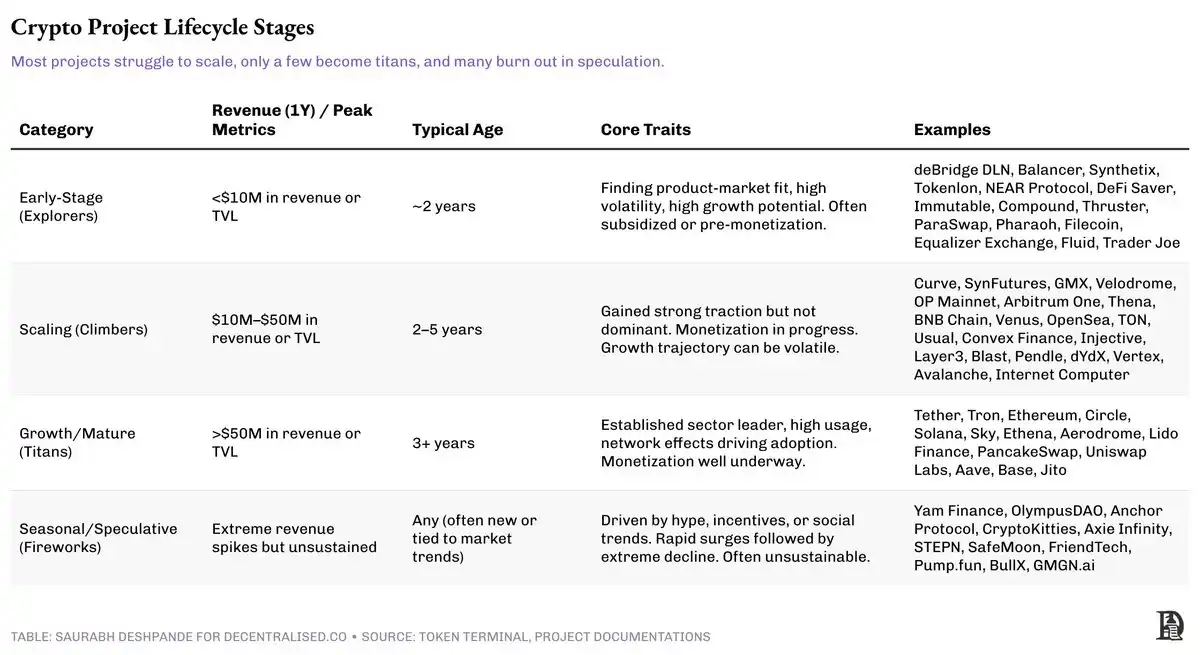
Similar to traditional companies, crypto projects go through different growth stages. At each stage, the project's attitude towards revenue—whether to reinvest or distribute profits—undergoes significant changes.
Explorer: Just Survive

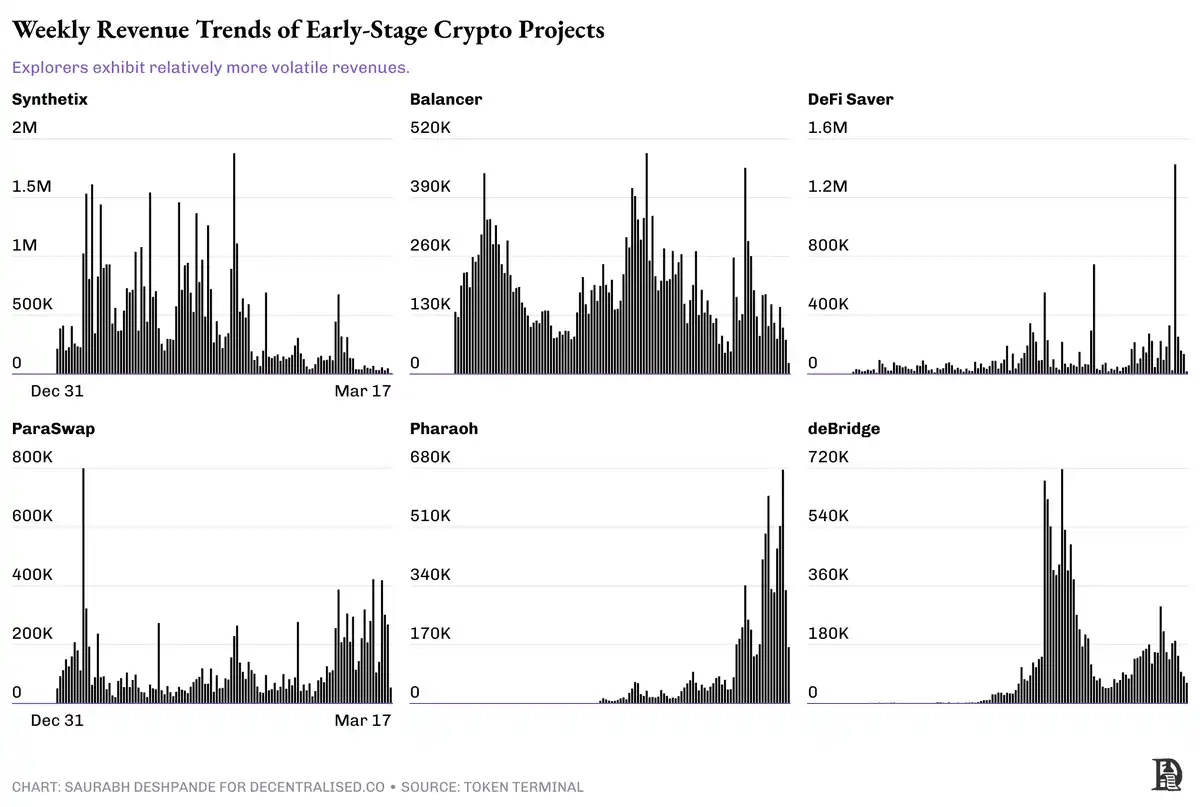
These projects are in the early stages, with governance still highly centralized, the ecosystem fragile, and a focus on experimentation rather than monetization. Even if there is revenue, it tends to be highly volatile and unsustainable, reflecting more market speculation rather than user loyalty. Many projects rely on incentives, grants, or venture capital funding to sustain themselves.

For example, projects like Synthetix and Balancer, which have been around for about 5 years, currently generate weekly revenues ranging from $100,000 to $1 million, with occasional spikes during active market periods. This kind of volatility is not a sign of failure but a characteristic of the early stage. What truly matters is whether these teams can translate their experimental results into stable user demand.
Climber: Growing, yet Unstable

Climbers are in a higher growth stage, with annual revenues ranging from $10 million to $50 million, starting to move away from a growth model driven solely by inflation incentives (such as large token distributions). Their governance structures are becoming more mature, shifting the focus from mere acquisition to long-term retention of users.

Unlike Explorers, Climbers' revenue is no longer just the result of short-term speculation but demonstrates stable demand across multiple market cycles. At the same time, their organizational structures are evolving—from centralized teams gradually transitioning to community governance and starting to explore diversified revenue streams.
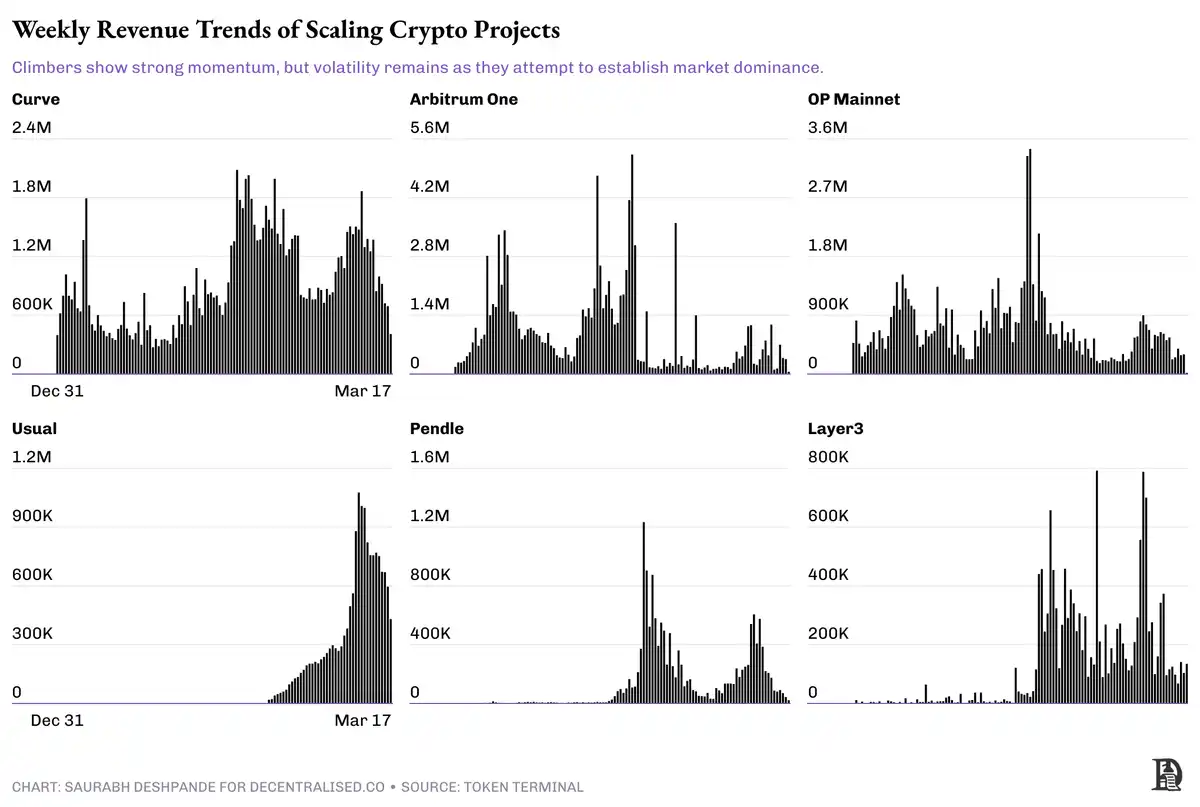
The unique aspect of Climbers is that they have more agency. They have already built enough market trust to experiment with income distribution strategies, such as starting buybacks or implementing revenue sharing. However, at the same time, if they over-expand or fail to establish a strong moat, they may lose their growth momentum.

Unlike Survivors' "survival mode," Climbers need to make strategic trade-offs — whether to continue expanding or solidify their existing market? Is it to distribute income or reinvest? Is it to focus on core business or expand outward?

This is the most fragile stage of project development, not because of volatility, but because every decision is a matter of life and death. If income distribution starts too early, it may slow down growth; but if delayed too long, token holders may lose interest.

Giants: Getting Ready for Income Distribution

Projects like Aave, Uniswap, and Hyperliquid have already crossed the crucial threshold — they have stable income, decentralized governance, and benefit from strong network effects. No longer relying on inflationary tokenomics, these projects have established a robust user base and battle-tested business models.

They usually do not attempt to dabble in all areas but focus on their core business:

· Aave dominates decentralized lending

· Uniswap has the spot trading market

· Hyperliquid is building a DeFi stack focused on execution efficiency

Their success stems from defensible market positioning and high execution capabilities.

Most giants have become leaders in their respective races. Their goal is no longer to capture market share but to expand the entire industry's pie, enabling overall ecosystem growth.
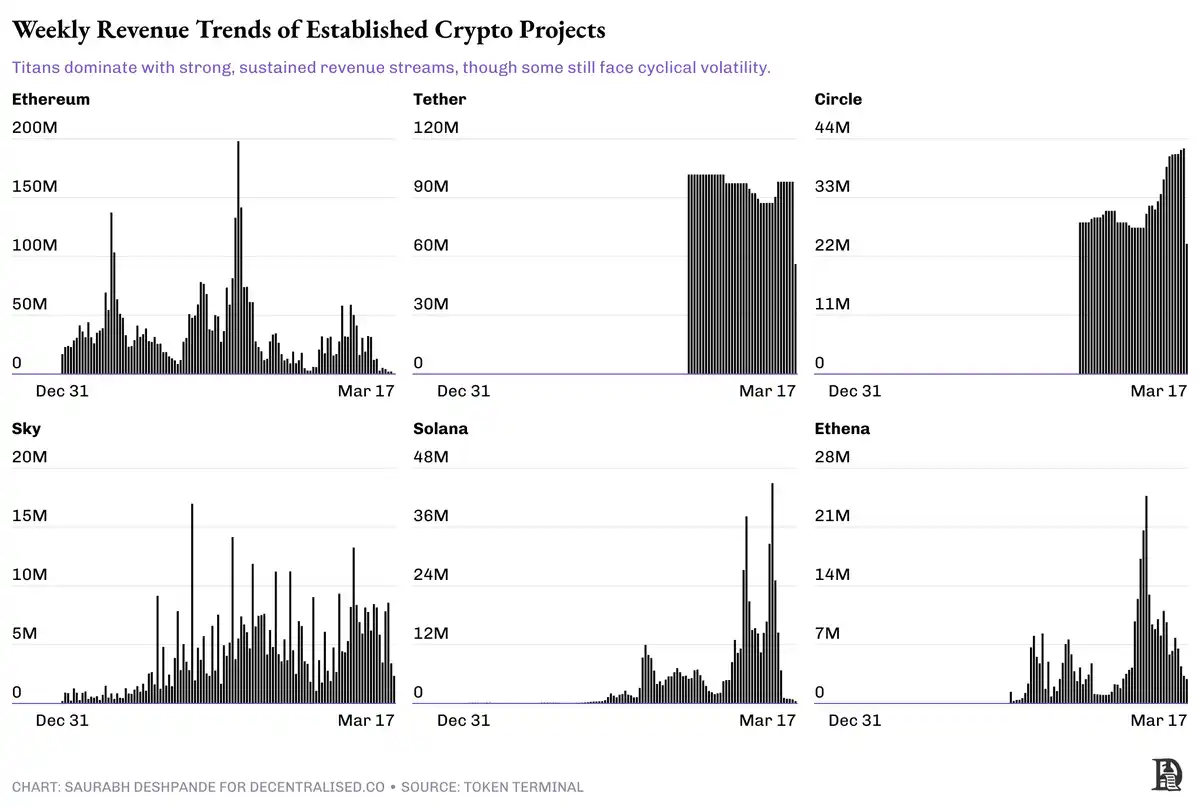
These projects have enough confidence to engage in buybacks while sustaining years of development. Although giants are still affected by market fluctuations, they have enough risk resilience to calmly navigate through cyclical changes.

Seasonal Players: Explosive Hype but Unstable Foundation

These projects often have the highest trading volume but are also the most fragile. Their short-term income may rival or even surpass the giants at times, but this growth typically depends on market hype, speculative sentiment, or temporary social trends.

For example, projects like FriendTech and PumpFun have the ability to ignite the market in a short period, bringing significant user engagement and transaction volume. However, they often struggle to maintain long-term retention.

Of course, these types of projects are not entirely without prospects. Some projects may successfully transition and find a sustainable development path. But the vast majority of seasonal players are more like "short-term speculative products" in the market, with their value more driven by emotions rather than stability as long-term infrastructure.

Insights from the Public Offering Market

A similar reference is provided by the development path of companies in the traditional stock market:

· Young companies typically reinvest free cash flow to scale up;

· Mature companies tend to distribute profits to shareholders through dividends or stock buybacks.

The diagram below shows how companies allocate profits: as companies grow and mature, the amount of dividends and buybacks increases.
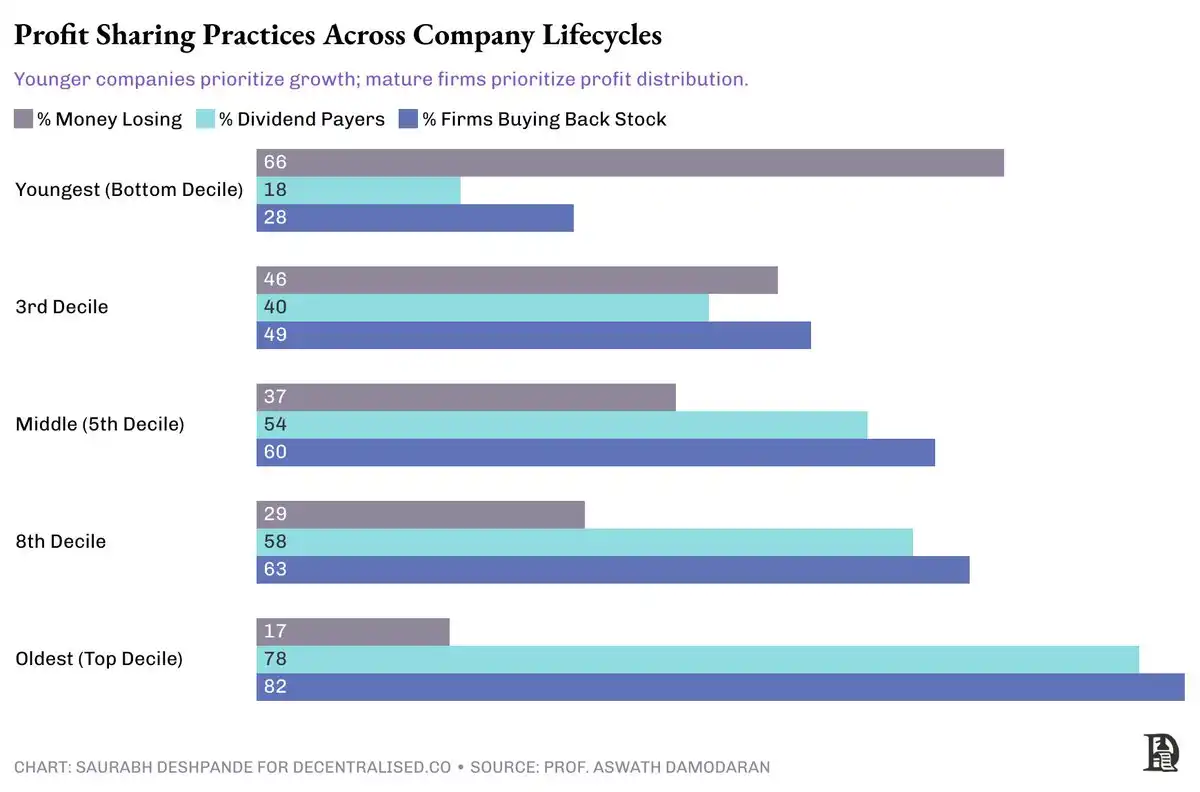
Established projects should distribute earnings, while early-stage projects should retain and continue to grow. However, not all projects can clearly identify their stage of development.

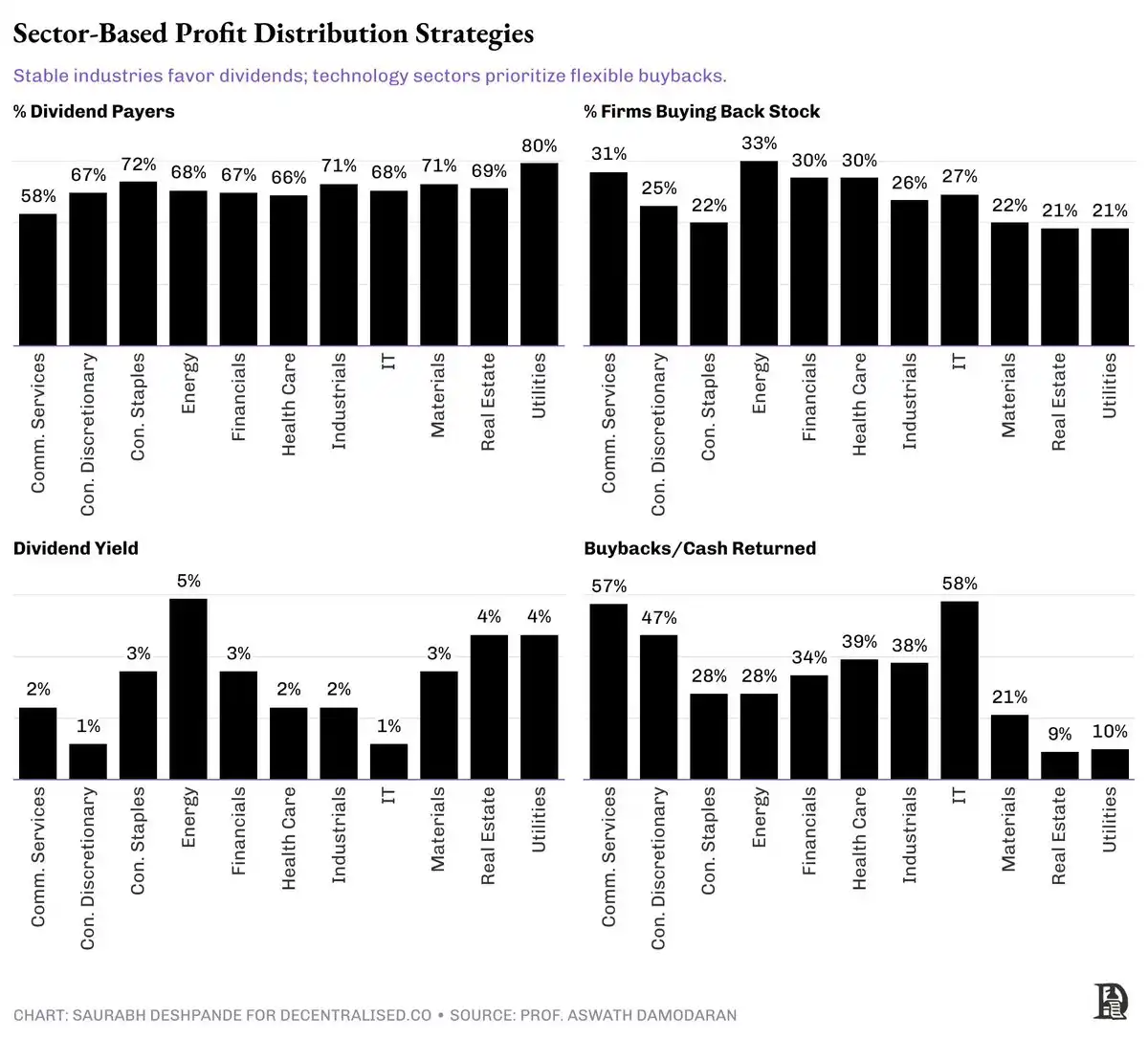
The industry nature is also important, and projects like utilities (e.g., stablecoins) are more like consumer essentials, suitable for a stable dividend model. These projects have often been around for years, with a relatively predictable demand pattern, and their performance does not significantly deviate from market expectations, allowing them to consistently distribute profits to holders.

High-growth DeFi projects are more like tech stocks, where buybacks may be a more optimal value distribution method. The market demand for tech companies has a certain seasonality, and the growth pattern is not as stable as in traditional industries. Therefore, it is more reasonable to flexibly feedback value through buybacks.

When DeFi projects have had outstanding quarterly or yearly performance, they can deliver value through token buybacks rather than direct dividends.
Dividends vs. Buybacks

Dividends have rigidity—once dividends are committed, the market expects continuous stable dividends, and companies find it challenging to adjust. Buybacks are more flexible—teams can adjust the timing of buybacks based on market cycles or undervaluation of tokens, strategically allocating value.

Since the 1990s, the share of buybacks in profit distribution has increased from about 20% to 60% in 2024. In terms of total U.S. dollar amount, buybacks have surpassed dividends since 1999, becoming the preferred profit feedback method for companies.
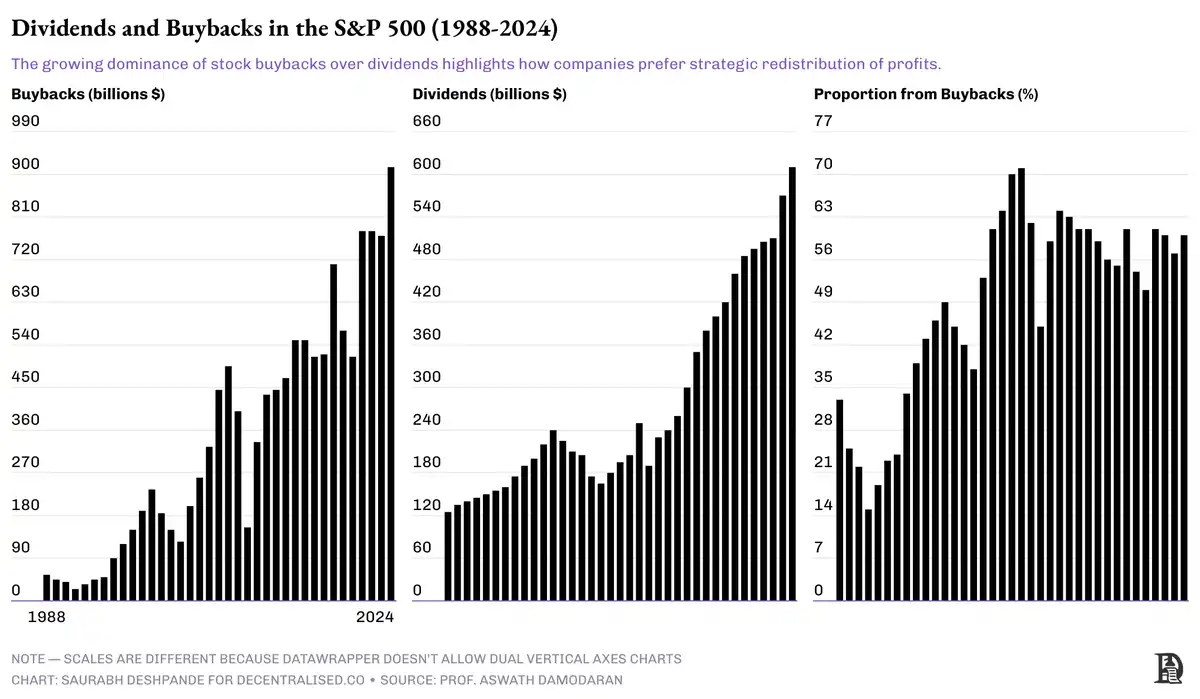
Buybacks also have downsides. Without proper communication or pricing, they may shift value from long-term holders to short-term traders. Governance needs to be airtight. As management often has key performance indicators (KPIs) such as increasing earnings per share (EPS), when you utilize buybacks to retire shares in circulation, you reduce the denominator, artificially boosting the EPS figure.

Both dividends and buybacks have their roles to play. However, if governance is inadequate, buybacks may quietly benefit insiders at the expense of the community.

A good buyback requires three prerequisites:

· Strong capital reserves

· Well-thought-out valuation logic

· Transparent reporting

If a project lacks these, it may still be in reinvestment mode.

How Leading Projects Handle Profits

@JupiterExchange explicitly stated during token issuance: no direct income distribution. After experiencing a 10x user growth and having enough financial reserves to support multiple years, they introduced the Litterbox Trust—an ungoverned buyback mechanism currently holding about $9.7 million worth of JUP.

@aave has over $95 million in capital reserves, allocating $1 million weekly for buybacks, executed after several months of community dialogue through a structured plan called "Buy & Burn."

@HyperliquidX goes even further. Fifty-four percent of the revenue is used for buybacks, and 46% is allocated to incentivize liquidity providers. To date, over 250 million HYPE has been bought back, all funded by VCs.

What do these projects have in common? None of them started buybacks recklessly before ensuring a solid financial foundation.

The Missing Layer: Investor Relations

The crypto industry loves talking about transparency, but most projects only release data when it suits them. Investor relations (IR) should be a core infrastructure. Projects need to share not only revenue but also expenses, financial condition, fund strategies, and buyback executions. This is the only way to build long-term trust.

The goal is not to advocate for a particular "correct" value distribution. Instead, it is to recognize that distribution should align with maturity, which is still lacking in the crypto industry.

Most projects are still finding their positioning. But those getting it right—having revenue, strategy, trust—have a significant opportunity to become the large-scale infrastructure this industry truly needs.

Strong IR is a moat. It builds trust, reduces panic during market downturns, and maintains institutional capital participation.

What it might look like:

· Quarterly financial reports: Transparent disclosure of income and expenses

· Real-time treasury dashboard

· Public log of buyback execution

· Clear explanation of token distribution and unlocking

· On-chain validation of funding, salaries, and operations

If we want tokens to be seen as true assets, they need to start communicating like real businesses.

Original Article Link

You may also like

Token Cannot Compound, Where Is the Real Investment Opportunity?

The next chapter in the crypto industry will undoubtedly be written by Crypto-empowered Stocks.

February 6th Market Key Intelligence, How Much Did You Miss?

1. On-chain Flows: $508.2M USD inflow to Ethereum today; $390.8M USD outflow from Arbitrum 2. Biggest Gainers/Losers: $HBTC, $AIO 3. Top News: Current Bitcoin weekly RSI oversold signal comparable to June 2022

China's Central Bank and Eight Other Departments' Latest Regulatory Focus: Key Attention to RWA Tokenized Asset Risk


Foreword: Today, the People's Bank of China's website published the "Notice of the People's Bank of China, National Development and Reform Commission, Ministry of Industry and Information Technology, Ministry of Public Security, State Administration for Market Regulation, China Banking and Insurance Regulatory Commission, China Securities Regulatory Commission, State Administration of Foreign Exchange on Further Preventing and Dealing with Risks Related to Virtual Currency and Others (Yinfa [2026] No. 42)", the latest regulatory requirements from the eight departments including the central bank, which are basically consistent with the regulatory requirements of recent years. The main focus of the regulation is on speculative activities such as virtual currency trading, exchanges, ICOs, overseas platform services, and this time, regulatory oversight of RWA has been added, explicitly prohibiting RWA tokenization, stablecoins (especially those pegged to the RMB). The following is the full text:


To the people's governments of all provinces, autonomous regions, and municipalities directly under the Central Government, the Xinjiang Production and Construction Corps:


  Recently, there have been speculative activities related to virtual currency and Real-World Assets (RWA) tokenization, disrupting the economic and financial order and jeopardizing the property security of the people. In order to further prevent and address the risks related to virtual currency and Real-World Assets tokenization, effectively safeguard national security and social stability, in accordance with the "Law of the People's Republic of China on the People's Bank of China," "Law of the People's Republic of China on Commercial Banks," "Securities Law of the People's Republic of China," "Law of the People's Republic of China on Securities Investment Funds," "Law of the People's Republic of China on Futures and Derivatives," "Cybersecurity Law of the People's Republic of China," "Regulations of the People's Republic of China on the Administration of Renminbi," "Regulations on Prevention and Disposal of Illegal Fundraising," "Regulations of the People's Republic of China on Foreign Exchange Administration," "Telecommunications Regulations of the People's Republic of China," and other provisions, after reaching consensus with the Cyberspace Administration of China, the Supreme People's Court, and the Supreme People's Procuratorate, and with the approval of the State Council, the relevant matters are notified as follows:


  I. Clarify the essential attributes of virtual currency, Real-World Assets tokenization, and related business activities


  (I) Virtual currency does not possess the legal status equivalent to fiat currency. Virtual currencies such as Bitcoin, Ether, Tether, etc., have the main characteristics of being issued by non-monetary authorities, using encryption technology and distributed ledger or similar technology, existing in digital form, etc. They do not have legal tender status, should not and cannot be circulated and used as currency in the market.


  The business activities related to virtual currency are classified as illegal financial activities. The exchange of fiat currency and virtual currency within the territory, exchange of virtual currencies, acting as a central counterparty in buying and selling virtual currencies, providing information intermediary and pricing services for virtual currency transactions, token issuance financing, and trading of virtual currency-related financial products, etc., fall under illegal financial activities, such as suspected illegal issuance of token vouchers, unauthorized public issuance of securities, illegal operation of securities and futures business, illegal fundraising, etc., are strictly prohibited across the board and resolutely banned in accordance with the law. Overseas entities and individuals are not allowed to provide virtual currency-related services to domestic entities in any form.


  A stablecoin pegged to a fiat currency indirectly fulfills some functions of the fiat currency in circulation. Without the consent of relevant authorities in accordance with the law and regulations, any domestic or foreign entity or individual is not allowed to issue a RMB-pegged stablecoin overseas.


(II)Tokenization of Real-World Assets refers to the use of encryption technology and distributed ledger or similar technologies to transform ownership rights, income rights, etc., of assets into tokens (tokens) or other interests or bond certificates with token (token) characteristics, and carry out issuance and trading activities.


  Engaging in the tokenization of real-world assets domestically, as well as providing related intermediary, information technology services, etc., which are suspected of illegal issuance of token vouchers, unauthorized public offering of securities, illegal operation of securities and futures business, illegal fundraising, and other illegal financial activities, shall be prohibited; except for relevant business activities carried out with the approval of the competent authorities in accordance with the law and regulations and relying on specific financial infrastructures. Overseas entities and individuals are not allowed to illegally provide services related to the tokenization of real-world assets to domestic entities in any form.


  II. Sound Work Mechanism


  (III) Inter-agency Coordination. The People's Bank of China, together with the National Development and Reform Commission, the Ministry of Industry and Information Technology, the Ministry of Public Security, the State Administration for Market Regulation, the China Banking and Insurance Regulatory Commission, the China Securities Regulatory Commission, the State Administration of Foreign Exchange, and other departments, will improve the work mechanism, strengthen coordination with the Cyberspace Administration of China, the Supreme People's Court, and the Supreme People's Procuratorate, coordinate efforts, and overall guide regions to carry out risk prevention and disposal of virtual currency-related illegal financial activities.


  The China Securities Regulatory Commission, together with the National Development and Reform Commission, the Ministry of Industry and Information Technology, the Ministry of Public Security, the People's Bank of China, the State Administration for Market Regulation, the China Banking and Insurance Regulatory Commission, the State Administration of Foreign Exchange, and other departments, will improve the work mechanism, strengthen coordination with the Cyberspace Administration of China, the Supreme People's Court, and the Supreme People's Procuratorate, coordinate efforts, and overall guide regions to carry out risk prevention and disposal of illegal financial activities related to the tokenization of real-world assets.


  (IV) Strengthening Local Implementation. The people's governments at the provincial level are overall responsible for the prevention and disposal of risks related to virtual currencies and the tokenization of real-world assets in their respective administrative regions. The specific leading department is the local financial regulatory department, with participation from branches and dispatched institutions of the State Council's financial regulatory department, telecommunications regulators, public security, market supervision, and other departments, in coordination with cyberspace departments, courts, and procuratorates, to improve the normalization of the work mechanism, effectively connect with the relevant work mechanisms of central departments, form a cooperative and coordinated working pattern between central and local governments, effectively prevent and properly handle risks related to virtual currencies and the tokenization of real-world assets, and maintain economic and financial order and social stability.


  III. Strengthened Risk Monitoring, Prevention, and Disposal


  (5) Enhanced Risk Monitoring. The People's Bank of China, China Securities Regulatory Commission, National Development and Reform Commission, Ministry of Industry and Information Technology, Ministry of Public Security, State Administration of Foreign Exchange, Cyberspace Administration of China, and other departments continue to improve monitoring techniques and system support, enhance cross-departmental data analysis and sharing, establish sound information sharing and cross-validation mechanisms, promptly grasp the risk situation of activities related to virtual currency and real-world asset tokenization. Local governments at all levels give full play to the role of local monitoring and early warning mechanisms. Local financial regulatory authorities, together with branches and agencies of the State Council's financial regulatory authorities, as well as departments of cyberspace and public security, ensure effective connection between online monitoring, offline investigation, and fund tracking, efficiently and accurately identify activities related to virtual currency and real-world asset tokenization, promptly share risk information, improve early warning information dissemination, verification, and rapid response mechanisms.


  (6) Strengthened Oversight of Financial Institutions, Intermediaries, and Technology Service Providers. Financial institutions (including non-bank payment institutions) are prohibited from providing account opening, fund transfer, and clearing services for virtual currency-related business activities, issuing and selling financial products related to virtual currency, including virtual currency and related financial products in the scope of collateral, conducting insurance business related to virtual currency, or including virtual currency in the scope of insurance liability. Financial institutions (including non-bank payment institutions) are prohibited from providing custody, clearing, and settlement services for unauthorized real-world asset tokenization-related business and related financial products. Relevant intermediary institutions and information technology service providers are prohibited from providing intermediary, technical, or other services for unauthorized real-world asset tokenization-related businesses and related financial products.


  (7) Enhanced Management of Internet Information Content and Access. Internet enterprises are prohibited from providing online business venues, commercial displays, marketing, advertising, or paid traffic diversion services for virtual currency and real-world asset tokenization-related business activities. Upon discovering clues of illegal activities, they should promptly report to relevant departments and provide technical support and assistance for related investigations and inquiries. Based on the clues transferred by the financial regulatory authorities, the cyberspace administration, telecommunications authorities, and public security departments should promptly close and deal with websites, mobile applications (including mini-programs), and public accounts engaged in virtual currency and real-world asset tokenization-related business activities in accordance with the law.


  (8) Strengthened Entity Registration and Advertisement Management. Market supervision departments strengthen entity registration and management, and enterprise and individual business registrations must not contain terms such as "virtual currency," "virtual asset," "cryptocurrency," "crypto asset," "stablecoin," "real-world asset tokenization," or "RWA" in their names or business scopes. Market supervision departments, together with financial regulatory authorities, legally enhance the supervision of advertisements related to virtual currency and real-world asset tokenization, promptly investigating and handling relevant illegal advertisements.


  (IX) Continued Rectification of Virtual Currency Mining Activities. The National Development and Reform Commission, together with relevant departments, strictly controls virtual currency mining activities, continuously promotes the rectification of virtual currency mining activities. The people's governments of various provinces take overall responsibility for the rectification of "mining" within their respective administrative regions. In accordance with the requirements of the National Development and Reform Commission and other departments in the "Notice on the Rectification of Virtual Currency Mining Activities" (NDRC Energy-saving Building [2021] No. 1283) and the provisions of the "Guidance Catalog for Industrial Structure Adjustment (2024 Edition)," a comprehensive review, investigation, and closure of existing virtual currency mining projects are conducted, new mining projects are strictly prohibited, and mining machine production enterprises are strictly prohibited from providing mining machine sales and other services within the country.


  (X) Severe Crackdown on Related Illegal Financial Activities. Upon discovering clues to illegal financial activities related to virtual currency and the tokenization of real-world assets, local financial regulatory authorities, branches of the State Council's financial regulatory authorities, and other relevant departments promptly investigate, determine, and properly handle the issues in accordance with the law, and seriously hold the relevant entities and individuals legally responsible. Those suspected of crimes are transferred to the judicial authorities for processing according to the law.


 (XI) Severe Crackdown on Related Illegal and Criminal Activities. The Ministry of Public Security, the People's Bank of China, the State Administration for Market Regulation, the China Banking and Insurance Regulatory Commission, the China Securities Regulatory Commission, as well as judicial and procuratorial organs, in accordance with their respective responsibilities, rigorously crack down on illegal and criminal activities related to virtual currency, the tokenization of real-world assets, such as fraud, money laundering, illegal business operations, pyramid schemes, illegal fundraising, and other illegal and criminal activities carried out under the guise of virtual currency, the tokenization of real-world assets, etc.


  (XII) Strengthen Industry Self-discipline. Relevant industry associations should enhance membership management and policy advocacy, based on their own responsibilities, advocate and urge member units to resist illegal financial activities related to virtual currency and the tokenization of real-world assets. Member units that violate regulatory policies and industry self-discipline rules are to be disciplined in accordance with relevant self-regulatory management regulations. By leveraging various industry infrastructure, conduct risk monitoring related to virtual currency, the tokenization of real-world assets, and promptly transfer issue clues to relevant departments.


  IV. Strict Supervision of Domestic Entities Engaging in Overseas Business Activities


(XIII) Without the approval of relevant departments in accordance with the law and regulations, domestic entities and foreign entities controlled by them may not issue virtual currency overseas.


  (XIV) Domestic entities engaging directly or indirectly in overseas external debt-based tokenization of real-world assets, or conducting asset securitization activities abroad based on domestic ownership rights, income rights, etc. (hereinafter referred to as domestic equity), should be strictly regulated in accordance with the principles of "same business, same risk, same rules." The National Development and Reform Commission, the China Securities Regulatory Commission, the State Administration of Foreign Exchange, and other relevant departments regulate it according to their respective responsibilities. For other forms of overseas real-world asset tokenization activities based on domestic equity by domestic entities, the China Securities Regulatory Commission, together with relevant departments, supervise according to their division of responsibilities. Without the consent and filing of relevant departments, no unit or individual may engage in the above-mentioned business.


  (15) Overseas subsidiaries and branches of domestic financial institutions providing Real World Asset Tokenization-related services overseas shall do so legally and prudently. They shall have professional personnel and systems in place to effectively mitigate business risks, strictly implement customer onboarding, suitability management, anti-money laundering requirements, and incorporate them into the domestic financial institutions' compliance and risk management system. Intermediaries and information technology service providers offering Real World Asset Tokenization services abroad based on domestic equity or conducting Real World Asset Tokenization business in the form of overseas debt for domestic entities directly or indirectly venturing abroad must strictly comply with relevant laws and regulations. They should establish and improve relevant compliance and internal control systems in accordance with relevant normative requirements, strengthen business and risk control, and report the business developments to the relevant regulatory authorities for approval or filing.


  V. Strengthen Organizational Implementation


  (16) Strengthen organizational leadership and overall coordination. All departments and regions should attach great importance to the prevention of risks related to virtual currencies and Real World Asset Tokenization, strengthen organizational leadership, clarify work responsibilities, form a long-term effective working mechanism with centralized coordination, local implementation, and shared responsibilities, maintain high pressure, dynamically monitor risks, effectively prevent and mitigate risks in an orderly and efficient manner, legally protect the property security of the people, and make every effort to maintain economic and financial order and social stability.


  (17) Widely carry out publicity and education. All departments, regions, and industry associations should make full use of various media and other communication channels to disseminate information through legal and policy interpretation, analysis of typical cases, and education on investment risks, etc. They should promote the illegality and harm of virtual currencies and Real World Asset Tokenization-related businesses and their manifestations, fully alert to potential risks and hidden dangers, and enhance public awareness and identification capabilities for risk prevention.


  VI. Legal Responsibility


  (18) Engaging in illegal financial activities related to virtual currencies and Real World Asset Tokenization in violation of this notice, as well as providing services for virtual currencies and Real World Asset Tokenization-related businesses, shall be punished in accordance with relevant regulations. If it constitutes a crime, criminal liability shall be pursued according to the law. For domestic entities and individuals who knowingly or should have known that overseas entities illegally provided virtual currency or Real World Asset Tokenization-related services to domestic entities and still assisted them, relevant responsibilities shall be pursued according to the law. If it constitutes a crime, criminal liability shall be pursued according to the law.


  (19) If any unit or individual invests in virtual currencies, Real World Asset Tokens, and related financial products against public order and good customs, the relevant civil legal actions shall be invalid, and any resulting losses shall be borne by them. If there are suspicions of disrupting financial order and jeopardizing financial security, the relevant departments shall deal with them according to the law.


  This notice shall enter into force upon the date of its issuance. The People's Bank of China and ten other departments' "Notice on Further Preventing and Dealing with the Risks of Virtual Currency Trading Speculation" (Yinfa [2021] No. 237) is hereby repealed.


Former Partner's Perspective on Multicoin: Kyle's Exit, But the Game He Left Behind Just Getting Started

Kyle knew his game, so he decided to focus on playing the game he was good at and interested in.

Why Bitcoin Is Falling Now: The Real Reasons Behind BTC's Crash & WEEX's Smart Profit Playbook

Bitcoin's ongoing crash explained: Discover the 5 hidden triggers behind BTC's plunge & how WEEX's Auto Earn and Trade to Earn strategies help traders profit from crypto market volatility.

Wall Street's Hottest Trades See Exodus

This time there is no single triggering factor, but rather market anxiety about asset valuation, with many already skeptical of these valuations being too high, leading to investors choosing to retreat almost simultaneously.

Popular coins

Latest Crypto News

Read more