
- Buy Crypto
- Markets
 Futures
- Spot
- Copy Trade
 Earn
Earn- More
Decode Stock on Chain: Why Are Crypto Enthusiasts Investing in US Stocks While Wall Street Is Going Blockchain Unfriendly?

Original Title: "Understanding Stock Tokenization in One Article: Why Crypto Enthusiasts Are Investing in Stocks While Wall Street Is Going the Other Way?"
Original Authors: Changan, Amelia, Biteye
Over the past year, a thought-provoking phenomenon has repeatedly appeared:
While the US stock market and precious metals have repeatedly hit new highs driven by the productivity boom and AI narrative, the crypto market has been mired in periodic liquidity droughts.
Many investors lamented that "the end of the crypto world is in stocks" and even chose to exit entirely.
But what if I told you that these two seemingly opposing paths to wealth are undergoing a historic convergence through tokenization? Would you still choose to leave?
Why is it that from BlackRock to Coinbase, top global institutions in their 2025 annual outlook all unanimously favor asset tokenization?
This is not just a simple "stock migration." Starting from the underlying logic, this article thoroughly dissects the underlying logic of US stock tokenization for you and inventories the current trading platforms and frontline KOLs involved in stock tokenization with in-depth insights.
Core: More Than Just On-chain
Stock tokenization refers to converting US stocks (such as Apple, Tesla, NVIDIA, etc., shares of listed companies) into tokens. These tokens are usually 1:1 pegged to the equity or value of real stocks and are issued, traded, and settled through blockchain technology.
In simple terms, it moves traditional US stocks onto the blockchain, turning stocks into programmable assets. Token holders can obtain the economic benefits of stocks (such as price fluctuations, dividends), but not necessarily full shareholder rights (depending on the specific product design).
As shown in the figure, the TVL of US stock tokenization has grown exponentially since the fourth quarter of this year.
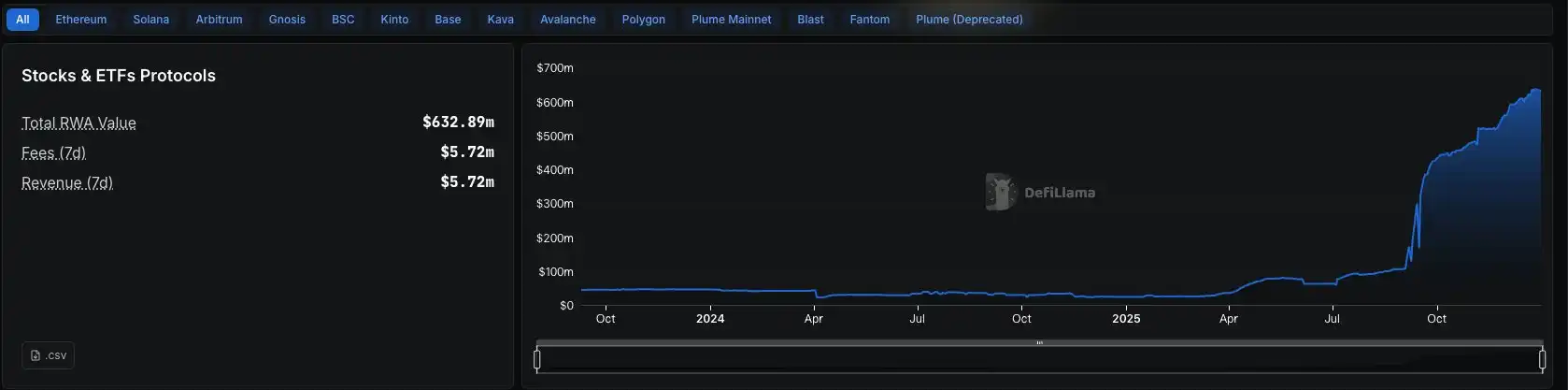
(Source: Dune)
After clarifying the basic definition of US stock tokenization and its differences from traditional assets, a more fundamental question arises: since the traditional securities market has been operating for hundreds of years, why should we go to great lengths to put stocks on the chain?
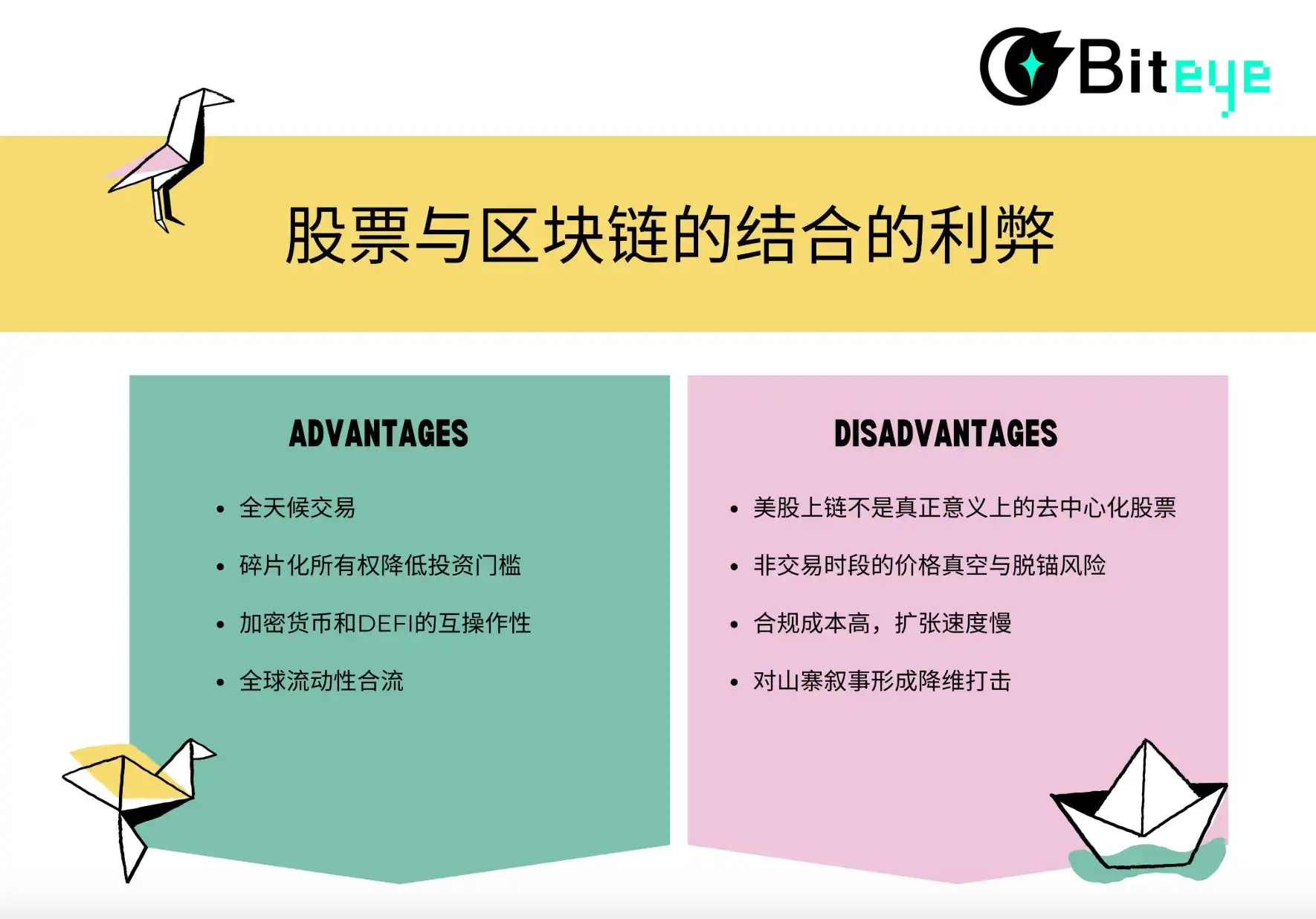
Because the combination of stocks and blockchain will bring many innovations and benefits to the traditional financial system.
1. 24/7 Trading: Breaking the shackles of trading hours on the NYSE and NASDAQ, the cryptocurrency market can achieve 24/7 uninterrupted trading.
2. Fractional Ownership Reduces Investment Threshold: In the traditional stock market, the minimum purchase is usually 1 lot (100 shares). Tokenization allows assets to be divided into tiny fractions, enabling investors to invest $10 or $50, without having to buy the full share. Ordinary investors worldwide can also equally partake in the growth dividends of top companies.
3. Interoperability of Cryptocurrency and DeFi: Once stocks are tokenized, they can seamlessly interact with the entire decentralized finance ecosystem. This means you can do things with tokenized stocks that are impossible (or difficult) with traditional stocks. For example: you can use tokenized stocks as collateral for cryptocurrency loans, or leverage tokenized stocks in LP to earn trading fees.
4. Global Liquidity Convergence: Under the traditional system, the liquidity of US stocks and other assets is somewhat segregated, with macro benefits often "rising on one side." After US stocks go on-chain, crypto capital can participate in global high-quality assets without moving, fundamentally advancing liquidity efficiency.
BlackRock's CEO Larry Fink also stated: the next generation market, the next generation securities, will be security tokenization.
This also hits the cyclical dilemma in the crypto market - when US stocks and precious metals perform strongly, the crypto market often faces liquidity shortages, leading to capital outflows. However, if "US stock tokenization" matures, bringing more high-quality traditional assets into the crypto world, investors are less likely to exit altogether, thus enhancing the resilience and attractiveness of the entire ecosystem.
Of course, US stock on-chain is not a utopian solution that removes all friction. On the contrary, many of the issues it exposes are precisely because it is beginning to integrate into the real-world financial order.
1. US Stock On-chain is not Truly Decentralized Stock
Currently, mainstream US stock tokenization products mostly rely on regulated entities to custody real stocks and issue corresponding tokens on-chain. Users actually hold claims to the underlying stocks, not full shareholder identities. This means that asset security and redeemability largely depend on the issuer's legal structure, custody arrangements, and compliance stability. If the regulatory environment changes or the custodian faces extreme risks, the liquidity and redeemability of on-chain assets could be affected.
2. Price Vacuum and Depegging Risk During Non-Trading Hours
During the US stock market closure, especially in perpetual contracts or products with non-1:1 pegging, on-chain prices lack real-time references from traditional markets, relying more on internal crypto market sentiment and liquidity structure. When market depth is insufficient, prices can easily deviate significantly and even be manipulated by large funds. This issue is similar to pre-market and after-hours trading in traditional markets but is further amplified in the 24/7 on-chain environment.
3. High Compliance Costs, Slow Expansion Speed
Unlike native crypto assets, stock tokenization naturally falls within a strong regulatory boundary. From security attribute identification, cross-jurisdictional compliance, to custody and settlement mechanism design, each step requires deep coordination with the real-world financial system. This makes it difficult for this space to replicate the explosive growth path of DeFi or meme coins, with each step involving legal structures, custody, and licensing.
4. Deals a Heavy Blow to the Shanzhai Narrative
When on-chain trading of high-quality assets like Apple and NVIDIA is possible, the attractiveness of narrative-based assets lacking real cash flow and fundamental support will be significantly reduced. Capital begins to rebalance between the "high-volatility imagination space" and "real-world returns." This shift is positive for the long-term health of the ecosystem but lethal for some emotionally driven Shanzhai assets.
In summary, bringing US stocks on-chain is a slow, realistic process with long-term certainty in financial evolution. It may not create short-term frenzy but is likely to become a mainstream theme in the crypto world, deeply integrated with traditional finance and eventually solidifying as infrastructure.
Implementation Logic: Custodial Support vs Synthetic Assets
Tokenized stocks are created by issuing blockchain-based tokens that reflect the value of specific equity. Depending on the underlying implementation, tokenized stocks in the current market are usually created using one of the following two models:
· Custodial-backed Tokens: Regulated entities hold real stocks in the traditional securities market as reserves and issue corresponding tokens on-chain at a certain ratio. On-chain tokens represent holders' economic claims to the underlying stocks, with their legal enforceability depending on the issuer's compliance structure, custody arrangements, and disclosure transparency.
This model is more aligned with compliance and asset security in the traditional financial system, making it the primary implementation path for current US stock tokenization.
· Synthetic Tokens: Synthetic tokens do not hold real stocks but rather track stock prices through smart contracts and oracle systems to provide users with price exposure. These products are more akin to financial derivatives, focusing on trading and hedging rather than transferring asset ownership.
Due to the lack of real asset backing and inherent compliance and security vulnerabilities, early pure synthetic models represented by Mirror Protocol have gradually faded from the mainstream view.
With tightening regulatory requirements and institutional capital inflow, the model based on real asset custody has become the mainstream choice for the tokenization of US stocks in 2025. Platforms such as Ondo Finance and xStocks have made significant progress in compliance frameworks, liquidity access, and user experience.
However, at the operational level, these models still need to coordinate between the traditional financial system and on-chain systems, bringing about some engineering differences worth noting.
1. Execution Detail Differences Due to Batch Settlement Mechanism
Platforms generally adopt a net batch settlement method in executing real stock trades in traditional markets (e.g., Nasdaq, NYSE). While this inherits deep liquidity from traditional markets, resulting in very low slippage for large orders (usually <0.2%), it also means:
1) During non-US stock market hours, minting and redeeming may experience brief delays;
2) During extreme volatile markets, the execution price may have slight deviations from on-chain pricing (due to platform spread or fee buffers).
2. Custodial Concentration and Operational Risks
Stocks are held by a few regulated custodians. If there are custodian operational errors, bankruptcies, settlement delays, or extreme black swan events, it could theoretically affect token redemptions.
Similar issues are prevalent in Perpdex targeting US stocks. Unlike spot trading's 1:1 peg, during US stock market closures, contract trading faces the following extreme scenarios:
1) De-pegging Risk:
On normal trading days, contract prices are forcibly pegged to the Nasdaq price through funding rates and oracles. Once in a non-trading day, with external spot prices frozen, on-chain prices are solely driven by on-chain funds. If there is a significant crypto market fluctuation or large sell-offs by whales, on-chain prices will quickly deviate.
2) Poor Liquidity Leading to Manipulation:
On non-trading days, both open interest (OI) and order book depth are usually thin. Large holders can manipulate the price through high-leverage orders, triggering cascading liquidations. This is similar to the pre-market futures contracts scenario, akin to the situation seen in the $MMT$MON price action, where violent price surges by whales trigger cascading liquidations when investors are overwhelmingly positioned in a similar way (collective short hedges).
Inventory of On-Chain Trading Platforms for US Stocks
For most investors, the key question is: amidst the vast array of the crypto ecosystem, which projects have actually turned this vision into a tangible reality?
· OndoFinance
Ondo Finance is a leading RWA tokenization platform focused on bringing traditional financial assets onto the blockchain. In September 2025, Ondo Global Markets was launched, offering 100+ tokenized US stocks and ETFs (for non-US investors) with 24/7 trading, instant settlements, and DeFi integrations (such as collateralized borrowing and lending).
The platform has expanded to Ethereum, BNB Chain, and plans to launch on Solana in early 2026, supporting over 1000 assets. The Total Value Locked (TVL) has grown rapidly, exceeding hundreds of millions of dollars by the end of 2025, making it one of the largest platforms in the tokenized stock space.
Ondo has raised over a billion dollars in funding (including early rounds). In 2025, there were no major new public fundraises, but the TVL soared from hundreds of millions at the beginning of the year to over $1 billion by the end of the year, with strong institutional support (such as partnerships with Alpaca and Chainlink).
On November 25, 2025, Ondo Global Markets was officially integrated into the Binance Wallet, directly listing 100+ tokenized US stocks in the "Markets> Stocks" section of the app. This deep integration between Ondo and Binance's ecosystem allows users to trade on-chain (e.g., Apple, Tesla) without requiring additional brokerage accounts and supports DeFi use cases like collateralized borrowing and lending.
Ondo has become the largest global tokenized securities platform, with a year-end TVL exceeding $1 billion, directly challenging traditional brokers.
· Robinhood
The traditional brokerage giant Robinhood is breaking financial barriers using blockchain technology to bring US stock trading into the DeFi ecosystem. In the EU market, it offers tokenized stocks as derivatives based on the MiFID II regulations, operating as an efficient "internal ledger."
In June 2025, the tokenized stocks and ETF products based on Arbitrum will be officially launched for European Union users, covering over 200 US stocks, supporting 24/5 trading on weekdays, and commission-free. There are plans to launch their own Layer2 chain, "Robinhood Chain," in the future and migrate assets to this chain.
Thanks to innovations such as predictive markets, crypto business expansion, and stock tokenization, Robinhood's $HOOD stock price has surged over 220% year-to-date, becoming one of the standout performers in the S&P 500 Index.
· xStocks
xStocks is the core product of the Swiss compliant issuer Backed Finance, issuing tokens backed 1:1 by real US stocks (60+ types, including Apple, Tesla, NVIDIA). It mainly trades on platforms such as Kraken, Bybit, Binance, supports leverage, and DeFi usage (such as collateral). It emphasizes EU regulatory compliance and high liquidity.
Backed Finance raised millions in early funding, with no new public rounds in 2025, but its product trading volume exceeds $300 million, and there is strong partner expansion.
In the first half of 2025, there was a large-scale launch on Solana/BNB Chain/Tron, leading to a significant increase in trading volume; it is seen as the most mature custody model, with plans for more ETFs and institutional-level expansions in the future.
· StableStock
StableStock is a crypto-friendly next-generation brokerage supported by YZi Labs, MPCi, and Vertex Ventures, committed to providing global users with borderless access to financial markets through stablecoins.
StableStock deeply integrates licensed brokerage systems with a stablecoin-native crypto financial architecture, allowing users to trade real stocks and other assets directly using stablecoins without relying on traditional banking systems, significantly reducing the barriers and frictions of cross-border finance. Its long-term goal is to build a global trading system centered around stablecoins, serving as an entry point for tokenized stocks and a wider range of real-world assets. This vision is gradually being realized through specific product forms.
In August 2025, the core brokerage product StableBroker was launched for public testing, and in October, a partnership with Native was established to introduce 24/7 trading of tokenized stocks on the BNB Chain. The current platform supports over 300 US stock equities and ETFs, with an active user base of thousands, daily trading volume of US equities approaching a million dollars, and continuous growth in asset size and various metrics.
· Aster
Aster is the next-gen multi-chain perpetual contract DEX (merged from Astherus and APX Finance), supporting stock perps (including US stocks like AAPL, TSLA), leverage up to 1001x, hidden orders, and yield farming. Cross-chain on BNB Chain, Solana, Ethereum, emphasizing high performance and institutional-grade experience.
The seed round was led by YZi Labs, with a post-2025 TGE peak market cap of over $7 billion for $ASTER.
Post September 2025 TGE, trading volume surged, exceeding $500 billion for the year; launching stock perps, a mobile app, and Aster Chain Beta; with over 2 million users, end-of-2025 TVL exceeding $400 million, becoming the second-largest perps DEX platform.
Of note: CZ publicly disclosed buying $ASTER tokens in the secondary market, underscoring Aster's strategic position on BNBChain.
· Trade.xyz
Trade.xyz is an emerging Pre-IPO tokenization platform, focusing on unicorn company equity (such as SpaceX, OpenAI), issuing tokens via SPV backed by real shares, supporting on-chain trading and redemption. Emphasizing low barriers and liquidity.
With no public record of large fundraising rounds, it is an early-stage project, relying on community and ecosystem growth.
Partially launched on the testnet in 2025, integrating perps with Hyperliquid HIP-3; moderate trading volume, planning to expand to more companies and DeFi integrations in 2026.
· Ventuals
Ventuals is built on Hyperliquid, using the HIP-3 standard to create Pre-IPO company valuation perpetual contracts (not actual ownership but price exposure, such as OpenAI, SpaceX). Supporting leveraged long/short positions, priced based on a valuation oracle.
Incubated by Paradigm, in October 2025, the HYPE collateral vault attracted $38 million in 30 minutes (for market deployment).
Launched on the testnet in 2025, quickly becoming a key player in the Hyperliquid ecosystem for Pre-IPO perps; deploying multiple markets in October, experiencing rapid trading volume growth; planning to expand to more companies and settlement mechanisms, positioning as an innovative futures.
· Jarsy
Jarsy is a compliance-focused Pre-IPO platform that tokenizes real private shares at a 1:1 ratio (such as SpaceX, Anthropic, Stripe), with a minimum investment of $10. Purchase real shares through the tokenization of actual stock after pre-sale test demand, supporting on-chain proof of reserves and verification.
Completed a $5 million pre-seed round in June 2025, led by Breyer Capital, with participation from Karman Ventures and several angels (such as Mysten Labs, Anchorage).
Officially launched in June 2025, rapidly adding popular companies; emphasizing transparency and compliance, TVL growing; future plans to expand dividend simulations and more DeFi compatibility.
In the wave of on-chain U.S. stocks, top CEXs such as Binance, OKX, Bitget, Bybit play a crucial role as traffic gateways, commonly adopting an aggregation model, directly connecting to asset pools of regulated issuers like Ondo Finance, xStocks.
Binance Wallet and OKX Wallet, Bitget's U.S. stock tokenization service deeply integrate with Ondo, providing U.S. stock trading services to users directly in the app's market section.
Bybit, on the other hand, provides U.S. stock contract trading for users through TradFi platforms, specifically synthetic derivatives that track the price movements of real U.S. stocks or indices. Trading hours follow the traditional market, offering 24/5 trading only.
KOL Insights: Consensus, Disagreement, and Vision
· Jiayi (XDO Founder): Looking ahead, stock tokenization is unlikely to follow an explosive growth curve, but it could become a highly resilient infrastructure evolution path in the Web3 world.
https://x.com/mscryptojiayi/status/1940782437879238992?s=20
· Roger (KOL): 2025 U.S. Stock Tokenization (RWA) Core Benefits Top 10
https://x.com/roger9949/status/2000177223874101705?s=20
· Ru7 (KOL): Stock tokenization is not about "copying stocks to the blockchain." It is more like connecting the traditional capital markets with an open, composable decentralized financial system.
https://x.com/Ru7Longcrypto/status/2003821123553902998?s=20
· Blue Fox (KOL): The tokenization of US stocks is a fatal blow to crypto projects, leaving no chance for even a tiny bit of future copycatting.
https://x.com/lanhubiji/status/2001849239874531381?s=20
· Lao Bai (Amber.ac Advisor): The essence of stock tokenization is the "digital migration" of assets: Just as the Internet enables the free flow of information and undermines old intermediaries, blockchain is restructuring the underlying logic of stock assets by eliminating settlement costs, breaking geographical barriers, and decentralizing power.
https://x.com/Wuhuoqiu/status/2003447315139559911?s=20
Epilogue: From the Financial "Parallel World" to the "Twin System"
Returning to the initial question: Why are major institutions unanimously bullish on tokenization in their annual outlooks?
From a first principles perspective, tokenization is liberating assets from the traditional island of geography, institution, and transaction time, transforming them into globally programmable, composable digital assets. When the growth dividend of top companies is no longer restricted by borders and transaction time, the trust foundation of finance is also shifting from centralized intermediaries to code and consensus.
The tokenization of US stocks is far more than just the on-chain movement of assets; it is a fundamental reconstruction of financial civilization.
Just as the Internet demolished the walls of information, blockchain is leveling the playing field for investment.
The crypto industry is also venturing into the deep waters of the real world.
It is no longer just the antithesis of traditional finance but is evolving into a deeply integrated twin financial system with the real-world financial system, advancing together in tandem.
This is not only a leap in transaction efficiency but also a crucial step for global investors to move from passive participation to financial empowerment.
In 2026, the migration of asset liquidity is just beginning.
(This article is for reference only and does not constitute investment advice. The market is risky, so please participate rationally.)
You may also like

Token Cannot Compound, Where Is the Real Investment Opportunity?

February 6th Market Key Intelligence, How Much Did You Miss?

China's Central Bank and Eight Other Departments' Latest Regulatory Focus: Key Attention to RWA Tokenized Asset Risk
Foreword: Today, the People's Bank of China's website published the "Notice of the People's Bank of China, National Development and Reform Commission, Ministry of Industry and Information Technology, Ministry of Public Security, State Administration for Market Regulation, China Banking and Insurance Regulatory Commission, China Securities Regulatory Commission, State Administration of Foreign Exchange on Further Preventing and Dealing with Risks Related to Virtual Currency and Others (Yinfa [2026] No. 42)", the latest regulatory requirements from the eight departments including the central bank, which are basically consistent with the regulatory requirements of recent years. The main focus of the regulation is on speculative activities such as virtual currency trading, exchanges, ICOs, overseas platform services, and this time, regulatory oversight of RWA has been added, explicitly prohibiting RWA tokenization, stablecoins (especially those pegged to the RMB). The following is the full text:
To the people's governments of all provinces, autonomous regions, and municipalities directly under the Central Government, the Xinjiang Production and Construction Corps:
Recently, there have been speculative activities related to virtual currency and Real-World Assets (RWA) tokenization, disrupting the economic and financial order and jeopardizing the property security of the people. In order to further prevent and address the risks related to virtual currency and Real-World Assets tokenization, effectively safeguard national security and social stability, in accordance with the "Law of the People's Republic of China on the People's Bank of China," "Law of the People's Republic of China on Commercial Banks," "Securities Law of the People's Republic of China," "Law of the People's Republic of China on Securities Investment Funds," "Law of the People's Republic of China on Futures and Derivatives," "Cybersecurity Law of the People's Republic of China," "Regulations of the People's Republic of China on the Administration of Renminbi," "Regulations on Prevention and Disposal of Illegal Fundraising," "Regulations of the People's Republic of China on Foreign Exchange Administration," "Telecommunications Regulations of the People's Republic of China," and other provisions, after reaching consensus with the Cyberspace Administration of China, the Supreme People's Court, and the Supreme People's Procuratorate, and with the approval of the State Council, the relevant matters are notified as follows:
(I) Virtual currency does not possess the legal status equivalent to fiat currency. Virtual currencies such as Bitcoin, Ether, Tether, etc., have the main characteristics of being issued by non-monetary authorities, using encryption technology and distributed ledger or similar technology, existing in digital form, etc. They do not have legal tender status, should not and cannot be circulated and used as currency in the market.
The business activities related to virtual currency are classified as illegal financial activities. The exchange of fiat currency and virtual currency within the territory, exchange of virtual currencies, acting as a central counterparty in buying and selling virtual currencies, providing information intermediary and pricing services for virtual currency transactions, token issuance financing, and trading of virtual currency-related financial products, etc., fall under illegal financial activities, such as suspected illegal issuance of token vouchers, unauthorized public issuance of securities, illegal operation of securities and futures business, illegal fundraising, etc., are strictly prohibited across the board and resolutely banned in accordance with the law. Overseas entities and individuals are not allowed to provide virtual currency-related services to domestic entities in any form.
A stablecoin pegged to a fiat currency indirectly fulfills some functions of the fiat currency in circulation. Without the consent of relevant authorities in accordance with the law and regulations, any domestic or foreign entity or individual is not allowed to issue a RMB-pegged stablecoin overseas.
(II)Tokenization of Real-World Assets refers to the use of encryption technology and distributed ledger or similar technologies to transform ownership rights, income rights, etc., of assets into tokens (tokens) or other interests or bond certificates with token (token) characteristics, and carry out issuance and trading activities.
Engaging in the tokenization of real-world assets domestically, as well as providing related intermediary, information technology services, etc., which are suspected of illegal issuance of token vouchers, unauthorized public offering of securities, illegal operation of securities and futures business, illegal fundraising, and other illegal financial activities, shall be prohibited; except for relevant business activities carried out with the approval of the competent authorities in accordance with the law and regulations and relying on specific financial infrastructures. Overseas entities and individuals are not allowed to illegally provide services related to the tokenization of real-world assets to domestic entities in any form.
(III) Inter-agency Coordination. The People's Bank of China, together with the National Development and Reform Commission, the Ministry of Industry and Information Technology, the Ministry of Public Security, the State Administration for Market Regulation, the China Banking and Insurance Regulatory Commission, the China Securities Regulatory Commission, the State Administration of Foreign Exchange, and other departments, will improve the work mechanism, strengthen coordination with the Cyberspace Administration of China, the Supreme People's Court, and the Supreme People's Procuratorate, coordinate efforts, and overall guide regions to carry out risk prevention and disposal of virtual currency-related illegal financial activities.
The China Securities Regulatory Commission, together with the National Development and Reform Commission, the Ministry of Industry and Information Technology, the Ministry of Public Security, the People's Bank of China, the State Administration for Market Regulation, the China Banking and Insurance Regulatory Commission, the State Administration of Foreign Exchange, and other departments, will improve the work mechanism, strengthen coordination with the Cyberspace Administration of China, the Supreme People's Court, and the Supreme People's Procuratorate, coordinate efforts, and overall guide regions to carry out risk prevention and disposal of illegal financial activities related to the tokenization of real-world assets.
(IV) Strengthening Local Implementation. The people's governments at the provincial level are overall responsible for the prevention and disposal of risks related to virtual currencies and the tokenization of real-world assets in their respective administrative regions. The specific leading department is the local financial regulatory department, with participation from branches and dispatched institutions of the State Council's financial regulatory department, telecommunications regulators, public security, market supervision, and other departments, in coordination with cyberspace departments, courts, and procuratorates, to improve the normalization of the work mechanism, effectively connect with the relevant work mechanisms of central departments, form a cooperative and coordinated working pattern between central and local governments, effectively prevent and properly handle risks related to virtual currencies and the tokenization of real-world assets, and maintain economic and financial order and social stability.
(5) Enhanced Risk Monitoring. The People's Bank of China, China Securities Regulatory Commission, National Development and Reform Commission, Ministry of Industry and Information Technology, Ministry of Public Security, State Administration of Foreign Exchange, Cyberspace Administration of China, and other departments continue to improve monitoring techniques and system support, enhance cross-departmental data analysis and sharing, establish sound information sharing and cross-validation mechanisms, promptly grasp the risk situation of activities related to virtual currency and real-world asset tokenization. Local governments at all levels give full play to the role of local monitoring and early warning mechanisms. Local financial regulatory authorities, together with branches and agencies of the State Council's financial regulatory authorities, as well as departments of cyberspace and public security, ensure effective connection between online monitoring, offline investigation, and fund tracking, efficiently and accurately identify activities related to virtual currency and real-world asset tokenization, promptly share risk information, improve early warning information dissemination, verification, and rapid response mechanisms.
(6) Strengthened Oversight of Financial Institutions, Intermediaries, and Technology Service Providers. Financial institutions (including non-bank payment institutions) are prohibited from providing account opening, fund transfer, and clearing services for virtual currency-related business activities, issuing and selling financial products related to virtual currency, including virtual currency and related financial products in the scope of collateral, conducting insurance business related to virtual currency, or including virtual currency in the scope of insurance liability. Financial institutions (including non-bank payment institutions) are prohibited from providing custody, clearing, and settlement services for unauthorized real-world asset tokenization-related business and related financial products. Relevant intermediary institutions and information technology service providers are prohibited from providing intermediary, technical, or other services for unauthorized real-world asset tokenization-related businesses and related financial products.
(7) Enhanced Management of Internet Information Content and Access. Internet enterprises are prohibited from providing online business venues, commercial displays, marketing, advertising, or paid traffic diversion services for virtual currency and real-world asset tokenization-related business activities. Upon discovering clues of illegal activities, they should promptly report to relevant departments and provide technical support and assistance for related investigations and inquiries. Based on the clues transferred by the financial regulatory authorities, the cyberspace administration, telecommunications authorities, and public security departments should promptly close and deal with websites, mobile applications (including mini-programs), and public accounts engaged in virtual currency and real-world asset tokenization-related business activities in accordance with the law.
(8) Strengthened Entity Registration and Advertisement Management. Market supervision departments strengthen entity registration and management, and enterprise and individual business registrations must not contain terms such as "virtual currency," "virtual asset," "cryptocurrency," "crypto asset," "stablecoin," "real-world asset tokenization," or "RWA" in their names or business scopes. Market supervision departments, together with financial regulatory authorities, legally enhance the supervision of advertisements related to virtual currency and real-world asset tokenization, promptly investigating and handling relevant illegal advertisements.
(IX) Continued Rectification of Virtual Currency Mining Activities. The National Development and Reform Commission, together with relevant departments, strictly controls virtual currency mining activities, continuously promotes the rectification of virtual currency mining activities. The people's governments of various provinces take overall responsibility for the rectification of "mining" within their respective administrative regions. In accordance with the requirements of the National Development and Reform Commission and other departments in the "Notice on the Rectification of Virtual Currency Mining Activities" (NDRC Energy-saving Building [2021] No. 1283) and the provisions of the "Guidance Catalog for Industrial Structure Adjustment (2024 Edition)," a comprehensive review, investigation, and closure of existing virtual currency mining projects are conducted, new mining projects are strictly prohibited, and mining machine production enterprises are strictly prohibited from providing mining machine sales and other services within the country.
(X) Severe Crackdown on Related Illegal Financial Activities. Upon discovering clues to illegal financial activities related to virtual currency and the tokenization of real-world assets, local financial regulatory authorities, branches of the State Council's financial regulatory authorities, and other relevant departments promptly investigate, determine, and properly handle the issues in accordance with the law, and seriously hold the relevant entities and individuals legally responsible. Those suspected of crimes are transferred to the judicial authorities for processing according to the law.
(XI) Severe Crackdown on Related Illegal and Criminal Activities. The Ministry of Public Security, the People's Bank of China, the State Administration for Market Regulation, the China Banking and Insurance Regulatory Commission, the China Securities Regulatory Commission, as well as judicial and procuratorial organs, in accordance with their respective responsibilities, rigorously crack down on illegal and criminal activities related to virtual currency, the tokenization of real-world assets, such as fraud, money laundering, illegal business operations, pyramid schemes, illegal fundraising, and other illegal and criminal activities carried out under the guise of virtual currency, the tokenization of real-world assets, etc.
(XII) Strengthen Industry Self-discipline. Relevant industry associations should enhance membership management and policy advocacy, based on their own responsibilities, advocate and urge member units to resist illegal financial activities related to virtual currency and the tokenization of real-world assets. Member units that violate regulatory policies and industry self-discipline rules are to be disciplined in accordance with relevant self-regulatory management regulations. By leveraging various industry infrastructure, conduct risk monitoring related to virtual currency, the tokenization of real-world assets, and promptly transfer issue clues to relevant departments.
(XIII) Without the approval of relevant departments in accordance with the law and regulations, domestic entities and foreign entities controlled by them may not issue virtual currency overseas.
(XIV) Domestic entities engaging directly or indirectly in overseas external debt-based tokenization of real-world assets, or conducting asset securitization activities abroad based on domestic ownership rights, income rights, etc. (hereinafter referred to as domestic equity), should be strictly regulated in accordance with the principles of "same business, same risk, same rules." The National Development and Reform Commission, the China Securities Regulatory Commission, the State Administration of Foreign Exchange, and other relevant departments regulate it according to their respective responsibilities. For other forms of overseas real-world asset tokenization activities based on domestic equity by domestic entities, the China Securities Regulatory Commission, together with relevant departments, supervise according to their division of responsibilities. Without the consent and filing of relevant departments, no unit or individual may engage in the above-mentioned business.
(15) Overseas subsidiaries and branches of domestic financial institutions providing Real World Asset Tokenization-related services overseas shall do so legally and prudently. They shall have professional personnel and systems in place to effectively mitigate business risks, strictly implement customer onboarding, suitability management, anti-money laundering requirements, and incorporate them into the domestic financial institutions' compliance and risk management system. Intermediaries and information technology service providers offering Real World Asset Tokenization services abroad based on domestic equity or conducting Real World Asset Tokenization business in the form of overseas debt for domestic entities directly or indirectly venturing abroad must strictly comply with relevant laws and regulations. They should establish and improve relevant compliance and internal control systems in accordance with relevant normative requirements, strengthen business and risk control, and report the business developments to the relevant regulatory authorities for approval or filing.
(16) Strengthen organizational leadership and overall coordination. All departments and regions should attach great importance to the prevention of risks related to virtual currencies and Real World Asset Tokenization, strengthen organizational leadership, clarify work responsibilities, form a long-term effective working mechanism with centralized coordination, local implementation, and shared responsibilities, maintain high pressure, dynamically monitor risks, effectively prevent and mitigate risks in an orderly and efficient manner, legally protect the property security of the people, and make every effort to maintain economic and financial order and social stability.
(17) Widely carry out publicity and education. All departments, regions, and industry associations should make full use of various media and other communication channels to disseminate information through legal and policy interpretation, analysis of typical cases, and education on investment risks, etc. They should promote the illegality and harm of virtual currencies and Real World Asset Tokenization-related businesses and their manifestations, fully alert to potential risks and hidden dangers, and enhance public awareness and identification capabilities for risk prevention.
(18) Engaging in illegal financial activities related to virtual currencies and Real World Asset Tokenization in violation of this notice, as well as providing services for virtual currencies and Real World Asset Tokenization-related businesses, shall be punished in accordance with relevant regulations. If it constitutes a crime, criminal liability shall be pursued according to the law. For domestic entities and individuals who knowingly or should have known that overseas entities illegally provided virtual currency or Real World Asset Tokenization-related services to domestic entities and still assisted them, relevant responsibilities shall be pursued according to the law. If it constitutes a crime, criminal liability shall be pursued according to the law.
(19) If any unit or individual invests in virtual currencies, Real World Asset Tokens, and related financial products against public order and good customs, the relevant civil legal actions shall be invalid, and any resulting losses shall be borne by them. If there are suspicions of disrupting financial order and jeopardizing financial security, the relevant departments shall deal with them according to the law.
This notice shall enter into force upon the date of its issuance. The People's Bank of China and ten other departments' "Notice on Further Preventing and Dealing with the Risks of Virtual Currency Trading Speculation" (Yinfa [2021] No. 237) is hereby repealed.

Former Partner's Perspective on Multicoin: Kyle's Exit, But the Game He Left Behind Just Getting Started
Why Bitcoin Is Falling Now: The Real Reasons Behind BTC's Crash & WEEX's Smart Profit Playbook
Bitcoin's ongoing crash explained: Discover the 5 hidden triggers behind BTC's plunge & how WEEX's Auto Earn and Trade to Earn strategies help traders profit from crypto market volatility.

Wall Street's Hottest Trades See Exodus

Vitalik Discusses Ethereum Scaling Path, Circle Announces Partnership with Polymarket, What's the Overseas Crypto Community Talking About Today?

Believing in the Capital Markets - The Essence and Core Value of Cryptocurrency

Polymarket's 'Weatherman': Predict Temperature, Win Million-Dollar Payout

$15K+ Profits: The 4 AI Trading Secrets WEEX Hackathon Prelim Winners Used to Dominate Volatile Crypto Markets
How WEEX Hackathon's top AI trading strategies made $15K+ in crypto markets: 4 proven rules for ETH/BTC trading, market structure analysis, and risk management in volatile conditions.

A nearly 20% one-day plunge, how long has it been since you last saw a $60,000 Bitcoin?

Raoul Pal: I've seen every single panic, and they are never the end.

Key Market Information Discrepancy on February 6th - A Must-Read! | Alpha Morning Report

2026 Crypto Industry's First Snowfall
The Harsh Reality Behind the $26 Billion Crypto Liquidation: Liquidity Is Killing the Market
Why Is Gold, US Stocks, Bitcoin All Falling?

Key Market Intelligence for February 5th, how much did you miss out on?

Wintermute: By 2026, crypto had gradually become the settlement layer of the Internet economy
Token Cannot Compound, Where Is the Real Investment Opportunity?
February 6th Market Key Intelligence, How Much Did You Miss?
China's Central Bank and Eight Other Departments' Latest Regulatory Focus: Key Attention to RWA Tokenized Asset Risk
Foreword: Today, the People's Bank of China's website published the "Notice of the People's Bank of China, National Development and Reform Commission, Ministry of Industry and Information Technology, Ministry of Public Security, State Administration for Market Regulation, China Banking and Insurance Regulatory Commission, China Securities Regulatory Commission, State Administration of Foreign Exchange on Further Preventing and Dealing with Risks Related to Virtual Currency and Others (Yinfa [2026] No. 42)", the latest regulatory requirements from the eight departments including the central bank, which are basically consistent with the regulatory requirements of recent years. The main focus of the regulation is on speculative activities such as virtual currency trading, exchanges, ICOs, overseas platform services, and this time, regulatory oversight of RWA has been added, explicitly prohibiting RWA tokenization, stablecoins (especially those pegged to the RMB). The following is the full text:
To the people's governments of all provinces, autonomous regions, and municipalities directly under the Central Government, the Xinjiang Production and Construction Corps:
Recently, there have been speculative activities related to virtual currency and Real-World Assets (RWA) tokenization, disrupting the economic and financial order and jeopardizing the property security of the people. In order to further prevent and address the risks related to virtual currency and Real-World Assets tokenization, effectively safeguard national security and social stability, in accordance with the "Law of the People's Republic of China on the People's Bank of China," "Law of the People's Republic of China on Commercial Banks," "Securities Law of the People's Republic of China," "Law of the People's Republic of China on Securities Investment Funds," "Law of the People's Republic of China on Futures and Derivatives," "Cybersecurity Law of the People's Republic of China," "Regulations of the People's Republic of China on the Administration of Renminbi," "Regulations on Prevention and Disposal of Illegal Fundraising," "Regulations of the People's Republic of China on Foreign Exchange Administration," "Telecommunications Regulations of the People's Republic of China," and other provisions, after reaching consensus with the Cyberspace Administration of China, the Supreme People's Court, and the Supreme People's Procuratorate, and with the approval of the State Council, the relevant matters are notified as follows:
(I) Virtual currency does not possess the legal status equivalent to fiat currency. Virtual currencies such as Bitcoin, Ether, Tether, etc., have the main characteristics of being issued by non-monetary authorities, using encryption technology and distributed ledger or similar technology, existing in digital form, etc. They do not have legal tender status, should not and cannot be circulated and used as currency in the market.
The business activities related to virtual currency are classified as illegal financial activities. The exchange of fiat currency and virtual currency within the territory, exchange of virtual currencies, acting as a central counterparty in buying and selling virtual currencies, providing information intermediary and pricing services for virtual currency transactions, token issuance financing, and trading of virtual currency-related financial products, etc., fall under illegal financial activities, such as suspected illegal issuance of token vouchers, unauthorized public issuance of securities, illegal operation of securities and futures business, illegal fundraising, etc., are strictly prohibited across the board and resolutely banned in accordance with the law. Overseas entities and individuals are not allowed to provide virtual currency-related services to domestic entities in any form.
A stablecoin pegged to a fiat currency indirectly fulfills some functions of the fiat currency in circulation. Without the consent of relevant authorities in accordance with the law and regulations, any domestic or foreign entity or individual is not allowed to issue a RMB-pegged stablecoin overseas.
(II)Tokenization of Real-World Assets refers to the use of encryption technology and distributed ledger or similar technologies to transform ownership rights, income rights, etc., of assets into tokens (tokens) or other interests or bond certificates with token (token) characteristics, and carry out issuance and trading activities.
Engaging in the tokenization of real-world assets domestically, as well as providing related intermediary, information technology services, etc., which are suspected of illegal issuance of token vouchers, unauthorized public offering of securities, illegal operation of securities and futures business, illegal fundraising, and other illegal financial activities, shall be prohibited; except for relevant business activities carried out with the approval of the competent authorities in accordance with the law and regulations and relying on specific financial infrastructures. Overseas entities and individuals are not allowed to illegally provide services related to the tokenization of real-world assets to domestic entities in any form.
(III) Inter-agency Coordination. The People's Bank of China, together with the National Development and Reform Commission, the Ministry of Industry and Information Technology, the Ministry of Public Security, the State Administration for Market Regulation, the China Banking and Insurance Regulatory Commission, the China Securities Regulatory Commission, the State Administration of Foreign Exchange, and other departments, will improve the work mechanism, strengthen coordination with the Cyberspace Administration of China, the Supreme People's Court, and the Supreme People's Procuratorate, coordinate efforts, and overall guide regions to carry out risk prevention and disposal of virtual currency-related illegal financial activities.
The China Securities Regulatory Commission, together with the National Development and Reform Commission, the Ministry of Industry and Information Technology, the Ministry of Public Security, the People's Bank of China, the State Administration for Market Regulation, the China Banking and Insurance Regulatory Commission, the State Administration of Foreign Exchange, and other departments, will improve the work mechanism, strengthen coordination with the Cyberspace Administration of China, the Supreme People's Court, and the Supreme People's Procuratorate, coordinate efforts, and overall guide regions to carry out risk prevention and disposal of illegal financial activities related to the tokenization of real-world assets.
(IV) Strengthening Local Implementation. The people's governments at the provincial level are overall responsible for the prevention and disposal of risks related to virtual currencies and the tokenization of real-world assets in their respective administrative regions. The specific leading department is the local financial regulatory department, with participation from branches and dispatched institutions of the State Council's financial regulatory department, telecommunications regulators, public security, market supervision, and other departments, in coordination with cyberspace departments, courts, and procuratorates, to improve the normalization of the work mechanism, effectively connect with the relevant work mechanisms of central departments, form a cooperative and coordinated working pattern between central and local governments, effectively prevent and properly handle risks related to virtual currencies and the tokenization of real-world assets, and maintain economic and financial order and social stability.
(5) Enhanced Risk Monitoring. The People's Bank of China, China Securities Regulatory Commission, National Development and Reform Commission, Ministry of Industry and Information Technology, Ministry of Public Security, State Administration of Foreign Exchange, Cyberspace Administration of China, and other departments continue to improve monitoring techniques and system support, enhance cross-departmental data analysis and sharing, establish sound information sharing and cross-validation mechanisms, promptly grasp the risk situation of activities related to virtual currency and real-world asset tokenization. Local governments at all levels give full play to the role of local monitoring and early warning mechanisms. Local financial regulatory authorities, together with branches and agencies of the State Council's financial regulatory authorities, as well as departments of cyberspace and public security, ensure effective connection between online monitoring, offline investigation, and fund tracking, efficiently and accurately identify activities related to virtual currency and real-world asset tokenization, promptly share risk information, improve early warning information dissemination, verification, and rapid response mechanisms.
(6) Strengthened Oversight of Financial Institutions, Intermediaries, and Technology Service Providers. Financial institutions (including non-bank payment institutions) are prohibited from providing account opening, fund transfer, and clearing services for virtual currency-related business activities, issuing and selling financial products related to virtual currency, including virtual currency and related financial products in the scope of collateral, conducting insurance business related to virtual currency, or including virtual currency in the scope of insurance liability. Financial institutions (including non-bank payment institutions) are prohibited from providing custody, clearing, and settlement services for unauthorized real-world asset tokenization-related business and related financial products. Relevant intermediary institutions and information technology service providers are prohibited from providing intermediary, technical, or other services for unauthorized real-world asset tokenization-related businesses and related financial products.
(7) Enhanced Management of Internet Information Content and Access. Internet enterprises are prohibited from providing online business venues, commercial displays, marketing, advertising, or paid traffic diversion services for virtual currency and real-world asset tokenization-related business activities. Upon discovering clues of illegal activities, they should promptly report to relevant departments and provide technical support and assistance for related investigations and inquiries. Based on the clues transferred by the financial regulatory authorities, the cyberspace administration, telecommunications authorities, and public security departments should promptly close and deal with websites, mobile applications (including mini-programs), and public accounts engaged in virtual currency and real-world asset tokenization-related business activities in accordance with the law.
(8) Strengthened Entity Registration and Advertisement Management. Market supervision departments strengthen entity registration and management, and enterprise and individual business registrations must not contain terms such as "virtual currency," "virtual asset," "cryptocurrency," "crypto asset," "stablecoin," "real-world asset tokenization," or "RWA" in their names or business scopes. Market supervision departments, together with financial regulatory authorities, legally enhance the supervision of advertisements related to virtual currency and real-world asset tokenization, promptly investigating and handling relevant illegal advertisements.
(IX) Continued Rectification of Virtual Currency Mining Activities. The National Development and Reform Commission, together with relevant departments, strictly controls virtual currency mining activities, continuously promotes the rectification of virtual currency mining activities. The people's governments of various provinces take overall responsibility for the rectification of "mining" within their respective administrative regions. In accordance with the requirements of the National Development and Reform Commission and other departments in the "Notice on the Rectification of Virtual Currency Mining Activities" (NDRC Energy-saving Building [2021] No. 1283) and the provisions of the "Guidance Catalog for Industrial Structure Adjustment (2024 Edition)," a comprehensive review, investigation, and closure of existing virtual currency mining projects are conducted, new mining projects are strictly prohibited, and mining machine production enterprises are strictly prohibited from providing mining machine sales and other services within the country.
(X) Severe Crackdown on Related Illegal Financial Activities. Upon discovering clues to illegal financial activities related to virtual currency and the tokenization of real-world assets, local financial regulatory authorities, branches of the State Council's financial regulatory authorities, and other relevant departments promptly investigate, determine, and properly handle the issues in accordance with the law, and seriously hold the relevant entities and individuals legally responsible. Those suspected of crimes are transferred to the judicial authorities for processing according to the law.
(XI) Severe Crackdown on Related Illegal and Criminal Activities. The Ministry of Public Security, the People's Bank of China, the State Administration for Market Regulation, the China Banking and Insurance Regulatory Commission, the China Securities Regulatory Commission, as well as judicial and procuratorial organs, in accordance with their respective responsibilities, rigorously crack down on illegal and criminal activities related to virtual currency, the tokenization of real-world assets, such as fraud, money laundering, illegal business operations, pyramid schemes, illegal fundraising, and other illegal and criminal activities carried out under the guise of virtual currency, the tokenization of real-world assets, etc.
(XII) Strengthen Industry Self-discipline. Relevant industry associations should enhance membership management and policy advocacy, based on their own responsibilities, advocate and urge member units to resist illegal financial activities related to virtual currency and the tokenization of real-world assets. Member units that violate regulatory policies and industry self-discipline rules are to be disciplined in accordance with relevant self-regulatory management regulations. By leveraging various industry infrastructure, conduct risk monitoring related to virtual currency, the tokenization of real-world assets, and promptly transfer issue clues to relevant departments.
(XIII) Without the approval of relevant departments in accordance with the law and regulations, domestic entities and foreign entities controlled by them may not issue virtual currency overseas.
(XIV) Domestic entities engaging directly or indirectly in overseas external debt-based tokenization of real-world assets, or conducting asset securitization activities abroad based on domestic ownership rights, income rights, etc. (hereinafter referred to as domestic equity), should be strictly regulated in accordance with the principles of "same business, same risk, same rules." The National Development and Reform Commission, the China Securities Regulatory Commission, the State Administration of Foreign Exchange, and other relevant departments regulate it according to their respective responsibilities. For other forms of overseas real-world asset tokenization activities based on domestic equity by domestic entities, the China Securities Regulatory Commission, together with relevant departments, supervise according to their division of responsibilities. Without the consent and filing of relevant departments, no unit or individual may engage in the above-mentioned business.
(15) Overseas subsidiaries and branches of domestic financial institutions providing Real World Asset Tokenization-related services overseas shall do so legally and prudently. They shall have professional personnel and systems in place to effectively mitigate business risks, strictly implement customer onboarding, suitability management, anti-money laundering requirements, and incorporate them into the domestic financial institutions' compliance and risk management system. Intermediaries and information technology service providers offering Real World Asset Tokenization services abroad based on domestic equity or conducting Real World Asset Tokenization business in the form of overseas debt for domestic entities directly or indirectly venturing abroad must strictly comply with relevant laws and regulations. They should establish and improve relevant compliance and internal control systems in accordance with relevant normative requirements, strengthen business and risk control, and report the business developments to the relevant regulatory authorities for approval or filing.
(16) Strengthen organizational leadership and overall coordination. All departments and regions should attach great importance to the prevention of risks related to virtual currencies and Real World Asset Tokenization, strengthen organizational leadership, clarify work responsibilities, form a long-term effective working mechanism with centralized coordination, local implementation, and shared responsibilities, maintain high pressure, dynamically monitor risks, effectively prevent and mitigate risks in an orderly and efficient manner, legally protect the property security of the people, and make every effort to maintain economic and financial order and social stability.
(17) Widely carry out publicity and education. All departments, regions, and industry associations should make full use of various media and other communication channels to disseminate information through legal and policy interpretation, analysis of typical cases, and education on investment risks, etc. They should promote the illegality and harm of virtual currencies and Real World Asset Tokenization-related businesses and their manifestations, fully alert to potential risks and hidden dangers, and enhance public awareness and identification capabilities for risk prevention.
(18) Engaging in illegal financial activities related to virtual currencies and Real World Asset Tokenization in violation of this notice, as well as providing services for virtual currencies and Real World Asset Tokenization-related businesses, shall be punished in accordance with relevant regulations. If it constitutes a crime, criminal liability shall be pursued according to the law. For domestic entities and individuals who knowingly or should have known that overseas entities illegally provided virtual currency or Real World Asset Tokenization-related services to domestic entities and still assisted them, relevant responsibilities shall be pursued according to the law. If it constitutes a crime, criminal liability shall be pursued according to the law.
(19) If any unit or individual invests in virtual currencies, Real World Asset Tokens, and related financial products against public order and good customs, the relevant civil legal actions shall be invalid, and any resulting losses shall be borne by them. If there are suspicions of disrupting financial order and jeopardizing financial security, the relevant departments shall deal with them according to the law.
This notice shall enter into force upon the date of its issuance. The People's Bank of China and ten other departments' "Notice on Further Preventing and Dealing with the Risks of Virtual Currency Trading Speculation" (Yinfa [2021] No. 237) is hereby repealed.
Former Partner's Perspective on Multicoin: Kyle's Exit, But the Game He Left Behind Just Getting Started
Why Bitcoin Is Falling Now: The Real Reasons Behind BTC's Crash & WEEX's Smart Profit Playbook
Bitcoin's ongoing crash explained: Discover the 5 hidden triggers behind BTC's plunge & how WEEX's Auto Earn and Trade to Earn strategies help traders profit from crypto market volatility.


 App
App