
Dissecting Polymarket's Top 10 Whales' 27,000 Transactions: The Smart Money Mirage and the Law of Survival
Original Title: "In-Depth Analysis of Polymarket's Top 10 Whales' 27,000 Transactions: The Illusion of Smart Money's Win Rate and the Rule of Survival"
Original Author: Frank, PANews
Recently, the popularity of prediction markets has been steadily increasing, especially with smart money's arbitrage strategy being held in high regard. Many people have started to imitate and try, seemingly starting a new gold rush.
However, behind the popularity, how effective are these seemingly clever and reasonable strategies? How are they actually executed? PANews conducted an in-depth analysis of the 27,000 transactions of the top ten whales in profit ranking on Polymarket in December, exploring the truth behind their profits.
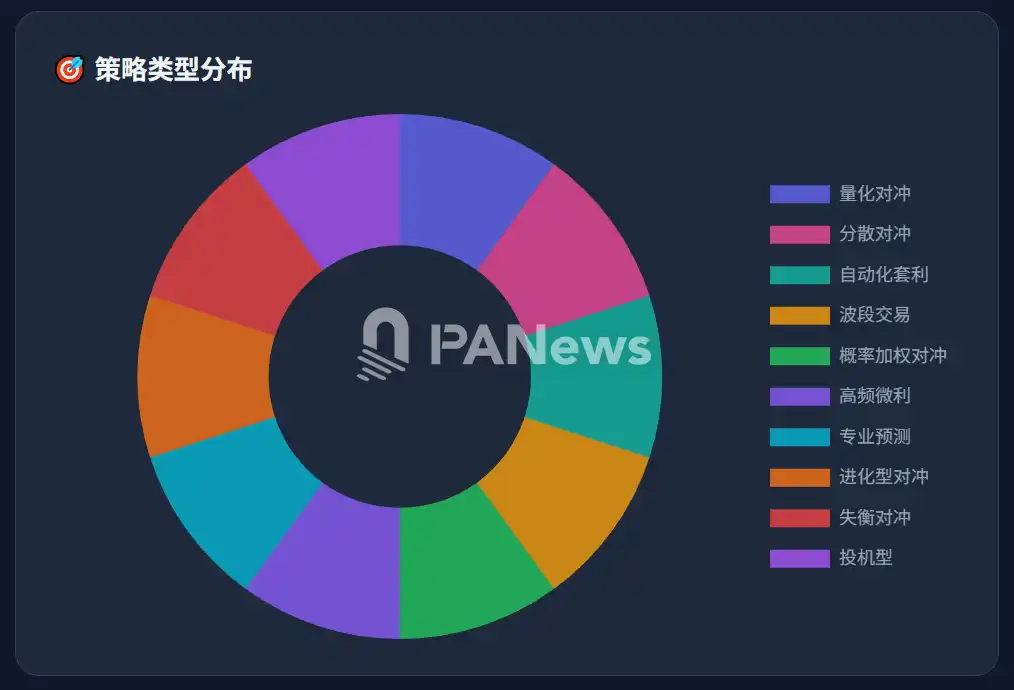
After the analysis, PANews found that although many of these "smart money" players executed hedging arbitrage strategies, this hedging is significantly different from the simple hedging interpreted on social media. The actual strategy is more complex, far from a simple "yes" or "no" combination, but rather utilizes rules like "spread" and "win/lose" in sports events to complete combination hedging. Another important finding is that behind the significantly high win rate based on historical positions, these whales have a large number of "zombie orders" still open but embellished to show results, with the actual win rate being far lower than the historical win rate.

Next, PANews will reveal the real operations of these "smart money" players through actual cases.
1. SeriouslySirius: A 73% Win Rate Embellished by "Zombie Orders," and a Complex Quantitative Hedging Network
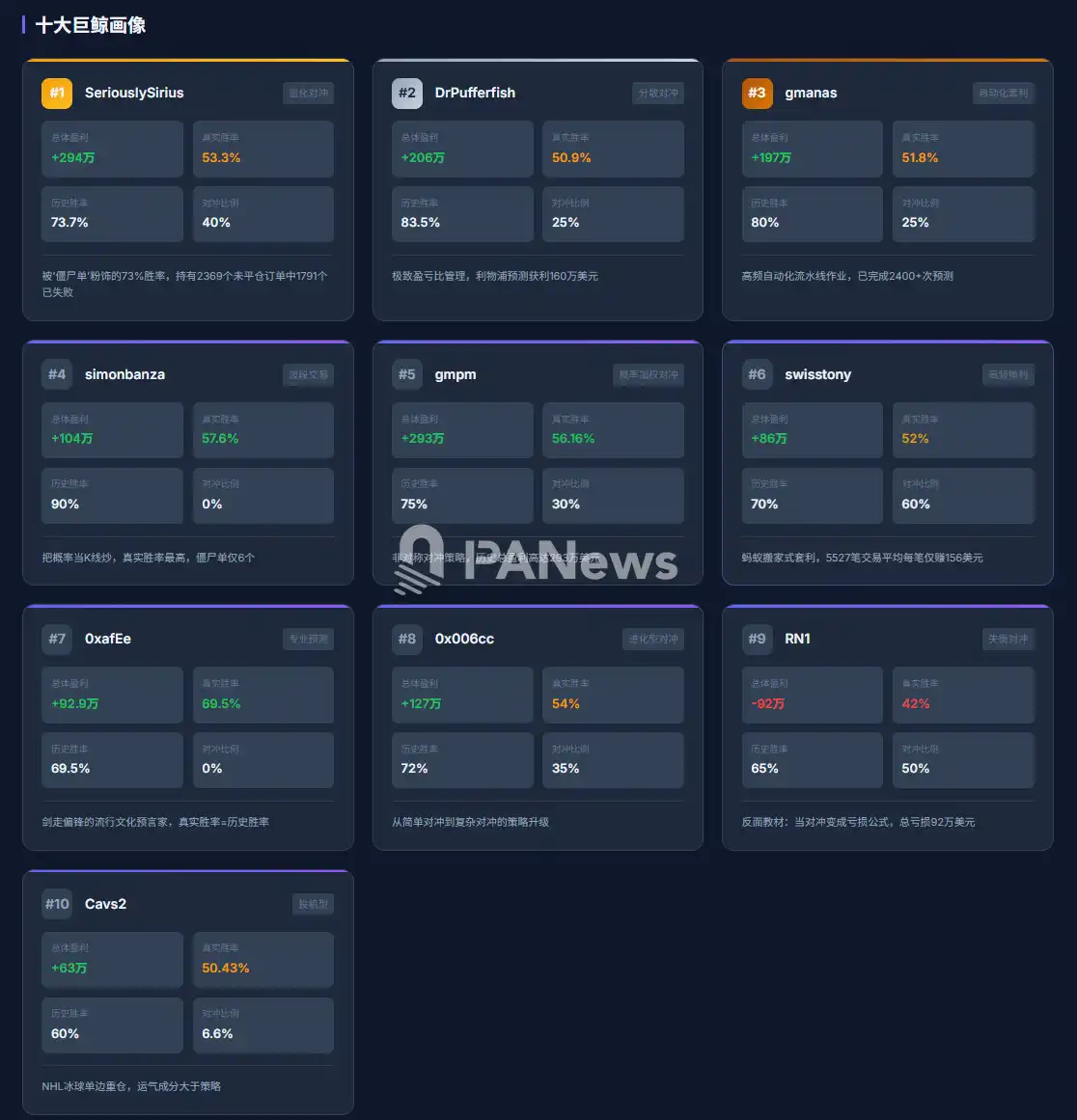
SeriouslySirius is the top-ranked address in December, with a profit of about $3.29 million in December and a total historical profit of $2.94 million. If only looking at his completed order records, his win rate is as high as 73.7%. However, the actual situation is that this address still has 2,369 open orders, with 4,690 orders settled. Among these, 1,791 of the open orders are actually complete failures, but the user has not closed them one by one. On the one hand, this can save a lot of effort and fees. On the other hand, since the orders he usually closes are profitable orders, the settled order data will show an extremely high win rate. However, if these uncleared "zombie orders" are considered, the actual win rate of this address drops to 53.3%, only slightly higher than randomly flipping a coin.
In his actual trades, about 40% of the orders are hedging orders betting on multiple directions for the same event. However, this hedging is not a simple "YES" + "NO." For example, in the NBA game between the 76ers and the Mavericks, he simultaneously bought Under (small spread), Over (large spread), 76ers (home team), Mavericks (away team), and 11 other directions, ultimately profiting $1,611. In this process, he did use an arbitrage strategy of insufficient probability, such as buying the 76ers' win probability at 56.8% and the Mavericks' at 39.37%, with a total cost of about 0.962, achieving a guaranteed profit state. In the end, in this game, he made $17,000 in profit.
However, this strategy is not always profitable. In a game between the Celtics and the Kings, for example, a total of 9 directions were involved, resulting in a loss of $2,900.
Furthermore, there was a significant imbalance in the allocation of funds for many orders. For instance, even though orders were placed in both directions, the difference in the amount of funds invested was more than 10x. This outcome was likely due to insufficient market liquidity, highlighting a key challenge in arbitrage strategies. While the opportunity may arise, executing balanced positions on both sides may not always be feasible.
Moreover, due to the automated execution, the buy and sell actions in such scenarios often lead to significant losses.
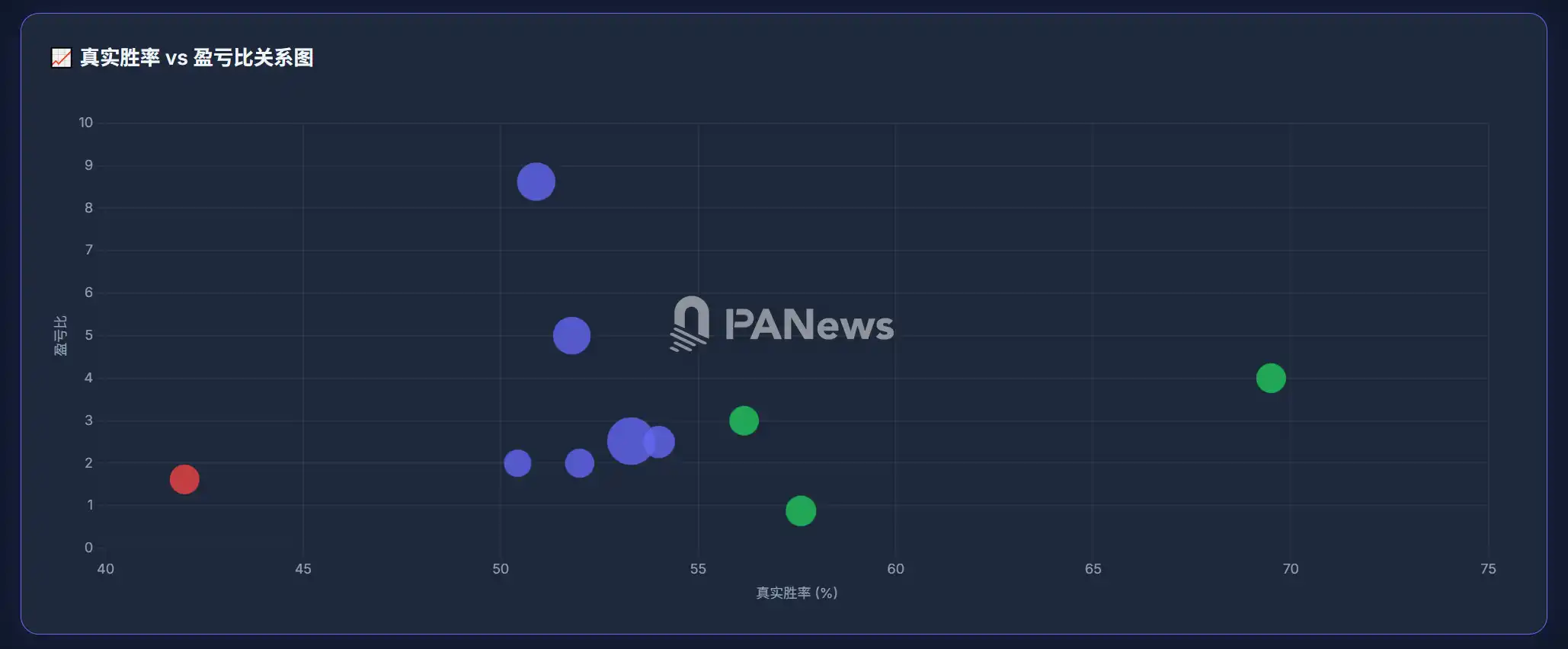
Nevertheless, the main reason SeriouslySirius was able to achieve substantial profits through this strategy was his sound position management, with a profit-to-loss ratio of about 2.52. This factor allowed him to realize profits despite a relatively low actual win rate.
Additionally, this strategy was not always profitable. Prior to December, the P&L of this address was not optimistic, remaining below the breakeven line for an extended period, with the maximum loss even reaching $1.8 million. The current maturity of the strategy raises questions about its ability to maintain such profit expectations in the long run.
2. DrPufferfish: Transforming Low Probability into High Probability, the Ultimate "Risk-Reward Ratio" Management Art
DrPufferfish was the second most profitable address in December, with a monthly profit of around $2.06 million. His historical win rate is even more impressive, reaching 83.5%. However, considering a large number of "zombie orders" in his portfolio, his win rate has returned to 50.9%. Yet, DrPufferfish's trading strategy differs significantly from SeriouslySirius's. While nearly 25% of his orders are hedging orders, this hedging is not in the opposite direction but rather through diversified bets. For instance, regarding the final championship of the MLB, he simultaneously bought into 27 low-probability teams, whose combined probability exceeded 54%. Through this strategy, he transformed a series of low-probability events into a high-probability event.
Furthermore, his ability to achieve substantial gains lies in his control of the risk-reward ratio. Taking Liverpool as an example (his favorite EPL team), he predicted the outcomes of this team 123 times, resulting in approximately $1.6 million in profits. Among the profitable predictions, the average gain was around $37,200, while the average loss from failed predictions was about $11,000. Additionally, he usually sells most of these losing orders early to manage position losses.
This operational approach also allowed his overall profit-loss ratio to reach 8.62, with a high profit expectation. However, overall, his strategy was not a simple arbitrage hedge, but rather a massive profit achieved through professional prediction analysis and strict position management. Another point is that most of his hedge trades were in a loss-making state, with the total P&L of these orders amounting to -$2.09 million. Therefore, it seems that the majority of this whale's hedge trades were used as a form of insurance.
3. gmanas: High-Frequency Automated Assembly Line Operation
The third-ranked address gmanas had a similar style to DrPufferfish and achieved an overall profit of $1.97 million in December. Their actual win rate of 51.8% was close to DrPufferfish's. However, their trading frequency was higher, with over 2400 predictions completed so far, indicating that their strategy is the result of automated program execution. Regarding their betting style, it is similar to the previous address, but we won't go into detail here.
4. Hunter simonbanza: Riding Prediction Probabilities like Candlestick Waves
The fourth-ranked address simonbanza is a professional prediction hunter. Unlike the previous addresses, his strategy contains no hedge orders, and he has achieved a profit of around $1.04 million, with a "zombie order" position loss of only $130,000. Compared to the previous addresses, although his fund size and trading volume are not high, his actual win rate is the highest at around 57.6%. Additionally, in settled orders, his average profit is around $32,000, and the average loss is $36,500. While the profit-loss ratio data is not high, with the high win rate, he ultimately achieved good returns.
Furthermore, this address has very few "zombie orders," only 6. This is because he usually does not wait for the event to end before settling but seizes the opportunity of probability fluctuations to profit. In simple terms, he takes profits when available and does not linger on the final outcome.
This is also a unique prediction market investment strategy. In his logic, these probability changes are more like the ups and downs of financial investment. Of course, we do not know the specific logic behind his high win rate; it is his exclusive survival secret.
5. Whale gmpm: Asymmetric Hedge Strategy, Using "Large Positions" to Seek Certainty
The fifth-ranked address, gmpm, while only fifth in December's profit-loss ranking, has a total historical profit higher than the previous addresses, reaching $2.93 million. Additionally, their actual win rate of about 56.16% is also at a high level. Their operational approach is similar to the fourth-ranked address, but the core strategy has its exclusive secret.
For example, you will see this address often placing both-sided bets on the same event. However, their strategy seems not to aim for arbitrage opportunities between these two directions but rather to allocate a higher amount of funds to the side with a greater probability and a smaller amount to the side with a lower probability. This way, they can have a larger position when a high-probability outcome wins, yet the potential loss isn't too high when a low-probability event occurs, achieving a hedging effect.
From a practical standpoint, this is a more advanced hedging strategy that does not solely rely on the mathematical arbitrage condition of "yes" + "no" < 1 but combines comprehensive event analysis with hedge loss mitigation.
6. Model Worker swisstony: "Ant Moving" High-Frequency Arbitrage
The sixth address, swisstony, is a super high-frequency arbitrage address and has the highest trading frequency among these addresses, with a total of 5527 transactions. Despite accumulating over $860,000 in profit, the average profit per transaction is only $156. Strategically, this address falls into the "Ant Moving" style. Similar to other arbitrage addresses, this address commonly buys all outcomes of a single event. For instance, in a Jazz vs. Clippers game, this address bought a total of 23 outcome directions. Due to the small investment amount, the fund allocation is relatively balanced, enabling a certain level of hedging effect.
However, this strategy seems to heavily rely on the details of the purchases, such as the requirement that "yes" + "no" must be less than 1. For some reason, the hedging orders made by swisstony often result in a total amount exceeding 1, leading to inevitable losses for these orders. Nevertheless, with reasonable risk-reward ratios and win rate data, the profitability situation remains positive.
7. Maverick 0xafEe: Unconventional "Pop Culture Prophet"
The seventh address, 0xafEe, is a truly low-frequency, high-winning-rate player. Their trading frequency is remarkably low, with an average of only 0.4 transactions per day, achieving a real win rate of 69.5%.
Through their completed orders, they have earned around $929,000 in profit with very few "zombie orders" and approximately $8,800 in unrealized losses. Moreover, they never engage in hedge orders but rather focus on predictions. Their predictions mainly revolve around Google search trends and pop culture-related content, such as "Will Pope Leo XIV become the most Googled person this year?" or "Will Gemini 3.0 be released before October 31?" In these prediction categories, they seem to have a unique analytical approach, resulting in an exceptionally high win rate. Among the top-ranking whales, they stand out as a "Maverick," being the only address outside of sports.
8. Manual Hedge Player 0x006cc: Strategy Upgrade from Simple Hedge to Complex Hedge
The eighth-ranked address 0x006cc is similar to several of the above-mentioned complex hedge addresses, with an overall net profit of approximately $1.27 million and a true win rate of around 54%. However, compared to other addresses executing automated programs, their trading frequency is very low, with an average of only 0.7 trades per day. Based on their early operations, this address may have initially adopted a "simple hedge strategy" through manual trading.
However, after entering December, this simple hedge strategy has also been upgraded to a complex hedge strategy. From their trading history, it can be observed that as the hedge strategy becomes more widely understood in this market, it is gradually evolving.
9. Case Study in What Not to Do RN1: When "Hedging" Turns into a "Loss Formula"
The ninth-ranked address RN1 is one of the top ten profitable addresses in December but currently represents an overall loss. Their realized profit is about $1.76 million, but their unrealized losses amount to $2.68 million, resulting in a total loss of $0.92 million. As a negative example, there are many aspects to consider in RN1's case.
Firstly, their true win rate is only 42%, which is the lowest among these addresses, with a profit-loss ratio of only 1.62. Considering these two data points together, their profit expectation is negative, indicating that this strategy is not profitable overall.
A closer look at their details reveals that this address is also clearly engaged in an arbitrage strategy. However, in many of their hedge trades, although the condition of "yes" + "no" <1 is met, they tend to allocate more to the side with the lower probability and less to the side with the higher probability. This imbalance in actual positions leads to real losses when events with higher probabilities occur.
10. Gambler Cavs2: Heavy Position on One Side in Ice Hockey Matches, Where Luck Outweighs Strategy
The tenth-ranked address Cavs2 is also a predictive gambler who enjoys taking a heavy position on one side, specializing in NHL ice hockey matches. However, from the overall data perspective, their total actual profit is approximately $0.63 million, with a true win rate of about 50.43% and a lower risk hedge ratio of 6.6%. The data is relatively average, with luck playing a significant role. They have successfully predicted the outcomes of several high-return individual matches, but the actual strategic value is not high.
5 Harsh Truths Behind the "Smart Money" Hype
After a deep dive into the transactions of this "smart money," PANews has summarized the reality behind the predictive market "wealth narrative."
1. The "Arbitrage Hedge Strategy" is far from simply achieving a probability condition. In a fiercely competitive market with liquidity constraints, it is highly likely to become a self-defeating loss formula. Blindly following and imitating is not advisable.
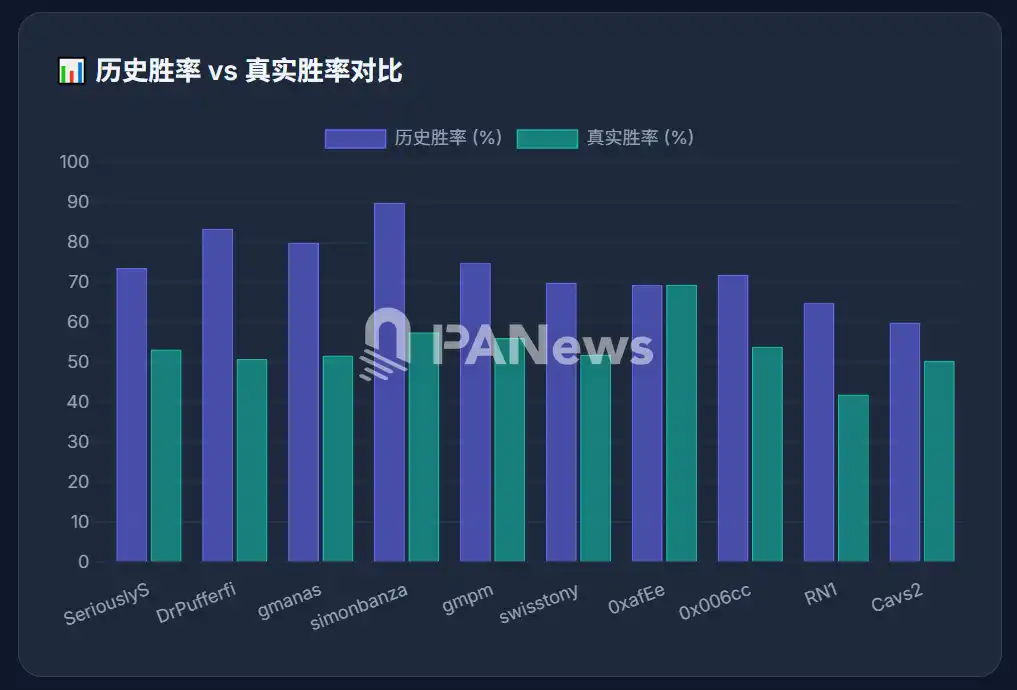
2. "Copy Trading" seems equally unsustainable in the predictive market. The main reasons include several points. First, the ranking or win rate seen is based on historical settled profit data, resulting in "distorted" data. Behind such data, a large amount of "smart money" is not as "smart" as it seems, with a real win rate of over 70% being extremely rare; most win rates are similar to flipping a coin. In addition, the trading depth in the predictive market is currently relatively poor, and the same arbitrage opportunities may only accommodate very small amounts of capital, leading to copy traders likely being squeezed out in this process.
3. Managing the risk-reward ratio and position size is more important than pursuing win rate. Among the addresses of several outstanding-performing strategies, they share a common characteristic of being very good at managing the risk-reward ratio. Even addresses like gmpm and DrPufferfish will exit positions promptly based on changes in probability trends to minimize losses and enhance the risk-reward ratio.
4. The real secret lies beyond the "mathematical formula." Currently, there are many interpretations of "arbitrage formulas" on social media. At first glance, these strategies seem very reasonable, but in actual operation, the true ability of this smart money seems to lie beyond these "mathematical formulas." Either they have a very strong judgment ability for certain events or they have a unique analysis model for popular culture. These invisible decision-making algorithms are the key to their success. For users without such "decision-making algorithms," the predictive market is also a ruthless "dark forest."
5. The profit scale of the predictive market is still quite small. Looking at the earnings of these top smart money players in December, the address with the highest total earnings has only around $3 million in current earnings. Compared to the crypto derivatives market, the profit potential of this market seems to have a clear limit. For those who entered with dreams of overnight riches, the scale of this market is clearly not large enough. In a market that is both unique in its professionalism and small in scale, it is probably not very attractive to institutions at the moment. I wonder if this is also a significant reason limiting the growth of the predictive market.

In the Polymarket, a seemingly gold-filled predictive market, most of the so-called "whale" players are merely surviving gamblers or hardworking day laborers. The true wealth code is not hidden in those overly optimistic win rate rankings but in the algorithms bet with real money by a few top players after eliminating noise.
You may also like

Token Cannot Compound, Where Is the Real Investment Opportunity?

February 6th Market Key Intelligence, How Much Did You Miss?

China's Central Bank and Eight Other Departments' Latest Regulatory Focus: Key Attention to RWA Tokenized Asset Risk
Foreword: Today, the People's Bank of China's website published the "Notice of the People's Bank of China, National Development and Reform Commission, Ministry of Industry and Information Technology, Ministry of Public Security, State Administration for Market Regulation, China Banking and Insurance Regulatory Commission, China Securities Regulatory Commission, State Administration of Foreign Exchange on Further Preventing and Dealing with Risks Related to Virtual Currency and Others (Yinfa [2026] No. 42)", the latest regulatory requirements from the eight departments including the central bank, which are basically consistent with the regulatory requirements of recent years. The main focus of the regulation is on speculative activities such as virtual currency trading, exchanges, ICOs, overseas platform services, and this time, regulatory oversight of RWA has been added, explicitly prohibiting RWA tokenization, stablecoins (especially those pegged to the RMB). The following is the full text:
To the people's governments of all provinces, autonomous regions, and municipalities directly under the Central Government, the Xinjiang Production and Construction Corps:
Recently, there have been speculative activities related to virtual currency and Real-World Assets (RWA) tokenization, disrupting the economic and financial order and jeopardizing the property security of the people. In order to further prevent and address the risks related to virtual currency and Real-World Assets tokenization, effectively safeguard national security and social stability, in accordance with the "Law of the People's Republic of China on the People's Bank of China," "Law of the People's Republic of China on Commercial Banks," "Securities Law of the People's Republic of China," "Law of the People's Republic of China on Securities Investment Funds," "Law of the People's Republic of China on Futures and Derivatives," "Cybersecurity Law of the People's Republic of China," "Regulations of the People's Republic of China on the Administration of Renminbi," "Regulations on Prevention and Disposal of Illegal Fundraising," "Regulations of the People's Republic of China on Foreign Exchange Administration," "Telecommunications Regulations of the People's Republic of China," and other provisions, after reaching consensus with the Cyberspace Administration of China, the Supreme People's Court, and the Supreme People's Procuratorate, and with the approval of the State Council, the relevant matters are notified as follows:
(I) Virtual currency does not possess the legal status equivalent to fiat currency. Virtual currencies such as Bitcoin, Ether, Tether, etc., have the main characteristics of being issued by non-monetary authorities, using encryption technology and distributed ledger or similar technology, existing in digital form, etc. They do not have legal tender status, should not and cannot be circulated and used as currency in the market.
The business activities related to virtual currency are classified as illegal financial activities. The exchange of fiat currency and virtual currency within the territory, exchange of virtual currencies, acting as a central counterparty in buying and selling virtual currencies, providing information intermediary and pricing services for virtual currency transactions, token issuance financing, and trading of virtual currency-related financial products, etc., fall under illegal financial activities, such as suspected illegal issuance of token vouchers, unauthorized public issuance of securities, illegal operation of securities and futures business, illegal fundraising, etc., are strictly prohibited across the board and resolutely banned in accordance with the law. Overseas entities and individuals are not allowed to provide virtual currency-related services to domestic entities in any form.
A stablecoin pegged to a fiat currency indirectly fulfills some functions of the fiat currency in circulation. Without the consent of relevant authorities in accordance with the law and regulations, any domestic or foreign entity or individual is not allowed to issue a RMB-pegged stablecoin overseas.
(II)Tokenization of Real-World Assets refers to the use of encryption technology and distributed ledger or similar technologies to transform ownership rights, income rights, etc., of assets into tokens (tokens) or other interests or bond certificates with token (token) characteristics, and carry out issuance and trading activities.
Engaging in the tokenization of real-world assets domestically, as well as providing related intermediary, information technology services, etc., which are suspected of illegal issuance of token vouchers, unauthorized public offering of securities, illegal operation of securities and futures business, illegal fundraising, and other illegal financial activities, shall be prohibited; except for relevant business activities carried out with the approval of the competent authorities in accordance with the law and regulations and relying on specific financial infrastructures. Overseas entities and individuals are not allowed to illegally provide services related to the tokenization of real-world assets to domestic entities in any form.
(III) Inter-agency Coordination. The People's Bank of China, together with the National Development and Reform Commission, the Ministry of Industry and Information Technology, the Ministry of Public Security, the State Administration for Market Regulation, the China Banking and Insurance Regulatory Commission, the China Securities Regulatory Commission, the State Administration of Foreign Exchange, and other departments, will improve the work mechanism, strengthen coordination with the Cyberspace Administration of China, the Supreme People's Court, and the Supreme People's Procuratorate, coordinate efforts, and overall guide regions to carry out risk prevention and disposal of virtual currency-related illegal financial activities.
The China Securities Regulatory Commission, together with the National Development and Reform Commission, the Ministry of Industry and Information Technology, the Ministry of Public Security, the People's Bank of China, the State Administration for Market Regulation, the China Banking and Insurance Regulatory Commission, the State Administration of Foreign Exchange, and other departments, will improve the work mechanism, strengthen coordination with the Cyberspace Administration of China, the Supreme People's Court, and the Supreme People's Procuratorate, coordinate efforts, and overall guide regions to carry out risk prevention and disposal of illegal financial activities related to the tokenization of real-world assets.
(IV) Strengthening Local Implementation. The people's governments at the provincial level are overall responsible for the prevention and disposal of risks related to virtual currencies and the tokenization of real-world assets in their respective administrative regions. The specific leading department is the local financial regulatory department, with participation from branches and dispatched institutions of the State Council's financial regulatory department, telecommunications regulators, public security, market supervision, and other departments, in coordination with cyberspace departments, courts, and procuratorates, to improve the normalization of the work mechanism, effectively connect with the relevant work mechanisms of central departments, form a cooperative and coordinated working pattern between central and local governments, effectively prevent and properly handle risks related to virtual currencies and the tokenization of real-world assets, and maintain economic and financial order and social stability.
(5) Enhanced Risk Monitoring. The People's Bank of China, China Securities Regulatory Commission, National Development and Reform Commission, Ministry of Industry and Information Technology, Ministry of Public Security, State Administration of Foreign Exchange, Cyberspace Administration of China, and other departments continue to improve monitoring techniques and system support, enhance cross-departmental data analysis and sharing, establish sound information sharing and cross-validation mechanisms, promptly grasp the risk situation of activities related to virtual currency and real-world asset tokenization. Local governments at all levels give full play to the role of local monitoring and early warning mechanisms. Local financial regulatory authorities, together with branches and agencies of the State Council's financial regulatory authorities, as well as departments of cyberspace and public security, ensure effective connection between online monitoring, offline investigation, and fund tracking, efficiently and accurately identify activities related to virtual currency and real-world asset tokenization, promptly share risk information, improve early warning information dissemination, verification, and rapid response mechanisms.
(6) Strengthened Oversight of Financial Institutions, Intermediaries, and Technology Service Providers. Financial institutions (including non-bank payment institutions) are prohibited from providing account opening, fund transfer, and clearing services for virtual currency-related business activities, issuing and selling financial products related to virtual currency, including virtual currency and related financial products in the scope of collateral, conducting insurance business related to virtual currency, or including virtual currency in the scope of insurance liability. Financial institutions (including non-bank payment institutions) are prohibited from providing custody, clearing, and settlement services for unauthorized real-world asset tokenization-related business and related financial products. Relevant intermediary institutions and information technology service providers are prohibited from providing intermediary, technical, or other services for unauthorized real-world asset tokenization-related businesses and related financial products.
(7) Enhanced Management of Internet Information Content and Access. Internet enterprises are prohibited from providing online business venues, commercial displays, marketing, advertising, or paid traffic diversion services for virtual currency and real-world asset tokenization-related business activities. Upon discovering clues of illegal activities, they should promptly report to relevant departments and provide technical support and assistance for related investigations and inquiries. Based on the clues transferred by the financial regulatory authorities, the cyberspace administration, telecommunications authorities, and public security departments should promptly close and deal with websites, mobile applications (including mini-programs), and public accounts engaged in virtual currency and real-world asset tokenization-related business activities in accordance with the law.
(8) Strengthened Entity Registration and Advertisement Management. Market supervision departments strengthen entity registration and management, and enterprise and individual business registrations must not contain terms such as "virtual currency," "virtual asset," "cryptocurrency," "crypto asset," "stablecoin," "real-world asset tokenization," or "RWA" in their names or business scopes. Market supervision departments, together with financial regulatory authorities, legally enhance the supervision of advertisements related to virtual currency and real-world asset tokenization, promptly investigating and handling relevant illegal advertisements.
(IX) Continued Rectification of Virtual Currency Mining Activities. The National Development and Reform Commission, together with relevant departments, strictly controls virtual currency mining activities, continuously promotes the rectification of virtual currency mining activities. The people's governments of various provinces take overall responsibility for the rectification of "mining" within their respective administrative regions. In accordance with the requirements of the National Development and Reform Commission and other departments in the "Notice on the Rectification of Virtual Currency Mining Activities" (NDRC Energy-saving Building [2021] No. 1283) and the provisions of the "Guidance Catalog for Industrial Structure Adjustment (2024 Edition)," a comprehensive review, investigation, and closure of existing virtual currency mining projects are conducted, new mining projects are strictly prohibited, and mining machine production enterprises are strictly prohibited from providing mining machine sales and other services within the country.
(X) Severe Crackdown on Related Illegal Financial Activities. Upon discovering clues to illegal financial activities related to virtual currency and the tokenization of real-world assets, local financial regulatory authorities, branches of the State Council's financial regulatory authorities, and other relevant departments promptly investigate, determine, and properly handle the issues in accordance with the law, and seriously hold the relevant entities and individuals legally responsible. Those suspected of crimes are transferred to the judicial authorities for processing according to the law.
(XI) Severe Crackdown on Related Illegal and Criminal Activities. The Ministry of Public Security, the People's Bank of China, the State Administration for Market Regulation, the China Banking and Insurance Regulatory Commission, the China Securities Regulatory Commission, as well as judicial and procuratorial organs, in accordance with their respective responsibilities, rigorously crack down on illegal and criminal activities related to virtual currency, the tokenization of real-world assets, such as fraud, money laundering, illegal business operations, pyramid schemes, illegal fundraising, and other illegal and criminal activities carried out under the guise of virtual currency, the tokenization of real-world assets, etc.
(XII) Strengthen Industry Self-discipline. Relevant industry associations should enhance membership management and policy advocacy, based on their own responsibilities, advocate and urge member units to resist illegal financial activities related to virtual currency and the tokenization of real-world assets. Member units that violate regulatory policies and industry self-discipline rules are to be disciplined in accordance with relevant self-regulatory management regulations. By leveraging various industry infrastructure, conduct risk monitoring related to virtual currency, the tokenization of real-world assets, and promptly transfer issue clues to relevant departments.
(XIII) Without the approval of relevant departments in accordance with the law and regulations, domestic entities and foreign entities controlled by them may not issue virtual currency overseas.
(XIV) Domestic entities engaging directly or indirectly in overseas external debt-based tokenization of real-world assets, or conducting asset securitization activities abroad based on domestic ownership rights, income rights, etc. (hereinafter referred to as domestic equity), should be strictly regulated in accordance with the principles of "same business, same risk, same rules." The National Development and Reform Commission, the China Securities Regulatory Commission, the State Administration of Foreign Exchange, and other relevant departments regulate it according to their respective responsibilities. For other forms of overseas real-world asset tokenization activities based on domestic equity by domestic entities, the China Securities Regulatory Commission, together with relevant departments, supervise according to their division of responsibilities. Without the consent and filing of relevant departments, no unit or individual may engage in the above-mentioned business.
(15) Overseas subsidiaries and branches of domestic financial institutions providing Real World Asset Tokenization-related services overseas shall do so legally and prudently. They shall have professional personnel and systems in place to effectively mitigate business risks, strictly implement customer onboarding, suitability management, anti-money laundering requirements, and incorporate them into the domestic financial institutions' compliance and risk management system. Intermediaries and information technology service providers offering Real World Asset Tokenization services abroad based on domestic equity or conducting Real World Asset Tokenization business in the form of overseas debt for domestic entities directly or indirectly venturing abroad must strictly comply with relevant laws and regulations. They should establish and improve relevant compliance and internal control systems in accordance with relevant normative requirements, strengthen business and risk control, and report the business developments to the relevant regulatory authorities for approval or filing.
(16) Strengthen organizational leadership and overall coordination. All departments and regions should attach great importance to the prevention of risks related to virtual currencies and Real World Asset Tokenization, strengthen organizational leadership, clarify work responsibilities, form a long-term effective working mechanism with centralized coordination, local implementation, and shared responsibilities, maintain high pressure, dynamically monitor risks, effectively prevent and mitigate risks in an orderly and efficient manner, legally protect the property security of the people, and make every effort to maintain economic and financial order and social stability.
(17) Widely carry out publicity and education. All departments, regions, and industry associations should make full use of various media and other communication channels to disseminate information through legal and policy interpretation, analysis of typical cases, and education on investment risks, etc. They should promote the illegality and harm of virtual currencies and Real World Asset Tokenization-related businesses and their manifestations, fully alert to potential risks and hidden dangers, and enhance public awareness and identification capabilities for risk prevention.
(18) Engaging in illegal financial activities related to virtual currencies and Real World Asset Tokenization in violation of this notice, as well as providing services for virtual currencies and Real World Asset Tokenization-related businesses, shall be punished in accordance with relevant regulations. If it constitutes a crime, criminal liability shall be pursued according to the law. For domestic entities and individuals who knowingly or should have known that overseas entities illegally provided virtual currency or Real World Asset Tokenization-related services to domestic entities and still assisted them, relevant responsibilities shall be pursued according to the law. If it constitutes a crime, criminal liability shall be pursued according to the law.
(19) If any unit or individual invests in virtual currencies, Real World Asset Tokens, and related financial products against public order and good customs, the relevant civil legal actions shall be invalid, and any resulting losses shall be borne by them. If there are suspicions of disrupting financial order and jeopardizing financial security, the relevant departments shall deal with them according to the law.
This notice shall enter into force upon the date of its issuance. The People's Bank of China and ten other departments' "Notice on Further Preventing and Dealing with the Risks of Virtual Currency Trading Speculation" (Yinfa [2021] No. 237) is hereby repealed.

Former Partner's Perspective on Multicoin: Kyle's Exit, But the Game He Left Behind Just Getting Started
Why Bitcoin Is Falling Now: The Real Reasons Behind BTC's Crash & WEEX's Smart Profit Playbook
Bitcoin's ongoing crash explained: Discover the 5 hidden triggers behind BTC's plunge & how WEEX's Auto Earn and Trade to Earn strategies help traders profit from crypto market volatility.

Wall Street's Hottest Trades See Exodus

Vitalik Discusses Ethereum Scaling Path, Circle Announces Partnership with Polymarket, What's the Overseas Crypto Community Talking About Today?

Believing in the Capital Markets - The Essence and Core Value of Cryptocurrency

Polymarket's 'Weatherman': Predict Temperature, Win Million-Dollar Payout
$15K+ Profits: The 4 AI Trading Secrets WEEX Hackathon Prelim Winners Used to Dominate Volatile Crypto Markets
How WEEX Hackathon's top AI trading strategies made $15K+ in crypto markets: 4 proven rules for ETH/BTC trading, market structure analysis, and risk management in volatile conditions.

A nearly 20% one-day plunge, how long has it been since you last saw a $60,000 Bitcoin?

Raoul Pal: I've seen every single panic, and they are never the end.

Key Market Information Discrepancy on February 6th - A Must-Read! | Alpha Morning Report

2026 Crypto Industry's First Snowfall

The Harsh Reality Behind the $26 Billion Crypto Liquidation: Liquidity Is Killing the Market

Why Is Gold, US Stocks, Bitcoin All Falling?

Key Market Intelligence for February 5th, how much did you miss out on?

Wintermute: By 2026, crypto had gradually become the settlement layer of the Internet economy
Token Cannot Compound, Where Is the Real Investment Opportunity?
February 6th Market Key Intelligence, How Much Did You Miss?
China's Central Bank and Eight Other Departments' Latest Regulatory Focus: Key Attention to RWA Tokenized Asset Risk
Foreword: Today, the People's Bank of China's website published the "Notice of the People's Bank of China, National Development and Reform Commission, Ministry of Industry and Information Technology, Ministry of Public Security, State Administration for Market Regulation, China Banking and Insurance Regulatory Commission, China Securities Regulatory Commission, State Administration of Foreign Exchange on Further Preventing and Dealing with Risks Related to Virtual Currency and Others (Yinfa [2026] No. 42)", the latest regulatory requirements from the eight departments including the central bank, which are basically consistent with the regulatory requirements of recent years. The main focus of the regulation is on speculative activities such as virtual currency trading, exchanges, ICOs, overseas platform services, and this time, regulatory oversight of RWA has been added, explicitly prohibiting RWA tokenization, stablecoins (especially those pegged to the RMB). The following is the full text:
To the people's governments of all provinces, autonomous regions, and municipalities directly under the Central Government, the Xinjiang Production and Construction Corps:
Recently, there have been speculative activities related to virtual currency and Real-World Assets (RWA) tokenization, disrupting the economic and financial order and jeopardizing the property security of the people. In order to further prevent and address the risks related to virtual currency and Real-World Assets tokenization, effectively safeguard national security and social stability, in accordance with the "Law of the People's Republic of China on the People's Bank of China," "Law of the People's Republic of China on Commercial Banks," "Securities Law of the People's Republic of China," "Law of the People's Republic of China on Securities Investment Funds," "Law of the People's Republic of China on Futures and Derivatives," "Cybersecurity Law of the People's Republic of China," "Regulations of the People's Republic of China on the Administration of Renminbi," "Regulations on Prevention and Disposal of Illegal Fundraising," "Regulations of the People's Republic of China on Foreign Exchange Administration," "Telecommunications Regulations of the People's Republic of China," and other provisions, after reaching consensus with the Cyberspace Administration of China, the Supreme People's Court, and the Supreme People's Procuratorate, and with the approval of the State Council, the relevant matters are notified as follows:
(I) Virtual currency does not possess the legal status equivalent to fiat currency. Virtual currencies such as Bitcoin, Ether, Tether, etc., have the main characteristics of being issued by non-monetary authorities, using encryption technology and distributed ledger or similar technology, existing in digital form, etc. They do not have legal tender status, should not and cannot be circulated and used as currency in the market.
The business activities related to virtual currency are classified as illegal financial activities. The exchange of fiat currency and virtual currency within the territory, exchange of virtual currencies, acting as a central counterparty in buying and selling virtual currencies, providing information intermediary and pricing services for virtual currency transactions, token issuance financing, and trading of virtual currency-related financial products, etc., fall under illegal financial activities, such as suspected illegal issuance of token vouchers, unauthorized public issuance of securities, illegal operation of securities and futures business, illegal fundraising, etc., are strictly prohibited across the board and resolutely banned in accordance with the law. Overseas entities and individuals are not allowed to provide virtual currency-related services to domestic entities in any form.
A stablecoin pegged to a fiat currency indirectly fulfills some functions of the fiat currency in circulation. Without the consent of relevant authorities in accordance with the law and regulations, any domestic or foreign entity or individual is not allowed to issue a RMB-pegged stablecoin overseas.
(II)Tokenization of Real-World Assets refers to the use of encryption technology and distributed ledger or similar technologies to transform ownership rights, income rights, etc., of assets into tokens (tokens) or other interests or bond certificates with token (token) characteristics, and carry out issuance and trading activities.
Engaging in the tokenization of real-world assets domestically, as well as providing related intermediary, information technology services, etc., which are suspected of illegal issuance of token vouchers, unauthorized public offering of securities, illegal operation of securities and futures business, illegal fundraising, and other illegal financial activities, shall be prohibited; except for relevant business activities carried out with the approval of the competent authorities in accordance with the law and regulations and relying on specific financial infrastructures. Overseas entities and individuals are not allowed to illegally provide services related to the tokenization of real-world assets to domestic entities in any form.
(III) Inter-agency Coordination. The People's Bank of China, together with the National Development and Reform Commission, the Ministry of Industry and Information Technology, the Ministry of Public Security, the State Administration for Market Regulation, the China Banking and Insurance Regulatory Commission, the China Securities Regulatory Commission, the State Administration of Foreign Exchange, and other departments, will improve the work mechanism, strengthen coordination with the Cyberspace Administration of China, the Supreme People's Court, and the Supreme People's Procuratorate, coordinate efforts, and overall guide regions to carry out risk prevention and disposal of virtual currency-related illegal financial activities.
The China Securities Regulatory Commission, together with the National Development and Reform Commission, the Ministry of Industry and Information Technology, the Ministry of Public Security, the People's Bank of China, the State Administration for Market Regulation, the China Banking and Insurance Regulatory Commission, the State Administration of Foreign Exchange, and other departments, will improve the work mechanism, strengthen coordination with the Cyberspace Administration of China, the Supreme People's Court, and the Supreme People's Procuratorate, coordinate efforts, and overall guide regions to carry out risk prevention and disposal of illegal financial activities related to the tokenization of real-world assets.
(IV) Strengthening Local Implementation. The people's governments at the provincial level are overall responsible for the prevention and disposal of risks related to virtual currencies and the tokenization of real-world assets in their respective administrative regions. The specific leading department is the local financial regulatory department, with participation from branches and dispatched institutions of the State Council's financial regulatory department, telecommunications regulators, public security, market supervision, and other departments, in coordination with cyberspace departments, courts, and procuratorates, to improve the normalization of the work mechanism, effectively connect with the relevant work mechanisms of central departments, form a cooperative and coordinated working pattern between central and local governments, effectively prevent and properly handle risks related to virtual currencies and the tokenization of real-world assets, and maintain economic and financial order and social stability.
(5) Enhanced Risk Monitoring. The People's Bank of China, China Securities Regulatory Commission, National Development and Reform Commission, Ministry of Industry and Information Technology, Ministry of Public Security, State Administration of Foreign Exchange, Cyberspace Administration of China, and other departments continue to improve monitoring techniques and system support, enhance cross-departmental data analysis and sharing, establish sound information sharing and cross-validation mechanisms, promptly grasp the risk situation of activities related to virtual currency and real-world asset tokenization. Local governments at all levels give full play to the role of local monitoring and early warning mechanisms. Local financial regulatory authorities, together with branches and agencies of the State Council's financial regulatory authorities, as well as departments of cyberspace and public security, ensure effective connection between online monitoring, offline investigation, and fund tracking, efficiently and accurately identify activities related to virtual currency and real-world asset tokenization, promptly share risk information, improve early warning information dissemination, verification, and rapid response mechanisms.
(6) Strengthened Oversight of Financial Institutions, Intermediaries, and Technology Service Providers. Financial institutions (including non-bank payment institutions) are prohibited from providing account opening, fund transfer, and clearing services for virtual currency-related business activities, issuing and selling financial products related to virtual currency, including virtual currency and related financial products in the scope of collateral, conducting insurance business related to virtual currency, or including virtual currency in the scope of insurance liability. Financial institutions (including non-bank payment institutions) are prohibited from providing custody, clearing, and settlement services for unauthorized real-world asset tokenization-related business and related financial products. Relevant intermediary institutions and information technology service providers are prohibited from providing intermediary, technical, or other services for unauthorized real-world asset tokenization-related businesses and related financial products.
(7) Enhanced Management of Internet Information Content and Access. Internet enterprises are prohibited from providing online business venues, commercial displays, marketing, advertising, or paid traffic diversion services for virtual currency and real-world asset tokenization-related business activities. Upon discovering clues of illegal activities, they should promptly report to relevant departments and provide technical support and assistance for related investigations and inquiries. Based on the clues transferred by the financial regulatory authorities, the cyberspace administration, telecommunications authorities, and public security departments should promptly close and deal with websites, mobile applications (including mini-programs), and public accounts engaged in virtual currency and real-world asset tokenization-related business activities in accordance with the law.
(8) Strengthened Entity Registration and Advertisement Management. Market supervision departments strengthen entity registration and management, and enterprise and individual business registrations must not contain terms such as "virtual currency," "virtual asset," "cryptocurrency," "crypto asset," "stablecoin," "real-world asset tokenization," or "RWA" in their names or business scopes. Market supervision departments, together with financial regulatory authorities, legally enhance the supervision of advertisements related to virtual currency and real-world asset tokenization, promptly investigating and handling relevant illegal advertisements.
(IX) Continued Rectification of Virtual Currency Mining Activities. The National Development and Reform Commission, together with relevant departments, strictly controls virtual currency mining activities, continuously promotes the rectification of virtual currency mining activities. The people's governments of various provinces take overall responsibility for the rectification of "mining" within their respective administrative regions. In accordance with the requirements of the National Development and Reform Commission and other departments in the "Notice on the Rectification of Virtual Currency Mining Activities" (NDRC Energy-saving Building [2021] No. 1283) and the provisions of the "Guidance Catalog for Industrial Structure Adjustment (2024 Edition)," a comprehensive review, investigation, and closure of existing virtual currency mining projects are conducted, new mining projects are strictly prohibited, and mining machine production enterprises are strictly prohibited from providing mining machine sales and other services within the country.
(X) Severe Crackdown on Related Illegal Financial Activities. Upon discovering clues to illegal financial activities related to virtual currency and the tokenization of real-world assets, local financial regulatory authorities, branches of the State Council's financial regulatory authorities, and other relevant departments promptly investigate, determine, and properly handle the issues in accordance with the law, and seriously hold the relevant entities and individuals legally responsible. Those suspected of crimes are transferred to the judicial authorities for processing according to the law.
(XI) Severe Crackdown on Related Illegal and Criminal Activities. The Ministry of Public Security, the People's Bank of China, the State Administration for Market Regulation, the China Banking and Insurance Regulatory Commission, the China Securities Regulatory Commission, as well as judicial and procuratorial organs, in accordance with their respective responsibilities, rigorously crack down on illegal and criminal activities related to virtual currency, the tokenization of real-world assets, such as fraud, money laundering, illegal business operations, pyramid schemes, illegal fundraising, and other illegal and criminal activities carried out under the guise of virtual currency, the tokenization of real-world assets, etc.
(XII) Strengthen Industry Self-discipline. Relevant industry associations should enhance membership management and policy advocacy, based on their own responsibilities, advocate and urge member units to resist illegal financial activities related to virtual currency and the tokenization of real-world assets. Member units that violate regulatory policies and industry self-discipline rules are to be disciplined in accordance with relevant self-regulatory management regulations. By leveraging various industry infrastructure, conduct risk monitoring related to virtual currency, the tokenization of real-world assets, and promptly transfer issue clues to relevant departments.
(XIII) Without the approval of relevant departments in accordance with the law and regulations, domestic entities and foreign entities controlled by them may not issue virtual currency overseas.
(XIV) Domestic entities engaging directly or indirectly in overseas external debt-based tokenization of real-world assets, or conducting asset securitization activities abroad based on domestic ownership rights, income rights, etc. (hereinafter referred to as domestic equity), should be strictly regulated in accordance with the principles of "same business, same risk, same rules." The National Development and Reform Commission, the China Securities Regulatory Commission, the State Administration of Foreign Exchange, and other relevant departments regulate it according to their respective responsibilities. For other forms of overseas real-world asset tokenization activities based on domestic equity by domestic entities, the China Securities Regulatory Commission, together with relevant departments, supervise according to their division of responsibilities. Without the consent and filing of relevant departments, no unit or individual may engage in the above-mentioned business.
(15) Overseas subsidiaries and branches of domestic financial institutions providing Real World Asset Tokenization-related services overseas shall do so legally and prudently. They shall have professional personnel and systems in place to effectively mitigate business risks, strictly implement customer onboarding, suitability management, anti-money laundering requirements, and incorporate them into the domestic financial institutions' compliance and risk management system. Intermediaries and information technology service providers offering Real World Asset Tokenization services abroad based on domestic equity or conducting Real World Asset Tokenization business in the form of overseas debt for domestic entities directly or indirectly venturing abroad must strictly comply with relevant laws and regulations. They should establish and improve relevant compliance and internal control systems in accordance with relevant normative requirements, strengthen business and risk control, and report the business developments to the relevant regulatory authorities for approval or filing.
(16) Strengthen organizational leadership and overall coordination. All departments and regions should attach great importance to the prevention of risks related to virtual currencies and Real World Asset Tokenization, strengthen organizational leadership, clarify work responsibilities, form a long-term effective working mechanism with centralized coordination, local implementation, and shared responsibilities, maintain high pressure, dynamically monitor risks, effectively prevent and mitigate risks in an orderly and efficient manner, legally protect the property security of the people, and make every effort to maintain economic and financial order and social stability.
(17) Widely carry out publicity and education. All departments, regions, and industry associations should make full use of various media and other communication channels to disseminate information through legal and policy interpretation, analysis of typical cases, and education on investment risks, etc. They should promote the illegality and harm of virtual currencies and Real World Asset Tokenization-related businesses and their manifestations, fully alert to potential risks and hidden dangers, and enhance public awareness and identification capabilities for risk prevention.
(18) Engaging in illegal financial activities related to virtual currencies and Real World Asset Tokenization in violation of this notice, as well as providing services for virtual currencies and Real World Asset Tokenization-related businesses, shall be punished in accordance with relevant regulations. If it constitutes a crime, criminal liability shall be pursued according to the law. For domestic entities and individuals who knowingly or should have known that overseas entities illegally provided virtual currency or Real World Asset Tokenization-related services to domestic entities and still assisted them, relevant responsibilities shall be pursued according to the law. If it constitutes a crime, criminal liability shall be pursued according to the law.
(19) If any unit or individual invests in virtual currencies, Real World Asset Tokens, and related financial products against public order and good customs, the relevant civil legal actions shall be invalid, and any resulting losses shall be borne by them. If there are suspicions of disrupting financial order and jeopardizing financial security, the relevant departments shall deal with them according to the law.
This notice shall enter into force upon the date of its issuance. The People's Bank of China and ten other departments' "Notice on Further Preventing and Dealing with the Risks of Virtual Currency Trading Speculation" (Yinfa [2021] No. 237) is hereby repealed.
Former Partner's Perspective on Multicoin: Kyle's Exit, But the Game He Left Behind Just Getting Started
Why Bitcoin Is Falling Now: The Real Reasons Behind BTC's Crash & WEEX's Smart Profit Playbook
Bitcoin's ongoing crash explained: Discover the 5 hidden triggers behind BTC's plunge & how WEEX's Auto Earn and Trade to Earn strategies help traders profit from crypto market volatility.
