Ethereum ETF Funds Experience Severe Outflows, Staking Difficulty Aggravates Ecosystem Crisis?

By: blockbeats|2025/03/24 20:15:03
0
Share
copy
Original Title: "Ethereum's Growing Pains: From ETF 'Hemorrhage' to On-Chain Fatigue, Can ETF Staking Boost the Market?"
Original Author: Nancy, PANews

Ethereum is going through a prolonged period of growing pains, with price continuing to be under pressure, on-chain activity seeing a significant decline, and continuous outflows from spot ETF funds... These signs are gradually eroding market confidence in its growth potential. As the U.S. crypto regulatory environment quietly shifts, several ETF issuers have recently submitted Ethereum ETF staking proposal applications to the U.S. SEC. For Ethereum, which currently lacks a clear demand catalyst, this change is also seen by the market as a key variable for Ethereum to emerge from its slump in the short term.

ETF Funds Hemorrhaging, ETF Staking Approval to be Announced Earliest this Month

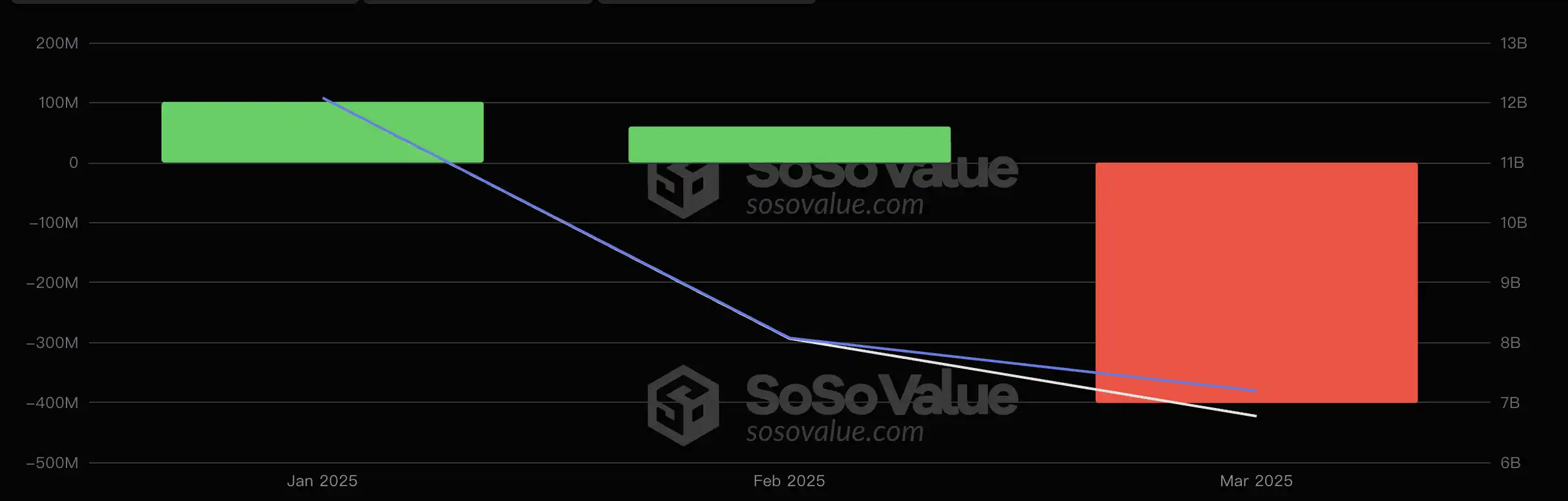
Currently, Ethereum spot ETF funds are experiencing continuous outflows, further denting market confidence. According to SoSoValue data, since the beginning of this year, U.S. Ethereum spot ETFs have seen net outflows of over $400 million in March, with a net outflow of nearly $240 million year-to-date. In contrast, although Bitcoin spot ETFs have also seen significant outflows in the past two months, the overall net inflow this year still exceeds $790 million, with the outflows this month shrinking by 74.9% compared to February.

Ethereum ETF Funds Experience Severe Outflows, Staking Difficulty Aggravates Ecosystem Crisis?

Ethereum ETF Monthly Inflows Year-to-Date

In response, Robert Mitchnick, Head of BlackRock's Digital Assets Division, believes that approval for staking may be a "huge leap" for Ethereum ETFs. He recently stated that the demand for Ethereum ETFs has been lackluster since their launch in July last year, but the situation could change if some regulatory issues hindering their development are resolved. It is widely believed that compared to the explosive growth of funds tracking Bitcoin, Ethereum ETFs' success has been "unremarkable." Although this is a "misconception," the inability of these funds to earn staking rewards may be a limiting factor in their development.

ETFs are a very attractive tool, but for today's ETH, an ETF without staking is not perfect, as staking rewards are a crucial part of generating investment returns in this space. This is not an issue that is particularly easy to solve; it's not like... a new government just flipping a switch and it all happens. There are many quite complex challenges to overcome. If these hurdles can be overcome, then there will be a quantum leap in seeing activity around these ETF products.

In fact, since February this year, many issuers including 21Shares, Grayscale, Fidelity, Bitwise, and Franklin have successively submitted proposals for Ethereum ETF staking. Among them, 21Shares was the earliest institution to submit the relevant application and received formal SEC acceptance on February 20th. According to the SEC approval process, the institution must make a preliminary decision within 45 days after submitting the 19b-4 filing, including whether to accept, reject, or delay. Starting from February 12th, the preliminary decision time for 21Shares' Ethereum ETF staking application is March 29th, which may actually be extended to the next working day, March 31st, due to weekends, and the latest final decision is expected to be made within 240 days, by October 9th.

In the market's view, the introduction of staking for Ethereum ETF is considered to have multiple potential advantages. In terms of investment return, the current annualized staking yield for Ethereum is about 3.12%. Compared to Bitcoin spot ETFs that rely solely on price fluctuations, the Ethereum ETF can generate additional returns for the held ETH through staking. This feature is particularly attractive to institutional investors and may help reverse the current weak demand situation. In terms of price driving, staking locked ETH will reduce market circulation, alleviate selling pressure, and potentially drive up the ETH price.

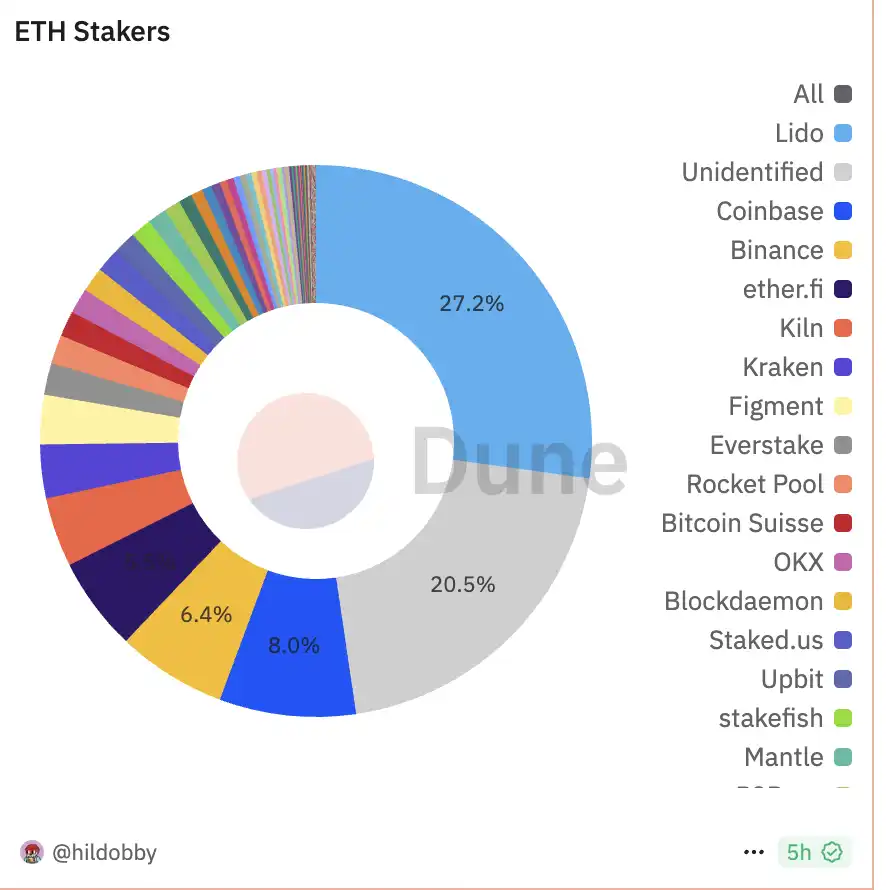
Dune data shows that as of March 24th, the total Ethereum staked on the Beacon Chain exceeded 34.199 million ETH, with staked ETH accounting for 27.85% of the total supply. If ETFs join the staking ranks, this ratio will further increase. In terms of network security, ETF participation in staking will increase the number of Ethereum network validators, enhance decentralization, and alleviate concerns in the community about the centralization risk of liquidity staking protocols like Lido. Dune data shows that as of March 24th, the liquidity staking protocol Lido alone occupies 27.28% of the Ethereum staking share.

However, for the sake of operational simplicity and regulatory compliance, the staking design of an Ethereum spot ETF may weaken its attractiveness to investment institutions. Taking the staking feature application document submitted by 21Shares as an example, its staking process is managed by the custodian Coinbase which safeguards the ETH, using a "point-and-click staking" model, meaning that through a simplified interface, the ETF can directly stake the ETH it holds without transferring the assets to a third-party protocol (such as Lido or Rocket Pool), thereby reducing security risks associated with asset transfers.

Furthermore, all staking rewards generated are owned by the ETF Trust as the issuer's revenue, rather than being directly distributed to investors. According to Dune data, compared to centralized exchanges such as Coinbase and Binance, decentralized staking derivatives like Lido and ether.fi are still the mainstream choice for ETH staking. Based on available information, none of the Ethereum spot ETF issuers have explicitly allowed staking rewards to be directly shared with investors. However, given the loosening of U.S. regulations and increased market competition, the possibility of introducing this mechanism cannot be ruled out.
Furthermore, Ethereum spot ETFs also face a challenge in staking efficiency. Due to the strict limitations of the Ethereum staking entry and exit mechanism (allowing a maximum of 8 nodes to enter and 16 nodes to exit per epoch, with an epoch generated every 6.4 minutes), the flexibility of ETFs is restricted. This limitation becomes more prominent during market volatility, as investors are unable to exit promptly, potentially exacerbating selling pressure.

For example, the current Ethereum spot ETF holds a total value of approximately $6.77 billion worth of ETH, which, at an ETH price (around $2064), equates to approximately 3.28 million ETH. Therefore, the entry time for staking is around 57.69 days, while the exit time is 28.47 days. This queuing mechanism fails to meet investor demand, and liquidity staking platforms that bypass these mechanisms are also excluded from ETF staking.

However, the Pectra upgrade (EIP-7251) increases the staking cap for individual validation nodes from 32 ETH to 2048 ETH, significantly enhancing staking efficiency. This change not only reduces the queuing time for entry and exit staking but also lowers the technical barrier. In the latest 153rd Ethereum All Core Developers' Call (ACDC) meeting, developers have decided to postpone the confirmation of the Pectra mainnet activation date, possibly delaying it until after May.

From this perspective, compared to the availability of staking functionality, issues such as reward distribution and efficiency are crucial factors affecting the demand for Ethereum spot ETFs.

On-chain Activity Remains Sluggish, ETF Staking Dilemma Unresolved

Even if Ethereum spot ETFs introduce staking functionality, their impact on circulating supply and market sentiment is limited, making it difficult to fundamentally reverse the competitive pressure and growth bottlenecks facing the Ethereum ecosystem. Currently, the sustained low on-chain activity, intensified L2 scaling effects, and challenges from other high-performance blockchains are all contributing to weakening Ethereum's market dominance.

From the perspective of ETF staking impact, as of now, Ethereum's staking rate is approximately 27.78%. The U.S. Ethereum spot ETF holds 2.84% of the total ETH, and even if all these ETFs participate in staking, it would only raise the staking rate to around 30.62%, an increase of 2.84%. This slight change has a minor impact on ETH's circulating supply and is still insufficient to be a decisive force driving price upward.

In contrast, the staking rates of other PoS competitive chains are much higher than Ethereum, such as Sui with a staking rate of 77.13%, Aptos at 75.83%, and Solana at 64.39%. While Ethereum has room for staking growth, the scale of ETF funds and staking potential are unlikely to constitute the dominant buying power in the market. The symbolic significance of staking is greater than its actual effect.

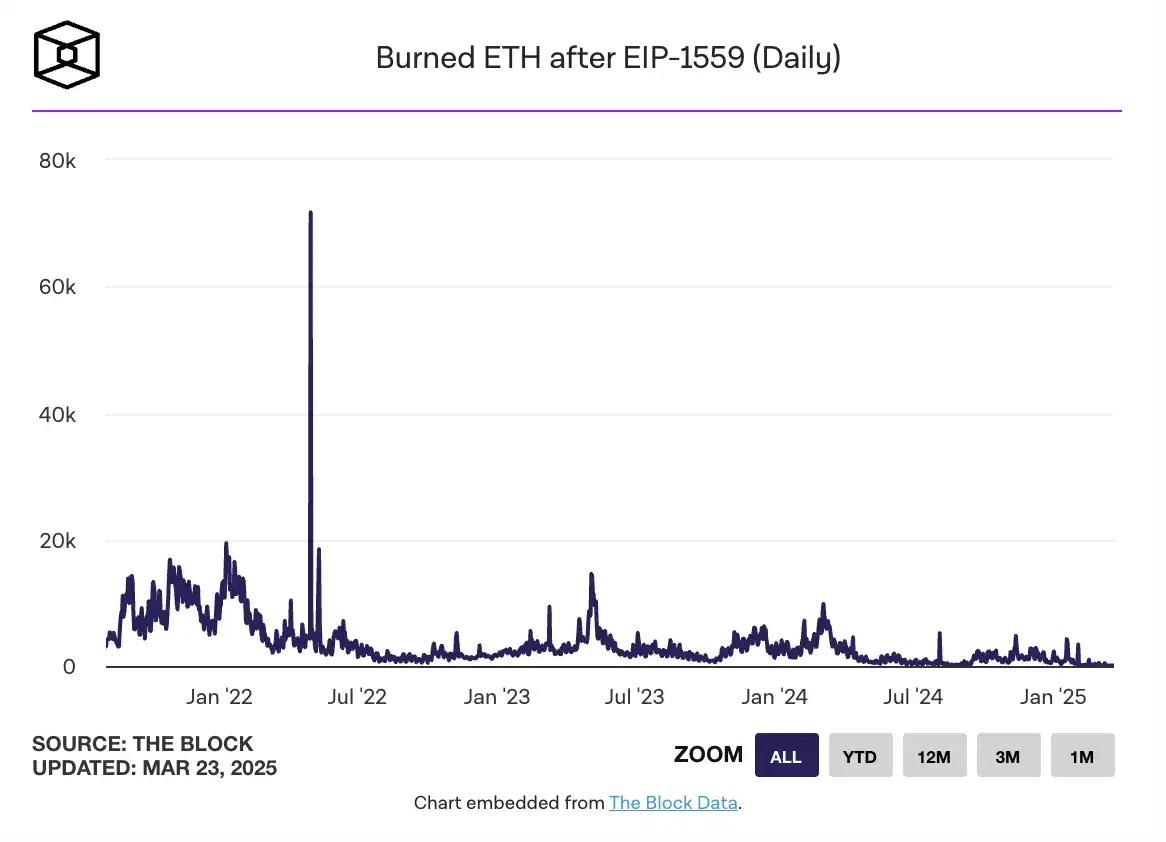
Furthermore, the continuous decline in on-chain activity data further highlights the fatigue of the Ethereum ecosystem. According to The Block data, as of March 22, the amount of ETH burned due to transaction fees on the Ethereum network has decreased to 53.07 ETH, approximately equivalent to $10.6K, hitting a historical low. Ultrasound.money data shows that based on the last 7 days, the annual supply growth rate of ETH is 0.76%. Moreover, Ethereum's on-chain active addresses, transaction volume, and number of transactions have all declined in recent weeks, indicating a waning vitality of the Ethereum ecosystem.
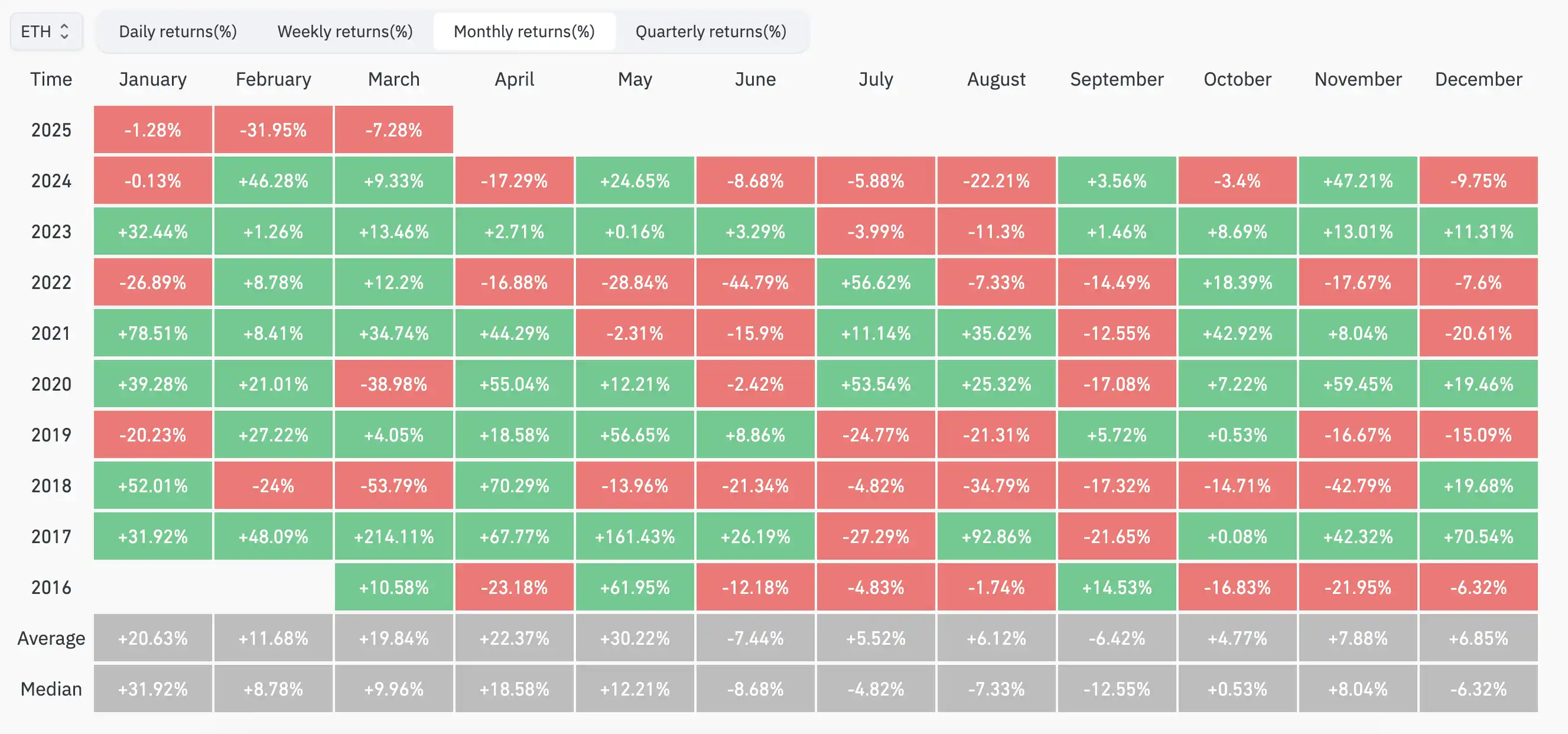
At the same time, Ethereum recorded its worst performance in Q1 of this year. Coinglass data shows that Ethereum experienced its worst start to a year in nearly a quarter in Q1 2025, with negative returns for three consecutive months: January: -1.28% (historical average return: +20.63%, median: +31.92%); February: -31.95% (historical average return: +11.68%, median: +8.78%); March: -7.28% (historical average return: +19.55%, median: +9.96%).
The challenges facing Ethereum stem from multiple structural issues. For instance, although L2 solutions such as Arbitrum and Optimism have significantly reduced transaction costs through Rollup technology, they have also diverted transaction volume away from the mainnet. The proportion of L2 transactions has surpassed that of the mainnet, leading to a decrease in mainnet gas fees and ETH burn. More critically, the transaction fees generated by L2 mostly stay within their ecosystems (such as Optimism's OP tokenomics) rather than flowing back to ETH. For example, Ethereum's market share is being eroded by other blockchains like Solana due to its lack of competitiveness in high-performance application scenarios.

Standard Chartered Bank has also revised its end-of-2025 ETH target price from $10,000 to $4,000 in its latest report, and made several key assessments: L2 Scaling Weakens ETH Market Cap: L2 solutions originally intended to enhance Ethereum's scalability (such as Coinbase's Base) have led to a $500 billion market cap evaporation; ETH/BTC Ratio Expected to Continue Declining: It is projected to fall to 0.015 by the end of 2027, reaching the lowest level since 2017; Future Growth May Depend on RWAs: If RWA tokenization develops rapidly, ETH may still maintain its 80% security market share, but the Ethereum Foundation would need to pursue a more proactive business strategy (such as taxing L2), although this possibility is low.

Overall, although Ethereum's ETF pledging can to some extent affect ETH supply and holder returns, it cannot directly address core challenges such as ecosystem competition, L2 diversion, or market sentiment downturn. Ethereum still needs to seek a profound breakthrough in both technology and narrative.

Original Article Link

You may also like

Token Cannot Compound, Where Is the Real Investment Opportunity?

The next chapter in the crypto industry will undoubtedly be written by Crypto-empowered Stocks.

February 6th Market Key Intelligence, How Much Did You Miss?

1. On-chain Flows: $508.2M USD inflow to Ethereum today; $390.8M USD outflow from Arbitrum 2. Biggest Gainers/Losers: $HBTC, $AIO 3. Top News: Current Bitcoin weekly RSI oversold signal comparable to June 2022

China's Central Bank and Eight Other Departments' Latest Regulatory Focus: Key Attention to RWA Tokenized Asset Risk


Foreword: Today, the People's Bank of China's website published the "Notice of the People's Bank of China, National Development and Reform Commission, Ministry of Industry and Information Technology, Ministry of Public Security, State Administration for Market Regulation, China Banking and Insurance Regulatory Commission, China Securities Regulatory Commission, State Administration of Foreign Exchange on Further Preventing and Dealing with Risks Related to Virtual Currency and Others (Yinfa [2026] No. 42)", the latest regulatory requirements from the eight departments including the central bank, which are basically consistent with the regulatory requirements of recent years. The main focus of the regulation is on speculative activities such as virtual currency trading, exchanges, ICOs, overseas platform services, and this time, regulatory oversight of RWA has been added, explicitly prohibiting RWA tokenization, stablecoins (especially those pegged to the RMB). The following is the full text:


To the people's governments of all provinces, autonomous regions, and municipalities directly under the Central Government, the Xinjiang Production and Construction Corps:


  Recently, there have been speculative activities related to virtual currency and Real-World Assets (RWA) tokenization, disrupting the economic and financial order and jeopardizing the property security of the people. In order to further prevent and address the risks related to virtual currency and Real-World Assets tokenization, effectively safeguard national security and social stability, in accordance with the "Law of the People's Republic of China on the People's Bank of China," "Law of the People's Republic of China on Commercial Banks," "Securities Law of the People's Republic of China," "Law of the People's Republic of China on Securities Investment Funds," "Law of the People's Republic of China on Futures and Derivatives," "Cybersecurity Law of the People's Republic of China," "Regulations of the People's Republic of China on the Administration of Renminbi," "Regulations on Prevention and Disposal of Illegal Fundraising," "Regulations of the People's Republic of China on Foreign Exchange Administration," "Telecommunications Regulations of the People's Republic of China," and other provisions, after reaching consensus with the Cyberspace Administration of China, the Supreme People's Court, and the Supreme People's Procuratorate, and with the approval of the State Council, the relevant matters are notified as follows:


  I. Clarify the essential attributes of virtual currency, Real-World Assets tokenization, and related business activities


  (I) Virtual currency does not possess the legal status equivalent to fiat currency. Virtual currencies such as Bitcoin, Ether, Tether, etc., have the main characteristics of being issued by non-monetary authorities, using encryption technology and distributed ledger or similar technology, existing in digital form, etc. They do not have legal tender status, should not and cannot be circulated and used as currency in the market.


  The business activities related to virtual currency are classified as illegal financial activities. The exchange of fiat currency and virtual currency within the territory, exchange of virtual currencies, acting as a central counterparty in buying and selling virtual currencies, providing information intermediary and pricing services for virtual currency transactions, token issuance financing, and trading of virtual currency-related financial products, etc., fall under illegal financial activities, such as suspected illegal issuance of token vouchers, unauthorized public issuance of securities, illegal operation of securities and futures business, illegal fundraising, etc., are strictly prohibited across the board and resolutely banned in accordance with the law. Overseas entities and individuals are not allowed to provide virtual currency-related services to domestic entities in any form.


  A stablecoin pegged to a fiat currency indirectly fulfills some functions of the fiat currency in circulation. Without the consent of relevant authorities in accordance with the law and regulations, any domestic or foreign entity or individual is not allowed to issue a RMB-pegged stablecoin overseas.


(II)Tokenization of Real-World Assets refers to the use of encryption technology and distributed ledger or similar technologies to transform ownership rights, income rights, etc., of assets into tokens (tokens) or other interests or bond certificates with token (token) characteristics, and carry out issuance and trading activities.


  Engaging in the tokenization of real-world assets domestically, as well as providing related intermediary, information technology services, etc., which are suspected of illegal issuance of token vouchers, unauthorized public offering of securities, illegal operation of securities and futures business, illegal fundraising, and other illegal financial activities, shall be prohibited; except for relevant business activities carried out with the approval of the competent authorities in accordance with the law and regulations and relying on specific financial infrastructures. Overseas entities and individuals are not allowed to illegally provide services related to the tokenization of real-world assets to domestic entities in any form.


  II. Sound Work Mechanism


  (III) Inter-agency Coordination. The People's Bank of China, together with the National Development and Reform Commission, the Ministry of Industry and Information Technology, the Ministry of Public Security, the State Administration for Market Regulation, the China Banking and Insurance Regulatory Commission, the China Securities Regulatory Commission, the State Administration of Foreign Exchange, and other departments, will improve the work mechanism, strengthen coordination with the Cyberspace Administration of China, the Supreme People's Court, and the Supreme People's Procuratorate, coordinate efforts, and overall guide regions to carry out risk prevention and disposal of virtual currency-related illegal financial activities.


  The China Securities Regulatory Commission, together with the National Development and Reform Commission, the Ministry of Industry and Information Technology, the Ministry of Public Security, the People's Bank of China, the State Administration for Market Regulation, the China Banking and Insurance Regulatory Commission, the State Administration of Foreign Exchange, and other departments, will improve the work mechanism, strengthen coordination with the Cyberspace Administration of China, the Supreme People's Court, and the Supreme People's Procuratorate, coordinate efforts, and overall guide regions to carry out risk prevention and disposal of illegal financial activities related to the tokenization of real-world assets.


  (IV) Strengthening Local Implementation. The people's governments at the provincial level are overall responsible for the prevention and disposal of risks related to virtual currencies and the tokenization of real-world assets in their respective administrative regions. The specific leading department is the local financial regulatory department, with participation from branches and dispatched institutions of the State Council's financial regulatory department, telecommunications regulators, public security, market supervision, and other departments, in coordination with cyberspace departments, courts, and procuratorates, to improve the normalization of the work mechanism, effectively connect with the relevant work mechanisms of central departments, form a cooperative and coordinated working pattern between central and local governments, effectively prevent and properly handle risks related to virtual currencies and the tokenization of real-world assets, and maintain economic and financial order and social stability.


  III. Strengthened Risk Monitoring, Prevention, and Disposal


  (5) Enhanced Risk Monitoring. The People's Bank of China, China Securities Regulatory Commission, National Development and Reform Commission, Ministry of Industry and Information Technology, Ministry of Public Security, State Administration of Foreign Exchange, Cyberspace Administration of China, and other departments continue to improve monitoring techniques and system support, enhance cross-departmental data analysis and sharing, establish sound information sharing and cross-validation mechanisms, promptly grasp the risk situation of activities related to virtual currency and real-world asset tokenization. Local governments at all levels give full play to the role of local monitoring and early warning mechanisms. Local financial regulatory authorities, together with branches and agencies of the State Council's financial regulatory authorities, as well as departments of cyberspace and public security, ensure effective connection between online monitoring, offline investigation, and fund tracking, efficiently and accurately identify activities related to virtual currency and real-world asset tokenization, promptly share risk information, improve early warning information dissemination, verification, and rapid response mechanisms.


  (6) Strengthened Oversight of Financial Institutions, Intermediaries, and Technology Service Providers. Financial institutions (including non-bank payment institutions) are prohibited from providing account opening, fund transfer, and clearing services for virtual currency-related business activities, issuing and selling financial products related to virtual currency, including virtual currency and related financial products in the scope of collateral, conducting insurance business related to virtual currency, or including virtual currency in the scope of insurance liability. Financial institutions (including non-bank payment institutions) are prohibited from providing custody, clearing, and settlement services for unauthorized real-world asset tokenization-related business and related financial products. Relevant intermediary institutions and information technology service providers are prohibited from providing intermediary, technical, or other services for unauthorized real-world asset tokenization-related businesses and related financial products.


  (7) Enhanced Management of Internet Information Content and Access. Internet enterprises are prohibited from providing online business venues, commercial displays, marketing, advertising, or paid traffic diversion services for virtual currency and real-world asset tokenization-related business activities. Upon discovering clues of illegal activities, they should promptly report to relevant departments and provide technical support and assistance for related investigations and inquiries. Based on the clues transferred by the financial regulatory authorities, the cyberspace administration, telecommunications authorities, and public security departments should promptly close and deal with websites, mobile applications (including mini-programs), and public accounts engaged in virtual currency and real-world asset tokenization-related business activities in accordance with the law.


  (8) Strengthened Entity Registration and Advertisement Management. Market supervision departments strengthen entity registration and management, and enterprise and individual business registrations must not contain terms such as "virtual currency," "virtual asset," "cryptocurrency," "crypto asset," "stablecoin," "real-world asset tokenization," or "RWA" in their names or business scopes. Market supervision departments, together with financial regulatory authorities, legally enhance the supervision of advertisements related to virtual currency and real-world asset tokenization, promptly investigating and handling relevant illegal advertisements.


  (IX) Continued Rectification of Virtual Currency Mining Activities. The National Development and Reform Commission, together with relevant departments, strictly controls virtual currency mining activities, continuously promotes the rectification of virtual currency mining activities. The people's governments of various provinces take overall responsibility for the rectification of "mining" within their respective administrative regions. In accordance with the requirements of the National Development and Reform Commission and other departments in the "Notice on the Rectification of Virtual Currency Mining Activities" (NDRC Energy-saving Building [2021] No. 1283) and the provisions of the "Guidance Catalog for Industrial Structure Adjustment (2024 Edition)," a comprehensive review, investigation, and closure of existing virtual currency mining projects are conducted, new mining projects are strictly prohibited, and mining machine production enterprises are strictly prohibited from providing mining machine sales and other services within the country.


  (X) Severe Crackdown on Related Illegal Financial Activities. Upon discovering clues to illegal financial activities related to virtual currency and the tokenization of real-world assets, local financial regulatory authorities, branches of the State Council's financial regulatory authorities, and other relevant departments promptly investigate, determine, and properly handle the issues in accordance with the law, and seriously hold the relevant entities and individuals legally responsible. Those suspected of crimes are transferred to the judicial authorities for processing according to the law.


 (XI) Severe Crackdown on Related Illegal and Criminal Activities. The Ministry of Public Security, the People's Bank of China, the State Administration for Market Regulation, the China Banking and Insurance Regulatory Commission, the China Securities Regulatory Commission, as well as judicial and procuratorial organs, in accordance with their respective responsibilities, rigorously crack down on illegal and criminal activities related to virtual currency, the tokenization of real-world assets, such as fraud, money laundering, illegal business operations, pyramid schemes, illegal fundraising, and other illegal and criminal activities carried out under the guise of virtual currency, the tokenization of real-world assets, etc.


  (XII) Strengthen Industry Self-discipline. Relevant industry associations should enhance membership management and policy advocacy, based on their own responsibilities, advocate and urge member units to resist illegal financial activities related to virtual currency and the tokenization of real-world assets. Member units that violate regulatory policies and industry self-discipline rules are to be disciplined in accordance with relevant self-regulatory management regulations. By leveraging various industry infrastructure, conduct risk monitoring related to virtual currency, the tokenization of real-world assets, and promptly transfer issue clues to relevant departments.


  IV. Strict Supervision of Domestic Entities Engaging in Overseas Business Activities


(XIII) Without the approval of relevant departments in accordance with the law and regulations, domestic entities and foreign entities controlled by them may not issue virtual currency overseas.


  (XIV) Domestic entities engaging directly or indirectly in overseas external debt-based tokenization of real-world assets, or conducting asset securitization activities abroad based on domestic ownership rights, income rights, etc. (hereinafter referred to as domestic equity), should be strictly regulated in accordance with the principles of "same business, same risk, same rules." The National Development and Reform Commission, the China Securities Regulatory Commission, the State Administration of Foreign Exchange, and other relevant departments regulate it according to their respective responsibilities. For other forms of overseas real-world asset tokenization activities based on domestic equity by domestic entities, the China Securities Regulatory Commission, together with relevant departments, supervise according to their division of responsibilities. Without the consent and filing of relevant departments, no unit or individual may engage in the above-mentioned business.


  (15) Overseas subsidiaries and branches of domestic financial institutions providing Real World Asset Tokenization-related services overseas shall do so legally and prudently. They shall have professional personnel and systems in place to effectively mitigate business risks, strictly implement customer onboarding, suitability management, anti-money laundering requirements, and incorporate them into the domestic financial institutions' compliance and risk management system. Intermediaries and information technology service providers offering Real World Asset Tokenization services abroad based on domestic equity or conducting Real World Asset Tokenization business in the form of overseas debt for domestic entities directly or indirectly venturing abroad must strictly comply with relevant laws and regulations. They should establish and improve relevant compliance and internal control systems in accordance with relevant normative requirements, strengthen business and risk control, and report the business developments to the relevant regulatory authorities for approval or filing.


  V. Strengthen Organizational Implementation


  (16) Strengthen organizational leadership and overall coordination. All departments and regions should attach great importance to the prevention of risks related to virtual currencies and Real World Asset Tokenization, strengthen organizational leadership, clarify work responsibilities, form a long-term effective working mechanism with centralized coordination, local implementation, and shared responsibilities, maintain high pressure, dynamically monitor risks, effectively prevent and mitigate risks in an orderly and efficient manner, legally protect the property security of the people, and make every effort to maintain economic and financial order and social stability.


  (17) Widely carry out publicity and education. All departments, regions, and industry associations should make full use of various media and other communication channels to disseminate information through legal and policy interpretation, analysis of typical cases, and education on investment risks, etc. They should promote the illegality and harm of virtual currencies and Real World Asset Tokenization-related businesses and their manifestations, fully alert to potential risks and hidden dangers, and enhance public awareness and identification capabilities for risk prevention.


  VI. Legal Responsibility


  (18) Engaging in illegal financial activities related to virtual currencies and Real World Asset Tokenization in violation of this notice, as well as providing services for virtual currencies and Real World Asset Tokenization-related businesses, shall be punished in accordance with relevant regulations. If it constitutes a crime, criminal liability shall be pursued according to the law. For domestic entities and individuals who knowingly or should have known that overseas entities illegally provided virtual currency or Real World Asset Tokenization-related services to domestic entities and still assisted them, relevant responsibilities shall be pursued according to the law. If it constitutes a crime, criminal liability shall be pursued according to the law.


  (19) If any unit or individual invests in virtual currencies, Real World Asset Tokens, and related financial products against public order and good customs, the relevant civil legal actions shall be invalid, and any resulting losses shall be borne by them. If there are suspicions of disrupting financial order and jeopardizing financial security, the relevant departments shall deal with them according to the law.


  This notice shall enter into force upon the date of its issuance. The People's Bank of China and ten other departments' "Notice on Further Preventing and Dealing with the Risks of Virtual Currency Trading Speculation" (Yinfa [2021] No. 237) is hereby repealed.


Former Partner's Perspective on Multicoin: Kyle's Exit, But the Game He Left Behind Just Getting Started

Kyle knew his game, so he decided to focus on playing the game he was good at and interested in.

Why Bitcoin Is Falling Now: The Real Reasons Behind BTC's Crash & WEEX's Smart Profit Playbook

Bitcoin's ongoing crash explained: Discover the 5 hidden triggers behind BTC's plunge & how WEEX's Auto Earn and Trade to Earn strategies help traders profit from crypto market volatility.

Wall Street's Hottest Trades See Exodus

This time there is no single triggering factor, but rather market anxiety about asset valuation, with many already skeptical of these valuations being too high, leading to investors choosing to retreat almost simultaneously.

Popular coins

Latest Crypto News

Read more