Former Goldman Sachs Executive, Built a Compliant CeDeFi Trading Platform

By: blockbeats|2025/03/25 17:15:03
0
Share
copy

Over the years, large-scale watershed events in the Crypto industry have almost always centered around exchanges.

Binance paid a $4.3 billion fine, setting the record for the largest fine in the history of Chinese entrepreneurship; Bybit fell victim to a $1.5 billion hack, setting a new record for the world's largest single hack attack amount; Bitget made a foray into the campus market, recruiting campus ambassadors at major universities; OKX delved deep into the grassroots market, launching PI Coin to reintroduce true "old" hodlers to the gameplay of exchanges.

Exchanges serve as both the industry's gateway and its mirror. In the past, the most prominent word on this mirror was "Mass Adoption," symbolizing growth. However, today, the priority of growth seems to be giving way to "compliance."

The Era of "Growth First, Compliance Later" is Over

Early exchanges were more like the 108 Heroes of Mount Liang, grassroots heroes who used a "growth-first, compliance-later" strategy to expand rapidly. However, after Binance's $4.3 billion "sky-high fine," everyone realized the significant cost of this approach. Binance was forced to close its Singapore office, Bybit left France for Dubai, and OKX withdrew from the Indian and Nigerian markets due to compliance issues. The exchange industry is in turmoil, and new exchanges are finding it difficult to replicate Binance's "playbook."

In hindsight, the "compliance-first, growth-later" strategy embodied by Coinbase seems to be the correct path. Although compliance costs are high, with legal fees reaching millions and constraints such as limited listings and no derivatives trading leading to lower trading volume and profits.

But as the saying goes, slow is fast. Today, Coinbase has a P/E ratio of 22, a total market value of around $52 billion, and has attracted the envy of the capital markets due to its "compliance." The acquisition or investment in cryptocurrency exchanges is the plan that Wall Street institutions are currently pursuing.

And compliant exchanges are the most suitable acquisition targets.

Not just profitable exchanges like Coinbase, even poorly performing exchanges like Bakkt, whose stock price surged 162% on reports of negotiations with TMTG, the company behind Trump's Truth Social, solely due to having a regulatory license. For example, Binance, which has paid a $4.3 billion fine and is barely stepping into the realm of "compliance," is also an attractive target; it recently announced a $2 billion investment from MGX, a top-tier entity established by the Abu Dhabi government.

Joining the inner circle will open the door to power, resources, and the market. Especially in Trump's four-year "cronyism" term, being able to infiltrate the inner circle made everything else easier.

Compliance is loved by all; non-compliance is sidelined.

GRVT: A Hybrid Trading Platform Emphasizing Compliance and Innovation

If Coinbase represents a successful case of "compliance-first, growth-second," then GRVT may be the next name worth paying attention to.

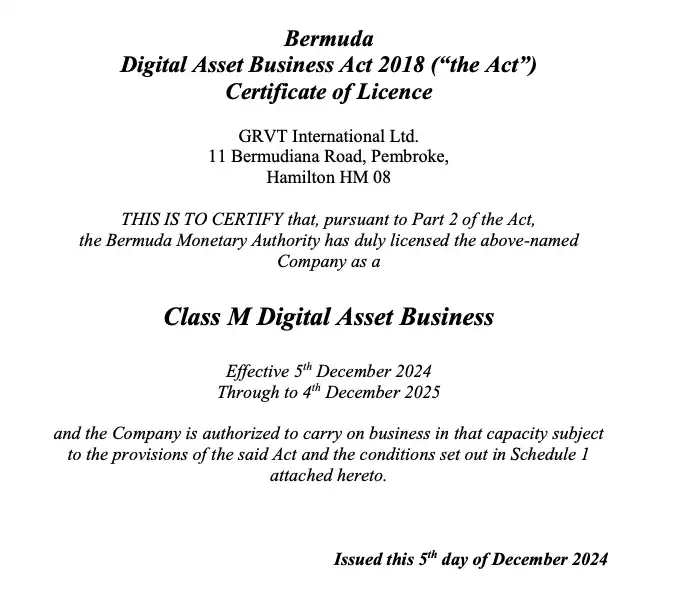
By the end of 2024, GRVT had obtained a Class Modified (M) Digital Asset Business License from the Bermuda Monetary Authority (BMA), allowing GRVT to operate as a regulated DEX. This licensing process took 15 months, aligning with the timing of its mainnet test launch on December 4 to institutional users.

Former Goldman Sachs Executive, Built a Compliant CeDeFi Trading Platform

Following the preliminary Class M license under the Bermuda Digital Asset Business Act (DABA), GRVT plans to apply for a Class Full (F) license by mid-2025 to further expand its business scope. This means that GRVT can not only operate compliantly in the centralized exchange (CEX) arena but also conduct business in the DEX space under a compliant identity, forming a true "CeDeFi" (Centralized + Decentralized Finance) trading platform.

It's worth noting that GRVT is not the only enterprise opting for the Bermuda regulatory framework. Kraken, as the world's seventh-largest CEX, has also chosen Bermuda as the regulatory starting point for its derivatives trading platform. Behind this choice lies Bermuda's mature compliance system, which has been committed to providing a clear regulatory framework for digital asset enterprises since 2017.

Furthermore, GRVT is actively seeking various global compliance licenses such as VARA (Dubai), ADGM (Abu Dhabi), and MiCA (EU), further solidifying its compliance advantage and advancing towards the North American market.

Before the mainnet launch at the end of last December, GRVT had already secured strategic commitments from 17 top cryptocurrency market makers (liquidity providers), with agreements to provide $42 billion in monthly trading volume to support the platform's liquidity development. These liquidity providers are all well-known institutions in the industry, including Galaxy Trading Asia, Ampersand, Amber Group, IMC, Flow Traders, Pulsar, QCP, Selini, and other institutions.

Currently, GRVT has more than 50 institutional partners and clients, as well as nearly 30,000 retail users who have completed KYC identity verification.

To better promote and encourage institutional adoption, GRVT has integrated with CoinRoutes, one of the world's largest cryptocurrency Order Execution Management Systems (OEMS). Institutional traders can now access GRVT directly through CoinRoutes' interface, unlocking a set of advanced trading features, including: optimized trade execution across multiple liquidity pools, market data dashboard, Transaction Cost Analysis (TCA), support for complex trading strategies across assets and trading pairs, and more.

Managing CeDeFi On-chain and Off-chain

Let's briefly revisit the history of trading platforms. In 2020, against the backdrop of the Fed's massive liquidity injections, fueled by liquidity mining and the Automated Market Maker (AMM) model, a group of DEX led by Uniswap experienced rapid growth. By October 2020, Uniswap had become the world's fourth-largest cryptocurrency exchange, trailing only the Big Three of HBO (Huobi, Binance, OKEx), gradually challenging the pricing power of CEX.

At that time, everyone was debating whether DEX would really replace CEX?

The answer today is quite clear: DEX is not here to replace CEX but to complement it, especially by capturing the long tail market that is hard to reach.

GRVT is not the only company to see the potential of combining CeFi and DeFi. In recent years, the concept of CeDeFi has been gradually emerging, with more and more companies adopting this model. For example, in November 2024, SafePal announced the adoption of CeDeFi principles in its Telegram Mini App, offering compliant cryptocurrency trading platform services and supporting digital Visa cards. Another example is the WEB3 wallet developed by OKX.

Yet we come back to the initial topic of this article: compliance. Although the SEC has dropped its lawsuit against Uniswap since the Trump administration took office, it does not mean that the DEX track can do whatever it wants. Compliance is still the key theme.

The market needs a trading platform that can meet the liquidity advantage of CEX, possess the transparency of DEX, and still maintain compliance. This is the original intention of GRVT's entry into the industry.

However, coordinating between CEX and DEX is not an easy task. What should go on-chain? What should stay off-chain?

Let's look at GRVT's answer to this issue and how they manage fund flows on-chain and off-chain: Initially, user's day-to-day operations are conducted off-chain to reduce transaction latency and costs. Operations involving funds are eventually pushed on-chain.

Specifically, this includes: transaction orders are matched off-chain before being pushed on-chain for final settlement; settlement actions are first triggered off-chain and then validated on-chain; transaction account creation, wallet binding, etc., are completed off-chain first and then validated on-chain; internal and external fund transfers are processed off-chain first, and finally settled on-chain.

And all operations involving fund security will ultimately be pushed to the GRVT chain and verified through Ethereum Zero-Knowledge Proofs (ZKPs).

Specific on-chain operations include: after order matching is completed, final transaction settlement is done on-chain; risk management validations such as risk liquidation are verified on-chain; account management operations like wallet binding are confirmed on-chain; fund transfers and management are finally validated and settled on-chain.

To achieve this, a reliable team with regulatory experience, technical expertise, and trading background is essential.

GRVT Team: International Background and Top Professionalism

GRVT has a highly internationalized and professional team, with the current team size exceeding 50 people, including members from Traditional Finance (TradFi), Crypto Finance, and global leading tech companies, such as Goldman Sachs, JPMorgan, Nomura, DBS Bank, Facebook, Cronos, OKX, Bybit, and other top WEB2 and WEB3 brands.

Left to right: Matthew Quek (COO), Hong Yea (CEO), Aaron Ong (CTO)

Co-founder and CEO Hong Yea, who previously served as a trader at Credit Suisse and Goldman Sachs for a decade and was promoted to executive director at Goldman Sachs, founded GRVT on the eve of the cryptocurrency market crash in May 2022.

Hong Yea's multicultural background and global perspective enable him to seamlessly bridge the gap between traditional finance and the crypto market, crafting a development strategy for GRVT that aligns with global compliance trends.

Related Read: "Leaving Goldman Sachs Midway to Entrepreneurship, GRVT CEO Talks about the Trust Dilemma, Custody, and Self-Custody in Modern Finance"

Co-Founder and COO Matthew Quek, prior to joining GRVT, has worked at DBS Bank and the Government Technology Agency of Singapore (GovTech Singapore). He led DBS Bank's blockchain and payments team and spearheaded the implementation of the national digital identity project. His professional background enables him to effectively bridge the traditional financial system with digital asset transactions, ensuring GRVT achieves business innovation within a compliance framework.

Co-Founder and CTO Aaron Ong is a product and software engineering expert with a blend of strategic thinking and technical leadership, holding a strong background in Mathematics and Computer Science from Yale-NUS College. He has held key positions at industry-leading companies such as Facebook, Sea, and Cronos Labs. During his tenure at Facebook, Aaron led core data infrastructure projects, significantly enhancing data privacy protection and operational efficiency. He also led over 30 engineers at Cronos Labs under Cryptocom, focusing on the DeFi and NFT sectors.

At GRVT, Aaron is responsible for technical architecture and innovation, leading the engineering and DevSecOps teams to drive GRVT's hybrid derivatives trading model. The trading model he designed combines off-chain order matching with on-chain settlement mechanisms capable of processing 600,000 transactions per second (TPS), providing GRVT with an efficient, transparent, and compliant trading environment.

On the fundraising front, GRVT has raised a total of $14.3 million to date. The latest strategic round raised $5 million, with exclusive investment from Further Ventures, a fund under the Abu Dhabi sovereign fund, with all funds being equity investments. Previous investors include top-tier VC firms such as ABCDE and Delphi Ventures.

20% Airdrop Allocation

It is worth noting that GRVT recently announced an airdrop allocation ratio, with the total airdrop amount accounting for 20% of GRVT's token total supply.
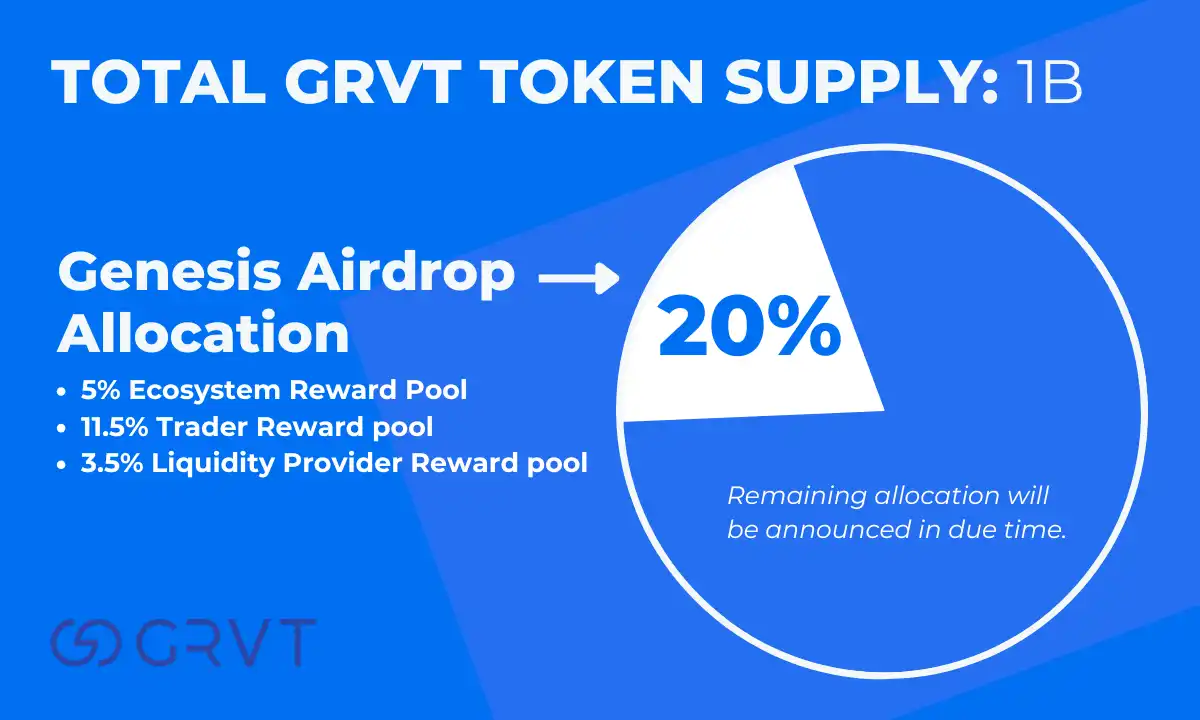
This 20% of the tokens will be divided into three separate reward pools: 5% Ecosystem Reward; 11.5% Trader Reward; 3.5% Liquidity Provider Reward.

Among them, 75% of the airdrop reward is directly based on user points on the platform, with 25% going to the community reward pool, allocating rewards to users who make long-term, small, but continuous contributions based on badge level and number of badges.
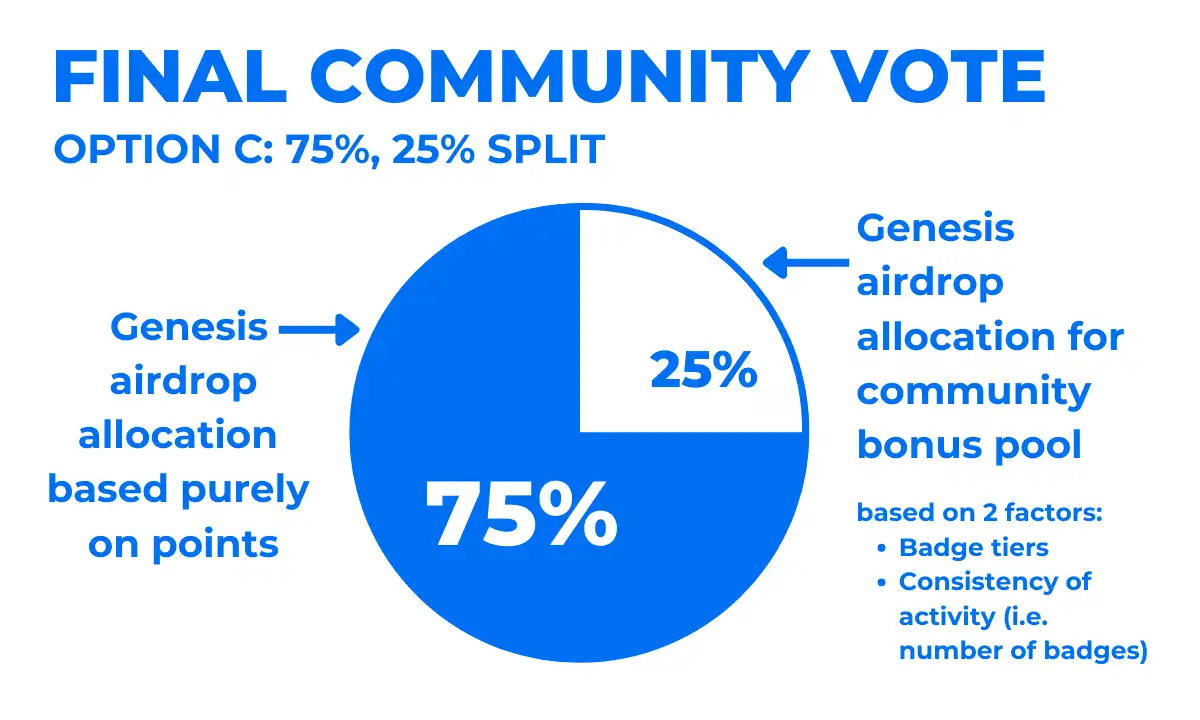
The current 9 badge levels will be expanded to 12 to optimize the incentive mechanism. Non-API traders will also receive double trading points, allowing retail traders to earn higher rewards and enabling them to earn more rewards.

Summary

In today's increasingly competitive cryptocurrency trading platform landscape, compliance is the new path forward and an unavoidable topic. Those exchanges that achieve compliance not only can survive longer but also become targets for capital investment.

In the future, there will only be two types of trading platforms: those with licenses, and compliant trading platforms, and the others that cannot enter the game.

This is GRVT's strategy: with compliance as the cornerstone, while also considering the CeFi and DeFi fields, it aims to create the future form of a trading platform in the CeDeFi model, attempting to secure a place in the new round of trading platform competition.

As for the final result, we will have to wait to see more progress from GRVT's product and more trading pairs listed before we can truly understand.

You may also like

Token Cannot Compound, Where Is the Real Investment Opportunity?

The next chapter in the crypto industry will undoubtedly be written by Crypto-empowered Stocks.

February 6th Market Key Intelligence, How Much Did You Miss?

1. On-chain Flows: $508.2M USD inflow to Ethereum today; $390.8M USD outflow from Arbitrum 2. Biggest Gainers/Losers: $HBTC, $AIO 3. Top News: Current Bitcoin weekly RSI oversold signal comparable to June 2022

China's Central Bank and Eight Other Departments' Latest Regulatory Focus: Key Attention to RWA Tokenized Asset Risk


Foreword: Today, the People's Bank of China's website published the "Notice of the People's Bank of China, National Development and Reform Commission, Ministry of Industry and Information Technology, Ministry of Public Security, State Administration for Market Regulation, China Banking and Insurance Regulatory Commission, China Securities Regulatory Commission, State Administration of Foreign Exchange on Further Preventing and Dealing with Risks Related to Virtual Currency and Others (Yinfa [2026] No. 42)", the latest regulatory requirements from the eight departments including the central bank, which are basically consistent with the regulatory requirements of recent years. The main focus of the regulation is on speculative activities such as virtual currency trading, exchanges, ICOs, overseas platform services, and this time, regulatory oversight of RWA has been added, explicitly prohibiting RWA tokenization, stablecoins (especially those pegged to the RMB). The following is the full text:


To the people's governments of all provinces, autonomous regions, and municipalities directly under the Central Government, the Xinjiang Production and Construction Corps:


  Recently, there have been speculative activities related to virtual currency and Real-World Assets (RWA) tokenization, disrupting the economic and financial order and jeopardizing the property security of the people. In order to further prevent and address the risks related to virtual currency and Real-World Assets tokenization, effectively safeguard national security and social stability, in accordance with the "Law of the People's Republic of China on the People's Bank of China," "Law of the People's Republic of China on Commercial Banks," "Securities Law of the People's Republic of China," "Law of the People's Republic of China on Securities Investment Funds," "Law of the People's Republic of China on Futures and Derivatives," "Cybersecurity Law of the People's Republic of China," "Regulations of the People's Republic of China on the Administration of Renminbi," "Regulations on Prevention and Disposal of Illegal Fundraising," "Regulations of the People's Republic of China on Foreign Exchange Administration," "Telecommunications Regulations of the People's Republic of China," and other provisions, after reaching consensus with the Cyberspace Administration of China, the Supreme People's Court, and the Supreme People's Procuratorate, and with the approval of the State Council, the relevant matters are notified as follows:


  I. Clarify the essential attributes of virtual currency, Real-World Assets tokenization, and related business activities


  (I) Virtual currency does not possess the legal status equivalent to fiat currency. Virtual currencies such as Bitcoin, Ether, Tether, etc., have the main characteristics of being issued by non-monetary authorities, using encryption technology and distributed ledger or similar technology, existing in digital form, etc. They do not have legal tender status, should not and cannot be circulated and used as currency in the market.


  The business activities related to virtual currency are classified as illegal financial activities. The exchange of fiat currency and virtual currency within the territory, exchange of virtual currencies, acting as a central counterparty in buying and selling virtual currencies, providing information intermediary and pricing services for virtual currency transactions, token issuance financing, and trading of virtual currency-related financial products, etc., fall under illegal financial activities, such as suspected illegal issuance of token vouchers, unauthorized public issuance of securities, illegal operation of securities and futures business, illegal fundraising, etc., are strictly prohibited across the board and resolutely banned in accordance with the law. Overseas entities and individuals are not allowed to provide virtual currency-related services to domestic entities in any form.


  A stablecoin pegged to a fiat currency indirectly fulfills some functions of the fiat currency in circulation. Without the consent of relevant authorities in accordance with the law and regulations, any domestic or foreign entity or individual is not allowed to issue a RMB-pegged stablecoin overseas.


(II)Tokenization of Real-World Assets refers to the use of encryption technology and distributed ledger or similar technologies to transform ownership rights, income rights, etc., of assets into tokens (tokens) or other interests or bond certificates with token (token) characteristics, and carry out issuance and trading activities.


  Engaging in the tokenization of real-world assets domestically, as well as providing related intermediary, information technology services, etc., which are suspected of illegal issuance of token vouchers, unauthorized public offering of securities, illegal operation of securities and futures business, illegal fundraising, and other illegal financial activities, shall be prohibited; except for relevant business activities carried out with the approval of the competent authorities in accordance with the law and regulations and relying on specific financial infrastructures. Overseas entities and individuals are not allowed to illegally provide services related to the tokenization of real-world assets to domestic entities in any form.


  II. Sound Work Mechanism


  (III) Inter-agency Coordination. The People's Bank of China, together with the National Development and Reform Commission, the Ministry of Industry and Information Technology, the Ministry of Public Security, the State Administration for Market Regulation, the China Banking and Insurance Regulatory Commission, the China Securities Regulatory Commission, the State Administration of Foreign Exchange, and other departments, will improve the work mechanism, strengthen coordination with the Cyberspace Administration of China, the Supreme People's Court, and the Supreme People's Procuratorate, coordinate efforts, and overall guide regions to carry out risk prevention and disposal of virtual currency-related illegal financial activities.


  The China Securities Regulatory Commission, together with the National Development and Reform Commission, the Ministry of Industry and Information Technology, the Ministry of Public Security, the People's Bank of China, the State Administration for Market Regulation, the China Banking and Insurance Regulatory Commission, the State Administration of Foreign Exchange, and other departments, will improve the work mechanism, strengthen coordination with the Cyberspace Administration of China, the Supreme People's Court, and the Supreme People's Procuratorate, coordinate efforts, and overall guide regions to carry out risk prevention and disposal of illegal financial activities related to the tokenization of real-world assets.


  (IV) Strengthening Local Implementation. The people's governments at the provincial level are overall responsible for the prevention and disposal of risks related to virtual currencies and the tokenization of real-world assets in their respective administrative regions. The specific leading department is the local financial regulatory department, with participation from branches and dispatched institutions of the State Council's financial regulatory department, telecommunications regulators, public security, market supervision, and other departments, in coordination with cyberspace departments, courts, and procuratorates, to improve the normalization of the work mechanism, effectively connect with the relevant work mechanisms of central departments, form a cooperative and coordinated working pattern between central and local governments, effectively prevent and properly handle risks related to virtual currencies and the tokenization of real-world assets, and maintain economic and financial order and social stability.


  III. Strengthened Risk Monitoring, Prevention, and Disposal


  (5) Enhanced Risk Monitoring. The People's Bank of China, China Securities Regulatory Commission, National Development and Reform Commission, Ministry of Industry and Information Technology, Ministry of Public Security, State Administration of Foreign Exchange, Cyberspace Administration of China, and other departments continue to improve monitoring techniques and system support, enhance cross-departmental data analysis and sharing, establish sound information sharing and cross-validation mechanisms, promptly grasp the risk situation of activities related to virtual currency and real-world asset tokenization. Local governments at all levels give full play to the role of local monitoring and early warning mechanisms. Local financial regulatory authorities, together with branches and agencies of the State Council's financial regulatory authorities, as well as departments of cyberspace and public security, ensure effective connection between online monitoring, offline investigation, and fund tracking, efficiently and accurately identify activities related to virtual currency and real-world asset tokenization, promptly share risk information, improve early warning information dissemination, verification, and rapid response mechanisms.


  (6) Strengthened Oversight of Financial Institutions, Intermediaries, and Technology Service Providers. Financial institutions (including non-bank payment institutions) are prohibited from providing account opening, fund transfer, and clearing services for virtual currency-related business activities, issuing and selling financial products related to virtual currency, including virtual currency and related financial products in the scope of collateral, conducting insurance business related to virtual currency, or including virtual currency in the scope of insurance liability. Financial institutions (including non-bank payment institutions) are prohibited from providing custody, clearing, and settlement services for unauthorized real-world asset tokenization-related business and related financial products. Relevant intermediary institutions and information technology service providers are prohibited from providing intermediary, technical, or other services for unauthorized real-world asset tokenization-related businesses and related financial products.


  (7) Enhanced Management of Internet Information Content and Access. Internet enterprises are prohibited from providing online business venues, commercial displays, marketing, advertising, or paid traffic diversion services for virtual currency and real-world asset tokenization-related business activities. Upon discovering clues of illegal activities, they should promptly report to relevant departments and provide technical support and assistance for related investigations and inquiries. Based on the clues transferred by the financial regulatory authorities, the cyberspace administration, telecommunications authorities, and public security departments should promptly close and deal with websites, mobile applications (including mini-programs), and public accounts engaged in virtual currency and real-world asset tokenization-related business activities in accordance with the law.


  (8) Strengthened Entity Registration and Advertisement Management. Market supervision departments strengthen entity registration and management, and enterprise and individual business registrations must not contain terms such as "virtual currency," "virtual asset," "cryptocurrency," "crypto asset," "stablecoin," "real-world asset tokenization," or "RWA" in their names or business scopes. Market supervision departments, together with financial regulatory authorities, legally enhance the supervision of advertisements related to virtual currency and real-world asset tokenization, promptly investigating and handling relevant illegal advertisements.


  (IX) Continued Rectification of Virtual Currency Mining Activities. The National Development and Reform Commission, together with relevant departments, strictly controls virtual currency mining activities, continuously promotes the rectification of virtual currency mining activities. The people's governments of various provinces take overall responsibility for the rectification of "mining" within their respective administrative regions. In accordance with the requirements of the National Development and Reform Commission and other departments in the "Notice on the Rectification of Virtual Currency Mining Activities" (NDRC Energy-saving Building [2021] No. 1283) and the provisions of the "Guidance Catalog for Industrial Structure Adjustment (2024 Edition)," a comprehensive review, investigation, and closure of existing virtual currency mining projects are conducted, new mining projects are strictly prohibited, and mining machine production enterprises are strictly prohibited from providing mining machine sales and other services within the country.


  (X) Severe Crackdown on Related Illegal Financial Activities. Upon discovering clues to illegal financial activities related to virtual currency and the tokenization of real-world assets, local financial regulatory authorities, branches of the State Council's financial regulatory authorities, and other relevant departments promptly investigate, determine, and properly handle the issues in accordance with the law, and seriously hold the relevant entities and individuals legally responsible. Those suspected of crimes are transferred to the judicial authorities for processing according to the law.


 (XI) Severe Crackdown on Related Illegal and Criminal Activities. The Ministry of Public Security, the People's Bank of China, the State Administration for Market Regulation, the China Banking and Insurance Regulatory Commission, the China Securities Regulatory Commission, as well as judicial and procuratorial organs, in accordance with their respective responsibilities, rigorously crack down on illegal and criminal activities related to virtual currency, the tokenization of real-world assets, such as fraud, money laundering, illegal business operations, pyramid schemes, illegal fundraising, and other illegal and criminal activities carried out under the guise of virtual currency, the tokenization of real-world assets, etc.


  (XII) Strengthen Industry Self-discipline. Relevant industry associations should enhance membership management and policy advocacy, based on their own responsibilities, advocate and urge member units to resist illegal financial activities related to virtual currency and the tokenization of real-world assets. Member units that violate regulatory policies and industry self-discipline rules are to be disciplined in accordance with relevant self-regulatory management regulations. By leveraging various industry infrastructure, conduct risk monitoring related to virtual currency, the tokenization of real-world assets, and promptly transfer issue clues to relevant departments.


  IV. Strict Supervision of Domestic Entities Engaging in Overseas Business Activities


(XIII) Without the approval of relevant departments in accordance with the law and regulations, domestic entities and foreign entities controlled by them may not issue virtual currency overseas.


  (XIV) Domestic entities engaging directly or indirectly in overseas external debt-based tokenization of real-world assets, or conducting asset securitization activities abroad based on domestic ownership rights, income rights, etc. (hereinafter referred to as domestic equity), should be strictly regulated in accordance with the principles of "same business, same risk, same rules." The National Development and Reform Commission, the China Securities Regulatory Commission, the State Administration of Foreign Exchange, and other relevant departments regulate it according to their respective responsibilities. For other forms of overseas real-world asset tokenization activities based on domestic equity by domestic entities, the China Securities Regulatory Commission, together with relevant departments, supervise according to their division of responsibilities. Without the consent and filing of relevant departments, no unit or individual may engage in the above-mentioned business.


  (15) Overseas subsidiaries and branches of domestic financial institutions providing Real World Asset Tokenization-related services overseas shall do so legally and prudently. They shall have professional personnel and systems in place to effectively mitigate business risks, strictly implement customer onboarding, suitability management, anti-money laundering requirements, and incorporate them into the domestic financial institutions' compliance and risk management system. Intermediaries and information technology service providers offering Real World Asset Tokenization services abroad based on domestic equity or conducting Real World Asset Tokenization business in the form of overseas debt for domestic entities directly or indirectly venturing abroad must strictly comply with relevant laws and regulations. They should establish and improve relevant compliance and internal control systems in accordance with relevant normative requirements, strengthen business and risk control, and report the business developments to the relevant regulatory authorities for approval or filing.


  V. Strengthen Organizational Implementation


  (16) Strengthen organizational leadership and overall coordination. All departments and regions should attach great importance to the prevention of risks related to virtual currencies and Real World Asset Tokenization, strengthen organizational leadership, clarify work responsibilities, form a long-term effective working mechanism with centralized coordination, local implementation, and shared responsibilities, maintain high pressure, dynamically monitor risks, effectively prevent and mitigate risks in an orderly and efficient manner, legally protect the property security of the people, and make every effort to maintain economic and financial order and social stability.


  (17) Widely carry out publicity and education. All departments, regions, and industry associations should make full use of various media and other communication channels to disseminate information through legal and policy interpretation, analysis of typical cases, and education on investment risks, etc. They should promote the illegality and harm of virtual currencies and Real World Asset Tokenization-related businesses and their manifestations, fully alert to potential risks and hidden dangers, and enhance public awareness and identification capabilities for risk prevention.


  VI. Legal Responsibility


  (18) Engaging in illegal financial activities related to virtual currencies and Real World Asset Tokenization in violation of this notice, as well as providing services for virtual currencies and Real World Asset Tokenization-related businesses, shall be punished in accordance with relevant regulations. If it constitutes a crime, criminal liability shall be pursued according to the law. For domestic entities and individuals who knowingly or should have known that overseas entities illegally provided virtual currency or Real World Asset Tokenization-related services to domestic entities and still assisted them, relevant responsibilities shall be pursued according to the law. If it constitutes a crime, criminal liability shall be pursued according to the law.


  (19) If any unit or individual invests in virtual currencies, Real World Asset Tokens, and related financial products against public order and good customs, the relevant civil legal actions shall be invalid, and any resulting losses shall be borne by them. If there are suspicions of disrupting financial order and jeopardizing financial security, the relevant departments shall deal with them according to the law.


  This notice shall enter into force upon the date of its issuance. The People's Bank of China and ten other departments' "Notice on Further Preventing and Dealing with the Risks of Virtual Currency Trading Speculation" (Yinfa [2021] No. 237) is hereby repealed.


Former Partner's Perspective on Multicoin: Kyle's Exit, But the Game He Left Behind Just Getting Started

Kyle knew his game, so he decided to focus on playing the game he was good at and interested in.

Why Bitcoin Is Falling Now: The Real Reasons Behind BTC's Crash & WEEX's Smart Profit Playbook

Bitcoin's ongoing crash explained: Discover the 5 hidden triggers behind BTC's plunge & how WEEX's Auto Earn and Trade to Earn strategies help traders profit from crypto market volatility.

Wall Street's Hottest Trades See Exodus

This time there is no single triggering factor, but rather market anxiety about asset valuation, with many already skeptical of these valuations being too high, leading to investors choosing to retreat almost simultaneously.

Popular coins

Latest Crypto News

Read more