From DOGE to GHIBLI, What Should the Next Level of Meme Coins Look Like?

By: blockbeats|2025/03/30 10:45:02
0
Share
copy
Original Article Title: Social currencies are the future of memecoins
Original Article Author: LucaNetz, Pudgy Penguins NFT CEO
Original Article Translation: Deep Translation Agency

Editor's Note: The article focuses on the rise of Meme coins and their potential and limitations. The author believes that while Meme coins serve as a unique vehicle for cryptocurrency speculation, their development is hindered by a lack of innovation, stagnation, and reliance solely on hype. The article proposes that Meme coins should evolve into "social currencies" to drive the development of the crypto industry. Social currencies are the evolved form of Meme coins, with their success depending on execution rather than luck, and they may ultimately lead a new transformation in the crypto space.

The following is the original content (slightly reorganized for better readability):

The past 18 months in the cryptocurrency market have been like a rollercoaster, and in this chaos, we have witnessed the rise of Meme coins. While Meme coins are not a new phenomenon—in fact, they are one of the oldest forms of cryptocurrency—they have once again proven themselves to be the preferred vessel for participating in the most unique mechanism (speculation) of cryptocurrency.

Although Meme coins are fundamentally pure and almost artistic, they also have a dark side. No, the issue is not with insiders or small groups—this is a common ailment plaguing the entire cryptocurrency space. In my view, the real issue lies in a lack of effort, a failure to seize the moment, and people being stuck in a rut when it comes to building Meme coins. Perhaps I am too naive, but I refuse to accept that Meme coins end here—at least I hope they don't.

I deeply believe that the Trojan horse of cryptocurrency adoption is intellectual property (IP), as it can establish credibility in a field lacking a trust hierarchy, and Meme coins, like NFTs, are a form of IP. Meme coins have a huge opportunity to drive the development of the crypto industry by delving into the minds of ordinary people. However, they have not tapped into the full potential of transcending the native role of crypto; instead, they are stagnant in their path to exceed, lacking originality and being mundane. I am concerned that if they remain as they are, the drawbacks will outweigh the benefits. For this category to thrive, Meme coins must evolve, and I strongly believe that the direction of evolution is to become social currencies—tokens that go beyond lazy pumps and dumps, transforming into scalable, memorable, and beloved IPs.

My proposition is not to replace Meme coins with social currencies but to add a final stage to their growth roadmap. Meme coins must graduate from on-chain meaningless images to become social currencies that can drive the development of the crypto industry, being productive and perceptive. I believe there are already tokens in this category. This article will discuss the current state of Meme coins, why successful projects should evolve into social currencies, and the impact of social currencies on the crypto space.

First of All, What Is a Social Currency?

A social currency is a tokenized asset that represents value within a specific community, often used to incentivize participation, reward contributions, and enhance brand or community loyalty. It operates similarly to traditional currency, but its value is derived from social interaction, reputation, and influence.

In simple terms, a social currency is a fundamentally sound Meme coin — it is progressive, insightful, focused on nurturing a community capable of sustaining a viral effect, rather than extracting value from short-lived hype.

Meme Coin vs. Social Currency

Meme coins do not create viral effects — they monetize viral effects, squeezing out popularity until it fades away. On the other hand, social currencies are insightful, actively driving their intellectual property through various media, collaborations, and integrations to consistently generate viral effects.

Typical Lifecycle of a Meme Coin:

· Idea → Token Launch → Community Cultivation → Community Advocacy Narrative → Narrative Demise → Community Dissolution

Lifecycle of a Social Currency:

· Idea → Token Launch → Community Cultivation → Community Advocacy Narrative → Brand Establishment → Brand Expansion → Ecosystem Building → Global Adoption and Recognition as Currency

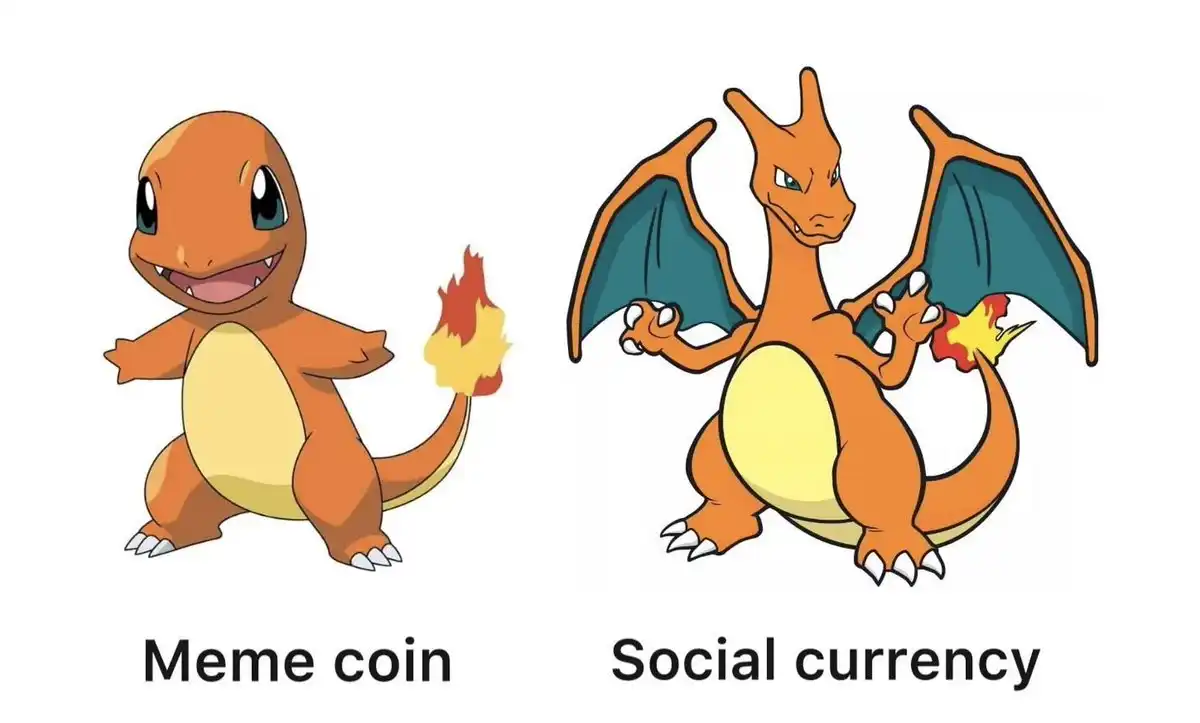
In my view, all social currencies start as Meme coins initially, but with accumulated momentum, they must evolve into social currencies. The diagram below accurately illustrates this process.

From DOGE to GHIBLI, What Should the Next Level of Meme Coins Look Like?

I love this diagram because it shows that social currency is not meant to replace Meme coins but is their evolutionary form. To me, a social currency is a Meme coin with real value backing. Anyone can issue a Meme coin, but only the best can inject real value into it.

If you believe that liquid crypto assets will primarily belong to the retail asset class, then you are betting on Meme coins and their success. If you believe that institutional capital will eventually flow into altcoins, then you must expect fundamentals to prevail. Social currency combines the advantages of both — it has the retail appeal of Meme coins and the fun factor to attract institutional participation. In my opinion, social currency integrates the essence of Meme coins and utility tokens.
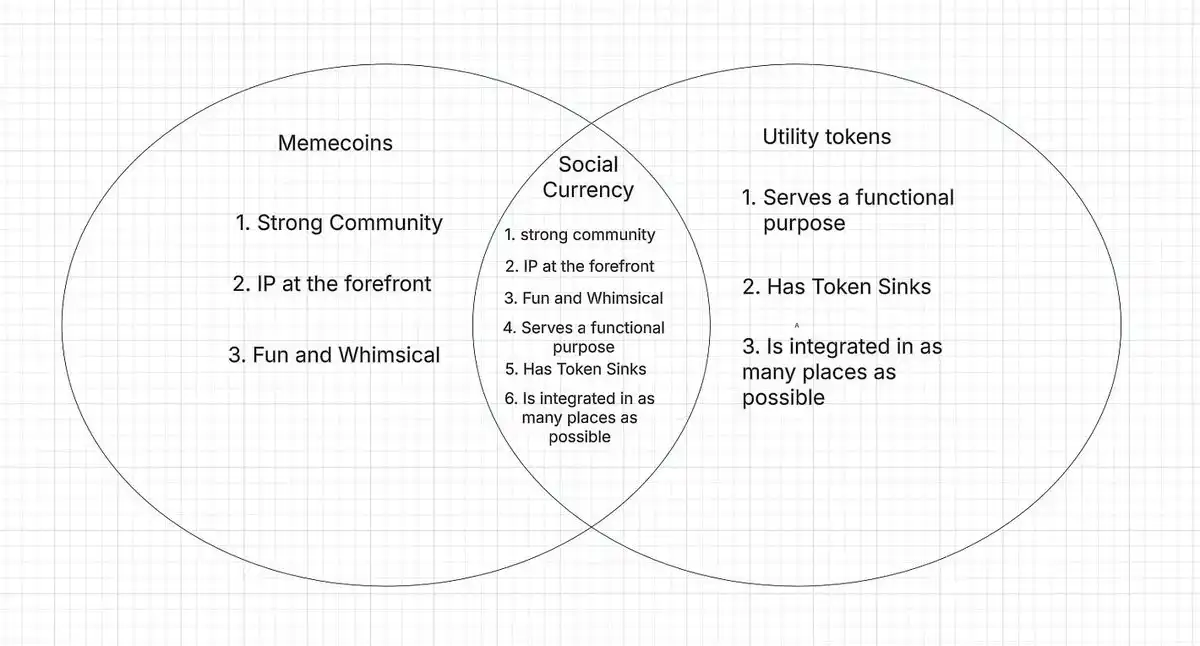
When dissecting the flaws of Meme coins, it is evident that they could be more potent, but we have allowed societal consensus to convince us that "Meme coins are supposed to be useless, it has always been that way." I personally refuse to accept this as the future standard for this field. To understand my frustration, we must first break down the current factors constraining Meme coins and how social currencies address these issues.

Flaws of Meme Coins

· Meme coins are prone to rug pulls: momentum fades, leading to a loss of driving force.

· Stigmatization: 99% of speculators incur losses as meme coins are not intended for long-term holding.

· PvP Mode: Designed for quick gains, turning into a game of musical chairs among existing holders.

· Lack of infrastructure to attract new users.

· Apart from a speculative narrative, meme coins lack genuine faith support — they lack fundamentals.

· Success often relies on fantasy and luck.

Advantages of Social Tokens

· Perceptiveness: Ability to both create and capture trends, maintaining sustained relevance.

· New narrative: Combining the longevity of meme coins with genuine fundamental growth support, suitable for long-term holding.

· PvE Mode: Aimed at driving industry development and attracting new users.

· Continuously creating demand through content strategies, brand partnerships, and IP growth.

· Building real-world assets beyond the industry to enhance holder identification and belief — establishing genuine faith foundations.

· Success is not reliant on luck or narrative but is supported by genuine fundamentals.
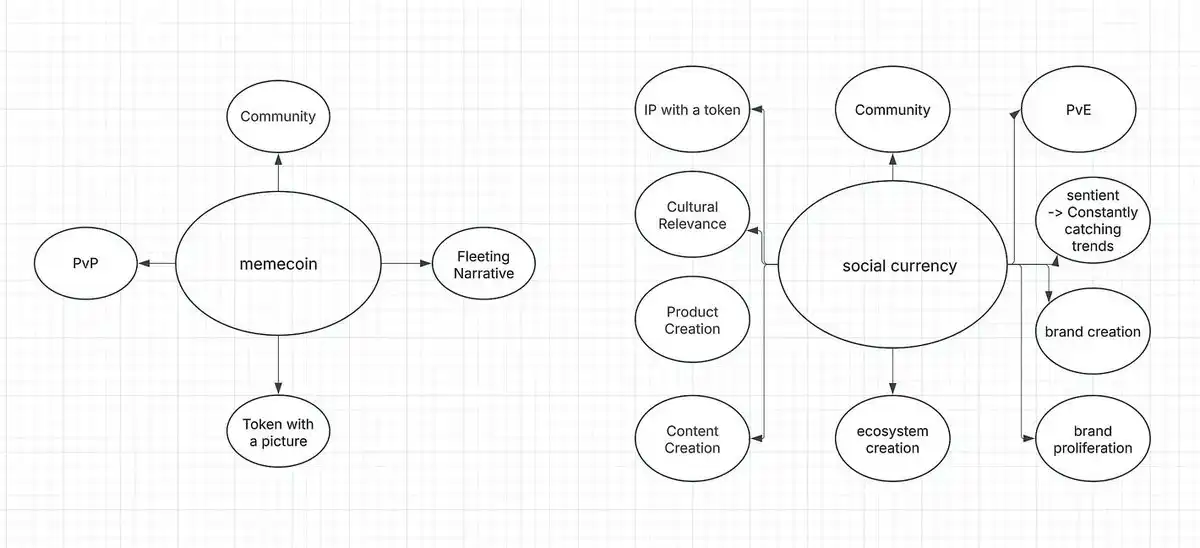
Perceptiveness vs. Non-Perceptiveness

For traders and investors, the core difference between meme coins and social tokens lies in perceptiveness — the ability to maintain continuous relevance. Social tokens possess perceptiveness, unlike meme coins, which is a key focus for traders. Perceptiveness = relevance = attention = potential energy. Unless you are a crypto legend (such as DOGE), anything non-perceptive will eventually fade away.

By this point, some may think, "I don't want meme coins to carry any execution risk."

This psychological warfare began with 2020 NFT art collectors, and I am surprised we have continued this narrative. My counterargument is simple: anything without execution risk solely relies on luck. Execution risk is the only risk worth taking. If your position does not rely on execution, I can say with 999,999 out of 1 million certainties that your performance will be inferior to those betting on execution (although I still wish you good luck).

The Future of Social Tokens

To achieve its true potential, a Meme coin needs to evolve into a social currency in its final chapter. Tokens that create culture, nurture deep community ties, and integrate real-world utility will define the new crypto era. Shifting from a stagnant speculative asset to a dynamic participatory ecosystem is not only necessary but also inevitable.

Now the question you need to ponder is: Who will lead this transformation?

Original Tweet

You may also like

Token Cannot Compound, Where Is the Real Investment Opportunity?

The next chapter in the crypto industry will undoubtedly be written by Crypto-empowered Stocks.

February 6th Market Key Intelligence, How Much Did You Miss?

1. On-chain Flows: $508.2M USD inflow to Ethereum today; $390.8M USD outflow from Arbitrum 2. Biggest Gainers/Losers: $HBTC, $AIO 3. Top News: Current Bitcoin weekly RSI oversold signal comparable to June 2022

China's Central Bank and Eight Other Departments' Latest Regulatory Focus: Key Attention to RWA Tokenized Asset Risk


Foreword: Today, the People's Bank of China's website published the "Notice of the People's Bank of China, National Development and Reform Commission, Ministry of Industry and Information Technology, Ministry of Public Security, State Administration for Market Regulation, China Banking and Insurance Regulatory Commission, China Securities Regulatory Commission, State Administration of Foreign Exchange on Further Preventing and Dealing with Risks Related to Virtual Currency and Others (Yinfa [2026] No. 42)", the latest regulatory requirements from the eight departments including the central bank, which are basically consistent with the regulatory requirements of recent years. The main focus of the regulation is on speculative activities such as virtual currency trading, exchanges, ICOs, overseas platform services, and this time, regulatory oversight of RWA has been added, explicitly prohibiting RWA tokenization, stablecoins (especially those pegged to the RMB). The following is the full text:


To the people's governments of all provinces, autonomous regions, and municipalities directly under the Central Government, the Xinjiang Production and Construction Corps:


  Recently, there have been speculative activities related to virtual currency and Real-World Assets (RWA) tokenization, disrupting the economic and financial order and jeopardizing the property security of the people. In order to further prevent and address the risks related to virtual currency and Real-World Assets tokenization, effectively safeguard national security and social stability, in accordance with the "Law of the People's Republic of China on the People's Bank of China," "Law of the People's Republic of China on Commercial Banks," "Securities Law of the People's Republic of China," "Law of the People's Republic of China on Securities Investment Funds," "Law of the People's Republic of China on Futures and Derivatives," "Cybersecurity Law of the People's Republic of China," "Regulations of the People's Republic of China on the Administration of Renminbi," "Regulations on Prevention and Disposal of Illegal Fundraising," "Regulations of the People's Republic of China on Foreign Exchange Administration," "Telecommunications Regulations of the People's Republic of China," and other provisions, after reaching consensus with the Cyberspace Administration of China, the Supreme People's Court, and the Supreme People's Procuratorate, and with the approval of the State Council, the relevant matters are notified as follows:


  I. Clarify the essential attributes of virtual currency, Real-World Assets tokenization, and related business activities


  (I) Virtual currency does not possess the legal status equivalent to fiat currency. Virtual currencies such as Bitcoin, Ether, Tether, etc., have the main characteristics of being issued by non-monetary authorities, using encryption technology and distributed ledger or similar technology, existing in digital form, etc. They do not have legal tender status, should not and cannot be circulated and used as currency in the market.


  The business activities related to virtual currency are classified as illegal financial activities. The exchange of fiat currency and virtual currency within the territory, exchange of virtual currencies, acting as a central counterparty in buying and selling virtual currencies, providing information intermediary and pricing services for virtual currency transactions, token issuance financing, and trading of virtual currency-related financial products, etc., fall under illegal financial activities, such as suspected illegal issuance of token vouchers, unauthorized public issuance of securities, illegal operation of securities and futures business, illegal fundraising, etc., are strictly prohibited across the board and resolutely banned in accordance with the law. Overseas entities and individuals are not allowed to provide virtual currency-related services to domestic entities in any form.


  A stablecoin pegged to a fiat currency indirectly fulfills some functions of the fiat currency in circulation. Without the consent of relevant authorities in accordance with the law and regulations, any domestic or foreign entity or individual is not allowed to issue a RMB-pegged stablecoin overseas.


(II)Tokenization of Real-World Assets refers to the use of encryption technology and distributed ledger or similar technologies to transform ownership rights, income rights, etc., of assets into tokens (tokens) or other interests or bond certificates with token (token) characteristics, and carry out issuance and trading activities.


  Engaging in the tokenization of real-world assets domestically, as well as providing related intermediary, information technology services, etc., which are suspected of illegal issuance of token vouchers, unauthorized public offering of securities, illegal operation of securities and futures business, illegal fundraising, and other illegal financial activities, shall be prohibited; except for relevant business activities carried out with the approval of the competent authorities in accordance with the law and regulations and relying on specific financial infrastructures. Overseas entities and individuals are not allowed to illegally provide services related to the tokenization of real-world assets to domestic entities in any form.


  II. Sound Work Mechanism


  (III) Inter-agency Coordination. The People's Bank of China, together with the National Development and Reform Commission, the Ministry of Industry and Information Technology, the Ministry of Public Security, the State Administration for Market Regulation, the China Banking and Insurance Regulatory Commission, the China Securities Regulatory Commission, the State Administration of Foreign Exchange, and other departments, will improve the work mechanism, strengthen coordination with the Cyberspace Administration of China, the Supreme People's Court, and the Supreme People's Procuratorate, coordinate efforts, and overall guide regions to carry out risk prevention and disposal of virtual currency-related illegal financial activities.


  The China Securities Regulatory Commission, together with the National Development and Reform Commission, the Ministry of Industry and Information Technology, the Ministry of Public Security, the People's Bank of China, the State Administration for Market Regulation, the China Banking and Insurance Regulatory Commission, the State Administration of Foreign Exchange, and other departments, will improve the work mechanism, strengthen coordination with the Cyberspace Administration of China, the Supreme People's Court, and the Supreme People's Procuratorate, coordinate efforts, and overall guide regions to carry out risk prevention and disposal of illegal financial activities related to the tokenization of real-world assets.


  (IV) Strengthening Local Implementation. The people's governments at the provincial level are overall responsible for the prevention and disposal of risks related to virtual currencies and the tokenization of real-world assets in their respective administrative regions. The specific leading department is the local financial regulatory department, with participation from branches and dispatched institutions of the State Council's financial regulatory department, telecommunications regulators, public security, market supervision, and other departments, in coordination with cyberspace departments, courts, and procuratorates, to improve the normalization of the work mechanism, effectively connect with the relevant work mechanisms of central departments, form a cooperative and coordinated working pattern between central and local governments, effectively prevent and properly handle risks related to virtual currencies and the tokenization of real-world assets, and maintain economic and financial order and social stability.


  III. Strengthened Risk Monitoring, Prevention, and Disposal


  (5) Enhanced Risk Monitoring. The People's Bank of China, China Securities Regulatory Commission, National Development and Reform Commission, Ministry of Industry and Information Technology, Ministry of Public Security, State Administration of Foreign Exchange, Cyberspace Administration of China, and other departments continue to improve monitoring techniques and system support, enhance cross-departmental data analysis and sharing, establish sound information sharing and cross-validation mechanisms, promptly grasp the risk situation of activities related to virtual currency and real-world asset tokenization. Local governments at all levels give full play to the role of local monitoring and early warning mechanisms. Local financial regulatory authorities, together with branches and agencies of the State Council's financial regulatory authorities, as well as departments of cyberspace and public security, ensure effective connection between online monitoring, offline investigation, and fund tracking, efficiently and accurately identify activities related to virtual currency and real-world asset tokenization, promptly share risk information, improve early warning information dissemination, verification, and rapid response mechanisms.


  (6) Strengthened Oversight of Financial Institutions, Intermediaries, and Technology Service Providers. Financial institutions (including non-bank payment institutions) are prohibited from providing account opening, fund transfer, and clearing services for virtual currency-related business activities, issuing and selling financial products related to virtual currency, including virtual currency and related financial products in the scope of collateral, conducting insurance business related to virtual currency, or including virtual currency in the scope of insurance liability. Financial institutions (including non-bank payment institutions) are prohibited from providing custody, clearing, and settlement services for unauthorized real-world asset tokenization-related business and related financial products. Relevant intermediary institutions and information technology service providers are prohibited from providing intermediary, technical, or other services for unauthorized real-world asset tokenization-related businesses and related financial products.


  (7) Enhanced Management of Internet Information Content and Access. Internet enterprises are prohibited from providing online business venues, commercial displays, marketing, advertising, or paid traffic diversion services for virtual currency and real-world asset tokenization-related business activities. Upon discovering clues of illegal activities, they should promptly report to relevant departments and provide technical support and assistance for related investigations and inquiries. Based on the clues transferred by the financial regulatory authorities, the cyberspace administration, telecommunications authorities, and public security departments should promptly close and deal with websites, mobile applications (including mini-programs), and public accounts engaged in virtual currency and real-world asset tokenization-related business activities in accordance with the law.


  (8) Strengthened Entity Registration and Advertisement Management. Market supervision departments strengthen entity registration and management, and enterprise and individual business registrations must not contain terms such as "virtual currency," "virtual asset," "cryptocurrency," "crypto asset," "stablecoin," "real-world asset tokenization," or "RWA" in their names or business scopes. Market supervision departments, together with financial regulatory authorities, legally enhance the supervision of advertisements related to virtual currency and real-world asset tokenization, promptly investigating and handling relevant illegal advertisements.


  (IX) Continued Rectification of Virtual Currency Mining Activities. The National Development and Reform Commission, together with relevant departments, strictly controls virtual currency mining activities, continuously promotes the rectification of virtual currency mining activities. The people's governments of various provinces take overall responsibility for the rectification of "mining" within their respective administrative regions. In accordance with the requirements of the National Development and Reform Commission and other departments in the "Notice on the Rectification of Virtual Currency Mining Activities" (NDRC Energy-saving Building [2021] No. 1283) and the provisions of the "Guidance Catalog for Industrial Structure Adjustment (2024 Edition)," a comprehensive review, investigation, and closure of existing virtual currency mining projects are conducted, new mining projects are strictly prohibited, and mining machine production enterprises are strictly prohibited from providing mining machine sales and other services within the country.


  (X) Severe Crackdown on Related Illegal Financial Activities. Upon discovering clues to illegal financial activities related to virtual currency and the tokenization of real-world assets, local financial regulatory authorities, branches of the State Council's financial regulatory authorities, and other relevant departments promptly investigate, determine, and properly handle the issues in accordance with the law, and seriously hold the relevant entities and individuals legally responsible. Those suspected of crimes are transferred to the judicial authorities for processing according to the law.


 (XI) Severe Crackdown on Related Illegal and Criminal Activities. The Ministry of Public Security, the People's Bank of China, the State Administration for Market Regulation, the China Banking and Insurance Regulatory Commission, the China Securities Regulatory Commission, as well as judicial and procuratorial organs, in accordance with their respective responsibilities, rigorously crack down on illegal and criminal activities related to virtual currency, the tokenization of real-world assets, such as fraud, money laundering, illegal business operations, pyramid schemes, illegal fundraising, and other illegal and criminal activities carried out under the guise of virtual currency, the tokenization of real-world assets, etc.


  (XII) Strengthen Industry Self-discipline. Relevant industry associations should enhance membership management and policy advocacy, based on their own responsibilities, advocate and urge member units to resist illegal financial activities related to virtual currency and the tokenization of real-world assets. Member units that violate regulatory policies and industry self-discipline rules are to be disciplined in accordance with relevant self-regulatory management regulations. By leveraging various industry infrastructure, conduct risk monitoring related to virtual currency, the tokenization of real-world assets, and promptly transfer issue clues to relevant departments.


  IV. Strict Supervision of Domestic Entities Engaging in Overseas Business Activities


(XIII) Without the approval of relevant departments in accordance with the law and regulations, domestic entities and foreign entities controlled by them may not issue virtual currency overseas.


  (XIV) Domestic entities engaging directly or indirectly in overseas external debt-based tokenization of real-world assets, or conducting asset securitization activities abroad based on domestic ownership rights, income rights, etc. (hereinafter referred to as domestic equity), should be strictly regulated in accordance with the principles of "same business, same risk, same rules." The National Development and Reform Commission, the China Securities Regulatory Commission, the State Administration of Foreign Exchange, and other relevant departments regulate it according to their respective responsibilities. For other forms of overseas real-world asset tokenization activities based on domestic equity by domestic entities, the China Securities Regulatory Commission, together with relevant departments, supervise according to their division of responsibilities. Without the consent and filing of relevant departments, no unit or individual may engage in the above-mentioned business.


  (15) Overseas subsidiaries and branches of domestic financial institutions providing Real World Asset Tokenization-related services overseas shall do so legally and prudently. They shall have professional personnel and systems in place to effectively mitigate business risks, strictly implement customer onboarding, suitability management, anti-money laundering requirements, and incorporate them into the domestic financial institutions' compliance and risk management system. Intermediaries and information technology service providers offering Real World Asset Tokenization services abroad based on domestic equity or conducting Real World Asset Tokenization business in the form of overseas debt for domestic entities directly or indirectly venturing abroad must strictly comply with relevant laws and regulations. They should establish and improve relevant compliance and internal control systems in accordance with relevant normative requirements, strengthen business and risk control, and report the business developments to the relevant regulatory authorities for approval or filing.


  V. Strengthen Organizational Implementation


  (16) Strengthen organizational leadership and overall coordination. All departments and regions should attach great importance to the prevention of risks related to virtual currencies and Real World Asset Tokenization, strengthen organizational leadership, clarify work responsibilities, form a long-term effective working mechanism with centralized coordination, local implementation, and shared responsibilities, maintain high pressure, dynamically monitor risks, effectively prevent and mitigate risks in an orderly and efficient manner, legally protect the property security of the people, and make every effort to maintain economic and financial order and social stability.


  (17) Widely carry out publicity and education. All departments, regions, and industry associations should make full use of various media and other communication channels to disseminate information through legal and policy interpretation, analysis of typical cases, and education on investment risks, etc. They should promote the illegality and harm of virtual currencies and Real World Asset Tokenization-related businesses and their manifestations, fully alert to potential risks and hidden dangers, and enhance public awareness and identification capabilities for risk prevention.


  VI. Legal Responsibility


  (18) Engaging in illegal financial activities related to virtual currencies and Real World Asset Tokenization in violation of this notice, as well as providing services for virtual currencies and Real World Asset Tokenization-related businesses, shall be punished in accordance with relevant regulations. If it constitutes a crime, criminal liability shall be pursued according to the law. For domestic entities and individuals who knowingly or should have known that overseas entities illegally provided virtual currency or Real World Asset Tokenization-related services to domestic entities and still assisted them, relevant responsibilities shall be pursued according to the law. If it constitutes a crime, criminal liability shall be pursued according to the law.


  (19) If any unit or individual invests in virtual currencies, Real World Asset Tokens, and related financial products against public order and good customs, the relevant civil legal actions shall be invalid, and any resulting losses shall be borne by them. If there are suspicions of disrupting financial order and jeopardizing financial security, the relevant departments shall deal with them according to the law.


  This notice shall enter into force upon the date of its issuance. The People's Bank of China and ten other departments' "Notice on Further Preventing and Dealing with the Risks of Virtual Currency Trading Speculation" (Yinfa [2021] No. 237) is hereby repealed.


Former Partner's Perspective on Multicoin: Kyle's Exit, But the Game He Left Behind Just Getting Started

Kyle knew his game, so he decided to focus on playing the game he was good at and interested in.

Why Bitcoin Is Falling Now: The Real Reasons Behind BTC's Crash & WEEX's Smart Profit Playbook

Bitcoin's ongoing crash explained: Discover the 5 hidden triggers behind BTC's plunge & how WEEX's Auto Earn and Trade to Earn strategies help traders profit from crypto market volatility.

Wall Street's Hottest Trades See Exodus

This time there is no single triggering factor, but rather market anxiety about asset valuation, with many already skeptical of these valuations being too high, leading to investors choosing to retreat almost simultaneously.

Popular coins

Latest Crypto News

Read more