
- Buy Crypto
- Markets
- Futures
- Spot
- Copy Trade
 Earn
Earn- More
From NVIDIA to Binance, Selling Shovels is the Ultimate Business Model

Original Title: "From NVIDIA to Binance, Selling Shovels Is the Ultimate Business Model"
Original Author: Liam, Deep Tide TechFlow
In 1849, during the California Gold Rush, countless people with dreams of striking it rich flocked to the American West.
German immigrant Levi Strauss had initially wanted to join the gold rush, but he keenly observed another business opportunity: miners' pants were frequently tearing and they urgently needed more durable workwear.
As a result, he crafted a batch of denim jeans and sold them specifically to gold prospectors, thus birthing a clothing empire named "Levi's." Meanwhile, the majority of those who had actually participated in the gold rush ended up empty-handed.
On November 20, 2025, NVIDIA once again delivered an "out-of-this-world" financial report.
Q3 revenue reached a record $57 billion, a 62% year-over-year increase; net profit was $31.9 billion, soaring 65% year-over-year. The latest generation GPU remained a scarce item that "money alone couldn't buy," with the entire AI industry working for it.
Meanwhile, in the cryptocurrency world across the cyber abyss, this same script was unfolding.
From the 2017 ICO bull market, to the 2020 DeFi summer, and then to the 2024 Bitcoin ETF and Meme wave, in every narrative and every wave of stories of sudden wealth, retail traders, project teams, and VCs kept rotating, but only platforms like Binance consistently stood at the top of the food chain.
History always rhymes.
From the 1849 California Gold Rush to the cryptocurrency frenzy and AI wave, the biggest winners are often not the direct competitors, the "gold miners," but rather those who provide them with the "shovels." Selling shovels is the ultimate business model for navigating cycles and harvesting uncertainty.
AI Gold Rush Enriches NVIDIA
In the public eye, the protagonist of this AI wave is undoubtedly large models represented by ChatGPT, intelligent beings that can write, draw, and code.
However, from a business and profit perspective, the essence of this AI wave is not an "application explosion" but an unprecedented revolution in computing power.
Similar to the California Gold Rush of the 19th century, tech giants such as Meta, Google, and Alibaba are all gold diggers, engaged in an AI gold rush.
Meta recently announced a whopping $72 billion investment in AI infrastructure this year and stated that next year's expenditure will be even higher. CEO Mark Zuckerberg said he would rather risk "missing out on hundreds of billions of dollars" than fall behind in the development of superintelligence.
Companies such as Amazon, Google, Microsoft, and OpenAI have all made record capital expenditures in the AI field.
The tech giants are going crazy, and Huang Renxun is grinning from ear to ear. He is the Levi Strauss of the AI era.
Every company that wants to build large models must massively purchase GPUs or rent GPU cloud services. Every model iteration consumes a huge amount of training and inference resources.
The model may not surpass its competitors, the application may not find a clear path to commercialization. You can start over, but the GPUs you bought and the computing power contracts you signed have already cost you a fortune.
In other words, when it comes to the proposition of "Can AI change the world" and "Can AI applications be profitable in the long term," everyone is still exploring. But as long as you want to participate in this game, you must first pay the "entry fee" to the computing power provider.
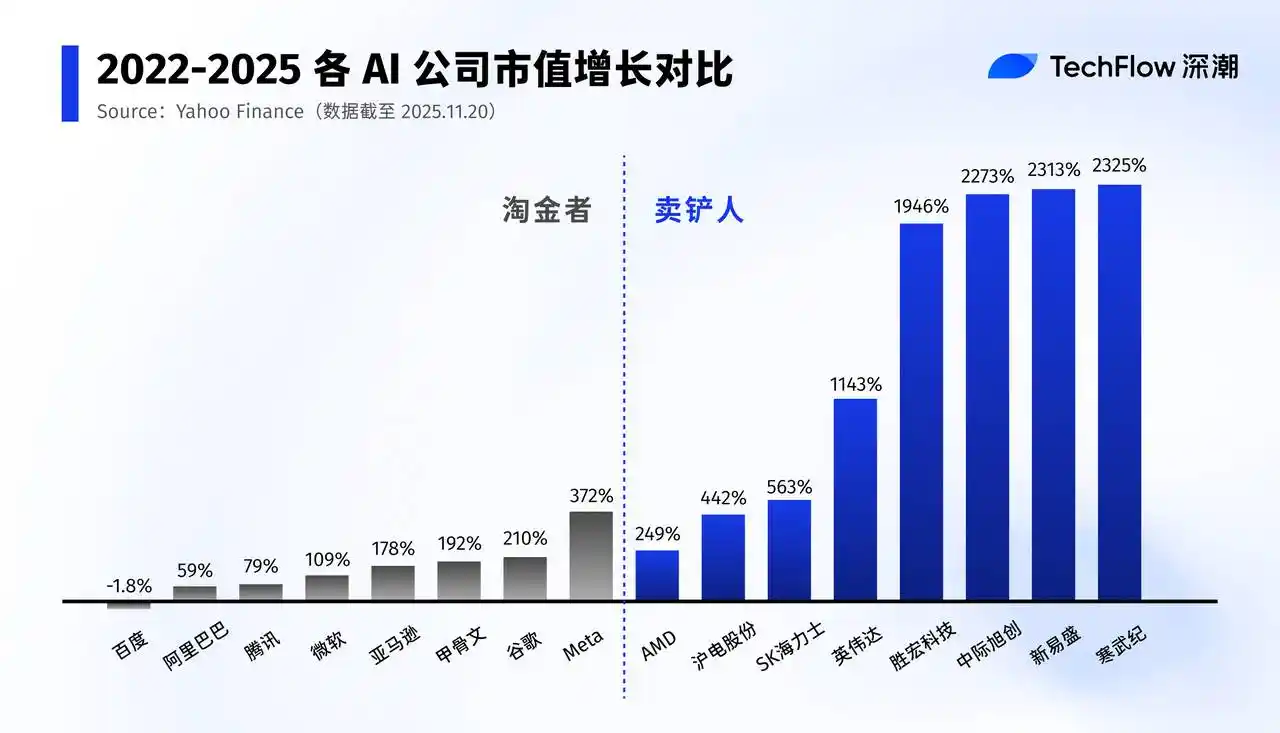
NVIDIA happens to sit at the very top of this computing power food chain.
It has almost monopolized the high-performance training chip market, with the H100, H200, and B100 becoming the "golden shovels" that AI companies compete for. It has extended its dominance from GPUs through software ecosystem (CUDA), development tools, and framework support, further forming a dual moat of technology and ecosystem.
It doesn't need to bet on which large model will win; it just needs the entire industry to continue to "gamble": to bet that AI can create a certain future and can support higher valuations and budgets.
In the traditional Internet, AWS from Amazon once played a similar role; whether a startup survives is one thing, but sorry, you first pay for the cloud resources you used.
Of course, NVIDIA is not alone; it has a whole "selling shovels supply chain" behind it, and they are also big winners who are secretly laughing under the AI wave.
GPUs require high-speed interconnects and optical modules. A-share companies such as InnoLight, IntelliFiber, and Transtek Communications have become an indispensable part of the "shovel," with their stock prices soaring several times this year.
Data center transformation requires a large number of server racks, power systems, and cooling solutions. From liquid cooling, power distribution to data center infrastructure, new industrial opportunities continue to emerge. Storage, PCB, connectors, packaging testing — all component manufacturers related to "AI servers" are taking turns reaping valuation and profit in this wave.
This is the terrifying aspect of the Shovel Seller model:
Miners may lose money, mining activities may fail, but as long as people keep mining, the shovel sellers will never lose.
While large models are still struggling to figure out "how to make money," the compute power and hardware chain have been steadily counting the cash.
Crypto Shovel Sellers
If NVIDIA is the shovel seller for AI, then who is the shovel seller for Crypto?
The answer is something everyone can guess: the exchange platforms.
The industry is always changing, with exchange platforms being the only constant money printer.
2017 was the first true global bull market in crypto history.
The barrier to entry for projects was extremely low, with a whitepaper and a few PPT slides being enough to start fundraising. Investors were crazily chasing after "tenfold or hundredfold coins," numerous tokens went from launch to zero, and most projects were frozen or delisted within 1-2 years, with even the founding teams disappearing from the timeline.
But listing fees were charged for project listings, users had to pay transaction fees, and futures contracts incurred fees based on position.
The token price could be halved and halved again, but the exchange platforms only needed to look at the trading volume to make a profit; the more frequent the trades, the more volatile the fluctuations, the more they earn.
In 2020, the DeFi summer arrived, and Uniswap challenged the traditional order book with the AMM model. Various mining, lending, and liquidity pools made people feel like "decentralized exchange platforms were no longer needed."
However, reality is very nuanced. A large amount of funds moved from centralized exchanges (CEX) to on-chain mining, only to return to CEX for risk control, cash-out, and hedging during peak periods and crashes.
In the narrative, DeFi is the future, but CEX remains the preferred entry point for deposits, withdrawals, hedging, and perpetual contract trading.
By 2024–2025, Bitcoin ETFs, the Solana ecosystem, and Meme 2.0 will once again push the crypto space to a climax.
Throughout this cycle, whether the narrative has shifted to "institutional entry" or "on-chain paradise," one fact has remained the same: there is still a large amount of leverage-seeking funds flowing to centralized exchanges; leverage, futures, options, perpetual contracts, and various structured products have formed the "profit moat" of exchanges.
Furthermore, CEXs have also integrated with DEXs at the product level, with trading on-chain assets in CEXs becoming the norm.
Price may fluctuate, projects may rotate, regulations may tighten, sectors may rotate, but as long as everyone is still trading, as long as volatility persists, the exchange will be the most stable "sell-shovel-in-a-gold-rush" player in this game.
In addition to exchanges, there are many other "sell-shovel" players in the crypto world:
For example, mining companies like Bitmain profit by selling mining rigs rather than mining, enabling them to remain profitable through multiple bull and bear cycles.
API service providers like Infura, Alchemy, benefit from the growth of blockchain applications;
Stablecoin issuers like Tether, Circle, profit from spreads and asset allocation, earning the "seigniorage of digital dollars";
Asset issuance platforms like Pump.Fun continue to tax through batch issuance of meme assets.
...
In these positions, they do not need to bet on which chain will win out each time or which meme will go viral, but as long as speculation and liquidity persist, they can stably mint money.
Why Is "Sell Shovel" the Most Bullish Business Model?
The real business world is much crueler than most people imagine; innovation is often a perilous endeavor, requiring not only individual effort but reliance on the processes of history.
For any cyclical industry, the outcome often looks like this:
Building upper-layer applications is like gold mining, pursuing Alpha (excess returns), you need to bet on the right direction, the right timing, defeat your opponents, with a very low success rate and high odds, a slight misjudgment can lead to a total loss;
Developing fundamental infrastructure is like being an upstream "sell-shovel" player, earning Beta, as long as the entire industry is still growing, as long as the player base continues to expand, you can reap the dividends of scale and network effects, sell-shovel players are in the business of probability, not luck.
Nvidia doesn't need to choose which AI big model will "take off," and Binance doesn't need to judge which narrative will last the longest.
They only need one condition: "Everyone keeps playing this game".
Moreover, once you are accustomed to NVIDIA's CUDA ecosystem, the migration cost is so high that it is unimaginable. Once your assets are all on a large exchange and you are used to its depth and liquidity, it is hard to readjust to a small exchange.
The endgame of selling shovels business is often a monopoly. And once the monopoly is established, pricing power is entirely in the hands of the sellers of shovels, just look at NVIDIA's staggering 73% gross margin.
To summarize with a very rough perspective:
The companies selling shovels earn the "industry existence tax," the gold rush companies earn the "time window dividend," they must capture the user's mind within a short window, or else be abandoned; the people creating content or narratives earn the "attention fluctuation money," once the trend shifts, the traffic immediately dissipates.
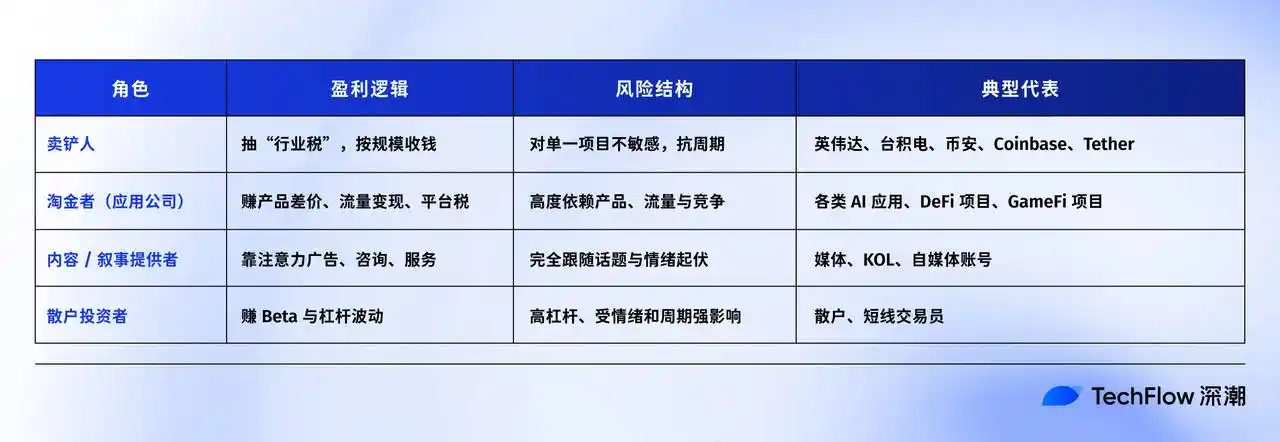
To put it more bluntly:
Selling shovels is betting on "this era will follow this path";
Building applications is betting on "everyone will choose only me".
The former is a macro proposition, the latter is a brutal elimination game. Therefore, from the perspective of probability theory, the winning rate of selling shovels is an order of magnitude higher.
For us retail investors or entrepreneurs, this is also a profound insight: If you cannot see who the ultimate winner is, or do not know which asset will continue to multiply, then invest in the one that provides water to all miners, sells shovels, or even just sells jeans.
Finally, sharing one more piece of data: Ctrip's Q3 net profit of 19.919 billion surpassed Maotai (19.2 billion) and Xiaomi (11.3 billion).
Don't just focus on who shines the brightest in the story,
Think about who can continue to charge in all stories.
In an era of fanaticism, serving the fanatics but staying calm is the highest wisdom in business.
You may also like

Russia’s Largest Bitcoin Miner BitRiver Faces Bankruptcy Crisis – What Went Wrong?
Key Takeaways BitRiver, the largest Bitcoin mining operator in Russia, faces a bankruptcy crisis due to unresolved debts…

Polymarket Predicts Over 70% Chance Bitcoin Will Drop Below $65K
Key Takeaways Polymarket bettors forecast a 71% chance for Bitcoin to fall below $65,000 by 2026. Strong bearish…

BitMine Reports 4.285M ETH Holdings, Expands Staked Position With Massive Reward Outlook
Key Takeaways BitMine Immersion Technologies holds 4,285,125 ETH, which is approximately 3.55% of Ethereum’s total supply. The company…

US Liquidity Crisis Sparked $250B Crash, Not a ‘Broken’ Crypto Market: Analyst
Key Takeaways: A massive $250 billion crash shook the cryptocurrency markets, attributed largely to liquidity issues in the…

Vitalik Advocates for Anonymous Voting in Ethereum’s Governance — A Solution to Attacks?
Key Takeaways Vitalik Buterin proposes a two-layer governance framework utilizing anonymous voting to address collusion and capture attacks,…

South Korea Utilizes AI to Pursue Unfair Crypto Trading: Offenders Face Severe Penalties
Key Takeaways South Korea is intensifying its use of AI to crack down on unfair cryptocurrency trading practices.…

Average Bitcoin ETF Investor Turns Underwater After Major Outflows
Key Takeaways: U.S. spot Bitcoin ETFs hold approximately $113 billion in assets, equivalent to around 1.28 million BTC.…

Japan’s Biggest Wealth Manager Adjusts Crypto Strategy After Q3 Setbacks
Key Takeaways Nomura Holdings, Japan’s leading wealth management firm, scales back its crypto involvement following significant third-quarter losses.…
CFTC Regulatory Shift Could Unlock New Opportunities for Coinbase Prediction Markets
Key Takeaways: The U.S. Commodity Futures Trading Commission (CFTC) is focusing on clearer regulations for crypto-linked prediction markets,…
Hong Kong Set to Approve First Stablecoin Licenses in March — Who’s In?
Key Takeaways Hong Kong’s financial regulator, the Hong Kong Monetary Authority (HKMA), is on the verge of approving…

BitRiver Founder and CEO Igor Runets Detained Over Tax Evasion Charges
Key Takeaways: Russian authorities have detained Igor Runets, CEO of BitRiver, on allegations of tax evasion. Runets is…

Crypto Investment Products Struggle with $1.7B Outflows Amid Market Turmoil
Key Takeaways: The recent $1.7 billion outflow in the crypto investment sector represents a second consecutive week of…

Why Is Crypto Down Today? – February 2, 2026
Key Takeaways: The crypto market has seen a downturn today, with a significant decrease of 2.9% in the…

Nevada Court Temporarily Bars Polymarket From Offering Contracts in the State
Key Takeaways A Nevada state court has temporarily restrained Polymarket from offering event contracts in the state, citing…

Bitcoin Falls Below $80K As Warsh Named Fed Chair, Triggers $2.5B Liquidation
Key Takeaways Bitcoin’s price tumbled below the crucial $80,000 mark following the announcement of Kevin Warsh as the…

Strategy’s Bitcoin Holdings Face $900M in Losses as BTC Slips Below $76K
Key Takeaways Strategy Inc., led by Michael Saylor, faces over $900 million in unrealized losses as Bitcoin price…
Trump-Linked Crypto Company Secures $500M UAE Investment, Sparking Conflict Concerns
Key Takeaways A Trump-affiliated crypto company, World Liberty Financial, has garnered $500 million from UAE investors, igniting conflict…

Billionaire Michael Saylor’s Strategy Buys $75M of More Bitcoin – Bullish Signal?
Key Takeaways Michael Saylor’s firm, Strategy, has significantly increased its Bitcoin holdings by acquiring an additional 855 BTC…
Russia’s Largest Bitcoin Miner BitRiver Faces Bankruptcy Crisis – What Went Wrong?
Key Takeaways BitRiver, the largest Bitcoin mining operator in Russia, faces a bankruptcy crisis due to unresolved debts…
Polymarket Predicts Over 70% Chance Bitcoin Will Drop Below $65K
Key Takeaways Polymarket bettors forecast a 71% chance for Bitcoin to fall below $65,000 by 2026. Strong bearish…
BitMine Reports 4.285M ETH Holdings, Expands Staked Position With Massive Reward Outlook
Key Takeaways BitMine Immersion Technologies holds 4,285,125 ETH, which is approximately 3.55% of Ethereum’s total supply. The company…
US Liquidity Crisis Sparked $250B Crash, Not a ‘Broken’ Crypto Market: Analyst
Key Takeaways: A massive $250 billion crash shook the cryptocurrency markets, attributed largely to liquidity issues in the…
Vitalik Advocates for Anonymous Voting in Ethereum’s Governance — A Solution to Attacks?
Key Takeaways Vitalik Buterin proposes a two-layer governance framework utilizing anonymous voting to address collusion and capture attacks,…
South Korea Utilizes AI to Pursue Unfair Crypto Trading: Offenders Face Severe Penalties
Key Takeaways South Korea is intensifying its use of AI to crack down on unfair cryptocurrency trading practices.…


 App
App