
From P2P to RWA: Financial Innovation and Inclusive Model Restructuring in the Virtual Asset Era


Original Title: "From P2P to RWA: Financial Innovation and Inclusive Model Reconstruction in the Virtual Asset Era"
Original Author: Yekai (WeChat/Twitter: YekaiMeta)
Introduction
Recently, several RWA projects have been related to P2P and consumer finance, so I will take this opportunity to summarize some design ideas.
As an important model of Internet finance, P2P has its innovative rationale as well as driving force and limitations.
What we are considering is: can RWA, as blockchain-driven financial innovation, reconstruct the P2P model to promote inclusive finance development?
From an inclusive perspective, can small and medium-sized enterprise assets, individual assets, and retail investors be combined with AI intelligent agents and smart devices to achieve permissionless RWA asset intelligent issuance and transaction investment matching?
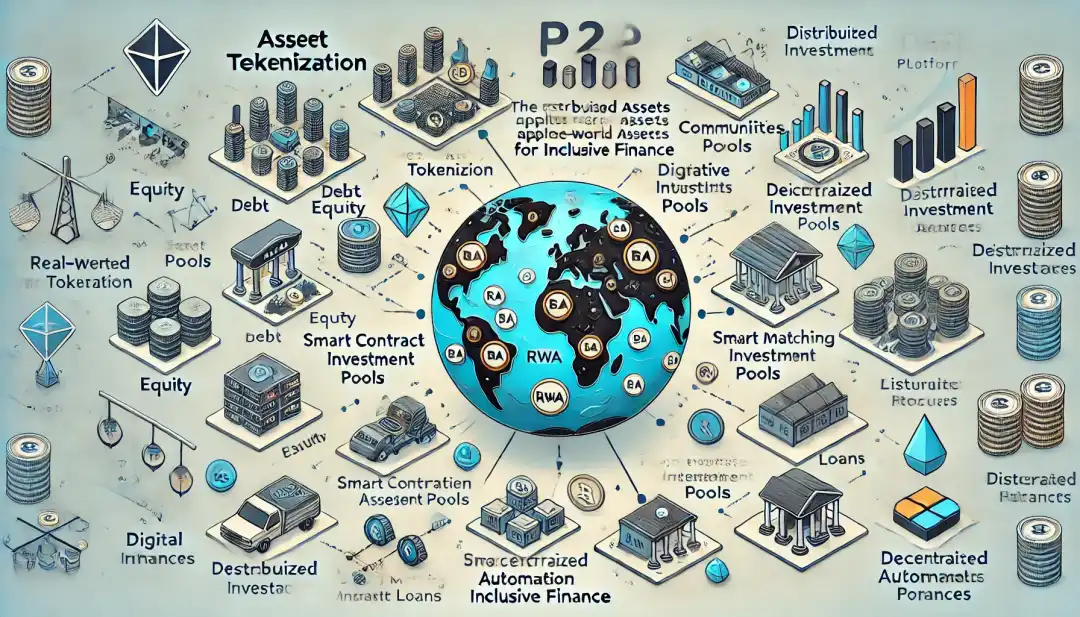
Currently, in the first stage of RWA (Real World Asset Tokenization), financial market products such as funds, bonds, and stocks mainly target the institutional market, and the participation and actions of these institutions are crucial. However, in the long term, individual retail users will be more suitable for RWA, so the second stage will further target the retail market, possibly leaning towards something like T-P2P (Tokenization of P2P), becoming an effective new financial tool for retail investors, small and medium-sized enterprises, and individual assets.
Because traditional RWAs are often assets in the institutional market such as bonds, stocks, oil and gas, commodities, and precious metals, these assets are usually difficult for ordinary individual investors to participate in. However, drawing from the P2P (peer-to-peer) model, these traditional assets can be made more inclusive through RWA tokenization, breaking the traditional investment threshold, allowing everyone to participate.
Part One: Development Background and Market Pain Points of Internet Finance P2P
1. Development Background of P2P
People have a strong aversion to P2P mainly because P2P platforms used to frequently default and face regulatory compliance issues. This situation is not a problem with the P2P model itself but is due to the combined effect of multiple factors: imperfect risk management, irregular platform operations, lack of effective regulation, intense competition, and immature business models, among others. The accumulation of these issues eventually led to the collapse of the P2P platform's funding chain, undermining investor trust and hindering the industry's healthy development.
If these issues can be addressed, strengthening regulation, enhancing platform transparency, and improving risk control measures can ensure that P2P platforms operate reasonably within a compliant and ethical framework. We need to recognize the pain points of the traditional financial system: In some aspects, the traditional financial system cannot fully meet the needs of consumers and businesses, especially for those who have difficulty accessing banking services, such as underserved populations and small and micro-enterprises.
· High Costs and Inefficiency: Traditional financial institutions (such as banks), acting as intermediaries, often charge high fees and have slower processing speeds. Especially in lending services, cross-border payments, or small-value transactions, intermediary fees and processing times become significant obstacles. The P2P model, by eliminating intermediaries, reduces transaction costs and improves efficiency.
· Financial Services Inequality: Many residents in many countries or regions, especially in developing countries, often cannot access traditional bank financial services. P2P platforms break the limitations of the traditional financial system, enabling more people to participate in financial services. For example, a P2P lending platform can provide loan services to users without bank accounts. Market Demand Changes As the global economy continues to evolve, changes in market demand have also driven the rapid development of P2P.
• Personalized and Flexible Financial Needs: Consumers and small businesses have increasingly diverse financial service needs, and traditional bank products are often rigid and cannot fully meet market demands. The flexibility and personalization of P2P lending, P2P payments, and other services fill this gap.
• Low-Interest Rate Environment: The low-interest rate policies of central banks worldwide have resulted in low returns on traditional investment channels, especially when deposit rates are close to zero, and China's savings rates are continuously decreasing. In this environment, P2P platforms provide investors with higher return opportunities while offering borrowers relatively low financing costs.
2. P2P Market Pain Points
We will not delve into the details of the P2P market but have summarized several core market pain points in combination with the previous background of platform crises and regulatory purges as a reference for learning.
• Information Asymmetry: There is a lack of transparent information sharing between borrowers and investors, leading to credit risk accumulation. One of the primary reasons for platform crises is self-lending and self-investment.
• Risks of Fund Pool Models: Some P2P platforms have misappropriated funds in their operations.
• High Default Rates and Inadequate Risk Control: The platform's credit assessment mechanism is immature, leading to high default risks.
• Lack of Compliance: The lack of global P2P regulation or its lagging behind has led to frequent industry collapses.
• Lack of Liquidity: Investor funds are often locked up, and the exit mechanism is not flexible enough.
Part Two: A Comparative Analysis of P2P and RWA
Can the P2P (Peer-to-Peer) financial lending model and RWA tokenization learn from each other and progress? What are their similarities and innovations?
1. Similarities
• Shared Goal: Both aim to break traditional financial barriers and ultimately serve small investors and asset borrowers.
• Inclusivity: By innovating to lower the participation threshold, they increase funding and investment opportunities.
• Disintermediation: Reduce the high cost of traditional financial institutions as intermediaries and simplify processes through technological means (one through Internet technology, the other through blockchain technology).
2. Innovations
• Technological Foundation: P2P is based on the Internet and platform algorithms, while RWA relies on blockchain technology.
• Transparency: P2P has lower information transparency, whereas RWA provides full-chain transparency through the blockchain.
• Liquidity: P2P has poorer liquidity, and RWA improves asset liquidity through asset tokenization and decentralized trading platforms.
• Risk Management: P2P relies on centralized risk control teams, while RWA automatically enforces risk control rules through smart contracts and transparent on-chain mechanisms.
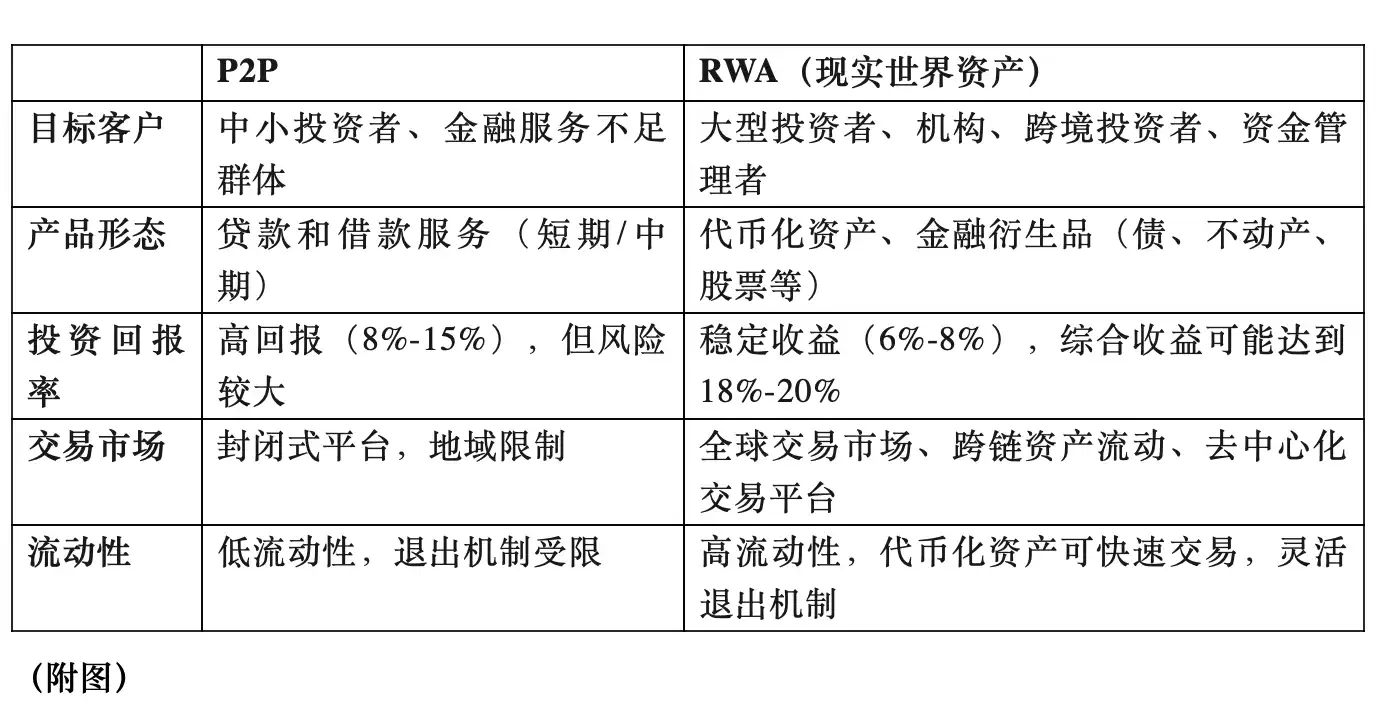
P2P (Peer-to-Peer) and RWA (Real World Assets) as two distinct financial models have significant differences in target customer base, product form, investment return, trading market, and liquidity.
We conduct a comprehensive comparative analysis of P2P and RWA from these 5 angles to help understand the core differences between the two and their respective strengths and limitations.
1. Target Customer Base
P2P
• Mainly Targeting Small and Medium Investors and Borrowers: The core customer base of P2P platforms is often those who cannot access loans through traditional financial channels, such as small and medium-sized enterprises or individuals, while also attracting retail investors seeking high returns.
• Underserved Financially: Particularly suitable for those excluded from the traditional financial system, such as individuals with poor credit or no bank account.
• Users with High Risk Tolerance: P2P platforms attract investors willing to take on higher risk due to their high-interest rates.
RWA
• Targeting a Diverse Investor Base: RWA platforms mainly cater to institutional investors from the traditional financial markets, large enterprises, and new types of investors seeking asset tokenization. Through tokenization, ordinary investors can also participate.
• Investors with Strong Financial Capacity and Risk Management Awareness: Investors usually need a certain level of capital and risk appetite, especially in asset tokenization selection and market volatility management.
• Cross-Border Investors: The RWA model is particularly suitable for investors seeking cross-border investment, asset diversification, higher liquidity, or digital asset investors, and Crypto Funds.
2. Product Forms
P2P
• Loan Products: The main products of P2P platforms are loan services, usually short-term or medium-term loans. Investors can invest in different loan projects based on their risk appetite.
• Unsecured/Secured Loans: Most P2P platforms offer both unsecured and secured loans, with borrowers deciding whether to provide collateral based on their credit and asset situation.
RWA
• Tokenized Asset Products: RWA platforms create a new form of assets by tokenizing traditional assets (such as bonds, stocks, mineral resources, real estate, etc.). Investors can invest in tokenized assets using fiat currency or stablecoins and enjoy the returns from these assets.
• Financial Derivatives and Derivative Products: In addition to basic tokenized assets, an RWA platform can also offer more complex financial products through derivatives (such as collateralized lending, DeFi, etc.) to meet the needs of sophisticated investors.
3. Return on Investment
P2P
• High Returns: P2P platforms typically offer higher returns compared to traditional bank savings or bonds. The annualized return rate is generally between 8% - 15%, depending on the borrower's credit rating and the loan project's risk.
• High Risk High Return: P2P platforms experience significant return rate fluctuations due to the varying risk profiles of borrowers. Loan defaults or delinquencies can impact the overall return.
RWA
• Stable Income: Tokenized assets on RWA platforms typically offer a more stable annualized return rate, especially for fixed income products such as bonds, real estate, etc. The annual return rate is usually around 6% - 8%, and is generally influenced by market risk and asset quality with minimal fluctuations.
• High Return Potential: Through the tokenization of high-return assets (such as corporate bonds, real estate, etc.), investors may benefit from participating in the secondary market liquidity and secondary market premiums of RWA assets, achieving returns higher than traditional investments. The overall yield sometimes can reach 10% - 20% or higher (depending on secondary market conditions and asset quality).
4. Trading Market
P2P
• Closed Trading Market: P2P platforms typically operate as a closed market where internal matching trades occur. Transactions between borrowers and investors can only take place within the platform, and the platform needs to manage the matching system.
• Geographic Restrictions: The trading market of P2P platforms is often subject to legal and policy restrictions of the country/region, especially in cross-border transactions involving complex compliance issues.
RWA
• Globalized Trading Market: Trading of RWA tokenized assets usually occurs across multiple platforms and may even support international transactions. Investors can trade through decentralized trading platforms (such as DeFi) and licensed virtual asset trading platforms or cryptocurrency exchanges.
• Asset Liquidity Enhancement: The RWA platform supports transactions between traditional assets and crypto assets, enabling assets with originally low liquidity (such as real estate, bonds, etc.) to circulate and be traded globally, even across fiat and digital currencies.
5. Liquidity
P2P
• Low Liquidity: The liquidity of P2P platforms is relatively low, and investors often need to wait for the borrower's repayment or the end of the loan term to reclaim their funds. When the investment project has a long-term setting, liquidity issues become more prominent.
• Limited Exit Mechanism: The exit mechanism provided by P2P platforms usually relies on the platform's secondary market or investor trading demand, but these markets have poor liquidity.
RWA
• High Liquidity: Through asset tokenization, the RWA platform significantly enhances the liquidity of traditional assets. After asset tokenization, if a well-designed secondary market and aftermarket exist, transactions can occur across chain and cross-platform, offering higher liquidity than traditional financial markets.
• Flexible Exit Mechanism: Investors can exit through the RWA trading platform or decentralized exchanges at any time, and even automatically exit investments under specific conditions through smart contracts (OTC or Swap), enhancing fund liquidity and market participation.
After a comprehensive comparative analysis, it is concluded that P2P and RWA each have their advantages. P2P is more suitable for small investors seeking high-risk, high-return investments, while RWA provides institutional investors and cross-border investors with a more stable, higher liquidity, and more transparent asset investment platform. Combined with blockchain technology, the RWA model can better meet modern investors' needs for liquidity, returns, and compliance, theoretically becoming an upgraded version of the P2P model.
Part III: Proposed Solution – How Can RWA Restructure the P2P Model in the Virtual Asset Era?
In the era of virtual assets, RWA (Real World Assets) has redefined the boundaries of financial services through asset tokenization, smart contracts, and blockchain technology, making it possible to be designed as an upgraded version of the P2P model.
The key innovations of RWA are: Firstly, it expands the traditional single-lending model into a diversified asset investment platform, tokenizing diversified assets such as bonds, stocks, real estate, and minerals, effectively lowering the investment threshold and achieving true inclusive finance. Secondly, it introduces a DAO mechanism to replace the centralized control of traditional platforms with community governance, enhancing governance transparency and investor trust;
At the same time, through blockchain technology to comprehensively record transaction information and asset details, it thoroughly solves the information asymmetry problem of traditional P2P; furthermore, through DeFi platforms to achieve multi-platform circulation and secondary market trading of tokenized assets, significantly enhancing asset liquidity, addressing the traditional P2P exit dilemma; smart contract technology automates the execution of lending agreements, asset collateralization, and default processing, significantly improving risk control effectiveness and reducing risks from manual operations; finally, RWA's cross-border tokenization design ensures that global investors can participate in compliance, effectively overcoming the geographical restrictions of traditional P2P.
Therefore, RWA not only innovates asset forms and governance structures but also represents a comprehensive upgrade of the traditional P2P model, ushering in a new chapter of inclusive finance in the era of virtual assets. Learning from the P2P model, transforming RWA into digital inclusive financial products, in the first phase of the institutional market, based on RWA products such as bonds and stocks, how to learn from the P2P (peer-to-peer) model, through RWA tokenization intermediation, to achieve the RWA of the second stage—retail individual investors, making traditional assets more inclusive and accessible to everyone, allowing everyone to participate and benefit, and constructing a feasible path for digital inclusive financial product development.
1. Asset Tokenization: Transforming Traditional Assets into Digital Assets
• Tokenizing RWA Assets: Tokenize traditional RWA assets (such as bonds, equities, precious metals, etc.), with each RWA token representing a relatively low-granularity value of the asset unit, allowing investors to purchase these RWA tokens with small amounts of funds without requiring a large amount of capital or complex financial knowledge.
• Debt Asset Tokenization: Convert corporate bonds, government bonds, etc., into tokens, enabling investors to purchase and share the bond's yield with minimal amounts of funds.
• Commodity Asset Tokenization: For example, tokenizing bulk commodities such as gold, oil, etc., allows ordinary investors to participate in the returns of these assets by purchasing these tokens.
• Stock and Equity Tokenization: Tokenizing shares of public or private companies into small units, making it easier for ordinary investors to invest at a lower cost.
2. Decentralized Finance Platform (DeFi): Enhancing Transparency and Liquidity
• Decentralized Exchange Platform: Drawing on the decentralized concept of the P2P model and combining it with the blockchain-based DeFi model, allowing investors to directly engage in trading RWA tokens on the platform. Transactions are automatically executed through smart contracts, ensuring transparency and efficiency.
• Market Liquidity: The decentralized exchange platform (DEX) will serve as a trading platform for RWA tokenized assets. Investors can enter or exit the market at any time, free from traditional market constraints. Liquidity pools and Automated Market Makers (AMM) will provide sufficient liquidity for RWA tokens, ensuring the smooth operation of the market.
• Lending Platform: Through smart contracts, investors can not only invest in purchasing RWA tokens but also utilize the lending feature to collateralize RWA assets for liquidity, thereby increasing capital efficiency.
3. Distributed Scenario Investment: Distributed Asset Pool and Micro Investment Threshold
• Fractionalized Investment Products: Leveraging tokenization technology, large assets (such as real estate, minerals, energy, etc.) are divided into smaller units, creating micro-investment products. Each token has a very low face value (e.g., a few dollars), allowing the general public to invest with small amounts of funds.
• Distributed Scenario Products: The most common scenarios in consumer finance are mobile consumer loans and used car consumer loans, where the assets are characterized by decentralization and small amounts, but all have smart devices like mobile locks or car locks (BOM) and DePIN conditions. This enables on-chain RWA distributed asset pools and distributed capital pools, allowing ordinary retail investors to participate in the investment pool in small, distributed amounts, while large Crypto Funds can also underwrite.
• Regular Income Distribution: Investors receive regular income distributions based on the amount of RWA tokens they hold. For example, users holding RWA tokens receive proportionate rental income, dividends, or loan interest from the RWA assets.
• Lowering Investment Thresholds: This fractionalized investment approach allows any ordinary investor to participate in assets that are typically only accessible to institutions with very small amounts of money.
4. AI Smart Entity Automated Issuance and Asset Management
• Automated Issuance by AI Smart Entities: Small and medium-sized enterprises and individual assets, which cannot issue independently due to scale and issuance costs, can leverage an RWA asset management platform that integrates AI agents and DePIN smart device technology. Based on permissionless consensus protocols, this platform uses AI agent functionality to automate Launchpad, issue distributed assets, and validate nodes.
• Intelligent Algorithmic Asset Management of Distributed Asset Pools: Since it involves decentralized, small-denomination, various types of assets, and may even consist mostly of non-standard assets, there needs to be a distributed asset protocol and AI Agent to support asset classification, dynamic pricing, intelligent Total Asset Management (TAM), intelligent matching of investments, etc.
• AI Agent's AMM and Liquidity Pool: Smart matching trading and smart trading agents on non-trading platforms, even arbitrage trading robots, enabling decentralized small-denomination assets and funds to leverage digital currencies (such as USDT/USDC) and opportunities for inclusive finance achieved through social investment platforms, AI Agents, etc.
5. Community-Driven and Collective Wisdom: Enhancing User Engagement
• Decentralized Community Governance: Truly implement the community governance mindset from P2P into RWA investment products, allowing RWA token holders to actively participate in decision-making and governance. For example, investors can vote through a DAO (Decentralized Autonomous Organization) to decide on the management, appreciation, and distribution strategies of certain RWA assets. Community members can share investment information with each other, helping newcomers better understand the market.
• Community Incentive Mechanism: By incentivizing users to participate and promote the platform through social sharing, referrals, etc. The "social referral" model in P2P can be reused here, where an RWA asset management platform can incentivize investors to share information and onboard new users through a reward mechanism (such as an RWA Asset Management Platform Token).
6. Risk Control and Compliance: Ensuring Investment Security
• Smart Contracts and Risk Management: Implement automated risk control mechanisms through smart contracts. Each RWA token will have risk control rules, such as credit assessment of borrowers and investors, asset collateralization, and liquidation rules, all of which can be automatically enforced through smart contracts, thus reducing default risks.
• Tiered Risk and Reward Products: To meet the risk tolerance of different investors, an RWA asset management platform can design different levels of investment products. For example, basic-level investors can choose low-risk assets (such as government bonds or high-quality corporate bond tokens), while high-risk investors can opt for high-return digital securities or equity tokens.
• Compliance and Regulation: An RWA asset management platform needs to adhere to relevant financial regulations to ensure the compliance of asset tokenization, trading, cross-border payments, etc., to prevent exploitation by malicious actors and safeguard users' legal rights.
7. Payments and Settlement: Bridging Digital and Fiat Currencies
• Fiat and Digital Asset Bridge: To ensure the inclusivity of the platform, it is necessary to facilitate the circulation between fiat currency and digital assets on the platform. Users can purchase RWA tokens using fiat currency (such as USD, RMB, etc.) or convert cryptocurrencies (such as Bitcoin, Ethereum, etc.) into RWA assets.
• Multi-Currency Support: The platform can support the exchange of various digital currencies with fiat currency based on RWA assets, enhancing the platform's cross-border liquidity. Especially when facing cross-border investments, it provides convenient payment solutions.
Design Summary: The RWA product design in digital inclusive finance draws on the P2P model, combining blockchain technology and RWA tokenization. This design enables ordinary people to participate in traditional asset investment that was previously difficult to access, reducing investment barriers, improving transparency and liquidity, while ensuring compliance and risk control mechanisms. This not only provides ordinary investors with more diverse investment opportunities but also drives the decentralized development of global finance, achieving true digital inclusive finance. This "T-P2P" digital inclusive finance product based on RWA tokenization, DePIN smart devices, AI Agents, smart contracts, and decentralized governance can break the boundaries of traditional investment, allowing more people to equally participate, invest, and trade in a globalized market.
Part Four: Challenges and Feasibility Analysis of RWA
When analyzing the feasibility of RWA as an alternative and upgrade to the P2P era of virtual assets, we must also address the many challenges RWA currently faces. There is still a long way to go. Potential Challenges
1. Regulatory Barriers: Tokenizing cross-border assets involves complex legal and tax compliance issues. Regulatory framework disparities across different countries create regulatory uncertainties for globally tokenized RWA assets.
2. Technical Implementation: While blockchain technology has provided new opportunities for RWA tokenization, the high cost and complexity of combining technologies such as Layer2, distributed protocols, DePIN, and AI Agents remain obstacles to large-scale implementation. The widespread adoption and performance optimization of technology will be crucial in achieving this goal.
3. User Education: The general public has a low understanding of blockchain technology and RWA tokenization products. Extensive education and promotion efforts are needed to help investors understand the risks and opportunities of emerging technologies and investment models.
4. Market Acceptance: As a new investment and financing model, the ability of RWA to attract traditional financial users is still uncertain. Its acceptance and prevalence need to gradually establish trust through practice and market validation. Feasibility analysis, combined with case studies and data analysis, shows that RWA has significant technological advantages, economic benefits, and regulatory potential over traditional P2P models.
Compared to the P2P model, RWA can provide higher transparency, better risk management mechanisms, and more efficient asset liquidity, especially with unique advantages in cross-border and cross-chain transactions. In terms of economic benefits, RWA has optimized asset management and revenue distribution through tokenization and smart contracts, significantly reducing operational costs. Furthermore, in global compliance, RWA has greater potential than the P2P model, able to provide global investors with compliant, transparent financial services, thereby enhancing market attractiveness and user engagement.
Final Conclusion: Can RWA Replace and Redefine the P2P Era of Virtual Assets?
• Comprehensive View: RWA not only addresses the pain points of P2P platforms but also achieves further innovation in inclusive finance through blockchain technology. Its advantages in transparency, liquidity, risk management, and diversified investment opportunities can allow ordinary investors to access more financial assets.
• Future Outlook: The widespread adoption of RWA requires the collective drive of technology, regulation, and user education. If existing challenges can be overcome, RWA is poised to become the "new P2P" of the virtual asset era, creating a more fair, open, and efficient new financial ecosystem for global users.
#ARAW Always RWA Always Win!
By 2025, the RWA market will quickly find its place in rapid growth. WeChat cannot answer questions one by one. After the core disciple class, there will be a partner class and a listed company research camp. If you have needs or questions, you can bring them to the classroom for serious learning and interactive discussions and scenario simulations. Friends who are interested in understanding RWA and initiating RWA projects are welcome to reply "Course" or "Sign Up" in the official account to join the course preparation group, or long-press the QR code image below to join the RWA course discussion group.
You may also like

The AI gamble of mining companies: Valuations enter a phase of differentiation, and it's hard to turn the tide

A letter from Alliance to entrepreneurs: Written on the occasion of Cursor selling for 60 billion dollars

Stablecoins Finally Find Real Returns: On-Chain Reinsurance Re Explained | Interview with Re Founder Karan Saroya

The impossible triangle is simply a pseudo problem

Will MicroStrategy fall into a death spiral? What will the macro trend be in the second half of the year?

Blockchain Capital Partner: The Core Secret of Arbitrage
STRC unanchored by 11%, can the perpetual motion machine of Strategy still operate?

Bitcoin Market Analysis 2026: Can BTC Reach $150K by Year-End?
Bitcoin ETF Outflows Hit a Record $4.4 Billion: What Are Traders Doing With Their Cash?
WEEX App Just Got Smarter – New Tabs for Faster Trades & Easy Asset Management

WEEX All-New Search Features: Find, Trade & Earn Faster Than Ever

Morning Report | Illinois signs the strictest digital asset tax law in the U.S.; RWA tokenization market size surpasses $43 billion, institutions accelerate the migration of on-chain assets
Full version of the debut Q&A! Federal Reserve Chairman Waller: Sticking to the 2% inflation target, establishing five special working groups, individual did not submit the dot plot

From Disruptor to Shadow Market: The Crypto Market is Becoming a Colony of Traditional Finance
Dalio's important long article: How to position in the current market environment?
OKX Star analyzes Binance's competitive advantages: when regulation levels the playing field, competition has just begun

New gameplay for participating in initial offerings on cryptocurrency exchanges
Why Is Bitcoin Down Today? What the Hawkish FOMC Means for SpaceX, Gold and Nasdaq
The AI gamble of mining companies: Valuations enter a phase of differentiation, and it's hard to turn the tide
A letter from Alliance to entrepreneurs: Written on the occasion of Cursor selling for 60 billion dollars
Stablecoins Finally Find Real Returns: On-Chain Reinsurance Re Explained | Interview with Re Founder Karan Saroya
The impossible triangle is simply a pseudo problem
Will MicroStrategy fall into a death spiral? What will the macro trend be in the second half of the year?
Blockchain Capital Partner: The Core Secret of Arbitrage


