
- Buy Crypto
- Markets
 Futures
- Spot
- Copy Trade
 Earn
Earn- More
Header Fund 2025 Postmortem: What were the successful and unsuccessful trades made?

Original Title: Fisher8 Capital 2025-In-Review
Original Source: fisher8 capital
Original Compilation: Azuma, Odaily Planet Daily
Editor's Note: 2025 is now in the past. At the beginning of the new year, many VCs are rushing to publish a retrospective of 2025 and forecasts for 2026. However, due to their own business model orientation, VCs often tend to focus more on a primary market perspective, with limited guidance for retail investors focusing on the secondary market. This retrospective and readiness content from top-tier liquidity fund Fisher8 Capital is different. It fully documents the institution's successful and failed secondary operations in 2025 and also offers some more secondary-market-oriented reflections on the market direction for 2026.
The following is the original content from Fisher8 Capital, translated by Odaily Planet Daily.

Abstract
2025 was an exceptionally challenging year for most liquidity funds, characterized by extremely aggressive capital rotation and overall underperformance of crypto assets compared to traditional assets. While Fisher8 Capital achieved some results in mainstream and on-chain assets, due to our high conviction in certain long-term themes (such as AI, DeFi, etc.), we chose to maintain relevant positions through significant drawdowns in some emerging tracks.
Ultimately, Fisher8 Capital closed the year with a 16.7% annual return. We are confident that the discipline and foresight accumulated during this highly volatile year will help us continue to outperform the market in the future. However, from a risk-adjusted perspective, we might have been better off investing our money in a daycare center.
Trade Records
Our best trade operations in 2025 were as follows.
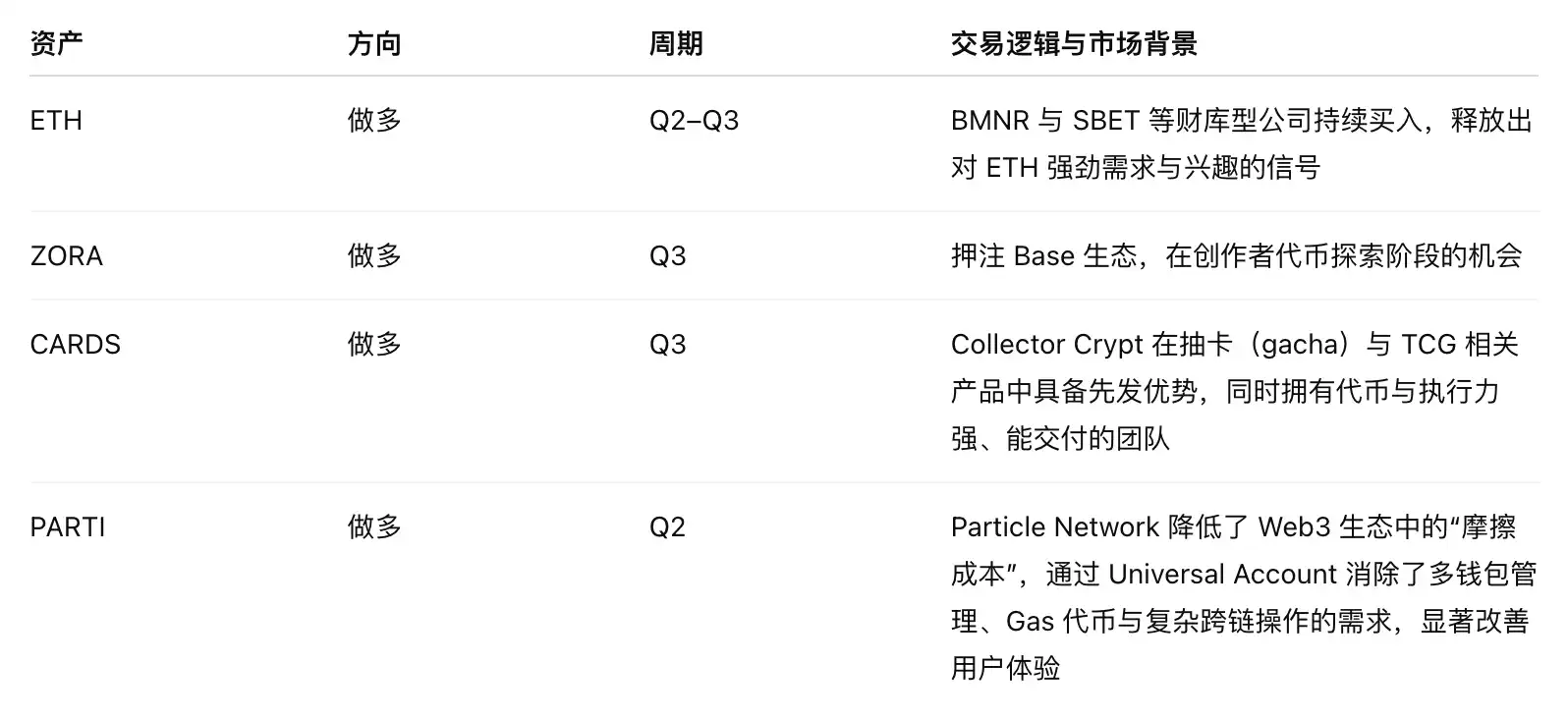
The worst trade operations were these.
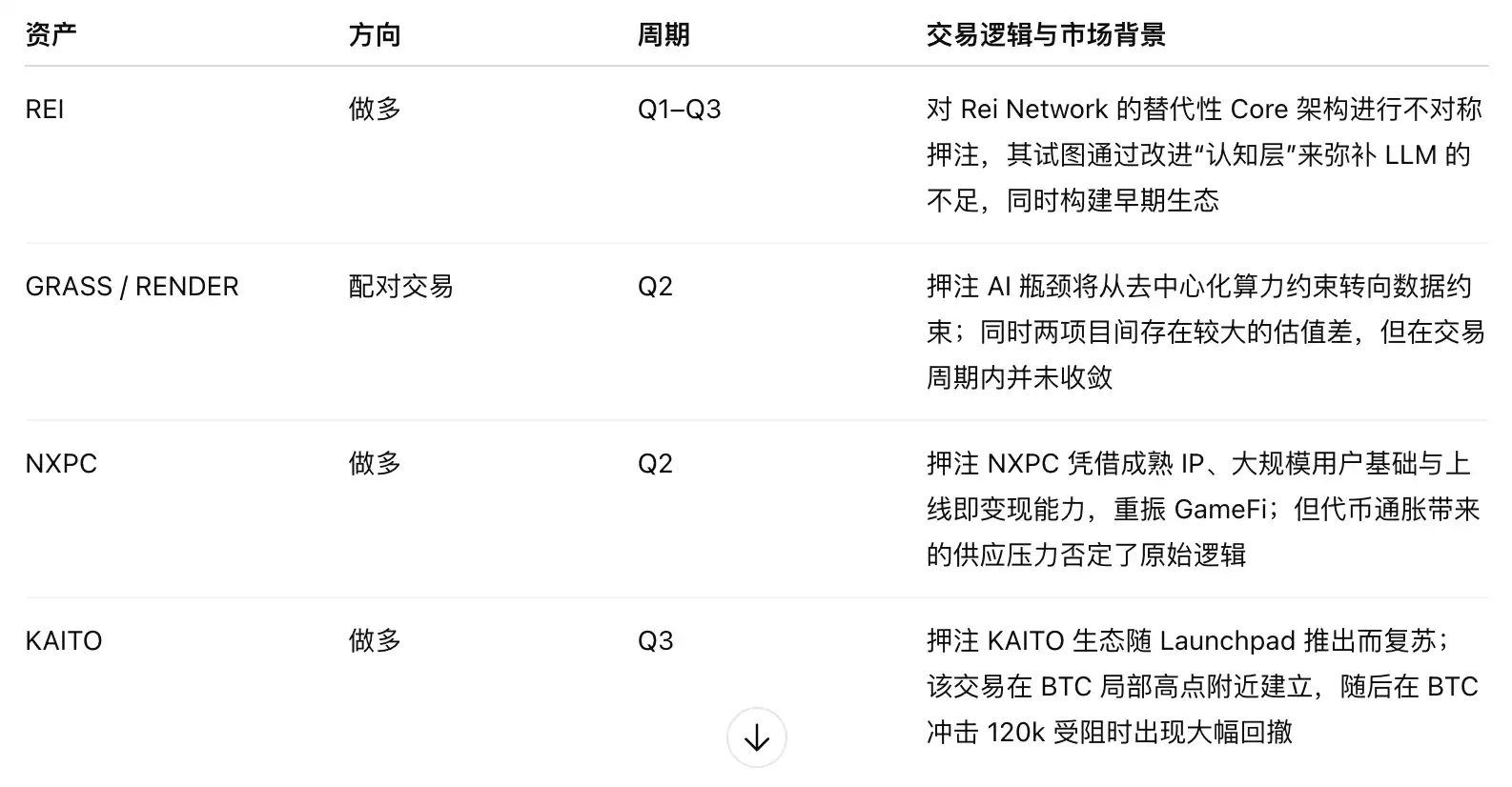
2025 Market Retrospective
Trump's Definitive Connection to the Crypto Market
Leading up to the 2024 presidential election, the market widely anticipated that a Trump victory would mark a significant turning point in the cryptocurrency regulatory environment and valuation scale. Key expectations included:
· Ending the regulatory approach of "regulation by enforcement";
· Explicit support for stablecoins;
· Exploring the establishment of a "Strategic Bitcoin Reserve";
· And launching Trump-related projects in September 2024, such as World Liberty Financial (WLFI);
These factors collectively made cryptocurrency one of the highest Beta expressions within the broader "Trump Trade," and significant policy optimism was priced in before the election results were revealed.
However, as this optimism began to wane post-election, the overall "Trump Trade" experienced a reversal. This phenomenon was evident not only in cryptocurrency assets but also in Trump-associated stocks, such as DJT, which peaked before the election and then notably declined. Despite the post-election confirmation of a more crypto-friendly policy stance, the market faced the inertia of legal and regulatory progress and a series of scattered, incremental policy outcomes, which failed to offset the overall derisking impact on "Trump-themed assets."
Furthermore, Trump himself, through his association with WLFI and the emergence of TRUMP, created a direct economic exposure to the cryptocurrency industry. This heightened market concerns—cryptocurrency assets had to some extent been financialized around Trump's personal popularity, introducing a "perception risk"—if his political capital were to decline, it could directly translate into a weakening of related asset prices.
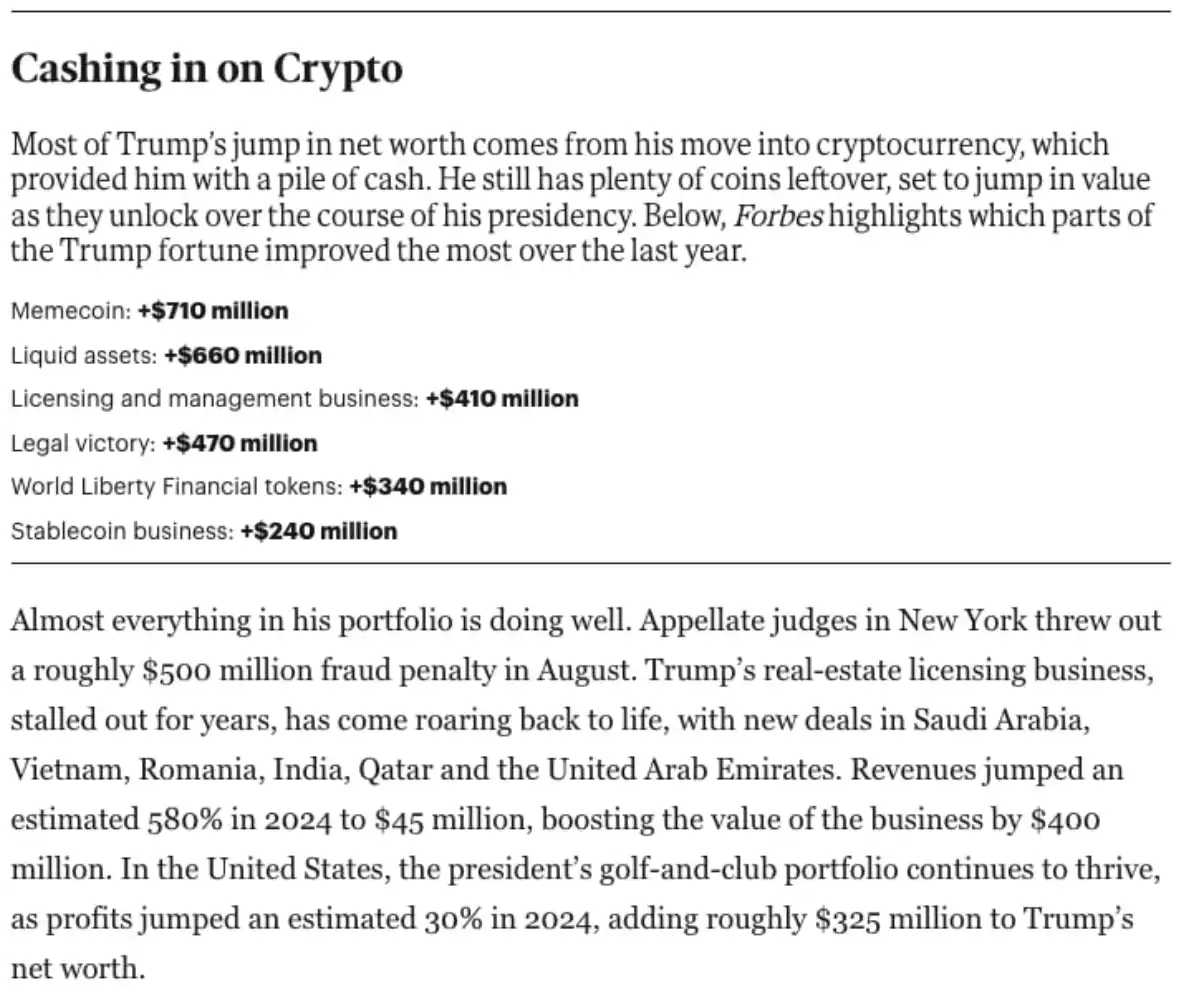
Forbes reported that Trump's net worth increased by $30 billion during his presidency.
While these concerns are not entirely unfounded, they can be mitigated entirely through the implementation of long-term policies or a reduction in reliance on demand driven by personal charm. Most notably, the August 2025 signing of the "Executive Order on Popularizing Alternative Asset Investments" expanded the permissible scope for 401(k) retirement plan trustees to include digital assets in portfolios. Though the order did not mandate allocation, it fundamentally lowered legal and reputational barriers to institutional participation, reshaping cryptocurrency from a speculative fringe asset into one that is at least permissible in long-term capital pools.
The true significance of this shift lies not in whether a large inflow of capital will immediately occur in the short term, but in the change of market demand structure. As long-term capital associated with retirement funds is included as a possibility, the crypto market is transitioning from a halving cycle purely driven by supply to a demand-regulated cycle characterized by longer duration and stickier capital. Even if it is just marginal adoption at scale, it has the potential to lift the equilibrium price level and compress the downside volatility space compared to the 50–80% deep retracements seen in past cycles.
Narrowing of the "Risk Appetite" Trading Range
The connotation of "risk appetite" trading is becoming more complex. In contrast to previous cycles, during the risk appetite recovery phase, speculative capital would flood into Memes and long-tail assets, the return differentiation between Beta assets in 2025 was unusually significant. This was particularly evident in early October when BTC hit a new all-time high but Meme performance remained relatively muted.
Instead, investors are starting to concentrate funds in a smaller range of crypto asset subsets, such as "stock-like assets" with crypto exposure (DAT, CEX, and funds), prediction markets, or tokens with a clear value capture mechanism. This differentiation reflects market maturity: capital is becoming more selective and rapidly rotating, fund flows are more short-term oriented and narrative-driven. Investors chase local momentum, swiftly harvest gains, and keep rolling liquidity into the next narrative. In 2025, the narrative cycle is compressed, and trading durations are shorter compared to past cycles.
In this environment, the idea of holding altcoins long-term for massive returns has largely become a mirage. Except for major tokens like BTC, ETH, and SOL benefiting from institutional capital accumulation, other tokens often appreciate only during compelling narrative peaks. Once the narrative fades, liquidity dries up, and prices regress. The narrowing of the risk appetite trading range has not extended the lifespan of altcoins; instead, it has accelerated the pace of capital testing, squeezing, and abandoning new narratives. This further reinforces one judgment—true long-term crypto investment still largely focuses on a few assets.
Expansion of Digital Asset Treasuries (DAT)
The rise of Digital Asset Treasuries (DAT) has introduced a new capital formation mechanism designed to replicate MicroStrategy's successful path. DATs allow public companies to raise funds and allocate directly to crypto assets, creating an embedded crypto exposure proxy. This bypasses a regulatory vacuum until the approval of altcoin ETFs.
As this type of structure rapidly proliferates, the market quickly shows signs of frothiness — a large number of new vehicles are eagerly packaging themselves as a "DAT" of some meme coin, even if the asset lacks genuine and sustained demand.
Many of the capital structures adopted by these meme coin DATs we classify as predatory structures. Specifically, these structures often engage in financial engineering by exchanging tokenized assets for equity in a manner designed to introduce a new cohort of participants while creating exit liquidity; paired with a very low-cost, highly favorable lock-up private sale round.
These mechanisms allow insiders to offload substantial amounts with minimal buy-side pressure, causing retail investors to be rapidly drained of value in both the equity and token markets simultaneously. This mismatch of scale is particularly pronounced in some aggressive DAT schemes — with some companies attempting to raise funds far exceeding their public market cap.
Investment Theme for 2026
Conclusion 1: Asymmetric Returns Will Emerge at the Application Layer
The "Fat Protocol Thesis" and "Moneyness" narrative that historically underpinned the "monetary premium era" enjoyed by the new generation of meme Layer1 is coming to an end. This premium was primarily supported by the belief that infrastructure would disproportionately capture value, with its token ultimately evolving into a global store of value asset.
However, the market has already integrated this monetary function around mainstream assets like BTC, ETH, SOL, as well as stablecoins, completely detaching the new Layer1's "moneyness" imaginative space.
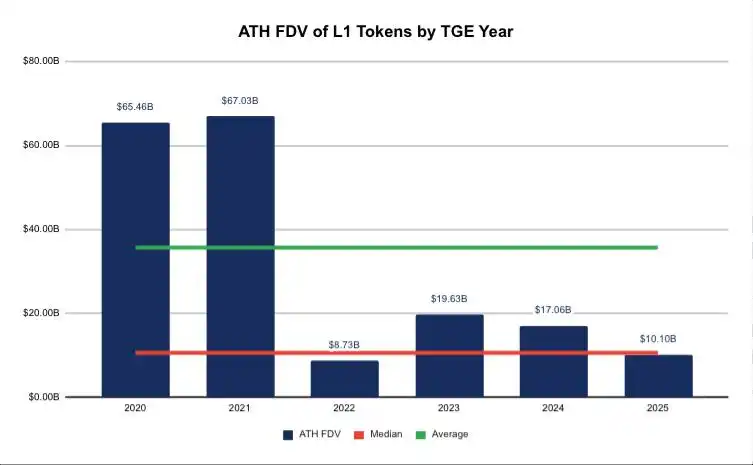
Layer1 token Historical All-Time High Fully Diluted Valuation (ATH FDV) per vintage TGE year statistics.
With the disappearance of the "moneyness" moat, the social consensus that previously bestowed multi-billion-dollar valuations upon new public chains is disintegrating. Since 2020, meme Layer1's historical ATH FDV has shown a clear structural downtrend, strongly indicating the continued waning of the monetary premium.
Furthermore, the remaining valuation "floor" that still exists is largely artificial: in recent years, many Layer1 projects have launched through fixed-price ICOs or direct listings on CEXs, with the team artificially setting the initial price. If these assets were subjected to true price discovery at launch, we believe their valuation would most likely fail to come close to historical average levels of past cycles.
This trend of valuation collapse is further amplified by the inertia advantage of existing public chains. The mature ecosystem already has a large number of "sticky applications" that firmly hold users, creating a very high barrier to entry for new entrants to the Layer1 scene.
From a data perspective, since 2022, around 70–80% of DEX trading volume and TVL has consistently been concentrated on three chains. Ethereum has always held its ground, while the other two positions have rotated in different cycles. For newcomers, breaking this oligopoly structure is almost like fighting an uphill battle, as historical experience shows that most projects ultimately fail to secure a long-term position.
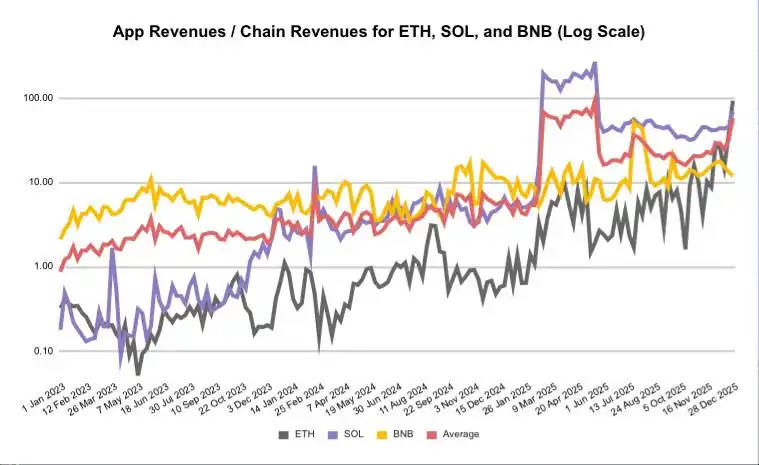
Comparison of Application Revenue / Chain Revenue for ETH, SOL, and BNB.
We believe the repricing of application tokens has begun, with the key driver being a significant deviation in value capture ability between Layer1 tokens and underlying applications. As shown in the chart above, over the past two years, application layer revenue has diverged significantly from infrastructure revenue: application revenue in the ETH and SOL ecosystems has grown by as much as 200–300 times.
However, the market value of applications still only represents a small fraction of their L1 market value. As the market gradually matures, we expect this mismatch to be corrected through capital rotation from overvalued infrastructure assets to applications with real revenue.
Conclusion Two: Midterm Elections Will Shape a High-Volatility Environment
The current focus of the Trump administration's policies appears to be on ensuring victory in the 2026 midterm elections, with an overall policy bias towards supporting short-term economic momentum. The "One Big Beautiful Bill Act (OBBBA)" stimulates demand through deficit financing, marginally increasing the probability of an inflationary reflation environment. For digital assets, this fiscal expansion is favorable for hard assets like Bitcoin, once again making it the ultimate "scarcity hedge tool" in essence.
At the same time, this fiscal expansion is also highly likely to encounter supply-side constraints in certain areas, such as grid capacity and manufacturing capacity. These bottlenecks will create inflationary pressures at the input cost and wage level in relevant industries, even as the overall level remains suppressed by structural deflationary forces such as tariff normalization and AI-driven productivity improvements.
The macro environmental characteristic that emerges from this is—nominal growth is tilted to the upside, but volatility rises in sync, causing the market to periodically reprice inflation risks. This tension will structurally elevate volatility. The market may oscillate between "reflation optimism" and "resurgence of inflation concerns," especially as economic data gradually reveal capacity constraints rather than insufficient demand.
Overlaying this macro backdrop is the historical pattern of the midterm election cycle lifting the political risk premium—investors typically demand higher risk compensation before elections to deal with policy uncertainty. Underpinning this trend is a clear political motive—to tolerate, or even widen, the fiscal deficit during the midterm election cycle. Additionally, if the Fed leadership becomes more dovish, it will also provide a more accommodative liquidity environment for risk assets.
Although this combination implies higher volatility in the short term, looking ahead, with OBBBA's impact compounded by the continued advancement of crypto-specific legislation, we still believe 2026 will be a constructive year for digital assets, albeit with a bumpier path.
Conclusion Three: Selective Enhancement, Shaping a Tokenomics of K-shaped Differentiation
The crypto market is bidding farewell to the era of indiscriminate capital allocation and entering a brutal period of structural differentiation—a K-shaped economy dominated by selectivity. The era of rising tides lifting all boats has ended. The market has shifted from blindly chasing speculative narratives to focusing more on the alignment of interests at the protocol level and among token holders.
At the core of this shift is a wholesale rejection of the "Equity-Token Split" model by the market. This structure was initially designed to withstand regulatory pressures in the Gensler era, but its executable ambiguity has always been a significant hazard. In this model: insiders (the team and VCs) hold the real value (IP, revenue, equity); retail investors, however, only receive "governance tokens" without any executable rights.
This mismatch has created a two-tier system—insiders have the fundamentals, while token holders have sentiment. As the market struggles to differentiate the true state of different protocols, it ultimately opts to uniformly discount the entire sector. Therefore, the current downward cycle is fundamentally a repricing of trust. The future winners will depend on their ability to demonstrate a clear, executable, and sustainable path to capturing value.
In this new paradigm, the "Upper K" of the K-shaped recovery will be composed of teams that replace "trust me" with "verify me." Here, credibility no longer comes from the reputation of the founders or social capital but from their willingness to proactively impose structural constraints on themselves. These teams demonstrate their ability to achieve value alignment through: making the value engine auditable; rendering the flow of revenue executable; proactively divesting themselves of the ability to transfer value off-chain. This transparency will form the basis of token holder confidence—during the downward cycle, sticky capital will be willing to support their valuation because they trust the mechanism, not just the people.
Blockworks' Token Transparency Dashboard is a valuable tool that categorizes protocols based on the level of disclosure required by the framework.
Conversely, assets at the downward end of the "K-shaped" curve are facing a liquidity crisis triggered by team reputation collapse. The market now sees opacity as an acknowledgment of conflicting interests. If a team refuses to clarify the relationship between protocol revenue and the token, investors often assume this relationship does not exist at all. In the absence of the high-cost signal of "executable value capture," these tokens cannot be fundamentally valued, and when the narrative fades, there are no natural buyers to support them. Teams that require investors to rely on "good faith" or selectively opaque future commitments are systematically being eliminated, destined to continue bleeding out in competition with high-quality protocols.
Other Initial Insights
The collectibles market will further expand — and extend into the sports memorabilia sector, especially items related to major historical moments with high intrinsic value. For example, Shohei Ohtani's 50/50 home run ball set a new auction record.
The prediction market is poised to become the new Meta. Following Hyperliquid's TGE, which had a demonstrative effect on the entire track, the TGEs of Polymarket and Kalshi are expected to ignite the prediction market narrative.
The scrutiny of the "Equity-Token" dual structure will continue to intensify. More and more investors will demand clear, auditable explanations of value distribution, clarifying how economic value is divided between equity holders and token holders; otherwise, a shift to a pure token structure will be necessary.
The potential risk of DAT being excluded from the MSCI index (final decision date: January 15, 2026) is closely watched by the market. Once this uncertainty is removed, it could trigger a new round of early-year rebound.
"Ownership Coins" will become the new norm, structurally reducing founder's "chronic Rug" risk.
DApps with privacy capabilities will be welcomed to a higher degree by both retail and institutional players. Protocols that can balance user experience and programmability while achieving a high level of compliance will win the final victory in the privacy race.
Tokenized stocks will go through an accelerated version of the "boom-bust" cycle as their initial adoption scale is likely still limited.
You may also like

Token Cannot Compound, Where Is the Real Investment Opportunity?

February 6th Market Key Intelligence, How Much Did You Miss?

China's Central Bank and Eight Other Departments' Latest Regulatory Focus: Key Attention to RWA Tokenized Asset Risk
Foreword: Today, the People's Bank of China's website published the "Notice of the People's Bank of China, National Development and Reform Commission, Ministry of Industry and Information Technology, Ministry of Public Security, State Administration for Market Regulation, China Banking and Insurance Regulatory Commission, China Securities Regulatory Commission, State Administration of Foreign Exchange on Further Preventing and Dealing with Risks Related to Virtual Currency and Others (Yinfa [2026] No. 42)", the latest regulatory requirements from the eight departments including the central bank, which are basically consistent with the regulatory requirements of recent years. The main focus of the regulation is on speculative activities such as virtual currency trading, exchanges, ICOs, overseas platform services, and this time, regulatory oversight of RWA has been added, explicitly prohibiting RWA tokenization, stablecoins (especially those pegged to the RMB). The following is the full text:
To the people's governments of all provinces, autonomous regions, and municipalities directly under the Central Government, the Xinjiang Production and Construction Corps:
Recently, there have been speculative activities related to virtual currency and Real-World Assets (RWA) tokenization, disrupting the economic and financial order and jeopardizing the property security of the people. In order to further prevent and address the risks related to virtual currency and Real-World Assets tokenization, effectively safeguard national security and social stability, in accordance with the "Law of the People's Republic of China on the People's Bank of China," "Law of the People's Republic of China on Commercial Banks," "Securities Law of the People's Republic of China," "Law of the People's Republic of China on Securities Investment Funds," "Law of the People's Republic of China on Futures and Derivatives," "Cybersecurity Law of the People's Republic of China," "Regulations of the People's Republic of China on the Administration of Renminbi," "Regulations on Prevention and Disposal of Illegal Fundraising," "Regulations of the People's Republic of China on Foreign Exchange Administration," "Telecommunications Regulations of the People's Republic of China," and other provisions, after reaching consensus with the Cyberspace Administration of China, the Supreme People's Court, and the Supreme People's Procuratorate, and with the approval of the State Council, the relevant matters are notified as follows:
(I) Virtual currency does not possess the legal status equivalent to fiat currency. Virtual currencies such as Bitcoin, Ether, Tether, etc., have the main characteristics of being issued by non-monetary authorities, using encryption technology and distributed ledger or similar technology, existing in digital form, etc. They do not have legal tender status, should not and cannot be circulated and used as currency in the market.
The business activities related to virtual currency are classified as illegal financial activities. The exchange of fiat currency and virtual currency within the territory, exchange of virtual currencies, acting as a central counterparty in buying and selling virtual currencies, providing information intermediary and pricing services for virtual currency transactions, token issuance financing, and trading of virtual currency-related financial products, etc., fall under illegal financial activities, such as suspected illegal issuance of token vouchers, unauthorized public issuance of securities, illegal operation of securities and futures business, illegal fundraising, etc., are strictly prohibited across the board and resolutely banned in accordance with the law. Overseas entities and individuals are not allowed to provide virtual currency-related services to domestic entities in any form.
A stablecoin pegged to a fiat currency indirectly fulfills some functions of the fiat currency in circulation. Without the consent of relevant authorities in accordance with the law and regulations, any domestic or foreign entity or individual is not allowed to issue a RMB-pegged stablecoin overseas.
(II)Tokenization of Real-World Assets refers to the use of encryption technology and distributed ledger or similar technologies to transform ownership rights, income rights, etc., of assets into tokens (tokens) or other interests or bond certificates with token (token) characteristics, and carry out issuance and trading activities.
Engaging in the tokenization of real-world assets domestically, as well as providing related intermediary, information technology services, etc., which are suspected of illegal issuance of token vouchers, unauthorized public offering of securities, illegal operation of securities and futures business, illegal fundraising, and other illegal financial activities, shall be prohibited; except for relevant business activities carried out with the approval of the competent authorities in accordance with the law and regulations and relying on specific financial infrastructures. Overseas entities and individuals are not allowed to illegally provide services related to the tokenization of real-world assets to domestic entities in any form.
(III) Inter-agency Coordination. The People's Bank of China, together with the National Development and Reform Commission, the Ministry of Industry and Information Technology, the Ministry of Public Security, the State Administration for Market Regulation, the China Banking and Insurance Regulatory Commission, the China Securities Regulatory Commission, the State Administration of Foreign Exchange, and other departments, will improve the work mechanism, strengthen coordination with the Cyberspace Administration of China, the Supreme People's Court, and the Supreme People's Procuratorate, coordinate efforts, and overall guide regions to carry out risk prevention and disposal of virtual currency-related illegal financial activities.
The China Securities Regulatory Commission, together with the National Development and Reform Commission, the Ministry of Industry and Information Technology, the Ministry of Public Security, the People's Bank of China, the State Administration for Market Regulation, the China Banking and Insurance Regulatory Commission, the State Administration of Foreign Exchange, and other departments, will improve the work mechanism, strengthen coordination with the Cyberspace Administration of China, the Supreme People's Court, and the Supreme People's Procuratorate, coordinate efforts, and overall guide regions to carry out risk prevention and disposal of illegal financial activities related to the tokenization of real-world assets.
(IV) Strengthening Local Implementation. The people's governments at the provincial level are overall responsible for the prevention and disposal of risks related to virtual currencies and the tokenization of real-world assets in their respective administrative regions. The specific leading department is the local financial regulatory department, with participation from branches and dispatched institutions of the State Council's financial regulatory department, telecommunications regulators, public security, market supervision, and other departments, in coordination with cyberspace departments, courts, and procuratorates, to improve the normalization of the work mechanism, effectively connect with the relevant work mechanisms of central departments, form a cooperative and coordinated working pattern between central and local governments, effectively prevent and properly handle risks related to virtual currencies and the tokenization of real-world assets, and maintain economic and financial order and social stability.
(5) Enhanced Risk Monitoring. The People's Bank of China, China Securities Regulatory Commission, National Development and Reform Commission, Ministry of Industry and Information Technology, Ministry of Public Security, State Administration of Foreign Exchange, Cyberspace Administration of China, and other departments continue to improve monitoring techniques and system support, enhance cross-departmental data analysis and sharing, establish sound information sharing and cross-validation mechanisms, promptly grasp the risk situation of activities related to virtual currency and real-world asset tokenization. Local governments at all levels give full play to the role of local monitoring and early warning mechanisms. Local financial regulatory authorities, together with branches and agencies of the State Council's financial regulatory authorities, as well as departments of cyberspace and public security, ensure effective connection between online monitoring, offline investigation, and fund tracking, efficiently and accurately identify activities related to virtual currency and real-world asset tokenization, promptly share risk information, improve early warning information dissemination, verification, and rapid response mechanisms.
(6) Strengthened Oversight of Financial Institutions, Intermediaries, and Technology Service Providers. Financial institutions (including non-bank payment institutions) are prohibited from providing account opening, fund transfer, and clearing services for virtual currency-related business activities, issuing and selling financial products related to virtual currency, including virtual currency and related financial products in the scope of collateral, conducting insurance business related to virtual currency, or including virtual currency in the scope of insurance liability. Financial institutions (including non-bank payment institutions) are prohibited from providing custody, clearing, and settlement services for unauthorized real-world asset tokenization-related business and related financial products. Relevant intermediary institutions and information technology service providers are prohibited from providing intermediary, technical, or other services for unauthorized real-world asset tokenization-related businesses and related financial products.
(7) Enhanced Management of Internet Information Content and Access. Internet enterprises are prohibited from providing online business venues, commercial displays, marketing, advertising, or paid traffic diversion services for virtual currency and real-world asset tokenization-related business activities. Upon discovering clues of illegal activities, they should promptly report to relevant departments and provide technical support and assistance for related investigations and inquiries. Based on the clues transferred by the financial regulatory authorities, the cyberspace administration, telecommunications authorities, and public security departments should promptly close and deal with websites, mobile applications (including mini-programs), and public accounts engaged in virtual currency and real-world asset tokenization-related business activities in accordance with the law.
(8) Strengthened Entity Registration and Advertisement Management. Market supervision departments strengthen entity registration and management, and enterprise and individual business registrations must not contain terms such as "virtual currency," "virtual asset," "cryptocurrency," "crypto asset," "stablecoin," "real-world asset tokenization," or "RWA" in their names or business scopes. Market supervision departments, together with financial regulatory authorities, legally enhance the supervision of advertisements related to virtual currency and real-world asset tokenization, promptly investigating and handling relevant illegal advertisements.
(IX) Continued Rectification of Virtual Currency Mining Activities. The National Development and Reform Commission, together with relevant departments, strictly controls virtual currency mining activities, continuously promotes the rectification of virtual currency mining activities. The people's governments of various provinces take overall responsibility for the rectification of "mining" within their respective administrative regions. In accordance with the requirements of the National Development and Reform Commission and other departments in the "Notice on the Rectification of Virtual Currency Mining Activities" (NDRC Energy-saving Building [2021] No. 1283) and the provisions of the "Guidance Catalog for Industrial Structure Adjustment (2024 Edition)," a comprehensive review, investigation, and closure of existing virtual currency mining projects are conducted, new mining projects are strictly prohibited, and mining machine production enterprises are strictly prohibited from providing mining machine sales and other services within the country.
(X) Severe Crackdown on Related Illegal Financial Activities. Upon discovering clues to illegal financial activities related to virtual currency and the tokenization of real-world assets, local financial regulatory authorities, branches of the State Council's financial regulatory authorities, and other relevant departments promptly investigate, determine, and properly handle the issues in accordance with the law, and seriously hold the relevant entities and individuals legally responsible. Those suspected of crimes are transferred to the judicial authorities for processing according to the law.
(XI) Severe Crackdown on Related Illegal and Criminal Activities. The Ministry of Public Security, the People's Bank of China, the State Administration for Market Regulation, the China Banking and Insurance Regulatory Commission, the China Securities Regulatory Commission, as well as judicial and procuratorial organs, in accordance with their respective responsibilities, rigorously crack down on illegal and criminal activities related to virtual currency, the tokenization of real-world assets, such as fraud, money laundering, illegal business operations, pyramid schemes, illegal fundraising, and other illegal and criminal activities carried out under the guise of virtual currency, the tokenization of real-world assets, etc.
(XII) Strengthen Industry Self-discipline. Relevant industry associations should enhance membership management and policy advocacy, based on their own responsibilities, advocate and urge member units to resist illegal financial activities related to virtual currency and the tokenization of real-world assets. Member units that violate regulatory policies and industry self-discipline rules are to be disciplined in accordance with relevant self-regulatory management regulations. By leveraging various industry infrastructure, conduct risk monitoring related to virtual currency, the tokenization of real-world assets, and promptly transfer issue clues to relevant departments.
(XIII) Without the approval of relevant departments in accordance with the law and regulations, domestic entities and foreign entities controlled by them may not issue virtual currency overseas.
(XIV) Domestic entities engaging directly or indirectly in overseas external debt-based tokenization of real-world assets, or conducting asset securitization activities abroad based on domestic ownership rights, income rights, etc. (hereinafter referred to as domestic equity), should be strictly regulated in accordance with the principles of "same business, same risk, same rules." The National Development and Reform Commission, the China Securities Regulatory Commission, the State Administration of Foreign Exchange, and other relevant departments regulate it according to their respective responsibilities. For other forms of overseas real-world asset tokenization activities based on domestic equity by domestic entities, the China Securities Regulatory Commission, together with relevant departments, supervise according to their division of responsibilities. Without the consent and filing of relevant departments, no unit or individual may engage in the above-mentioned business.
(15) Overseas subsidiaries and branches of domestic financial institutions providing Real World Asset Tokenization-related services overseas shall do so legally and prudently. They shall have professional personnel and systems in place to effectively mitigate business risks, strictly implement customer onboarding, suitability management, anti-money laundering requirements, and incorporate them into the domestic financial institutions' compliance and risk management system. Intermediaries and information technology service providers offering Real World Asset Tokenization services abroad based on domestic equity or conducting Real World Asset Tokenization business in the form of overseas debt for domestic entities directly or indirectly venturing abroad must strictly comply with relevant laws and regulations. They should establish and improve relevant compliance and internal control systems in accordance with relevant normative requirements, strengthen business and risk control, and report the business developments to the relevant regulatory authorities for approval or filing.
(16) Strengthen organizational leadership and overall coordination. All departments and regions should attach great importance to the prevention of risks related to virtual currencies and Real World Asset Tokenization, strengthen organizational leadership, clarify work responsibilities, form a long-term effective working mechanism with centralized coordination, local implementation, and shared responsibilities, maintain high pressure, dynamically monitor risks, effectively prevent and mitigate risks in an orderly and efficient manner, legally protect the property security of the people, and make every effort to maintain economic and financial order and social stability.
(17) Widely carry out publicity and education. All departments, regions, and industry associations should make full use of various media and other communication channels to disseminate information through legal and policy interpretation, analysis of typical cases, and education on investment risks, etc. They should promote the illegality and harm of virtual currencies and Real World Asset Tokenization-related businesses and their manifestations, fully alert to potential risks and hidden dangers, and enhance public awareness and identification capabilities for risk prevention.
(18) Engaging in illegal financial activities related to virtual currencies and Real World Asset Tokenization in violation of this notice, as well as providing services for virtual currencies and Real World Asset Tokenization-related businesses, shall be punished in accordance with relevant regulations. If it constitutes a crime, criminal liability shall be pursued according to the law. For domestic entities and individuals who knowingly or should have known that overseas entities illegally provided virtual currency or Real World Asset Tokenization-related services to domestic entities and still assisted them, relevant responsibilities shall be pursued according to the law. If it constitutes a crime, criminal liability shall be pursued according to the law.
(19) If any unit or individual invests in virtual currencies, Real World Asset Tokens, and related financial products against public order and good customs, the relevant civil legal actions shall be invalid, and any resulting losses shall be borne by them. If there are suspicions of disrupting financial order and jeopardizing financial security, the relevant departments shall deal with them according to the law.
This notice shall enter into force upon the date of its issuance. The People's Bank of China and ten other departments' "Notice on Further Preventing and Dealing with the Risks of Virtual Currency Trading Speculation" (Yinfa [2021] No. 237) is hereby repealed.

Former Partner's Perspective on Multicoin: Kyle's Exit, But the Game He Left Behind Just Getting Started
Why Bitcoin Is Falling Now: The Real Reasons Behind BTC's Crash & WEEX's Smart Profit Playbook
Bitcoin's ongoing crash explained: Discover the 5 hidden triggers behind BTC's plunge & how WEEX's Auto Earn and Trade to Earn strategies help traders profit from crypto market volatility.

Wall Street's Hottest Trades See Exodus

Vitalik Discusses Ethereum Scaling Path, Circle Announces Partnership with Polymarket, What's the Overseas Crypto Community Talking About Today?

Believing in the Capital Markets - The Essence and Core Value of Cryptocurrency

Polymarket's 'Weatherman': Predict Temperature, Win Million-Dollar Payout

$15K+ Profits: The 4 AI Trading Secrets WEEX Hackathon Prelim Winners Used to Dominate Volatile Crypto Markets
How WEEX Hackathon's top AI trading strategies made $15K+ in crypto markets: 4 proven rules for ETH/BTC trading, market structure analysis, and risk management in volatile conditions.

A nearly 20% one-day plunge, how long has it been since you last saw a $60,000 Bitcoin?

Raoul Pal: I've seen every single panic, and they are never the end.

Key Market Information Discrepancy on February 6th - A Must-Read! | Alpha Morning Report

2026 Crypto Industry's First Snowfall
The Harsh Reality Behind the $26 Billion Crypto Liquidation: Liquidity Is Killing the Market
Why Is Gold, US Stocks, Bitcoin All Falling?

Key Market Intelligence for February 5th, how much did you miss out on?

Wintermute: By 2026, crypto had gradually become the settlement layer of the Internet economy
Token Cannot Compound, Where Is the Real Investment Opportunity?
February 6th Market Key Intelligence, How Much Did You Miss?
China's Central Bank and Eight Other Departments' Latest Regulatory Focus: Key Attention to RWA Tokenized Asset Risk
Foreword: Today, the People's Bank of China's website published the "Notice of the People's Bank of China, National Development and Reform Commission, Ministry of Industry and Information Technology, Ministry of Public Security, State Administration for Market Regulation, China Banking and Insurance Regulatory Commission, China Securities Regulatory Commission, State Administration of Foreign Exchange on Further Preventing and Dealing with Risks Related to Virtual Currency and Others (Yinfa [2026] No. 42)", the latest regulatory requirements from the eight departments including the central bank, which are basically consistent with the regulatory requirements of recent years. The main focus of the regulation is on speculative activities such as virtual currency trading, exchanges, ICOs, overseas platform services, and this time, regulatory oversight of RWA has been added, explicitly prohibiting RWA tokenization, stablecoins (especially those pegged to the RMB). The following is the full text:
To the people's governments of all provinces, autonomous regions, and municipalities directly under the Central Government, the Xinjiang Production and Construction Corps:
Recently, there have been speculative activities related to virtual currency and Real-World Assets (RWA) tokenization, disrupting the economic and financial order and jeopardizing the property security of the people. In order to further prevent and address the risks related to virtual currency and Real-World Assets tokenization, effectively safeguard national security and social stability, in accordance with the "Law of the People's Republic of China on the People's Bank of China," "Law of the People's Republic of China on Commercial Banks," "Securities Law of the People's Republic of China," "Law of the People's Republic of China on Securities Investment Funds," "Law of the People's Republic of China on Futures and Derivatives," "Cybersecurity Law of the People's Republic of China," "Regulations of the People's Republic of China on the Administration of Renminbi," "Regulations on Prevention and Disposal of Illegal Fundraising," "Regulations of the People's Republic of China on Foreign Exchange Administration," "Telecommunications Regulations of the People's Republic of China," and other provisions, after reaching consensus with the Cyberspace Administration of China, the Supreme People's Court, and the Supreme People's Procuratorate, and with the approval of the State Council, the relevant matters are notified as follows:
(I) Virtual currency does not possess the legal status equivalent to fiat currency. Virtual currencies such as Bitcoin, Ether, Tether, etc., have the main characteristics of being issued by non-monetary authorities, using encryption technology and distributed ledger or similar technology, existing in digital form, etc. They do not have legal tender status, should not and cannot be circulated and used as currency in the market.
The business activities related to virtual currency are classified as illegal financial activities. The exchange of fiat currency and virtual currency within the territory, exchange of virtual currencies, acting as a central counterparty in buying and selling virtual currencies, providing information intermediary and pricing services for virtual currency transactions, token issuance financing, and trading of virtual currency-related financial products, etc., fall under illegal financial activities, such as suspected illegal issuance of token vouchers, unauthorized public issuance of securities, illegal operation of securities and futures business, illegal fundraising, etc., are strictly prohibited across the board and resolutely banned in accordance with the law. Overseas entities and individuals are not allowed to provide virtual currency-related services to domestic entities in any form.
A stablecoin pegged to a fiat currency indirectly fulfills some functions of the fiat currency in circulation. Without the consent of relevant authorities in accordance with the law and regulations, any domestic or foreign entity or individual is not allowed to issue a RMB-pegged stablecoin overseas.
(II)Tokenization of Real-World Assets refers to the use of encryption technology and distributed ledger or similar technologies to transform ownership rights, income rights, etc., of assets into tokens (tokens) or other interests or bond certificates with token (token) characteristics, and carry out issuance and trading activities.
Engaging in the tokenization of real-world assets domestically, as well as providing related intermediary, information technology services, etc., which are suspected of illegal issuance of token vouchers, unauthorized public offering of securities, illegal operation of securities and futures business, illegal fundraising, and other illegal financial activities, shall be prohibited; except for relevant business activities carried out with the approval of the competent authorities in accordance with the law and regulations and relying on specific financial infrastructures. Overseas entities and individuals are not allowed to illegally provide services related to the tokenization of real-world assets to domestic entities in any form.
(III) Inter-agency Coordination. The People's Bank of China, together with the National Development and Reform Commission, the Ministry of Industry and Information Technology, the Ministry of Public Security, the State Administration for Market Regulation, the China Banking and Insurance Regulatory Commission, the China Securities Regulatory Commission, the State Administration of Foreign Exchange, and other departments, will improve the work mechanism, strengthen coordination with the Cyberspace Administration of China, the Supreme People's Court, and the Supreme People's Procuratorate, coordinate efforts, and overall guide regions to carry out risk prevention and disposal of virtual currency-related illegal financial activities.
The China Securities Regulatory Commission, together with the National Development and Reform Commission, the Ministry of Industry and Information Technology, the Ministry of Public Security, the People's Bank of China, the State Administration for Market Regulation, the China Banking and Insurance Regulatory Commission, the State Administration of Foreign Exchange, and other departments, will improve the work mechanism, strengthen coordination with the Cyberspace Administration of China, the Supreme People's Court, and the Supreme People's Procuratorate, coordinate efforts, and overall guide regions to carry out risk prevention and disposal of illegal financial activities related to the tokenization of real-world assets.
(IV) Strengthening Local Implementation. The people's governments at the provincial level are overall responsible for the prevention and disposal of risks related to virtual currencies and the tokenization of real-world assets in their respective administrative regions. The specific leading department is the local financial regulatory department, with participation from branches and dispatched institutions of the State Council's financial regulatory department, telecommunications regulators, public security, market supervision, and other departments, in coordination with cyberspace departments, courts, and procuratorates, to improve the normalization of the work mechanism, effectively connect with the relevant work mechanisms of central departments, form a cooperative and coordinated working pattern between central and local governments, effectively prevent and properly handle risks related to virtual currencies and the tokenization of real-world assets, and maintain economic and financial order and social stability.
(5) Enhanced Risk Monitoring. The People's Bank of China, China Securities Regulatory Commission, National Development and Reform Commission, Ministry of Industry and Information Technology, Ministry of Public Security, State Administration of Foreign Exchange, Cyberspace Administration of China, and other departments continue to improve monitoring techniques and system support, enhance cross-departmental data analysis and sharing, establish sound information sharing and cross-validation mechanisms, promptly grasp the risk situation of activities related to virtual currency and real-world asset tokenization. Local governments at all levels give full play to the role of local monitoring and early warning mechanisms. Local financial regulatory authorities, together with branches and agencies of the State Council's financial regulatory authorities, as well as departments of cyberspace and public security, ensure effective connection between online monitoring, offline investigation, and fund tracking, efficiently and accurately identify activities related to virtual currency and real-world asset tokenization, promptly share risk information, improve early warning information dissemination, verification, and rapid response mechanisms.
(6) Strengthened Oversight of Financial Institutions, Intermediaries, and Technology Service Providers. Financial institutions (including non-bank payment institutions) are prohibited from providing account opening, fund transfer, and clearing services for virtual currency-related business activities, issuing and selling financial products related to virtual currency, including virtual currency and related financial products in the scope of collateral, conducting insurance business related to virtual currency, or including virtual currency in the scope of insurance liability. Financial institutions (including non-bank payment institutions) are prohibited from providing custody, clearing, and settlement services for unauthorized real-world asset tokenization-related business and related financial products. Relevant intermediary institutions and information technology service providers are prohibited from providing intermediary, technical, or other services for unauthorized real-world asset tokenization-related businesses and related financial products.
(7) Enhanced Management of Internet Information Content and Access. Internet enterprises are prohibited from providing online business venues, commercial displays, marketing, advertising, or paid traffic diversion services for virtual currency and real-world asset tokenization-related business activities. Upon discovering clues of illegal activities, they should promptly report to relevant departments and provide technical support and assistance for related investigations and inquiries. Based on the clues transferred by the financial regulatory authorities, the cyberspace administration, telecommunications authorities, and public security departments should promptly close and deal with websites, mobile applications (including mini-programs), and public accounts engaged in virtual currency and real-world asset tokenization-related business activities in accordance with the law.
(8) Strengthened Entity Registration and Advertisement Management. Market supervision departments strengthen entity registration and management, and enterprise and individual business registrations must not contain terms such as "virtual currency," "virtual asset," "cryptocurrency," "crypto asset," "stablecoin," "real-world asset tokenization," or "RWA" in their names or business scopes. Market supervision departments, together with financial regulatory authorities, legally enhance the supervision of advertisements related to virtual currency and real-world asset tokenization, promptly investigating and handling relevant illegal advertisements.
(IX) Continued Rectification of Virtual Currency Mining Activities. The National Development and Reform Commission, together with relevant departments, strictly controls virtual currency mining activities, continuously promotes the rectification of virtual currency mining activities. The people's governments of various provinces take overall responsibility for the rectification of "mining" within their respective administrative regions. In accordance with the requirements of the National Development and Reform Commission and other departments in the "Notice on the Rectification of Virtual Currency Mining Activities" (NDRC Energy-saving Building [2021] No. 1283) and the provisions of the "Guidance Catalog for Industrial Structure Adjustment (2024 Edition)," a comprehensive review, investigation, and closure of existing virtual currency mining projects are conducted, new mining projects are strictly prohibited, and mining machine production enterprises are strictly prohibited from providing mining machine sales and other services within the country.
(X) Severe Crackdown on Related Illegal Financial Activities. Upon discovering clues to illegal financial activities related to virtual currency and the tokenization of real-world assets, local financial regulatory authorities, branches of the State Council's financial regulatory authorities, and other relevant departments promptly investigate, determine, and properly handle the issues in accordance with the law, and seriously hold the relevant entities and individuals legally responsible. Those suspected of crimes are transferred to the judicial authorities for processing according to the law.
(XI) Severe Crackdown on Related Illegal and Criminal Activities. The Ministry of Public Security, the People's Bank of China, the State Administration for Market Regulation, the China Banking and Insurance Regulatory Commission, the China Securities Regulatory Commission, as well as judicial and procuratorial organs, in accordance with their respective responsibilities, rigorously crack down on illegal and criminal activities related to virtual currency, the tokenization of real-world assets, such as fraud, money laundering, illegal business operations, pyramid schemes, illegal fundraising, and other illegal and criminal activities carried out under the guise of virtual currency, the tokenization of real-world assets, etc.
(XII) Strengthen Industry Self-discipline. Relevant industry associations should enhance membership management and policy advocacy, based on their own responsibilities, advocate and urge member units to resist illegal financial activities related to virtual currency and the tokenization of real-world assets. Member units that violate regulatory policies and industry self-discipline rules are to be disciplined in accordance with relevant self-regulatory management regulations. By leveraging various industry infrastructure, conduct risk monitoring related to virtual currency, the tokenization of real-world assets, and promptly transfer issue clues to relevant departments.
(XIII) Without the approval of relevant departments in accordance with the law and regulations, domestic entities and foreign entities controlled by them may not issue virtual currency overseas.
(XIV) Domestic entities engaging directly or indirectly in overseas external debt-based tokenization of real-world assets, or conducting asset securitization activities abroad based on domestic ownership rights, income rights, etc. (hereinafter referred to as domestic equity), should be strictly regulated in accordance with the principles of "same business, same risk, same rules." The National Development and Reform Commission, the China Securities Regulatory Commission, the State Administration of Foreign Exchange, and other relevant departments regulate it according to their respective responsibilities. For other forms of overseas real-world asset tokenization activities based on domestic equity by domestic entities, the China Securities Regulatory Commission, together with relevant departments, supervise according to their division of responsibilities. Without the consent and filing of relevant departments, no unit or individual may engage in the above-mentioned business.
(15) Overseas subsidiaries and branches of domestic financial institutions providing Real World Asset Tokenization-related services overseas shall do so legally and prudently. They shall have professional personnel and systems in place to effectively mitigate business risks, strictly implement customer onboarding, suitability management, anti-money laundering requirements, and incorporate them into the domestic financial institutions' compliance and risk management system. Intermediaries and information technology service providers offering Real World Asset Tokenization services abroad based on domestic equity or conducting Real World Asset Tokenization business in the form of overseas debt for domestic entities directly or indirectly venturing abroad must strictly comply with relevant laws and regulations. They should establish and improve relevant compliance and internal control systems in accordance with relevant normative requirements, strengthen business and risk control, and report the business developments to the relevant regulatory authorities for approval or filing.
(16) Strengthen organizational leadership and overall coordination. All departments and regions should attach great importance to the prevention of risks related to virtual currencies and Real World Asset Tokenization, strengthen organizational leadership, clarify work responsibilities, form a long-term effective working mechanism with centralized coordination, local implementation, and shared responsibilities, maintain high pressure, dynamically monitor risks, effectively prevent and mitigate risks in an orderly and efficient manner, legally protect the property security of the people, and make every effort to maintain economic and financial order and social stability.
(17) Widely carry out publicity and education. All departments, regions, and industry associations should make full use of various media and other communication channels to disseminate information through legal and policy interpretation, analysis of typical cases, and education on investment risks, etc. They should promote the illegality and harm of virtual currencies and Real World Asset Tokenization-related businesses and their manifestations, fully alert to potential risks and hidden dangers, and enhance public awareness and identification capabilities for risk prevention.
(18) Engaging in illegal financial activities related to virtual currencies and Real World Asset Tokenization in violation of this notice, as well as providing services for virtual currencies and Real World Asset Tokenization-related businesses, shall be punished in accordance with relevant regulations. If it constitutes a crime, criminal liability shall be pursued according to the law. For domestic entities and individuals who knowingly or should have known that overseas entities illegally provided virtual currency or Real World Asset Tokenization-related services to domestic entities and still assisted them, relevant responsibilities shall be pursued according to the law. If it constitutes a crime, criminal liability shall be pursued according to the law.
(19) If any unit or individual invests in virtual currencies, Real World Asset Tokens, and related financial products against public order and good customs, the relevant civil legal actions shall be invalid, and any resulting losses shall be borne by them. If there are suspicions of disrupting financial order and jeopardizing financial security, the relevant departments shall deal with them according to the law.
This notice shall enter into force upon the date of its issuance. The People's Bank of China and ten other departments' "Notice on Further Preventing and Dealing with the Risks of Virtual Currency Trading Speculation" (Yinfa [2021] No. 237) is hereby repealed.
Former Partner's Perspective on Multicoin: Kyle's Exit, But the Game He Left Behind Just Getting Started
Why Bitcoin Is Falling Now: The Real Reasons Behind BTC's Crash & WEEX's Smart Profit Playbook
Bitcoin's ongoing crash explained: Discover the 5 hidden triggers behind BTC's plunge & how WEEX's Auto Earn and Trade to Earn strategies help traders profit from crypto market volatility.


 App
App