
Interview with Independent Developer Haole: Working at a Tech Giant by Day, Building Dreams on the Blockchain by Night | Base Builder Talk
The announcement that EOS has been rebranded as Vaulta and is transitioning to become a Web3 bank has stirred up many OGs in the crypto world. From ICOs, DeFi Summer, GameFi, NFTs, to meme coins, the narrative shift in the crypto world once again confirms its cruelty and romance.
In this issue of Base Builder Talk, our guest is haole, the developer of the Farcaster protocol client Recaster. He witnessed the rise and fall of Steemit, the first decentralized social platform, experienced the frenzy of DeFi Summer, and in the midst of the prophecy of AI devouring everything, he, as an independent developer, roamed outside the mainstream, dedicating himself to building the applications he needs and believes in.
This dedication not only stems from his pure love for technology but is deeply rooted in a philosophical speculation: whether to accept data fed in the comfortable centralized "matrix" or to choose the red pill leading to data sovereignty in the "real world." In the current wave of AI sweeping through and Web2 giants erecting high data barriers, Haole's persistence appears particularly valuable.
Building a product is not only about solving specific problems but also about practicing the ideal of an open network where "data belongs to users." For this increasingly monopolized and algorithm-defined digital world, he injects a rebellious undercurrent and a humanistic warmth. His story is that of a technological idealist's sobriety and persistence amidst the noisy crypto wave.
Below is the full interview:
BlockBeats: Please introduce yourself first. What was the trigger for you to enter the crypto world?
Haole: Currently, I work as a coder in a small factory in North America. Around 2016, I entered the crypto world when I needed to transfer money between China and the US. I found the traditional channels to be very troublesome, with layers of audits and slow transfer speeds. I realized that the hard-earned money was not truly mine. Because of this, I started to learn about Bitcoin, read related books, and got in touch with more and more crypto projects.
At that time, using Bitcoin for cross-border arbitrage between China and the US had a significant risk of fluctuation. There was a project called BitShares, which was considered a first-generation decentralized exchange platform. It had RMB gateways, which reduced the volatility, and the deposits and withdrawals were very convenient.
Due to this project, I became a fan of BitShares founder BM (Daniel Larimer) and delved deep into BitShares, Steemit, and EOS.
Related reading: "From Steemit to friend.tech: Tracing the 7-year Evolution of SocialFi"
In the following cycles, I have been involved in ICOs, DeFi, NFTs, Memes, and so on. However, it has always been a hobby for me, and I have never joined any blockchain company. Mainly because I feel that this industry has a strong speculative element, with too few long-term projects and companies dying too quickly.
BlockBeats: You didn't become a scientist after all?
Haole: I was somewhat of a scientist during the DeFi Summer period. I played around with some scripts and experiments, but later I found that the opportunity cost was high, and holding Bitcoin was more profitable. Through these cycles, I have come to realize that holding Bitcoin is the best strategy with the highest cost-effectiveness.
BlockBeats: Over the past year or two, from Recaster to Modbot, then to Newcaster, and also a payment product, which projects have you worked on part-time?
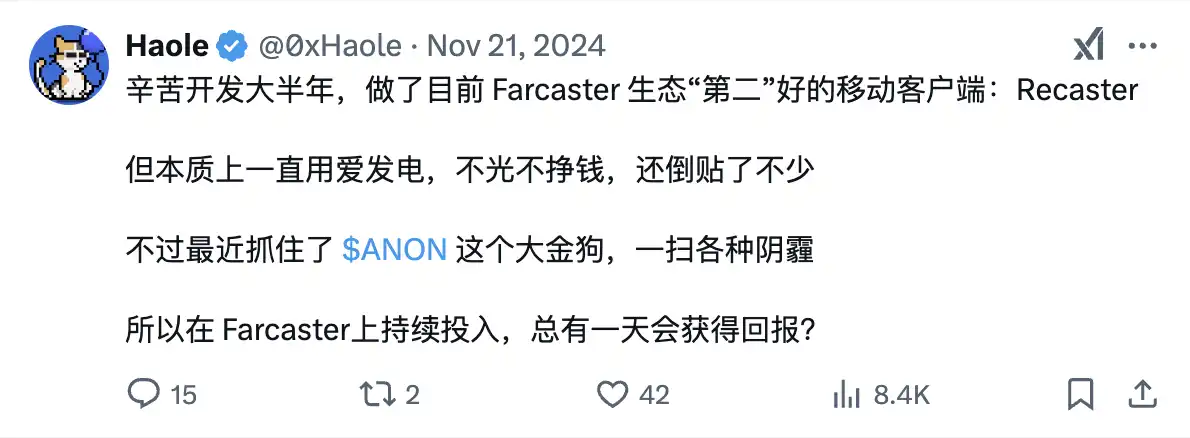
Haole: This year, I have mainly been working on Recaster, a client based on the Farcaster protocol. Modbot and Newcaster are both tools in the Farcaster ecosystem, and I have not invested too much time in them.
As for the payment product you mentioned, called Depal, it is a cryptocurrency-based payment platform that only I am currently using.
I developed this product to address a KYC + fee issue. Gateways like Coinbase in the crypto space charge a percentage of the payment amount, but the actual transaction cost is only a few cents. With large volumes, there is still a significant profit margin.
However, this product can only be considered a toy. To truly commercialize it, trust and a profitable business model need to be established.
BlockBeats: Apart from addressing your own needs, did you also aim to accumulate project experience by developing these products?
Haole: There are mainly two purposes. One is to address my own needs and create a product that satisfies me, and it would be even more fulfilling if it can help others. The second is to learn a new tech stack to use in my full-time work, which is essentially Web3 giving back to Web2.
BlockBeats: It's interesting to give back to Web2 using Web3. You mentioned in a statement that ordinary engineers entering the crypto industry can make money, and now everyone thinks AI is the way to go, that the crypto world is too chaotic and no one is optimistic. However, biases actually indicate opportunities. After this cycle, are you still satisfied with your initial judgment?
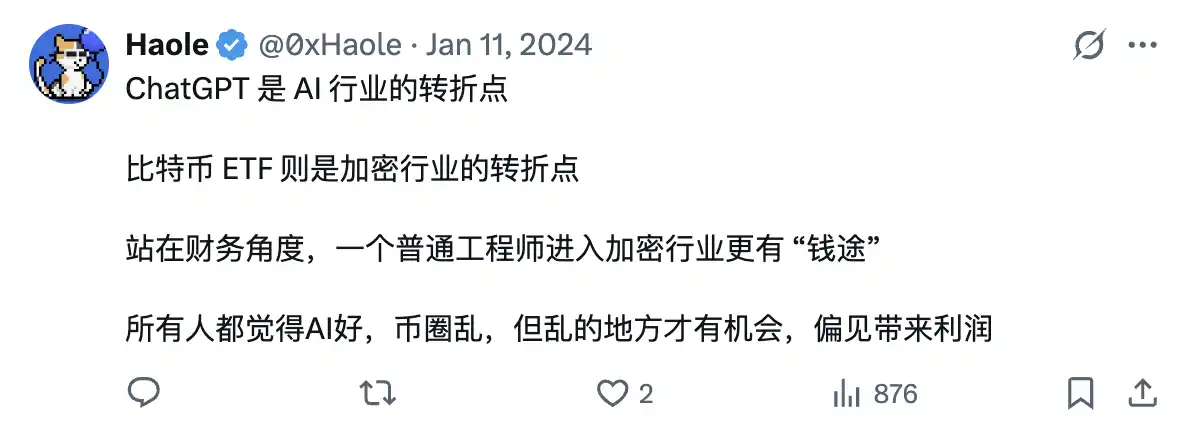
Haole: That tweet was actually posted in early 2024, just before the start of the bull market. At that time, everyone was chasing the AI trend, and the cryptocurrency circle was relatively quiet. The subsequent price surge from around $30,000 to $40,000 indeed validated this point, showing that bias can lead to opportunities and profits. However, the recent market reversal has proven that AI is the real hot trend now.
BlockBeats: Was that around the time when the Bitcoin ETF concept was starting to be hyped up?
Haole: Exactly, it was precisely at that time. The more people view the cryptocurrency industry with colored glasses, the more likely it is to identify value opportunities. When everyone is going crazy, it's actually time to consider pulling back.
BlockBeats: And in hindsight?
Haole: Speaking of this cycle, Bitcoin's performance is relatively satisfying, but during the meme season, there was a period of FOMO that led to significant losses. This cycle has once again proven that ordinary people are only suitable for holding Bitcoin. Meme coins are all zero-cost coins, and the final result of zero-cost coins is always going to zero.
Development Practice and Ecosystem Thinking of the Farcaster Client
BlockBeats: Why did you want to develop a Farcaster Protocol client?
Haole: Bitcoin solved the problem of private property rights, but when it comes to data ownership, there isn't a truly effective solution. Web2 social platforms are all leveraging user data for profit. Although they allow you to download your data, you cannot obtain all of the platform's data, while the platform can use global data to form data monopolies. In the AI era, platforms like Reddit, X, and Xiaohongshu are further restricting APIs to strengthen their data barriers.
Decentralized social platforms are attempts to address this issue. Due to network effects, everyone knows it’s challenging, but since there are teams actually working on it, I'm willing to participate and support the cause.
Currently, Farcaster should have the most abundant funding and the most practical technology team. They have been working for 3-4 years, and the founder enjoys engaging with the community. The team has weekly product iterations and is one of the rare teams in the cryptocurrency industry that takes a long-term view. That's why I prefer to do something persistent on Farcaster.

Recaster Custom Logo
BlockBeats: So when you were in a traditional tech company, working within that value system and rule set, and then you had a separate Open Network mindset where data belongs to everyone, didn't these two sets of values create a conflict in your mind?
Haole: It's precisely because I saw too much of Web2, where everyone makes money by monopolizing information, that I felt there should be another way to disrupt or restrict it. Just like how Bitcoin can hedge against the overissuance of fiat currency, decentralized social platforms also serve as a hedge against the information monopoly of large tech industry giants. Although progress is difficult, this is the right direction to invest in for the long term.
BlockBeats: Farcaster co-founder Varun once said in an interview that building applications and social networks is really, really difficult. It took a team of 20 people a year to build Warpcast. It's unrealistic to expect other teams to fully commit to building Farcaster from the start and invest 100% without any users. How much have you invested in this development process? Time, energy, funds?
Related Reading: "Exclusive Interview with Farcaster Co-founder: Exploring the Future of Decentralized Social Networks"
Haole: They needed to develop the protocol layer, front end, back end, and mobile end simultaneously, so the cost was relatively high. Now the community has Neynar providing backend APIs, and my development focus is mainly on the mobile end. I haven't invested much time, mainly utilizing weekends and evenings. In the initial stages, I spent about 20-30 hours per week, but now it's less, around 10 hours, and this has been ongoing for almost a year.
Funding-wise, I haven't hired anyone; I've been developing independently. The main expense is Neynar's service fee, $250 per month, plus miscellaneous server costs, keeping the overall monthly cost under $300, which is quite affordable.
BlockBeats: BlockBeats: Supercast (another front-end application of the Farcaster protocol) is now considered to have been acquired, and founder Woj has also joined the Farcaster protocol team. Where do you see Recaster heading in the future?
Haole: Currently, Farcaster's daily active users (DAU) are too few, making it challenging to sustain a full-time team of over 2 people without funding. The acquisition of Supercast is seen as a good outcome.
Recaster is quite unique, with very low costs as mentioned earlier. It does not require funding and has no commercialization needs. I am only responsible to myself, and I just want to polish it into a product that satisfies me. As long as the Farcaster protocol remains alive, Recaster will continue to exist.
If one day Recaster becomes popular among many people, with 10,000 to 20,000 daily active users, I may consider full-time development.
BlockBeats: How do you view the behavior of the Farcaster protocol developing its own client?
Haole: I think it's great, and I agree with it. Many people say the Farcaster team lacks the blockchain spirit and cannot build a protocol. But the fundamental issue currently is not about the protocol itself but about how to bring more people into the decentralized world. A pragmatic approach to decentralization is actually more effective in the early stages. However, the Farcaster protocol is open enough. For most core functions, I do not need official permission to develop.
BlockBeats: How do you see the competitive relationship between Warpcast and Tako, the other front-end applications of the Farcaster protocol?
Haole: It's hard to say there is competition; everyone is small and trying to find their product-market fit. Any team exploring decentralized social platforms should be supported and encouraged. Our real adversary is Web2 data monopolies. I also have a lot of exchanges with the Tako team, and we help each other.
BlockBeats: Throughout this process, you have persevered as a solo individual, which is truly remarkable.
Haole: Because my costs are low, and I am currently not focused on profitability, I just want to do something purely. If I were to truly build a team and consider making money, the pressure would be greater, making it harder to persist.
BlockBeats: Have you ever thought that Recaster would fail? What would be the reason for not being able to continue?
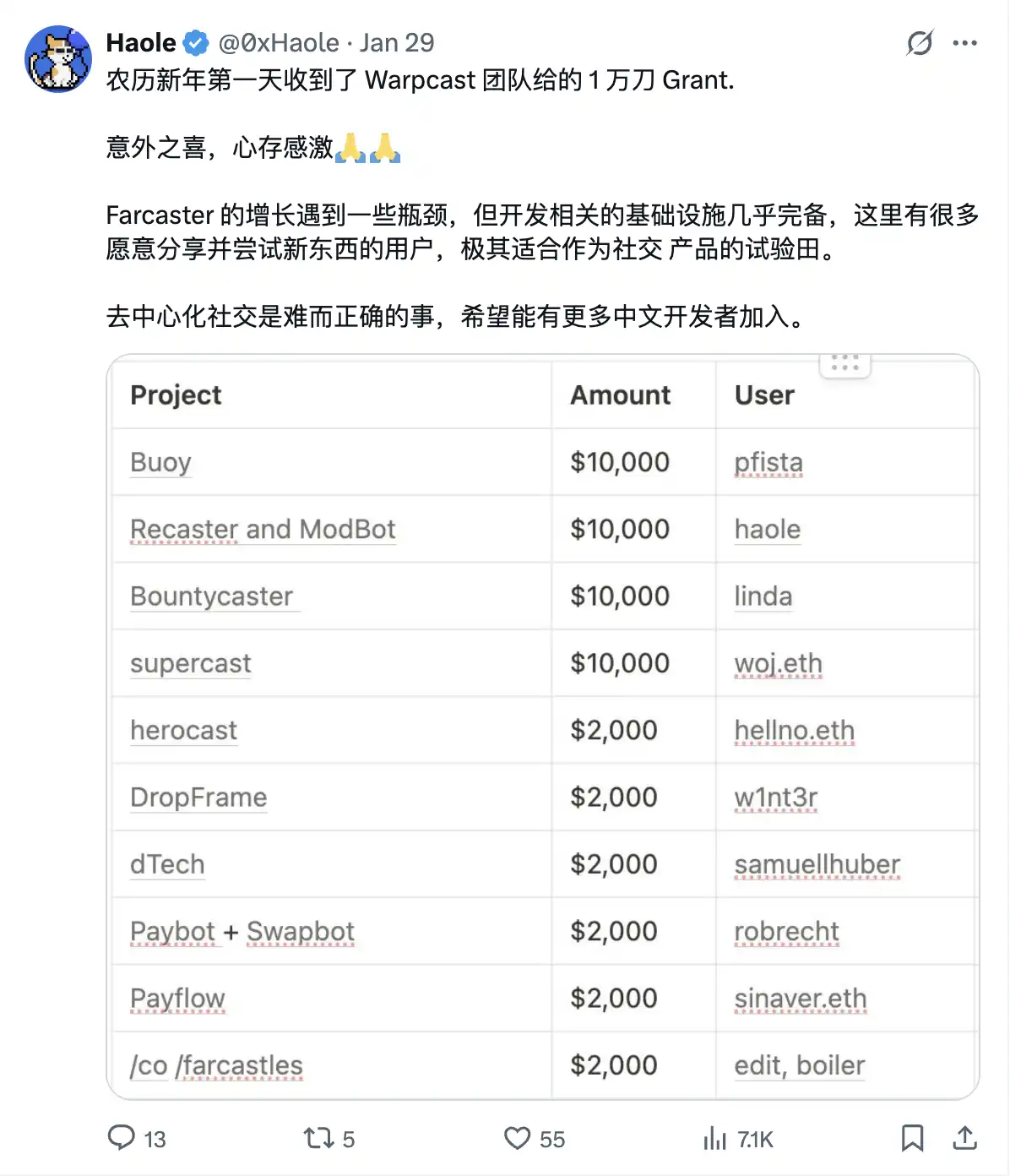
Haole: As long as the Farcaster protocol is alive, this product will also be alive because my costs are too low. The annual maintenance cost is less than $5,000, and the Farcaster Foundation has granted $10,000 to me. Even without spending the money, it's enough to sustain it for another two years. If I really can't continue, it can only mean that the Farcaster protocol is dead.
The Evolution of Developers in the AI Wave
BlockBeats: You have expressed on social media how AI has helped you. What is your greatest takeaway from this AI wave?
Haole: There will come a day when AI will replace programmers. Its development and execution capabilities are already stronger than most people. I can only say that I understand the constantly emerging new requirements in the real world better than it does?
BlockBeats: So, can we say that the role of a product manager will surpass that of an engineer who executes and delivers?
Haole: Perhaps in the future, AI can proactively discover needs and directly help people achieve them. Product managers and implementation engineers have the same fate.
But there is one thing that AI can never replace—relationships and communication between real people. However, the reality is that unless meeting offline, the online world cannot distinguish which accounts are real.
BlockBeats: How do you view the integration of AI agents and Crypto? Some say that in the future, AI on social media will have its own identity, combined with a Crypto payment system, making it indistinguishable from a real person. At that time, the virtual world will be very interesting, and some investors have mentioned that the metaverse will reignite.
Haole: I still prefer the real world. Just like in "The Matrix," choosing the red pill or the blue pill, I would choose the red pill. The path of reality is painful, imperfect, but genuine, allowing us to see the value of being alive.
BlockBeats: Having this kind of warmth is still very helpful for product development.
Haole: Yes, especially after you have children, after years of hard study, coming out not as good as AI, this is a very sad thing. What is the meaning of one's existence?
BlockBeats: So what is your answer to this question?
Haole: I haven't figured out the answer yet, I've just been thinking all the time. It might be a weakness of human nature, greed, fear, anger, sorrow, which can bring different brilliance to this world...
BlockBeats: Looking forward to you sharing your answer online in the future.
The Survival Philosophy of Indie Developers
BlockBeats: You've been in the U.S. for 10 years. Do you think there are any differences in developer culture between the U.S. and China?
Haole: Many students are starting their own businesses, and I often help them with their projects and provide oversight. Chinese engineers are indeed impressive, strong in technology and especially hardworking. Domestic teams use Feishu for remote collaboration, which is very efficient, much stronger than Slack. However, entrepreneurship in China is more realistic. Everyone gathers mainly to make money, and there are fewer idealistic people. Like the recently emerged Deepseek team, they are quite idealistic. Maybe after everyone has made enough money, they will pursue something else.
BlockBeats: After three cycles, what are the different aspects of the development ecosystem for you?
Haole: In 2016 and 2017, when I first entered the industry, my beliefs were not firm enough, so I entered and exited the industry several times, and my impression of the development ecosystem was not particularly deep. The DeFi Summer was the most exciting year, with many projects that were eye-catching, showing what blockchain can do (although in the end, they didn't solve any real problems). In this cycle, there is almost no excitement. The crypto world has become an extension of the dollar hegemony, becoming a laborer for the dollar.
BlockBeats: So now your faith in blockchain is only in Bitcoin.
Haole: Making data more open is also a belief.
BlockBeats: Are there any experiences from independent developers that can be shared with other developers in the blockchain industry?
Haole: Strictly speaking, I am not a true independent developer. Although I develop independently in form, true independent development should refer to a full-time and commercially viable model. Someone like me, who is currently not pursuing profit, is not suitable as an example. True independent developers must find PMF. Only when your product gains market recognition and users are willing to pay for it can you truly achieve independence.
However, from a realistic earnings perspective, aiming to make a big fortune through independent development may not be the optimal choice. Although there are success stories, when multiplied by probability, overall it is far less stable and reliable than joining a large company.
If you really want to do independent development, you must control costs, avoid blindly spending money, and recognize that the importance of marketing outweighs writing code. Truly good products require time to refine, whether it's one year, two years, or even five years. The value accumulated over time is the best moat.
You may also like

Token Cannot Compound, Where Is the Real Investment Opportunity?

February 6th Market Key Intelligence, How Much Did You Miss?

China's Central Bank and Eight Other Departments' Latest Regulatory Focus: Key Attention to RWA Tokenized Asset Risk
Foreword: Today, the People's Bank of China's website published the "Notice of the People's Bank of China, National Development and Reform Commission, Ministry of Industry and Information Technology, Ministry of Public Security, State Administration for Market Regulation, China Banking and Insurance Regulatory Commission, China Securities Regulatory Commission, State Administration of Foreign Exchange on Further Preventing and Dealing with Risks Related to Virtual Currency and Others (Yinfa [2026] No. 42)", the latest regulatory requirements from the eight departments including the central bank, which are basically consistent with the regulatory requirements of recent years. The main focus of the regulation is on speculative activities such as virtual currency trading, exchanges, ICOs, overseas platform services, and this time, regulatory oversight of RWA has been added, explicitly prohibiting RWA tokenization, stablecoins (especially those pegged to the RMB). The following is the full text:
To the people's governments of all provinces, autonomous regions, and municipalities directly under the Central Government, the Xinjiang Production and Construction Corps:
Recently, there have been speculative activities related to virtual currency and Real-World Assets (RWA) tokenization, disrupting the economic and financial order and jeopardizing the property security of the people. In order to further prevent and address the risks related to virtual currency and Real-World Assets tokenization, effectively safeguard national security and social stability, in accordance with the "Law of the People's Republic of China on the People's Bank of China," "Law of the People's Republic of China on Commercial Banks," "Securities Law of the People's Republic of China," "Law of the People's Republic of China on Securities Investment Funds," "Law of the People's Republic of China on Futures and Derivatives," "Cybersecurity Law of the People's Republic of China," "Regulations of the People's Republic of China on the Administration of Renminbi," "Regulations on Prevention and Disposal of Illegal Fundraising," "Regulations of the People's Republic of China on Foreign Exchange Administration," "Telecommunications Regulations of the People's Republic of China," and other provisions, after reaching consensus with the Cyberspace Administration of China, the Supreme People's Court, and the Supreme People's Procuratorate, and with the approval of the State Council, the relevant matters are notified as follows:
(I) Virtual currency does not possess the legal status equivalent to fiat currency. Virtual currencies such as Bitcoin, Ether, Tether, etc., have the main characteristics of being issued by non-monetary authorities, using encryption technology and distributed ledger or similar technology, existing in digital form, etc. They do not have legal tender status, should not and cannot be circulated and used as currency in the market.
The business activities related to virtual currency are classified as illegal financial activities. The exchange of fiat currency and virtual currency within the territory, exchange of virtual currencies, acting as a central counterparty in buying and selling virtual currencies, providing information intermediary and pricing services for virtual currency transactions, token issuance financing, and trading of virtual currency-related financial products, etc., fall under illegal financial activities, such as suspected illegal issuance of token vouchers, unauthorized public issuance of securities, illegal operation of securities and futures business, illegal fundraising, etc., are strictly prohibited across the board and resolutely banned in accordance with the law. Overseas entities and individuals are not allowed to provide virtual currency-related services to domestic entities in any form.
A stablecoin pegged to a fiat currency indirectly fulfills some functions of the fiat currency in circulation. Without the consent of relevant authorities in accordance with the law and regulations, any domestic or foreign entity or individual is not allowed to issue a RMB-pegged stablecoin overseas.
(II)Tokenization of Real-World Assets refers to the use of encryption technology and distributed ledger or similar technologies to transform ownership rights, income rights, etc., of assets into tokens (tokens) or other interests or bond certificates with token (token) characteristics, and carry out issuance and trading activities.
Engaging in the tokenization of real-world assets domestically, as well as providing related intermediary, information technology services, etc., which are suspected of illegal issuance of token vouchers, unauthorized public offering of securities, illegal operation of securities and futures business, illegal fundraising, and other illegal financial activities, shall be prohibited; except for relevant business activities carried out with the approval of the competent authorities in accordance with the law and regulations and relying on specific financial infrastructures. Overseas entities and individuals are not allowed to illegally provide services related to the tokenization of real-world assets to domestic entities in any form.
(III) Inter-agency Coordination. The People's Bank of China, together with the National Development and Reform Commission, the Ministry of Industry and Information Technology, the Ministry of Public Security, the State Administration for Market Regulation, the China Banking and Insurance Regulatory Commission, the China Securities Regulatory Commission, the State Administration of Foreign Exchange, and other departments, will improve the work mechanism, strengthen coordination with the Cyberspace Administration of China, the Supreme People's Court, and the Supreme People's Procuratorate, coordinate efforts, and overall guide regions to carry out risk prevention and disposal of virtual currency-related illegal financial activities.
The China Securities Regulatory Commission, together with the National Development and Reform Commission, the Ministry of Industry and Information Technology, the Ministry of Public Security, the People's Bank of China, the State Administration for Market Regulation, the China Banking and Insurance Regulatory Commission, the State Administration of Foreign Exchange, and other departments, will improve the work mechanism, strengthen coordination with the Cyberspace Administration of China, the Supreme People's Court, and the Supreme People's Procuratorate, coordinate efforts, and overall guide regions to carry out risk prevention and disposal of illegal financial activities related to the tokenization of real-world assets.
(IV) Strengthening Local Implementation. The people's governments at the provincial level are overall responsible for the prevention and disposal of risks related to virtual currencies and the tokenization of real-world assets in their respective administrative regions. The specific leading department is the local financial regulatory department, with participation from branches and dispatched institutions of the State Council's financial regulatory department, telecommunications regulators, public security, market supervision, and other departments, in coordination with cyberspace departments, courts, and procuratorates, to improve the normalization of the work mechanism, effectively connect with the relevant work mechanisms of central departments, form a cooperative and coordinated working pattern between central and local governments, effectively prevent and properly handle risks related to virtual currencies and the tokenization of real-world assets, and maintain economic and financial order and social stability.
(5) Enhanced Risk Monitoring. The People's Bank of China, China Securities Regulatory Commission, National Development and Reform Commission, Ministry of Industry and Information Technology, Ministry of Public Security, State Administration of Foreign Exchange, Cyberspace Administration of China, and other departments continue to improve monitoring techniques and system support, enhance cross-departmental data analysis and sharing, establish sound information sharing and cross-validation mechanisms, promptly grasp the risk situation of activities related to virtual currency and real-world asset tokenization. Local governments at all levels give full play to the role of local monitoring and early warning mechanisms. Local financial regulatory authorities, together with branches and agencies of the State Council's financial regulatory authorities, as well as departments of cyberspace and public security, ensure effective connection between online monitoring, offline investigation, and fund tracking, efficiently and accurately identify activities related to virtual currency and real-world asset tokenization, promptly share risk information, improve early warning information dissemination, verification, and rapid response mechanisms.
(6) Strengthened Oversight of Financial Institutions, Intermediaries, and Technology Service Providers. Financial institutions (including non-bank payment institutions) are prohibited from providing account opening, fund transfer, and clearing services for virtual currency-related business activities, issuing and selling financial products related to virtual currency, including virtual currency and related financial products in the scope of collateral, conducting insurance business related to virtual currency, or including virtual currency in the scope of insurance liability. Financial institutions (including non-bank payment institutions) are prohibited from providing custody, clearing, and settlement services for unauthorized real-world asset tokenization-related business and related financial products. Relevant intermediary institutions and information technology service providers are prohibited from providing intermediary, technical, or other services for unauthorized real-world asset tokenization-related businesses and related financial products.
(7) Enhanced Management of Internet Information Content and Access. Internet enterprises are prohibited from providing online business venues, commercial displays, marketing, advertising, or paid traffic diversion services for virtual currency and real-world asset tokenization-related business activities. Upon discovering clues of illegal activities, they should promptly report to relevant departments and provide technical support and assistance for related investigations and inquiries. Based on the clues transferred by the financial regulatory authorities, the cyberspace administration, telecommunications authorities, and public security departments should promptly close and deal with websites, mobile applications (including mini-programs), and public accounts engaged in virtual currency and real-world asset tokenization-related business activities in accordance with the law.
(8) Strengthened Entity Registration and Advertisement Management. Market supervision departments strengthen entity registration and management, and enterprise and individual business registrations must not contain terms such as "virtual currency," "virtual asset," "cryptocurrency," "crypto asset," "stablecoin," "real-world asset tokenization," or "RWA" in their names or business scopes. Market supervision departments, together with financial regulatory authorities, legally enhance the supervision of advertisements related to virtual currency and real-world asset tokenization, promptly investigating and handling relevant illegal advertisements.
(IX) Continued Rectification of Virtual Currency Mining Activities. The National Development and Reform Commission, together with relevant departments, strictly controls virtual currency mining activities, continuously promotes the rectification of virtual currency mining activities. The people's governments of various provinces take overall responsibility for the rectification of "mining" within their respective administrative regions. In accordance with the requirements of the National Development and Reform Commission and other departments in the "Notice on the Rectification of Virtual Currency Mining Activities" (NDRC Energy-saving Building [2021] No. 1283) and the provisions of the "Guidance Catalog for Industrial Structure Adjustment (2024 Edition)," a comprehensive review, investigation, and closure of existing virtual currency mining projects are conducted, new mining projects are strictly prohibited, and mining machine production enterprises are strictly prohibited from providing mining machine sales and other services within the country.
(X) Severe Crackdown on Related Illegal Financial Activities. Upon discovering clues to illegal financial activities related to virtual currency and the tokenization of real-world assets, local financial regulatory authorities, branches of the State Council's financial regulatory authorities, and other relevant departments promptly investigate, determine, and properly handle the issues in accordance with the law, and seriously hold the relevant entities and individuals legally responsible. Those suspected of crimes are transferred to the judicial authorities for processing according to the law.
(XI) Severe Crackdown on Related Illegal and Criminal Activities. The Ministry of Public Security, the People's Bank of China, the State Administration for Market Regulation, the China Banking and Insurance Regulatory Commission, the China Securities Regulatory Commission, as well as judicial and procuratorial organs, in accordance with their respective responsibilities, rigorously crack down on illegal and criminal activities related to virtual currency, the tokenization of real-world assets, such as fraud, money laundering, illegal business operations, pyramid schemes, illegal fundraising, and other illegal and criminal activities carried out under the guise of virtual currency, the tokenization of real-world assets, etc.
(XII) Strengthen Industry Self-discipline. Relevant industry associations should enhance membership management and policy advocacy, based on their own responsibilities, advocate and urge member units to resist illegal financial activities related to virtual currency and the tokenization of real-world assets. Member units that violate regulatory policies and industry self-discipline rules are to be disciplined in accordance with relevant self-regulatory management regulations. By leveraging various industry infrastructure, conduct risk monitoring related to virtual currency, the tokenization of real-world assets, and promptly transfer issue clues to relevant departments.
(XIII) Without the approval of relevant departments in accordance with the law and regulations, domestic entities and foreign entities controlled by them may not issue virtual currency overseas.
(XIV) Domestic entities engaging directly or indirectly in overseas external debt-based tokenization of real-world assets, or conducting asset securitization activities abroad based on domestic ownership rights, income rights, etc. (hereinafter referred to as domestic equity), should be strictly regulated in accordance with the principles of "same business, same risk, same rules." The National Development and Reform Commission, the China Securities Regulatory Commission, the State Administration of Foreign Exchange, and other relevant departments regulate it according to their respective responsibilities. For other forms of overseas real-world asset tokenization activities based on domestic equity by domestic entities, the China Securities Regulatory Commission, together with relevant departments, supervise according to their division of responsibilities. Without the consent and filing of relevant departments, no unit or individual may engage in the above-mentioned business.
(15) Overseas subsidiaries and branches of domestic financial institutions providing Real World Asset Tokenization-related services overseas shall do so legally and prudently. They shall have professional personnel and systems in place to effectively mitigate business risks, strictly implement customer onboarding, suitability management, anti-money laundering requirements, and incorporate them into the domestic financial institutions' compliance and risk management system. Intermediaries and information technology service providers offering Real World Asset Tokenization services abroad based on domestic equity or conducting Real World Asset Tokenization business in the form of overseas debt for domestic entities directly or indirectly venturing abroad must strictly comply with relevant laws and regulations. They should establish and improve relevant compliance and internal control systems in accordance with relevant normative requirements, strengthen business and risk control, and report the business developments to the relevant regulatory authorities for approval or filing.
(16) Strengthen organizational leadership and overall coordination. All departments and regions should attach great importance to the prevention of risks related to virtual currencies and Real World Asset Tokenization, strengthen organizational leadership, clarify work responsibilities, form a long-term effective working mechanism with centralized coordination, local implementation, and shared responsibilities, maintain high pressure, dynamically monitor risks, effectively prevent and mitigate risks in an orderly and efficient manner, legally protect the property security of the people, and make every effort to maintain economic and financial order and social stability.
(17) Widely carry out publicity and education. All departments, regions, and industry associations should make full use of various media and other communication channels to disseminate information through legal and policy interpretation, analysis of typical cases, and education on investment risks, etc. They should promote the illegality and harm of virtual currencies and Real World Asset Tokenization-related businesses and their manifestations, fully alert to potential risks and hidden dangers, and enhance public awareness and identification capabilities for risk prevention.
(18) Engaging in illegal financial activities related to virtual currencies and Real World Asset Tokenization in violation of this notice, as well as providing services for virtual currencies and Real World Asset Tokenization-related businesses, shall be punished in accordance with relevant regulations. If it constitutes a crime, criminal liability shall be pursued according to the law. For domestic entities and individuals who knowingly or should have known that overseas entities illegally provided virtual currency or Real World Asset Tokenization-related services to domestic entities and still assisted them, relevant responsibilities shall be pursued according to the law. If it constitutes a crime, criminal liability shall be pursued according to the law.
(19) If any unit or individual invests in virtual currencies, Real World Asset Tokens, and related financial products against public order and good customs, the relevant civil legal actions shall be invalid, and any resulting losses shall be borne by them. If there are suspicions of disrupting financial order and jeopardizing financial security, the relevant departments shall deal with them according to the law.
This notice shall enter into force upon the date of its issuance. The People's Bank of China and ten other departments' "Notice on Further Preventing and Dealing with the Risks of Virtual Currency Trading Speculation" (Yinfa [2021] No. 237) is hereby repealed.

Former Partner's Perspective on Multicoin: Kyle's Exit, But the Game He Left Behind Just Getting Started
Why Bitcoin Is Falling Now: The Real Reasons Behind BTC's Crash & WEEX's Smart Profit Playbook
Bitcoin's ongoing crash explained: Discover the 5 hidden triggers behind BTC's plunge & how WEEX's Auto Earn and Trade to Earn strategies help traders profit from crypto market volatility.

Wall Street's Hottest Trades See Exodus

Vitalik Discusses Ethereum Scaling Path, Circle Announces Partnership with Polymarket, What's the Overseas Crypto Community Talking About Today?

Believing in the Capital Markets - The Essence and Core Value of Cryptocurrency

Polymarket's 'Weatherman': Predict Temperature, Win Million-Dollar Payout
$15K+ Profits: The 4 AI Trading Secrets WEEX Hackathon Prelim Winners Used to Dominate Volatile Crypto Markets
How WEEX Hackathon's top AI trading strategies made $15K+ in crypto markets: 4 proven rules for ETH/BTC trading, market structure analysis, and risk management in volatile conditions.

A nearly 20% one-day plunge, how long has it been since you last saw a $60,000 Bitcoin?

Raoul Pal: I've seen every single panic, and they are never the end.

Key Market Information Discrepancy on February 6th - A Must-Read! | Alpha Morning Report

2026 Crypto Industry's First Snowfall

The Harsh Reality Behind the $26 Billion Crypto Liquidation: Liquidity Is Killing the Market

Why Is Gold, US Stocks, Bitcoin All Falling?

Key Market Intelligence for February 5th, how much did you miss out on?

Wintermute: By 2026, crypto had gradually become the settlement layer of the Internet economy
Token Cannot Compound, Where Is the Real Investment Opportunity?
February 6th Market Key Intelligence, How Much Did You Miss?
China's Central Bank and Eight Other Departments' Latest Regulatory Focus: Key Attention to RWA Tokenized Asset Risk
Foreword: Today, the People's Bank of China's website published the "Notice of the People's Bank of China, National Development and Reform Commission, Ministry of Industry and Information Technology, Ministry of Public Security, State Administration for Market Regulation, China Banking and Insurance Regulatory Commission, China Securities Regulatory Commission, State Administration of Foreign Exchange on Further Preventing and Dealing with Risks Related to Virtual Currency and Others (Yinfa [2026] No. 42)", the latest regulatory requirements from the eight departments including the central bank, which are basically consistent with the regulatory requirements of recent years. The main focus of the regulation is on speculative activities such as virtual currency trading, exchanges, ICOs, overseas platform services, and this time, regulatory oversight of RWA has been added, explicitly prohibiting RWA tokenization, stablecoins (especially those pegged to the RMB). The following is the full text:
To the people's governments of all provinces, autonomous regions, and municipalities directly under the Central Government, the Xinjiang Production and Construction Corps:
Recently, there have been speculative activities related to virtual currency and Real-World Assets (RWA) tokenization, disrupting the economic and financial order and jeopardizing the property security of the people. In order to further prevent and address the risks related to virtual currency and Real-World Assets tokenization, effectively safeguard national security and social stability, in accordance with the "Law of the People's Republic of China on the People's Bank of China," "Law of the People's Republic of China on Commercial Banks," "Securities Law of the People's Republic of China," "Law of the People's Republic of China on Securities Investment Funds," "Law of the People's Republic of China on Futures and Derivatives," "Cybersecurity Law of the People's Republic of China," "Regulations of the People's Republic of China on the Administration of Renminbi," "Regulations on Prevention and Disposal of Illegal Fundraising," "Regulations of the People's Republic of China on Foreign Exchange Administration," "Telecommunications Regulations of the People's Republic of China," and other provisions, after reaching consensus with the Cyberspace Administration of China, the Supreme People's Court, and the Supreme People's Procuratorate, and with the approval of the State Council, the relevant matters are notified as follows:
(I) Virtual currency does not possess the legal status equivalent to fiat currency. Virtual currencies such as Bitcoin, Ether, Tether, etc., have the main characteristics of being issued by non-monetary authorities, using encryption technology and distributed ledger or similar technology, existing in digital form, etc. They do not have legal tender status, should not and cannot be circulated and used as currency in the market.
The business activities related to virtual currency are classified as illegal financial activities. The exchange of fiat currency and virtual currency within the territory, exchange of virtual currencies, acting as a central counterparty in buying and selling virtual currencies, providing information intermediary and pricing services for virtual currency transactions, token issuance financing, and trading of virtual currency-related financial products, etc., fall under illegal financial activities, such as suspected illegal issuance of token vouchers, unauthorized public issuance of securities, illegal operation of securities and futures business, illegal fundraising, etc., are strictly prohibited across the board and resolutely banned in accordance with the law. Overseas entities and individuals are not allowed to provide virtual currency-related services to domestic entities in any form.
A stablecoin pegged to a fiat currency indirectly fulfills some functions of the fiat currency in circulation. Without the consent of relevant authorities in accordance with the law and regulations, any domestic or foreign entity or individual is not allowed to issue a RMB-pegged stablecoin overseas.
(II)Tokenization of Real-World Assets refers to the use of encryption technology and distributed ledger or similar technologies to transform ownership rights, income rights, etc., of assets into tokens (tokens) or other interests or bond certificates with token (token) characteristics, and carry out issuance and trading activities.
Engaging in the tokenization of real-world assets domestically, as well as providing related intermediary, information technology services, etc., which are suspected of illegal issuance of token vouchers, unauthorized public offering of securities, illegal operation of securities and futures business, illegal fundraising, and other illegal financial activities, shall be prohibited; except for relevant business activities carried out with the approval of the competent authorities in accordance with the law and regulations and relying on specific financial infrastructures. Overseas entities and individuals are not allowed to illegally provide services related to the tokenization of real-world assets to domestic entities in any form.
(III) Inter-agency Coordination. The People's Bank of China, together with the National Development and Reform Commission, the Ministry of Industry and Information Technology, the Ministry of Public Security, the State Administration for Market Regulation, the China Banking and Insurance Regulatory Commission, the China Securities Regulatory Commission, the State Administration of Foreign Exchange, and other departments, will improve the work mechanism, strengthen coordination with the Cyberspace Administration of China, the Supreme People's Court, and the Supreme People's Procuratorate, coordinate efforts, and overall guide regions to carry out risk prevention and disposal of virtual currency-related illegal financial activities.
The China Securities Regulatory Commission, together with the National Development and Reform Commission, the Ministry of Industry and Information Technology, the Ministry of Public Security, the People's Bank of China, the State Administration for Market Regulation, the China Banking and Insurance Regulatory Commission, the State Administration of Foreign Exchange, and other departments, will improve the work mechanism, strengthen coordination with the Cyberspace Administration of China, the Supreme People's Court, and the Supreme People's Procuratorate, coordinate efforts, and overall guide regions to carry out risk prevention and disposal of illegal financial activities related to the tokenization of real-world assets.
(IV) Strengthening Local Implementation. The people's governments at the provincial level are overall responsible for the prevention and disposal of risks related to virtual currencies and the tokenization of real-world assets in their respective administrative regions. The specific leading department is the local financial regulatory department, with participation from branches and dispatched institutions of the State Council's financial regulatory department, telecommunications regulators, public security, market supervision, and other departments, in coordination with cyberspace departments, courts, and procuratorates, to improve the normalization of the work mechanism, effectively connect with the relevant work mechanisms of central departments, form a cooperative and coordinated working pattern between central and local governments, effectively prevent and properly handle risks related to virtual currencies and the tokenization of real-world assets, and maintain economic and financial order and social stability.
(5) Enhanced Risk Monitoring. The People's Bank of China, China Securities Regulatory Commission, National Development and Reform Commission, Ministry of Industry and Information Technology, Ministry of Public Security, State Administration of Foreign Exchange, Cyberspace Administration of China, and other departments continue to improve monitoring techniques and system support, enhance cross-departmental data analysis and sharing, establish sound information sharing and cross-validation mechanisms, promptly grasp the risk situation of activities related to virtual currency and real-world asset tokenization. Local governments at all levels give full play to the role of local monitoring and early warning mechanisms. Local financial regulatory authorities, together with branches and agencies of the State Council's financial regulatory authorities, as well as departments of cyberspace and public security, ensure effective connection between online monitoring, offline investigation, and fund tracking, efficiently and accurately identify activities related to virtual currency and real-world asset tokenization, promptly share risk information, improve early warning information dissemination, verification, and rapid response mechanisms.
(6) Strengthened Oversight of Financial Institutions, Intermediaries, and Technology Service Providers. Financial institutions (including non-bank payment institutions) are prohibited from providing account opening, fund transfer, and clearing services for virtual currency-related business activities, issuing and selling financial products related to virtual currency, including virtual currency and related financial products in the scope of collateral, conducting insurance business related to virtual currency, or including virtual currency in the scope of insurance liability. Financial institutions (including non-bank payment institutions) are prohibited from providing custody, clearing, and settlement services for unauthorized real-world asset tokenization-related business and related financial products. Relevant intermediary institutions and information technology service providers are prohibited from providing intermediary, technical, or other services for unauthorized real-world asset tokenization-related businesses and related financial products.
(7) Enhanced Management of Internet Information Content and Access. Internet enterprises are prohibited from providing online business venues, commercial displays, marketing, advertising, or paid traffic diversion services for virtual currency and real-world asset tokenization-related business activities. Upon discovering clues of illegal activities, they should promptly report to relevant departments and provide technical support and assistance for related investigations and inquiries. Based on the clues transferred by the financial regulatory authorities, the cyberspace administration, telecommunications authorities, and public security departments should promptly close and deal with websites, mobile applications (including mini-programs), and public accounts engaged in virtual currency and real-world asset tokenization-related business activities in accordance with the law.
(8) Strengthened Entity Registration and Advertisement Management. Market supervision departments strengthen entity registration and management, and enterprise and individual business registrations must not contain terms such as "virtual currency," "virtual asset," "cryptocurrency," "crypto asset," "stablecoin," "real-world asset tokenization," or "RWA" in their names or business scopes. Market supervision departments, together with financial regulatory authorities, legally enhance the supervision of advertisements related to virtual currency and real-world asset tokenization, promptly investigating and handling relevant illegal advertisements.
(IX) Continued Rectification of Virtual Currency Mining Activities. The National Development and Reform Commission, together with relevant departments, strictly controls virtual currency mining activities, continuously promotes the rectification of virtual currency mining activities. The people's governments of various provinces take overall responsibility for the rectification of "mining" within their respective administrative regions. In accordance with the requirements of the National Development and Reform Commission and other departments in the "Notice on the Rectification of Virtual Currency Mining Activities" (NDRC Energy-saving Building [2021] No. 1283) and the provisions of the "Guidance Catalog for Industrial Structure Adjustment (2024 Edition)," a comprehensive review, investigation, and closure of existing virtual currency mining projects are conducted, new mining projects are strictly prohibited, and mining machine production enterprises are strictly prohibited from providing mining machine sales and other services within the country.
(X) Severe Crackdown on Related Illegal Financial Activities. Upon discovering clues to illegal financial activities related to virtual currency and the tokenization of real-world assets, local financial regulatory authorities, branches of the State Council's financial regulatory authorities, and other relevant departments promptly investigate, determine, and properly handle the issues in accordance with the law, and seriously hold the relevant entities and individuals legally responsible. Those suspected of crimes are transferred to the judicial authorities for processing according to the law.
(XI) Severe Crackdown on Related Illegal and Criminal Activities. The Ministry of Public Security, the People's Bank of China, the State Administration for Market Regulation, the China Banking and Insurance Regulatory Commission, the China Securities Regulatory Commission, as well as judicial and procuratorial organs, in accordance with their respective responsibilities, rigorously crack down on illegal and criminal activities related to virtual currency, the tokenization of real-world assets, such as fraud, money laundering, illegal business operations, pyramid schemes, illegal fundraising, and other illegal and criminal activities carried out under the guise of virtual currency, the tokenization of real-world assets, etc.
(XII) Strengthen Industry Self-discipline. Relevant industry associations should enhance membership management and policy advocacy, based on their own responsibilities, advocate and urge member units to resist illegal financial activities related to virtual currency and the tokenization of real-world assets. Member units that violate regulatory policies and industry self-discipline rules are to be disciplined in accordance with relevant self-regulatory management regulations. By leveraging various industry infrastructure, conduct risk monitoring related to virtual currency, the tokenization of real-world assets, and promptly transfer issue clues to relevant departments.
(XIII) Without the approval of relevant departments in accordance with the law and regulations, domestic entities and foreign entities controlled by them may not issue virtual currency overseas.
(XIV) Domestic entities engaging directly or indirectly in overseas external debt-based tokenization of real-world assets, or conducting asset securitization activities abroad based on domestic ownership rights, income rights, etc. (hereinafter referred to as domestic equity), should be strictly regulated in accordance with the principles of "same business, same risk, same rules." The National Development and Reform Commission, the China Securities Regulatory Commission, the State Administration of Foreign Exchange, and other relevant departments regulate it according to their respective responsibilities. For other forms of overseas real-world asset tokenization activities based on domestic equity by domestic entities, the China Securities Regulatory Commission, together with relevant departments, supervise according to their division of responsibilities. Without the consent and filing of relevant departments, no unit or individual may engage in the above-mentioned business.
(15) Overseas subsidiaries and branches of domestic financial institutions providing Real World Asset Tokenization-related services overseas shall do so legally and prudently. They shall have professional personnel and systems in place to effectively mitigate business risks, strictly implement customer onboarding, suitability management, anti-money laundering requirements, and incorporate them into the domestic financial institutions' compliance and risk management system. Intermediaries and information technology service providers offering Real World Asset Tokenization services abroad based on domestic equity or conducting Real World Asset Tokenization business in the form of overseas debt for domestic entities directly or indirectly venturing abroad must strictly comply with relevant laws and regulations. They should establish and improve relevant compliance and internal control systems in accordance with relevant normative requirements, strengthen business and risk control, and report the business developments to the relevant regulatory authorities for approval or filing.
(16) Strengthen organizational leadership and overall coordination. All departments and regions should attach great importance to the prevention of risks related to virtual currencies and Real World Asset Tokenization, strengthen organizational leadership, clarify work responsibilities, form a long-term effective working mechanism with centralized coordination, local implementation, and shared responsibilities, maintain high pressure, dynamically monitor risks, effectively prevent and mitigate risks in an orderly and efficient manner, legally protect the property security of the people, and make every effort to maintain economic and financial order and social stability.
(17) Widely carry out publicity and education. All departments, regions, and industry associations should make full use of various media and other communication channels to disseminate information through legal and policy interpretation, analysis of typical cases, and education on investment risks, etc. They should promote the illegality and harm of virtual currencies and Real World Asset Tokenization-related businesses and their manifestations, fully alert to potential risks and hidden dangers, and enhance public awareness and identification capabilities for risk prevention.
(18) Engaging in illegal financial activities related to virtual currencies and Real World Asset Tokenization in violation of this notice, as well as providing services for virtual currencies and Real World Asset Tokenization-related businesses, shall be punished in accordance with relevant regulations. If it constitutes a crime, criminal liability shall be pursued according to the law. For domestic entities and individuals who knowingly or should have known that overseas entities illegally provided virtual currency or Real World Asset Tokenization-related services to domestic entities and still assisted them, relevant responsibilities shall be pursued according to the law. If it constitutes a crime, criminal liability shall be pursued according to the law.
(19) If any unit or individual invests in virtual currencies, Real World Asset Tokens, and related financial products against public order and good customs, the relevant civil legal actions shall be invalid, and any resulting losses shall be borne by them. If there are suspicions of disrupting financial order and jeopardizing financial security, the relevant departments shall deal with them according to the law.
This notice shall enter into force upon the date of its issuance. The People's Bank of China and ten other departments' "Notice on Further Preventing and Dealing with the Risks of Virtual Currency Trading Speculation" (Yinfa [2021] No. 237) is hereby repealed.
Former Partner's Perspective on Multicoin: Kyle's Exit, But the Game He Left Behind Just Getting Started
Why Bitcoin Is Falling Now: The Real Reasons Behind BTC's Crash & WEEX's Smart Profit Playbook
Bitcoin's ongoing crash explained: Discover the 5 hidden triggers behind BTC's plunge & how WEEX's Auto Earn and Trade to Earn strategies help traders profit from crypto market volatility.
