IOSG: Port and New City, Two Cryptoverse Views of BNB Chain and Base

By: blockbeats|2026/01/01 17:30:01
0
Share
copy
Original Title: "IOSG Weekly Brief | A Tale of Two Cities: Understanding BNB Chain and Base from a Cultural Perspective"
Original Author: Jiawei, ISOG Ventures

IOSG: Port and New City, Two Cryptoverse Views of BNB Chain and Base


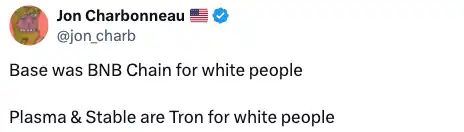
▲ Source: Jon Charbonneau

A while back, when I came across Jon Charbonneau's tweet, I couldn't help but laugh. When Base is referred to as the "white man's BNB Chain," what exactly is the implication behind this jest?

In Haseeb's article "Blockchains are cities," Ethereum and Solana are likened to New York and Los Angeles, respectively. If we apply the same analogy:

BNB Chain is a bustling port city that never sleeps, carrying massive traffic from Binance. Cargo ships come and go, the market is lively, street stalls and exchanges stand side by side. It doesn't matter where you're from; it only cares if you can participate immediately. Gas fees are low, the pace is fast, new projects launch every day, some make money, some leave. You don't need to understand urban planning or subscribe to a specific ideology—just know where the action is, where the opportunities are, and you'll survive.

Base, on the other hand, is a newly developing city inheriting Ethereum's values. Roads are still being paved, the community is taking shape, and the rules are under intense debate. Here, there is no port hustle and bustle, but it has attracted numerous engineers, creators, and institutions to settle in early. They are not in a rush to make quick money but are pondering: If there will be a new wave of truly mass-market on-chain applications in the next ten years, where should they originate?

In the same crypto world, different cities, residents, and lifestyles are diverging.

Perhaps understanding the differences between these two cities is much more important than debating which chain is superior.

Two Parallel Cultures

If we plot BNB Chain and Base on the same map, they may seem to be in competition; however, when viewed from the perspective of users and culture, it becomes clear that this is more like the parallel growth of two worldviews.

BNB Chain and Base fundamentally represent two distinct user structures, traffic sources, and growth logics. The former is rooted in Asia and emerging markets, while the latter has grown within the Euro-American developer community. Rather than simplifying their relationship as competitive, it is more accurate to say they are the result of the natural stratification of crypto users.
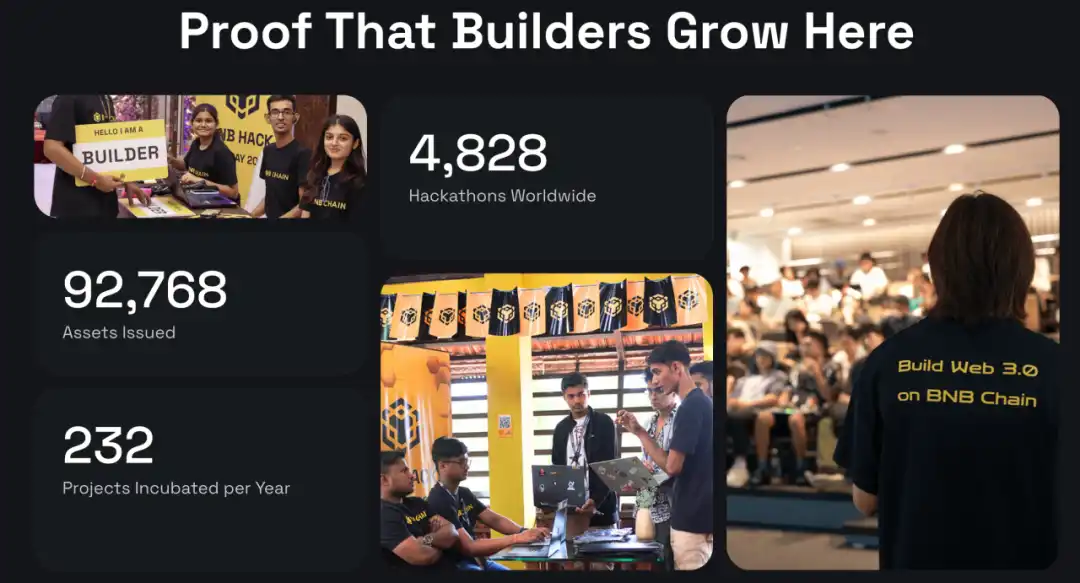
▲ Source: bnbchain.org

The user profile of BNB Chain is very clear.

A large number of users come from Binance's years of accumulation of retail users, many of whom are using on-chain products for the first time. They are mainly distributed in emerging markets such as Southeast Asia and the Middle East, and they are not obsessed with the purity of decentralization. Their focus is highly practical:

Is the gas fee low enough? Is the transaction fast enough? Can they participate in hot projects immediately?

For these users, the chain is not an ideology, just a tool. As long as it is user-friendly, cheap, and profitable, whether it is centralized or semi-decentralized is not a primary concern. This also explains why the BNB Chain's ecosystem has always revolved around efficiency, scale, and application density.

▲ Source: base.org

The user base of Base is somewhat different.

They are more likely Coinbase users and the "overflow crowd" from the Ethereum ecosystem, often having a deeper understanding of blockchain and being more willing to discuss underlying design issues. These users are concerned about Base's relationship with the Ethereum mainnet, the level of decentralization, the technical roadmap for Layer 2, and even whether the culture and narrative are orthodox.

In their eyes, blockchain is not just a tool for completing transactions, but also a space for self-expression, community building, and creative experimentation.

It is precisely this difference in user attributes that profoundly shapes the radically different cultural genes of the two chains.

BNB Chain has chosen a path closer to Web2 consumer internet: ecosystem integration, consolidating as many functions, applications, and scenarios as possible into the same system. For users in emerging markets, this "everything is available" model greatly reduces decision-making costs and learning curves, making the on-chain experience closer to the internet products they are familiar with.

Base, on the other hand, is more like an open experiment field, willing to reserve enough space and patience for developers and creators. It is not eager to cover all scenarios, but prioritizes allowing the right culture and tools to first settle.

From this perspective, BNB Chain and Base are not competing for the same group of users, but are growing in their respective best-suited environments.

They are not opposites, but rather two reasonable answers given by the same industry in different cultural backgrounds.

Vertical Integration: Similarities and Differences

Over the past few years, large-scale exchanges have almost simultaneously done one thing:

No longer satisfied with just being a "matching trading platform," they have extended their business tentacles to a more downstream position such as public chains and wallets.

The underlying business logic is not really complex.

If the trading platform can only interact with users at the moment of "buying" and "selling," then the user's value is discrete and transient; but once the trading platform grasps the chain and wallet, the user's value path will be elongated, turning into a multi-touch, recyclable lifecycle.

When a user completes deposit, on-chain activities, dApp usage, participation in new projects, and then returns to the trading platform within the same system, the trading platform is no longer just an endpoint, but the starting point and endpoint of the entire on-chain journey. With each additional step, the user's switching cost increases, and the stickiness is enhanced. This is exactly the desired outcome of vertical integration: transforming a one-time transactional relationship into a long-term retention relationship.

More importantly, this structure can directly amplify liquidity and trading volume.

The continuous emergence of new tokens and projects on-chain is essentially an ability to "continuously create new assets." And when the trading platform possesses both the chain and the rights to list and price contracts, this on-chain "coinage capability" can seamlessly translate into spot trading pairs and derivative underlyings, ultimately settling into continuous fee income.

From this perspective, BNB Chain and Base are both typical examples of the trading platform's vertical integration strategy, except that they amplify different advantages.
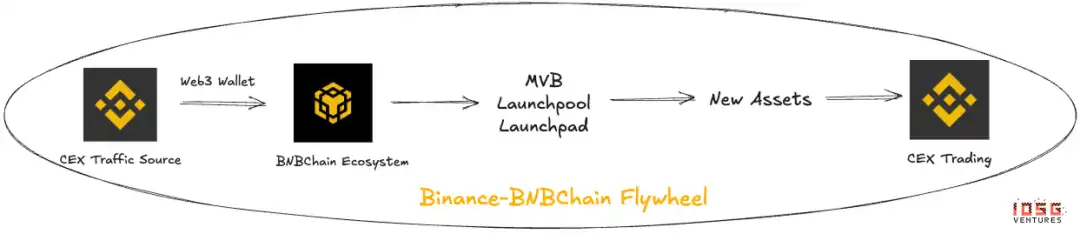
▲ Source: IOSG

BNB Chain's core competitiveness comes from Binance itself.

As a trading platform in the top tier globally in terms of user base and trading depth, Binance has extremely strong instant traffic distribution capabilities. Projects launched on BNB Chain do not need to educate the market from scratch and rarely go through a long cold-start period. A large number of users can directly transition from the trading platform to on-chain participation, then swiftly return to the trading platform for trading after the interaction. This "frictionless back and forth" path makes BNB Chain more like a high-speed lane born for applications.

Behind this pattern is Binance's strong trading platform DNA:

Quick response to market trends, deep understanding of user behavior, and highly mature traffic operation. BNB Chain does not pursue slow and meticulous ecosystem development, but excels in quickly scaling a new narrative to a large extent within a short period of time.
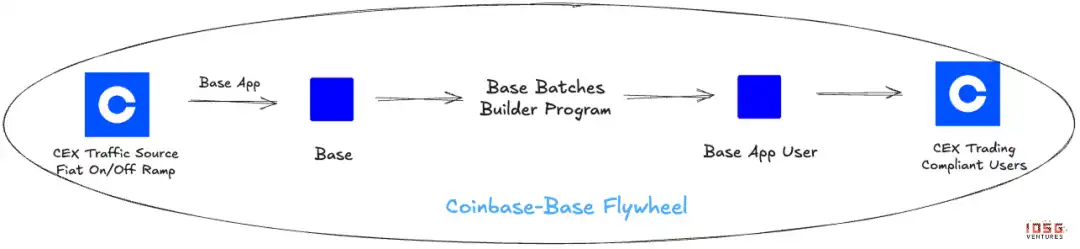
▲ Source: IOSG

Base's vertical integration path is clearly different.

It does not attempt to replicate BNB Chain's speed but relies on Coinbase's long-term accumulation of compliance brand, fiat gateway, and institutional credibility in the U.S. market to build a completely different trust structure. As the first publicly traded cryptocurrency exchange in the U.S., Coinbase's experience in surviving within regulatory frameworks is a scarce resource in itself. This also naturally gives Base the label of being "institutionally friendly."

For institutional investors, enterprise applications, and developers sensitive to compliance boundaries, Base provides an environment where they can confidently experiment and build long-term. Coupled with Coinbase's long-standing deep involvement in the Ethereum ecosystem, continuous investment in developer tools and infrastructure, Base has gradually formed a distinctly "builder-friendly" culture.

If BNB Chain is more like an efficient commercial experiment ground, then Base is closer to a future-oriented infrastructure platform.

The former excels at quickly turning traffic into scale, while the latter excels at slowly settling trust into an ecosystem.

From the perspective of a trading platform, these two paths are not right or wrong; they simply amplify their respective strengths.

It is precisely this difference that makes BNB Chain and Base the most worthwhile and representative samples in the current vertical integration of trading platforms.

Wallets — The Final Showdown?
▲ Source: IOSG, TokenTerminal

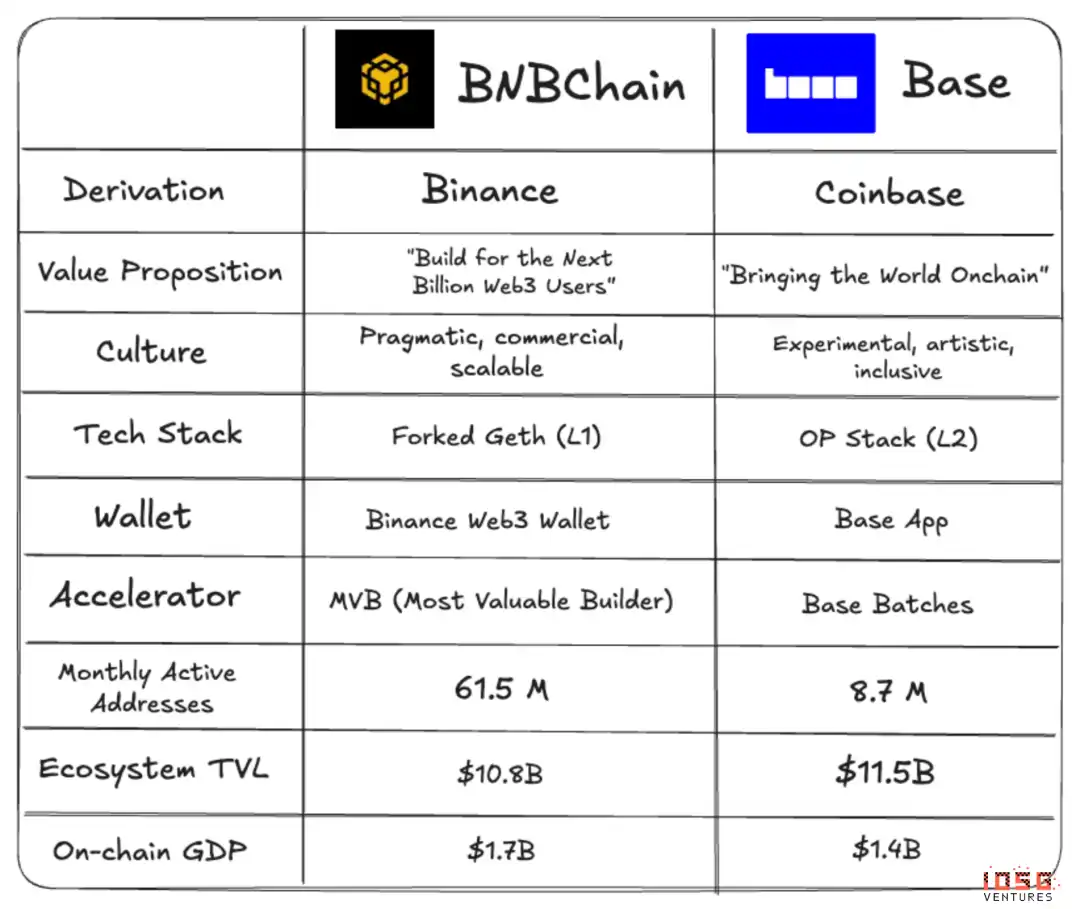
From the community's perspective, the Binance Web3 Wallet is not very popular, but it undoubtedly leads in first-line traffic. For many Binance users, the first time using the Web3 Wallet often comes from a very specific scenario: wanting to participate in a new project, claim an airdrop, or be involved in a hot project that is not yet on the exchange.

And thus, the built-in wallet of the trading platform emerged.

You don't need a mnemonic phrase, you don't need to understand a complex account model, and you don't even need to explicitly realize "I am now using an independent wallet."

From deposits, asset swaps, to cross-chain interactions, authorizations, and engagements, the whole process is an extremely smooth and seamless journey.

Behind this is Binance's consistent ability: to simplify complex financial operations.

It is also for this reason that the Binance Web3 Wallet inherently adapts to the ecosystem characteristics of the BNB Chain—

where trends emerge rapidly, project density is high, and user activity is highly concentrated within short periods.

In a 2025 on-chain study, the daily transaction volume of the Binance Wallet once reached around $92.6 million, occupying nearly 57.3% of the decentralized wallet transaction market share, a number that even surpassed the sum of all independent wallets.

Users can complete cross-chain transfers, swaps, mining, and airdrop participation without needing to remember a mnemonic phrase or exit their current app, an effortlessly frictionless experience that many independent wallets find hard to replicate.

The Coinbase Wallet (Base App), on the other hand, has a completely different disposition. According to recent market statistics, the Base App has reached a user base of around 11 million, ranking among the top in the global self-custody wallet ecosystem.

It was designed from the outset as a product that can exist independently from the trading platform. This has led to a significantly higher learning curve for the Base App.

But once this process is complete, a shift in the user's mindset occurs: this is "my wallet," not "I'm using Coinbase." This design aligns closely with Base's overall direction. Base is not eager to quickly funnel all users into a single popular app; rather, it is more concerned with: Is there anyone willing to stay long term, using the same wallet, the same address, and continuously building their on-chain identity?

Therefore, you will notice that deep users of Base App are often also: early adopters on Base, core participants in NFTs, social platforms, and creator tools, a group of people more sensitive to product experience and long-term narratives.

Under the Binance Web3 Wallet ecosystem, applications that tend to thrive are those with strong financial attributes, short cycles, high-frequency interactions, and the ability to swiftly capture trading platform traffic. On the other hand, within the Base App + Base ecosystem, what tends to flourish are products focused on user retention, sensitive to UX, community, and long-term relationships, not eager to monetize quickly but willing to gradually accumulate genuine users.

Conclusion
▲ Source: IOSG

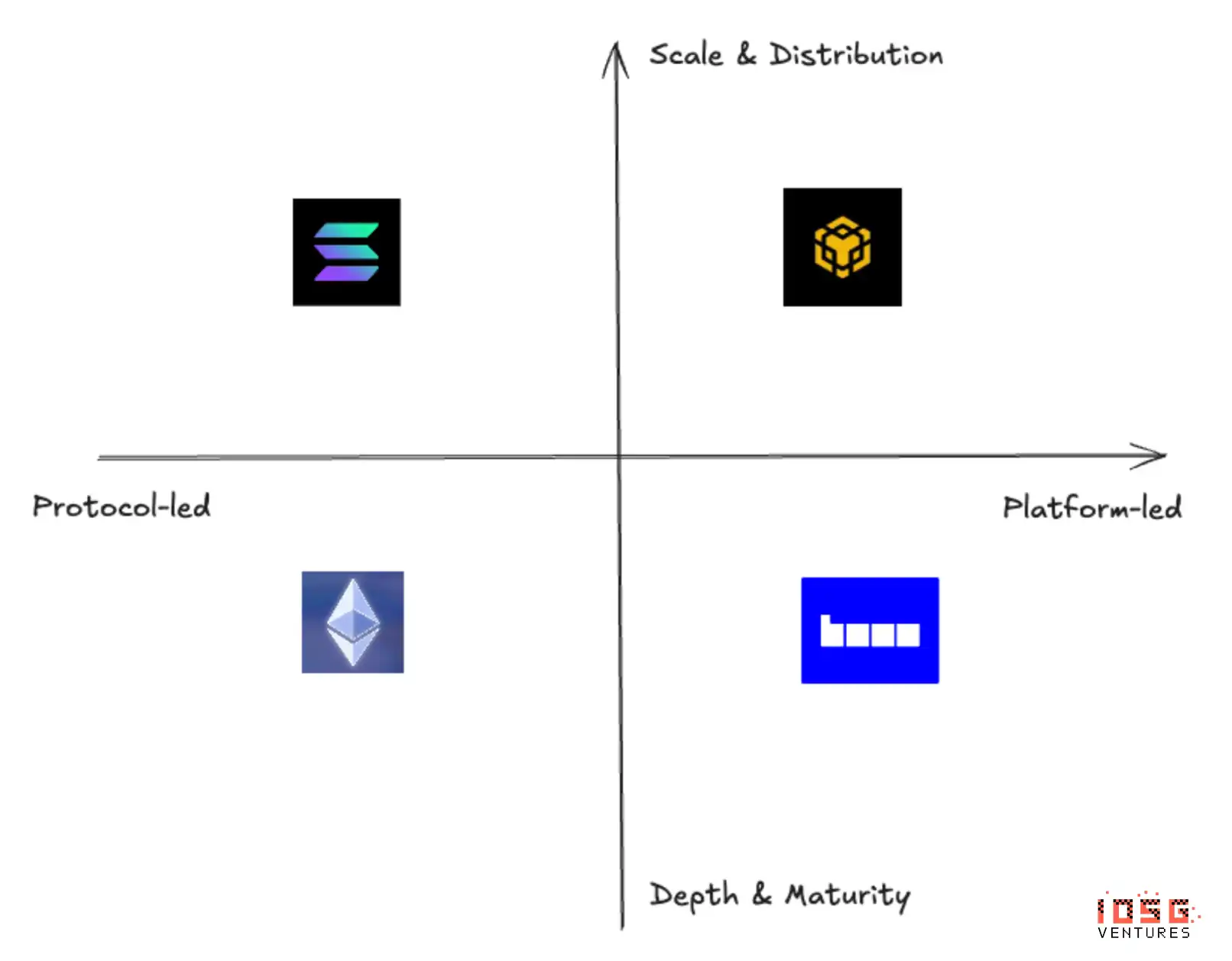
The author believes that in the future, the industry is most likely to see two types of ecosystems:

1. CEX-dominated super ecosystem (Binance, Coinbase)

2. Community-led large-scale public infrastructure (Ethereum, Solana)

BNB Chain and Base will not replace each other.

The global crypto users themselves are not a homogeneous group. What emerging markets need is low barriers, high efficiency, and strong applications; what Europe and the US need is compliance, developer-friendly environments, and cultural identity. These two needs will not disappear in the foreseeable future.

A more realistic scenario is that infrastructure such as wallets, cross-chain, and account abstraction will gradually eliminate usage differences; users will no longer "belong to only one chain" but will flow between different ecosystems.

From this perspective, BNB Chain and Base are more like two nodes in the same system: one is responsible for pushing Web3 to a larger scale, and the other is responsible for advancing Web3 towards a more mature form.

If early public chain competition was like competing for the "sole operating system," then today's competition is more akin to "different platforms jointly building the Internet ecosystem."

The real winner may not be a particular chain itself, but those applications and teams that can simultaneously understand these two ecosystems and freely switch between them.

Original Article Link

You may also like

Token Cannot Compound, Where Is the Real Investment Opportunity?

The next chapter in the crypto industry will undoubtedly be written by Crypto-empowered Stocks.

February 6th Market Key Intelligence, How Much Did You Miss?

1. On-chain Flows: $508.2M USD inflow to Ethereum today; $390.8M USD outflow from Arbitrum 2. Biggest Gainers/Losers: $HBTC, $AIO 3. Top News: Current Bitcoin weekly RSI oversold signal comparable to June 2022

China's Central Bank and Eight Other Departments' Latest Regulatory Focus: Key Attention to RWA Tokenized Asset Risk


Foreword: Today, the People's Bank of China's website published the "Notice of the People's Bank of China, National Development and Reform Commission, Ministry of Industry and Information Technology, Ministry of Public Security, State Administration for Market Regulation, China Banking and Insurance Regulatory Commission, China Securities Regulatory Commission, State Administration of Foreign Exchange on Further Preventing and Dealing with Risks Related to Virtual Currency and Others (Yinfa [2026] No. 42)", the latest regulatory requirements from the eight departments including the central bank, which are basically consistent with the regulatory requirements of recent years. The main focus of the regulation is on speculative activities such as virtual currency trading, exchanges, ICOs, overseas platform services, and this time, regulatory oversight of RWA has been added, explicitly prohibiting RWA tokenization, stablecoins (especially those pegged to the RMB). The following is the full text:


To the people's governments of all provinces, autonomous regions, and municipalities directly under the Central Government, the Xinjiang Production and Construction Corps:


  Recently, there have been speculative activities related to virtual currency and Real-World Assets (RWA) tokenization, disrupting the economic and financial order and jeopardizing the property security of the people. In order to further prevent and address the risks related to virtual currency and Real-World Assets tokenization, effectively safeguard national security and social stability, in accordance with the "Law of the People's Republic of China on the People's Bank of China," "Law of the People's Republic of China on Commercial Banks," "Securities Law of the People's Republic of China," "Law of the People's Republic of China on Securities Investment Funds," "Law of the People's Republic of China on Futures and Derivatives," "Cybersecurity Law of the People's Republic of China," "Regulations of the People's Republic of China on the Administration of Renminbi," "Regulations on Prevention and Disposal of Illegal Fundraising," "Regulations of the People's Republic of China on Foreign Exchange Administration," "Telecommunications Regulations of the People's Republic of China," and other provisions, after reaching consensus with the Cyberspace Administration of China, the Supreme People's Court, and the Supreme People's Procuratorate, and with the approval of the State Council, the relevant matters are notified as follows:


  I. Clarify the essential attributes of virtual currency, Real-World Assets tokenization, and related business activities


  (I) Virtual currency does not possess the legal status equivalent to fiat currency. Virtual currencies such as Bitcoin, Ether, Tether, etc., have the main characteristics of being issued by non-monetary authorities, using encryption technology and distributed ledger or similar technology, existing in digital form, etc. They do not have legal tender status, should not and cannot be circulated and used as currency in the market.


  The business activities related to virtual currency are classified as illegal financial activities. The exchange of fiat currency and virtual currency within the territory, exchange of virtual currencies, acting as a central counterparty in buying and selling virtual currencies, providing information intermediary and pricing services for virtual currency transactions, token issuance financing, and trading of virtual currency-related financial products, etc., fall under illegal financial activities, such as suspected illegal issuance of token vouchers, unauthorized public issuance of securities, illegal operation of securities and futures business, illegal fundraising, etc., are strictly prohibited across the board and resolutely banned in accordance with the law. Overseas entities and individuals are not allowed to provide virtual currency-related services to domestic entities in any form.


  A stablecoin pegged to a fiat currency indirectly fulfills some functions of the fiat currency in circulation. Without the consent of relevant authorities in accordance with the law and regulations, any domestic or foreign entity or individual is not allowed to issue a RMB-pegged stablecoin overseas.


(II)Tokenization of Real-World Assets refers to the use of encryption technology and distributed ledger or similar technologies to transform ownership rights, income rights, etc., of assets into tokens (tokens) or other interests or bond certificates with token (token) characteristics, and carry out issuance and trading activities.


  Engaging in the tokenization of real-world assets domestically, as well as providing related intermediary, information technology services, etc., which are suspected of illegal issuance of token vouchers, unauthorized public offering of securities, illegal operation of securities and futures business, illegal fundraising, and other illegal financial activities, shall be prohibited; except for relevant business activities carried out with the approval of the competent authorities in accordance with the law and regulations and relying on specific financial infrastructures. Overseas entities and individuals are not allowed to illegally provide services related to the tokenization of real-world assets to domestic entities in any form.


  II. Sound Work Mechanism


  (III) Inter-agency Coordination. The People's Bank of China, together with the National Development and Reform Commission, the Ministry of Industry and Information Technology, the Ministry of Public Security, the State Administration for Market Regulation, the China Banking and Insurance Regulatory Commission, the China Securities Regulatory Commission, the State Administration of Foreign Exchange, and other departments, will improve the work mechanism, strengthen coordination with the Cyberspace Administration of China, the Supreme People's Court, and the Supreme People's Procuratorate, coordinate efforts, and overall guide regions to carry out risk prevention and disposal of virtual currency-related illegal financial activities.


  The China Securities Regulatory Commission, together with the National Development and Reform Commission, the Ministry of Industry and Information Technology, the Ministry of Public Security, the People's Bank of China, the State Administration for Market Regulation, the China Banking and Insurance Regulatory Commission, the State Administration of Foreign Exchange, and other departments, will improve the work mechanism, strengthen coordination with the Cyberspace Administration of China, the Supreme People's Court, and the Supreme People's Procuratorate, coordinate efforts, and overall guide regions to carry out risk prevention and disposal of illegal financial activities related to the tokenization of real-world assets.


  (IV) Strengthening Local Implementation. The people's governments at the provincial level are overall responsible for the prevention and disposal of risks related to virtual currencies and the tokenization of real-world assets in their respective administrative regions. The specific leading department is the local financial regulatory department, with participation from branches and dispatched institutions of the State Council's financial regulatory department, telecommunications regulators, public security, market supervision, and other departments, in coordination with cyberspace departments, courts, and procuratorates, to improve the normalization of the work mechanism, effectively connect with the relevant work mechanisms of central departments, form a cooperative and coordinated working pattern between central and local governments, effectively prevent and properly handle risks related to virtual currencies and the tokenization of real-world assets, and maintain economic and financial order and social stability.


  III. Strengthened Risk Monitoring, Prevention, and Disposal


  (5) Enhanced Risk Monitoring. The People's Bank of China, China Securities Regulatory Commission, National Development and Reform Commission, Ministry of Industry and Information Technology, Ministry of Public Security, State Administration of Foreign Exchange, Cyberspace Administration of China, and other departments continue to improve monitoring techniques and system support, enhance cross-departmental data analysis and sharing, establish sound information sharing and cross-validation mechanisms, promptly grasp the risk situation of activities related to virtual currency and real-world asset tokenization. Local governments at all levels give full play to the role of local monitoring and early warning mechanisms. Local financial regulatory authorities, together with branches and agencies of the State Council's financial regulatory authorities, as well as departments of cyberspace and public security, ensure effective connection between online monitoring, offline investigation, and fund tracking, efficiently and accurately identify activities related to virtual currency and real-world asset tokenization, promptly share risk information, improve early warning information dissemination, verification, and rapid response mechanisms.


  (6) Strengthened Oversight of Financial Institutions, Intermediaries, and Technology Service Providers. Financial institutions (including non-bank payment institutions) are prohibited from providing account opening, fund transfer, and clearing services for virtual currency-related business activities, issuing and selling financial products related to virtual currency, including virtual currency and related financial products in the scope of collateral, conducting insurance business related to virtual currency, or including virtual currency in the scope of insurance liability. Financial institutions (including non-bank payment institutions) are prohibited from providing custody, clearing, and settlement services for unauthorized real-world asset tokenization-related business and related financial products. Relevant intermediary institutions and information technology service providers are prohibited from providing intermediary, technical, or other services for unauthorized real-world asset tokenization-related businesses and related financial products.


  (7) Enhanced Management of Internet Information Content and Access. Internet enterprises are prohibited from providing online business venues, commercial displays, marketing, advertising, or paid traffic diversion services for virtual currency and real-world asset tokenization-related business activities. Upon discovering clues of illegal activities, they should promptly report to relevant departments and provide technical support and assistance for related investigations and inquiries. Based on the clues transferred by the financial regulatory authorities, the cyberspace administration, telecommunications authorities, and public security departments should promptly close and deal with websites, mobile applications (including mini-programs), and public accounts engaged in virtual currency and real-world asset tokenization-related business activities in accordance with the law.


  (8) Strengthened Entity Registration and Advertisement Management. Market supervision departments strengthen entity registration and management, and enterprise and individual business registrations must not contain terms such as "virtual currency," "virtual asset," "cryptocurrency," "crypto asset," "stablecoin," "real-world asset tokenization," or "RWA" in their names or business scopes. Market supervision departments, together with financial regulatory authorities, legally enhance the supervision of advertisements related to virtual currency and real-world asset tokenization, promptly investigating and handling relevant illegal advertisements.


  (IX) Continued Rectification of Virtual Currency Mining Activities. The National Development and Reform Commission, together with relevant departments, strictly controls virtual currency mining activities, continuously promotes the rectification of virtual currency mining activities. The people's governments of various provinces take overall responsibility for the rectification of "mining" within their respective administrative regions. In accordance with the requirements of the National Development and Reform Commission and other departments in the "Notice on the Rectification of Virtual Currency Mining Activities" (NDRC Energy-saving Building [2021] No. 1283) and the provisions of the "Guidance Catalog for Industrial Structure Adjustment (2024 Edition)," a comprehensive review, investigation, and closure of existing virtual currency mining projects are conducted, new mining projects are strictly prohibited, and mining machine production enterprises are strictly prohibited from providing mining machine sales and other services within the country.


  (X) Severe Crackdown on Related Illegal Financial Activities. Upon discovering clues to illegal financial activities related to virtual currency and the tokenization of real-world assets, local financial regulatory authorities, branches of the State Council's financial regulatory authorities, and other relevant departments promptly investigate, determine, and properly handle the issues in accordance with the law, and seriously hold the relevant entities and individuals legally responsible. Those suspected of crimes are transferred to the judicial authorities for processing according to the law.


 (XI) Severe Crackdown on Related Illegal and Criminal Activities. The Ministry of Public Security, the People's Bank of China, the State Administration for Market Regulation, the China Banking and Insurance Regulatory Commission, the China Securities Regulatory Commission, as well as judicial and procuratorial organs, in accordance with their respective responsibilities, rigorously crack down on illegal and criminal activities related to virtual currency, the tokenization of real-world assets, such as fraud, money laundering, illegal business operations, pyramid schemes, illegal fundraising, and other illegal and criminal activities carried out under the guise of virtual currency, the tokenization of real-world assets, etc.


  (XII) Strengthen Industry Self-discipline. Relevant industry associations should enhance membership management and policy advocacy, based on their own responsibilities, advocate and urge member units to resist illegal financial activities related to virtual currency and the tokenization of real-world assets. Member units that violate regulatory policies and industry self-discipline rules are to be disciplined in accordance with relevant self-regulatory management regulations. By leveraging various industry infrastructure, conduct risk monitoring related to virtual currency, the tokenization of real-world assets, and promptly transfer issue clues to relevant departments.


  IV. Strict Supervision of Domestic Entities Engaging in Overseas Business Activities


(XIII) Without the approval of relevant departments in accordance with the law and regulations, domestic entities and foreign entities controlled by them may not issue virtual currency overseas.


  (XIV) Domestic entities engaging directly or indirectly in overseas external debt-based tokenization of real-world assets, or conducting asset securitization activities abroad based on domestic ownership rights, income rights, etc. (hereinafter referred to as domestic equity), should be strictly regulated in accordance with the principles of "same business, same risk, same rules." The National Development and Reform Commission, the China Securities Regulatory Commission, the State Administration of Foreign Exchange, and other relevant departments regulate it according to their respective responsibilities. For other forms of overseas real-world asset tokenization activities based on domestic equity by domestic entities, the China Securities Regulatory Commission, together with relevant departments, supervise according to their division of responsibilities. Without the consent and filing of relevant departments, no unit or individual may engage in the above-mentioned business.


  (15) Overseas subsidiaries and branches of domestic financial institutions providing Real World Asset Tokenization-related services overseas shall do so legally and prudently. They shall have professional personnel and systems in place to effectively mitigate business risks, strictly implement customer onboarding, suitability management, anti-money laundering requirements, and incorporate them into the domestic financial institutions' compliance and risk management system. Intermediaries and information technology service providers offering Real World Asset Tokenization services abroad based on domestic equity or conducting Real World Asset Tokenization business in the form of overseas debt for domestic entities directly or indirectly venturing abroad must strictly comply with relevant laws and regulations. They should establish and improve relevant compliance and internal control systems in accordance with relevant normative requirements, strengthen business and risk control, and report the business developments to the relevant regulatory authorities for approval or filing.


  V. Strengthen Organizational Implementation


  (16) Strengthen organizational leadership and overall coordination. All departments and regions should attach great importance to the prevention of risks related to virtual currencies and Real World Asset Tokenization, strengthen organizational leadership, clarify work responsibilities, form a long-term effective working mechanism with centralized coordination, local implementation, and shared responsibilities, maintain high pressure, dynamically monitor risks, effectively prevent and mitigate risks in an orderly and efficient manner, legally protect the property security of the people, and make every effort to maintain economic and financial order and social stability.


  (17) Widely carry out publicity and education. All departments, regions, and industry associations should make full use of various media and other communication channels to disseminate information through legal and policy interpretation, analysis of typical cases, and education on investment risks, etc. They should promote the illegality and harm of virtual currencies and Real World Asset Tokenization-related businesses and their manifestations, fully alert to potential risks and hidden dangers, and enhance public awareness and identification capabilities for risk prevention.


  VI. Legal Responsibility


  (18) Engaging in illegal financial activities related to virtual currencies and Real World Asset Tokenization in violation of this notice, as well as providing services for virtual currencies and Real World Asset Tokenization-related businesses, shall be punished in accordance with relevant regulations. If it constitutes a crime, criminal liability shall be pursued according to the law. For domestic entities and individuals who knowingly or should have known that overseas entities illegally provided virtual currency or Real World Asset Tokenization-related services to domestic entities and still assisted them, relevant responsibilities shall be pursued according to the law. If it constitutes a crime, criminal liability shall be pursued according to the law.


  (19) If any unit or individual invests in virtual currencies, Real World Asset Tokens, and related financial products against public order and good customs, the relevant civil legal actions shall be invalid, and any resulting losses shall be borne by them. If there are suspicions of disrupting financial order and jeopardizing financial security, the relevant departments shall deal with them according to the law.


  This notice shall enter into force upon the date of its issuance. The People's Bank of China and ten other departments' "Notice on Further Preventing and Dealing with the Risks of Virtual Currency Trading Speculation" (Yinfa [2021] No. 237) is hereby repealed.


Former Partner's Perspective on Multicoin: Kyle's Exit, But the Game He Left Behind Just Getting Started

Kyle knew his game, so he decided to focus on playing the game he was good at and interested in.

Why Bitcoin Is Falling Now: The Real Reasons Behind BTC's Crash & WEEX's Smart Profit Playbook

Bitcoin's ongoing crash explained: Discover the 5 hidden triggers behind BTC's plunge & how WEEX's Auto Earn and Trade to Earn strategies help traders profit from crypto market volatility.

Wall Street's Hottest Trades See Exodus

This time there is no single triggering factor, but rather market anxiety about asset valuation, with many already skeptical of these valuations being too high, leading to investors choosing to retreat almost simultaneously.