
Is the Aave-to-Solana move worth debating?


Yesterday, Virtuals Protocol announced that the VIRTUAL token is now tradable on the Solana blockchain, with its official LP now live on Meteora and preparations underway for Virtual Protocol's Launchpad on Solana. Meanwhile, Nansen CEO Alex Svanevik tweeted about when Aave would be available on Solana, mentioning Aave team members and Solana's founder.
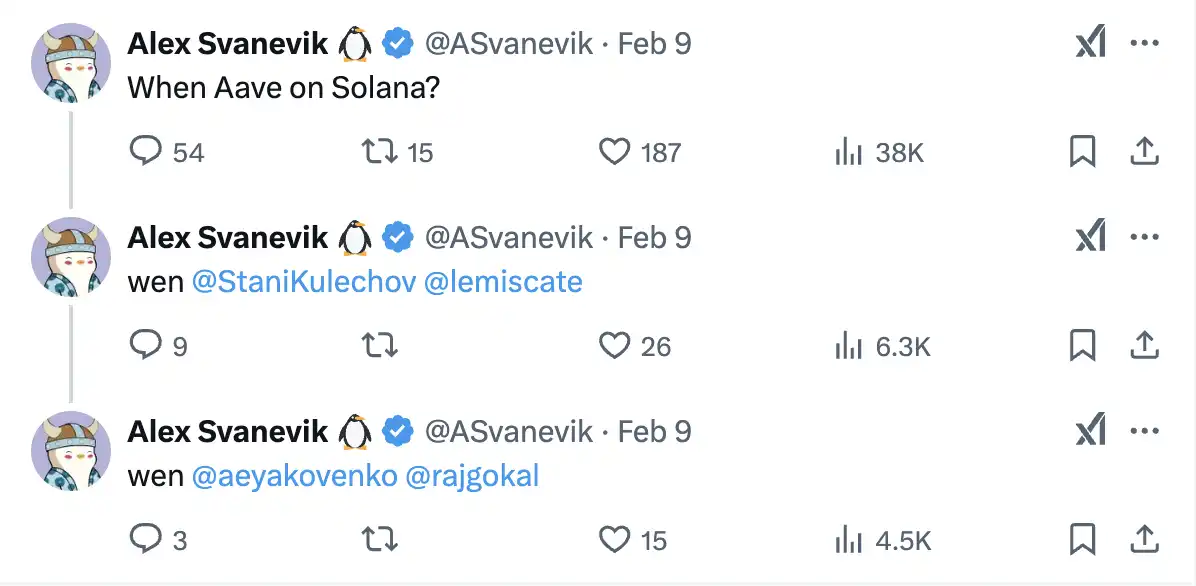
However, the replies to this tweet turned into a debate between Solana supporters and Aave fans, reflecting a broader market share battle between the Ethereum and Solana ecosystems in specific application areas.
A "War of Words" on Lending Protocols
Solana bull and Multicoin partner Kyle Samani commented under this tweet mentioning Kamino, a DeFi lending protocol in the Solana ecosystem, suggesting that Kamino is Solana's version of Aave.
Svanevik responded, stating that Aave is ten times larger than Kamino and that "if Aave users could seamlessly switch chains, it would unleash a significant TVL."
However, Solana's founder toly and Foundation Chair Lily Liu disagree. Lily mentioned that Kamino's product is superior, proudly stating, "Today's metrics don't represent tomorrow's performance." toly supported a native team focused on the Solana mainnet, suggesting that backing a team that concentrates on Solana long-term is wiser than supporting a multi-chain team with divided attention, effectively dismissing the possibility of Aave on Solana.
Amidst the sharp criticisms from the Solana community, supporters of Aave and the Ethereum ecosystem were not to be outdone.
Aave founder Stani directly criticized Solana DeFi, stating that it copied Aave's outdated technology, pasted a semi-finished UI, and restricted UK users. While Stani referred to Solana DeFi, it was clear to observers that he was targeting Kamino, another lending protocol.
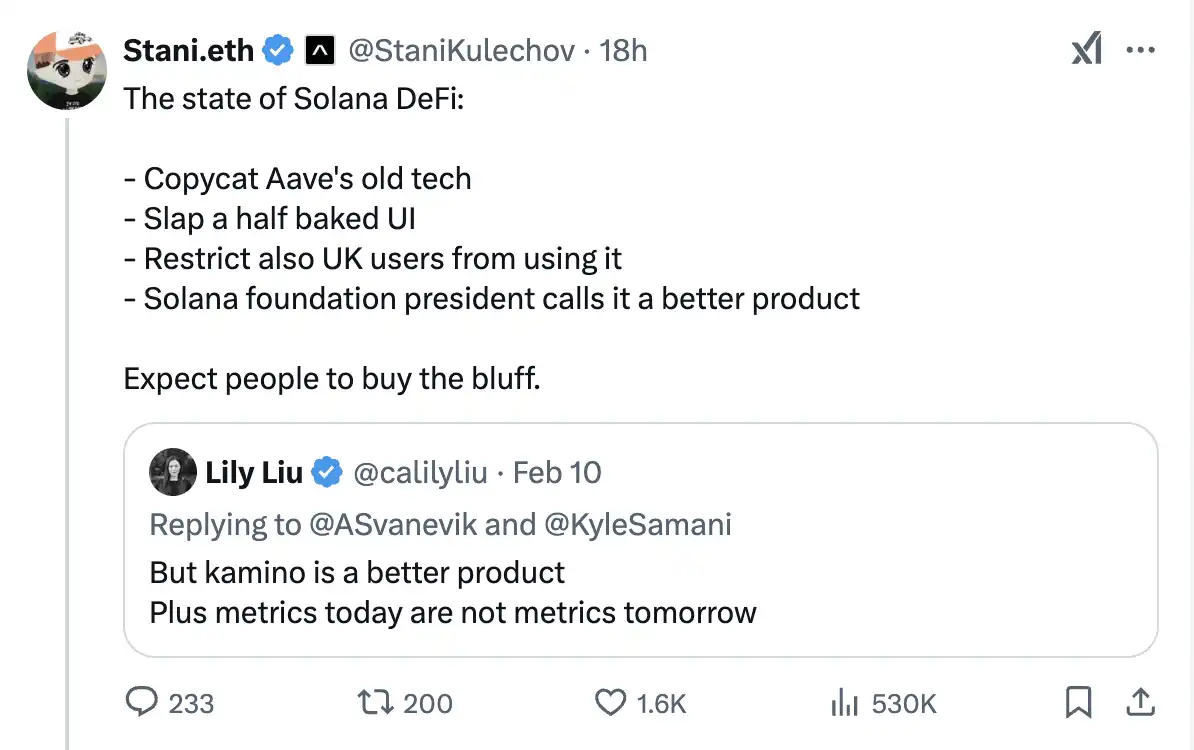
Subsequently, toly shared the DeFiLlama interface of Aave and Kamino, stating that Kamino's TVL is 1/8 of Aave's, but its revenue is only 1/2.5 of Aave's. "I don't understand why Aave would be a better product if no revenue can be squeezed out of it; TVL is just a cost."

Stani also sharply replied that Kamino's USDC reserve factor (i.e., the percentage the platform extracts from each transaction or pool) is 15%, while Aave's is only 10%, meaning it charges higher fees extracted from user pools. Stani believes this shows the current lack of competitiveness in the Solana ecosystem, resulting in weak bargaining power for users when choosing a DeFi platform, leading to higher fees that are ultimately borne by users.
The instigator of this "war of words," Alex Svanevik, then added fuel to the fire, suggesting that Solana has surpassed Ethereum in several key metrics, including active addresses, transaction volume, DEX trading volume, and total gas fee revenue. However, in terms of TVL, Solana has yet to surpass Ethereum. In light of this, the most direct strategy is to attract Aave, the top-ranked app by TVL on Ethereum, to deploy on Solana, further enhancing its competitiveness in the DeFi ecosystem.
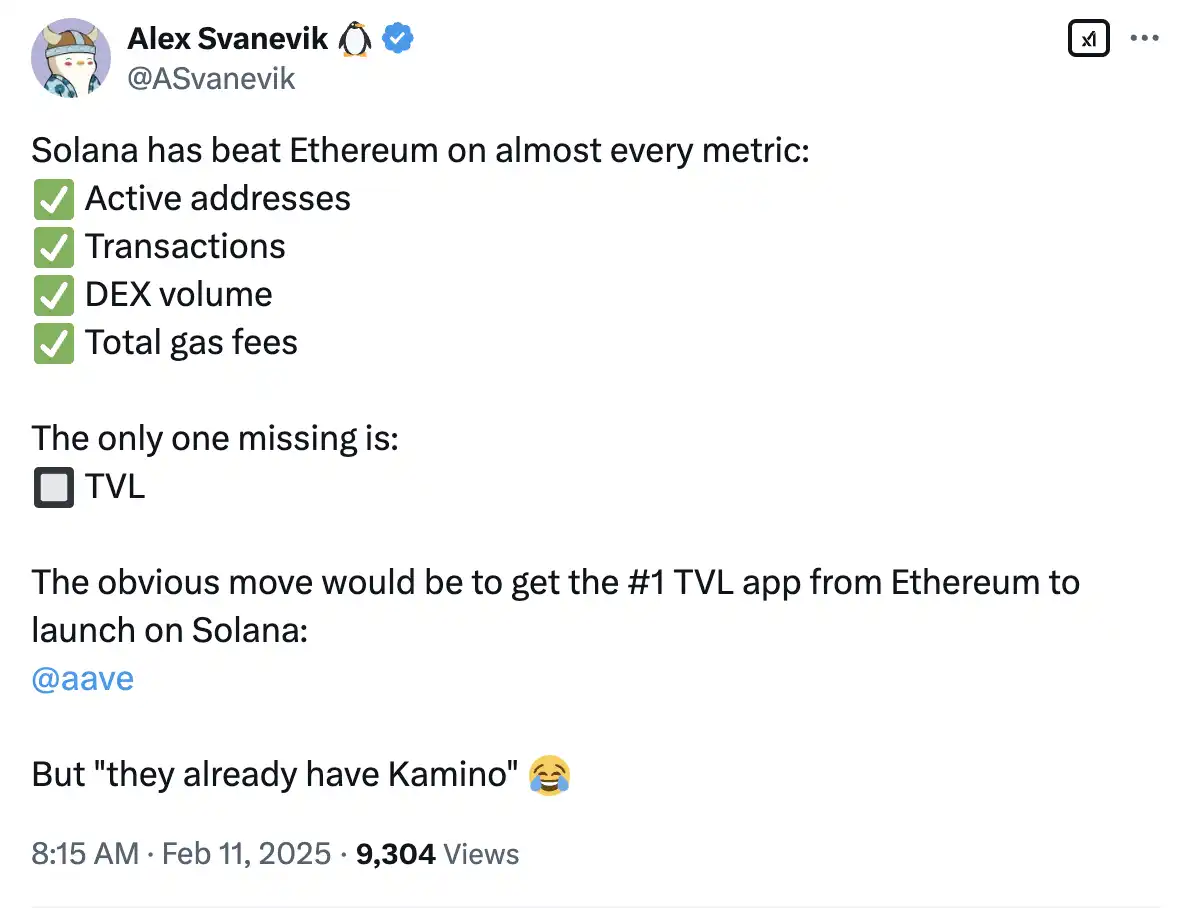
Some in the comments section questioned the rationale behind this, as deploying Aave on Solana would not magically create TVL. Svanevik explained that for Aave's deployment to have absolutely no impact on Solana's TVL growth, two conditions must be met simultaneously:
1. Aave's current TVL has no funds migrating to Solana;
2. There is no additional TVL entering Aave on Solana.
However, as Aave has already attracted $200 billion in TVL, Svanevik believes Aave should migrate to Solana, leaving people momentarily unable to determine whether Svanevik is an Ethereum maxi or a Solana maxi.
Trust Cost Above All
Undoubtedly, Aave is a core DeFi application in the Ethereum ecosystem, alongside Uniswap, Lido, and others, forming the core landscape of Ethereum DeFi. However, some in the community question why Ethereum's top DeFi applications would overlook an ecosystem like Solana with unlimited potential. Putting aside code and other technical factors, the reasons why an application chooses not to migrate to a new ecosystem are the same as those that choose to expand their ecosystem—to achieve incremental growth.
The Virtuals Protocol has expanded to Solana, gaining a broader user base and liquidity pool. The fact that Aave has not moved to Solana likely also involves considerations about the competitive landscape. Solana's current DeFi sector has become more mature, with multiple post-team projects competing in the lending protocol space, such as Kamino, marginfi, and Save. Therefore, the cost of Aave's expansion would be higher than anticipated.
More importantly, Aave's existing brand image will also face uncertainties due to the expansion. As some in the community have expressed, "If a fund in the seven to eight-digit range wishes to earn above-chain returns while ensuring security, nine out of ten times, they would recommend going to Aave on Ethereum rather than DeFi on Solana, Tron, Celestia, or any other chain."
Security is the foundation of a lending product. Only when there is an adequate security audit, experience in handling hack attempts, and a mature contract design will both large fund holders and regular users choose to park their assets there. Therefore, Aave's ability to become one of the most influential lending platforms on Ethereum is inseparable from Ethereum's long-standing developer ecosystem, security audit cases, and a huge, mature liquidity pool.
The financial nature of DeFi determines that "the longer it runs, the stickier it becomes." This stickiness is rooted in a deep trust in the security and stability of the product's smart contract. This "trust cost" extends beyond considerations of the speed, performance, and transaction fees of a new chain and includes the completeness of the infrastructure, the coverage of auditing companies, the community's alertness to potential security vulnerabilities, and the ecosystem's responsiveness to timely remedies under extreme conditions.
Further reading: "Rethinking DeFi: The Present and Future of Web3 Business Models"
Reflecting on Ethereum DeFi's development over the past few years, many projects have experienced significant vulnerabilities or security incidents, even suffering losses of hundreds of millions of dollars. It is through each response and iteration that the security rampart of Ethereum DeFi has gradually been built. Aave's popularity stems from leveraging this security moat, making it the preferred choice for high-volume users, especially institutional players. In other words, most people see Aave as synonymous with "low risk, decent returns," particularly for users with multi-million or even multi-tens-of-millions of dollars, where security and stability always come before incremental gains.
In contrast, Solana, as a high-performance Layer1 blockchain, does have certain advantages in transaction speed, gas fees, and other aspects. However, from the perspective of a lending protocol, the core of financial applications lies in the "risk-reward ratio." While speed and low fees are important, if a platform cannot provide sufficiently proven security and a tamper-resistant record, such advantages often may not be enough to support a long-term migration of significant liquidity in the DeFi space. Especially in lending businesses, they have to deal with multiple risk factors such as liquidation, interest rate fluctuations, smart contract audits, and hacking attacks; once issues arise, the platform's years of accumulated brand image and trust will be instantly shattered, and this "trust cost" is far more expensive than the technology itself.
Furthermore, even if Aave does choose to expand to Solana, it does not necessarily guarantee a "skyrocketing" Total Value Locked (TVL). Funds are profit-driven and rational; the two to three hundred billion dollars TVL accumulated by Aave on the Ethereum mainnet is not automatically willing to migrate to another chain. On the contrary, due to significant differences in underlying technology stacks, programming languages, and even community cultures among different chains, Aave needs to invest a significant amount of time and resources to adapt and audit, implying extremely high expansion costs and management risks. Moreover, the existing native lending protocols on Solana are also maturing, and Aave does not possess an insurmountable first-mover advantage.
Therefore, with the premise of having a triple moat of security barriers, brand, and fund scale, if Aave insists on expanding massively to Solana, it may not be the wisest choice. After all, in the long marathon race of DeFi, winning users' trust and security awareness is the most unshakable core barrier.
You may also like

The other side of Musk's trillion-dollar fortune: 85% cannot be sold

The U.S. government prohibits foreigners from using Fable 5, Anthropic issues a rebuttal

Citibank releases "2030 Asset Tokenization Market Outlook": 6 major trends may create a $8.2 trillion market

The trillion-dollar valuation test: Are the three major super IPOs a celebration for tech stocks or a nightmare for the crypto market?

Morning Report | Digital Asset completes $355 million financing led by a16z Crypto; Meta completes operational separation from Manus

a16z Crypto Partner: Cash flow is the moat

Cryptocurrency market makers collectively seek change as it becomes increasingly difficult to make money

How TradeXYZ, xStocks, and Alpaca break down the SpaceX IPO into three different strategies
$75 billion in risk asset redistribution: How will SpaceX's IPO affect U.S. stocks and Bitcoin?

Why Is BlackRock Investing $5 Billion in the SpaceX IPO?
Morning News | CME Group launches Nasdaq Cryptocurrency Index futures; Asset management giant Janus Henderson strategically invests in Ethena

Bitcoin Layer 2 Network Botanix: Why Did We Choose to Dissolve?

Why did Oracle deliver the strongest financial report in history, yet its stock price fell?
When the P2P illicit funds from ten years ago turned into 60,000 bitcoins
Dialogue with OmenX Founder: Why does the prediction market need an evolution from "spot" to "derivatives"?
Galaxy in-depth report: Is Solana still worth paying attention to?
Young people in South Korea make a "final effort" in the epic bull market
The pricing controversy of Trade.xyz exposes the fatal weakness of Pre-IPO perpetual contracts
The other side of Musk's trillion-dollar fortune: 85% cannot be sold
The U.S. government prohibits foreigners from using Fable 5, Anthropic issues a rebuttal
Citibank releases "2030 Asset Tokenization Market Outlook": 6 major trends may create a $8.2 trillion market
The trillion-dollar valuation test: Are the three major super IPOs a celebration for tech stocks or a nightmare for the crypto market?
Morning Report | Digital Asset completes $355 million financing led by a16z Crypto; Meta completes operational separation from Manus
a16z Crypto Partner: Cash flow is the moat


