
Learn from Traditional Companies: How Do Crypto Projects Distribute Profits?
Original Article Title: When Tokens Burn
Original Article Author: Saurabh Deshpande
Original Article Translation: Luffy, Foresight News
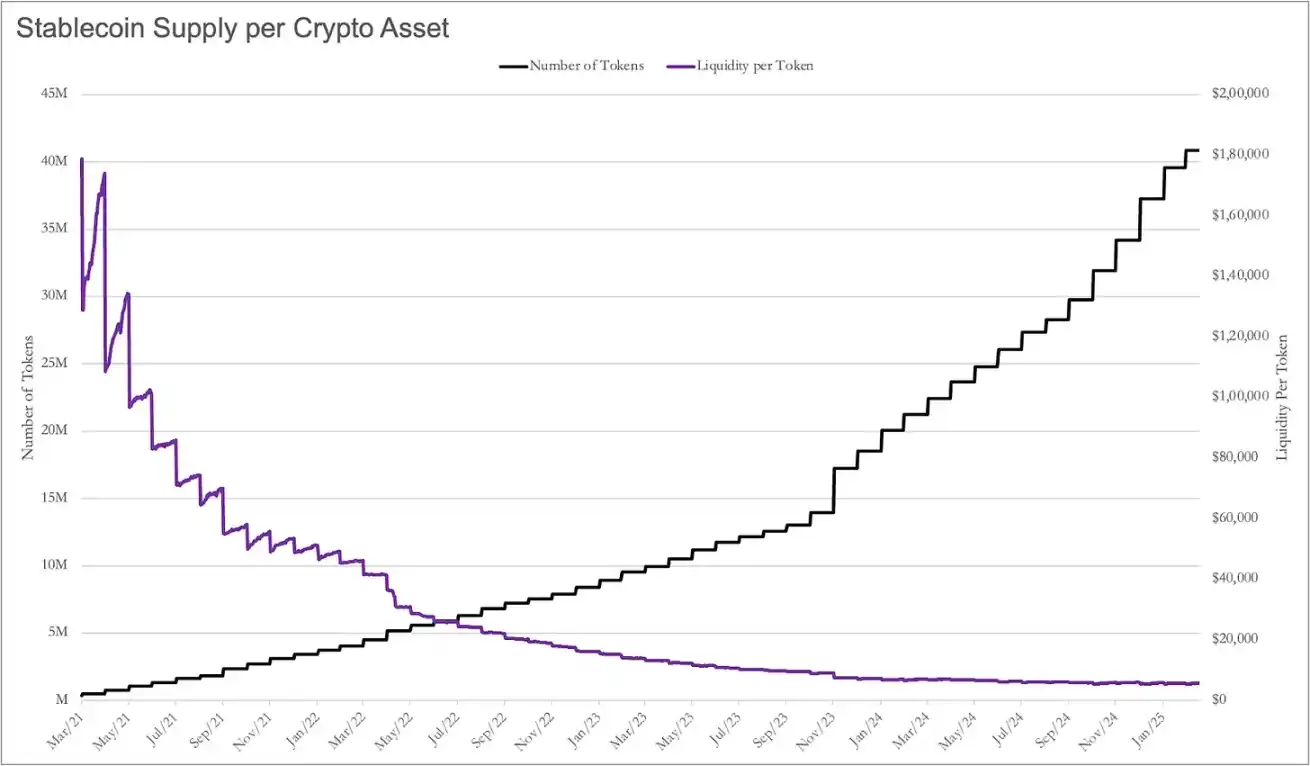
Lately, I have taken stablecoin supply as a metric for measuring liquidity, considering the number of tokens in the market to calculate the liquidity of each asset. As expected, liquidity eventually approaches zero, and the chart drawn based on the analysis results can be considered a piece of "art."
In March 2021, each cryptocurrency enjoyed approximately $1.8 million worth of stablecoin liquidity, but by March 2025, this number had dropped to only $5,500.
As a project, you are competing for the attention of users and investors with over 40 million other tokens, a number that was only 5 million three years ago. So, how do you retain token holders? You can try to build a community, where members say "GM" on Discord and conduct some airdrop events.
But then what? Once they get the token, they will move on to the next Discord group to say "GM."
Community members won't stay for no reason; you have to give them a reason. In my view, a high-quality product with actual cash flow is a reason, or making the project's data look good.
Russ Hanneman Syndrome
In the TV show "Silicon Valley," Russ Hanneman once boasted about becoming a billionaire by "putting the radio on the Internet." In the crypto space, everyone wants to be Russ, chasing overnight riches but not caring about the business fundamentals, building moats, and acquiring sustainable income—these "boring" yet practical issues.
Joel's recent articles "Death to Stagnation" and "Make Revenue Great Again" emphasize the urgent need for crypto projects to focus on sustainable value creation. Similar to the memorable scene in the show, Russ Hanneman dismisses Richard Hendricks' concerns about building a sustainable revenue model, many crypto projects similarly rely on speculative narratives and investor enthusiasm. Now, it appears that this strategy is clearly unsustainable.
However, unlike Russ, founders cannot rely solely on shouting "Tres Comas" (a wealth-flaunting term used by Russ in the show) to make a project successful. Most projects require sustainable revenue, and to achieve this, we first need to understand how existing revenue-generating projects operate.

https://youtu.be/BzAdXyPYKQo
The Zero-Sum Game of Attention
In the traditional market, regulatory bodies maintain stock liquidity for publicly traded companies by setting high barriers to entry. Globally, there are 359 million companies, with only about 55,000 publicly listed, accounting for only about 0.01%. The benefit of this approach is that most available capital is concentrated within a limited range. However, it also means that early-stage investors in companies and opportunities for high returns are scarce.
The dispersion of attention and liquidity is the price at which every token can be easily publicly traded. I am not here to judge which model is better, but simply to illustrate the differences between the two worlds.
The question then is, how to stand out in the seemingly endless ocean of tokens? One way is to demonstrate that the project you are building is in demand and to engage token holders in the project's growth. Do not misunderstand; not every project needs to be equally focused on revenue and profit maximization.
Revenue is not the end goal but a means to achieve long-term sustainability.
For example, an L1 that hosts a sufficient number of applications only needs to earn enough fees to offset token inflation. Ethereum's validator return rate is about 3.5%, which means its annual token supply will increase by 3.5%. Holders staking ETH to earn rewards will see their token holdings diluted. However, if Ethereum were to implement a fee burn mechanism to destroy an equivalent amount of tokens, then regular ETH holders would not be diluted.
As a project, Ethereum does not actually need to be profitable because it already has a thriving ecosystem. As long as validators can earn enough revenue to maintain node operation, Ethereum does not need additional income. However, for projects with a circulating supply ratio (circulating token percentage) of around 20%, these projects are more like traditional companies and may take time to reach a point where there are enough volunteers to sustain the project.
Founders must face the reality that Russ Hanneman overlooks: generating tangible, sustainable revenue is crucial. It should be noted that in this article, whenever "revenue" is mentioned, I am actually referring to Free Cash Flow (FCF) because obtaining the data behind revenue for most crypto projects is challenging.
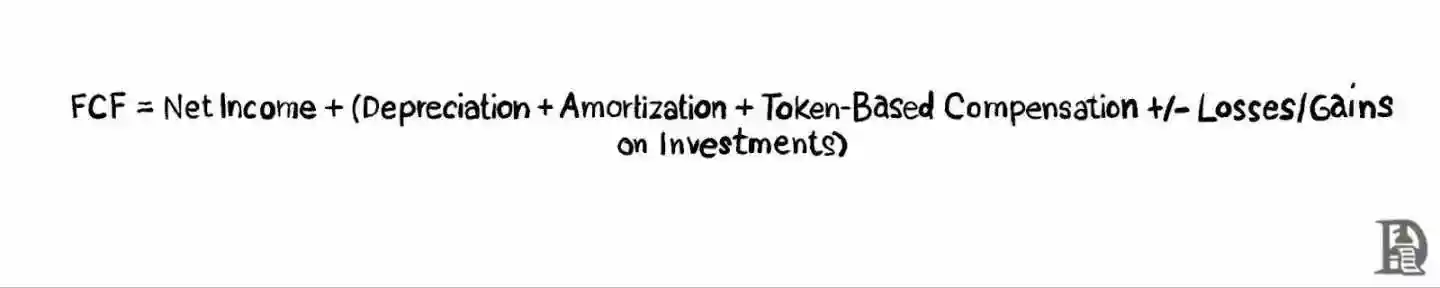
Understanding how to allocate Free Cash Flow (FCF), such as when to use it for reinvestment to drive growth, when to share it with token holders, and the optimal allocation method (e.g., buybacks or dividends), these decisions are likely to determine the success or failure of founders aiming to create lasting value.
Reference to the equity market is very helpful in making these decisions effectively. Traditional companies often distribute FCF through dividends and buybacks. Factors such as company maturity, industry position, profitability, growth potential, market conditions, and shareholder expectations will all impact these decisions.
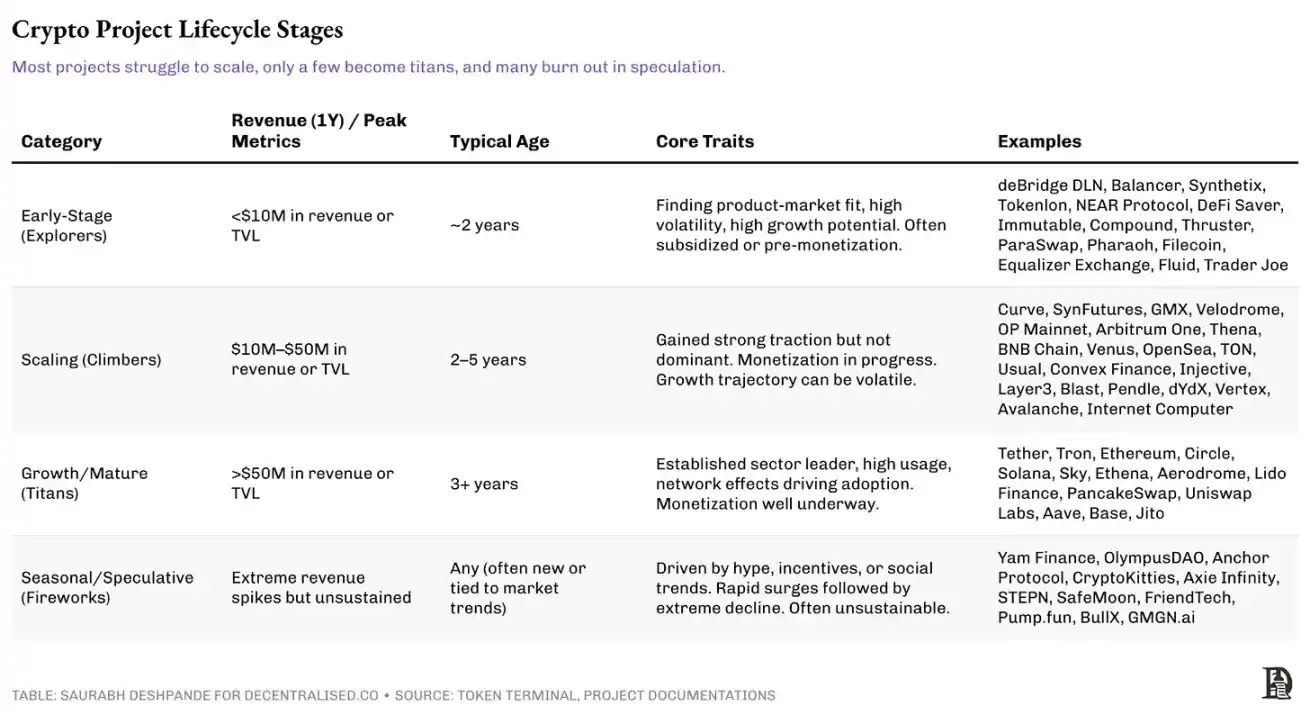
Different crypto projects naturally have different opportunities and limitations in value redistribution based on their lifecycle stage. Below, I will describe this in detail.
Crypto Project Lifecycle
(1) Explorer Stage
Early crypto projects are usually in the experimental stage, focusing on attracting users and refining the core product, rather than aggressively pursuing profits. The product-market fit is still unclear, and ideally, these projects prioritize reinvestment for long-term growth maximization rather than profit-sharing schemes.
The governance of these projects is usually more centralized, controlled by the founding team for upgrades and strategic decisions. The ecosystem is still nascent, network effects are weak, and user retention is a major challenge. Many of these projects rely on token incentives, venture capital, or grants to sustain initial user adoption, rather than arising from natural demand.
While some projects may find early success in a niche market, they still need to prove whether their model is sustainable. Most crypto startup projects fall into this category, and only a small fraction can break through and move forward.
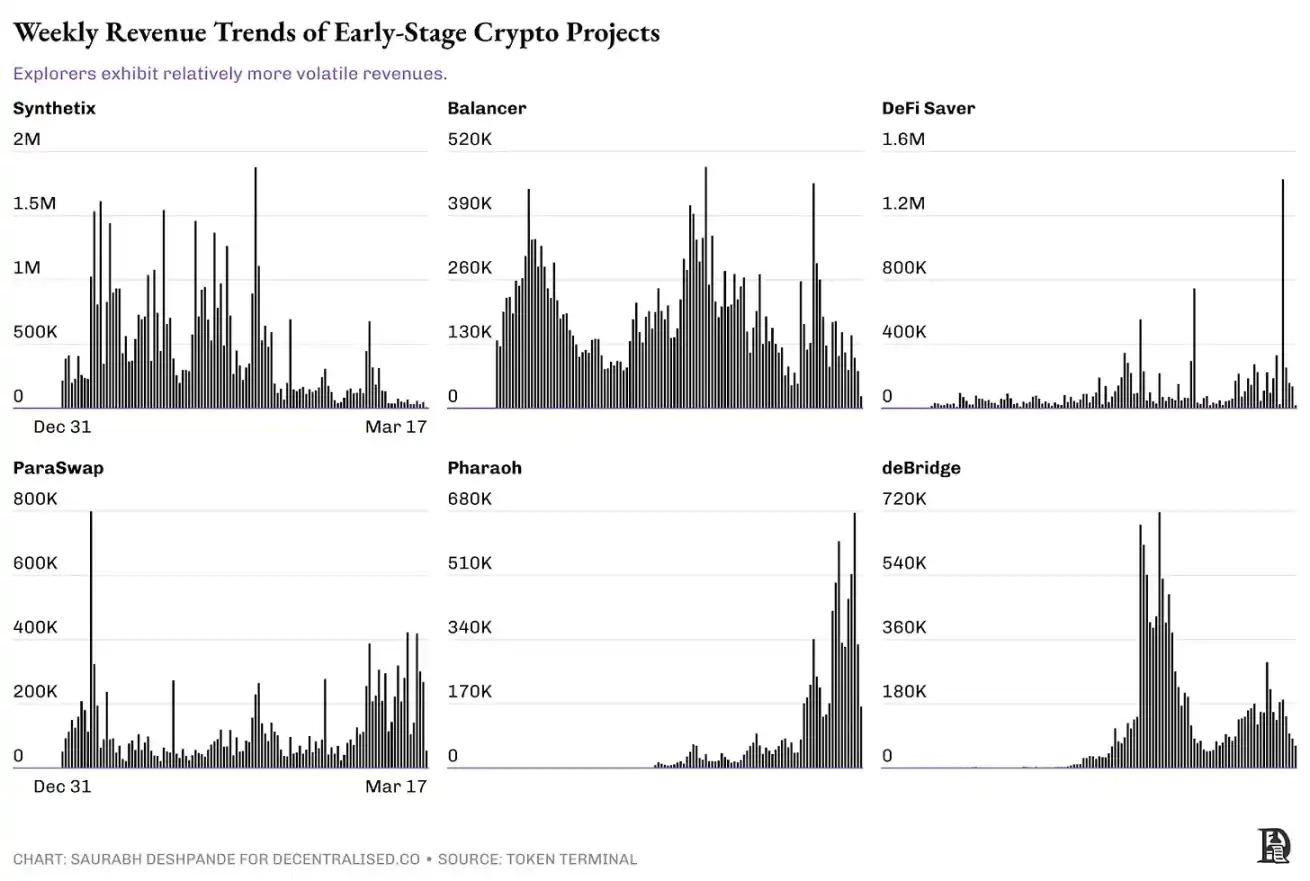
These projects are still seeking the product-market fit, and their revenue models highlight the dilemma of sustaining growth. Projects like Synthetix and Balancer show a pattern of revenue skyrocketing and then significantly declining, indicating a speculative phase rather than steady market acceptance.
(2) Climber Stage
Projects that have passed the early stages but have not yet established dominance belong to the growth category. These protocols can generate substantial revenue, ranging from $10 million to $50 million annually. However, they are still in the growth phase, with governance structures evolving continuously, and reinvestment remains a top priority. While some projects consider profit-sharing mechanisms, they must strike a balance between profit distribution and continued expansion.
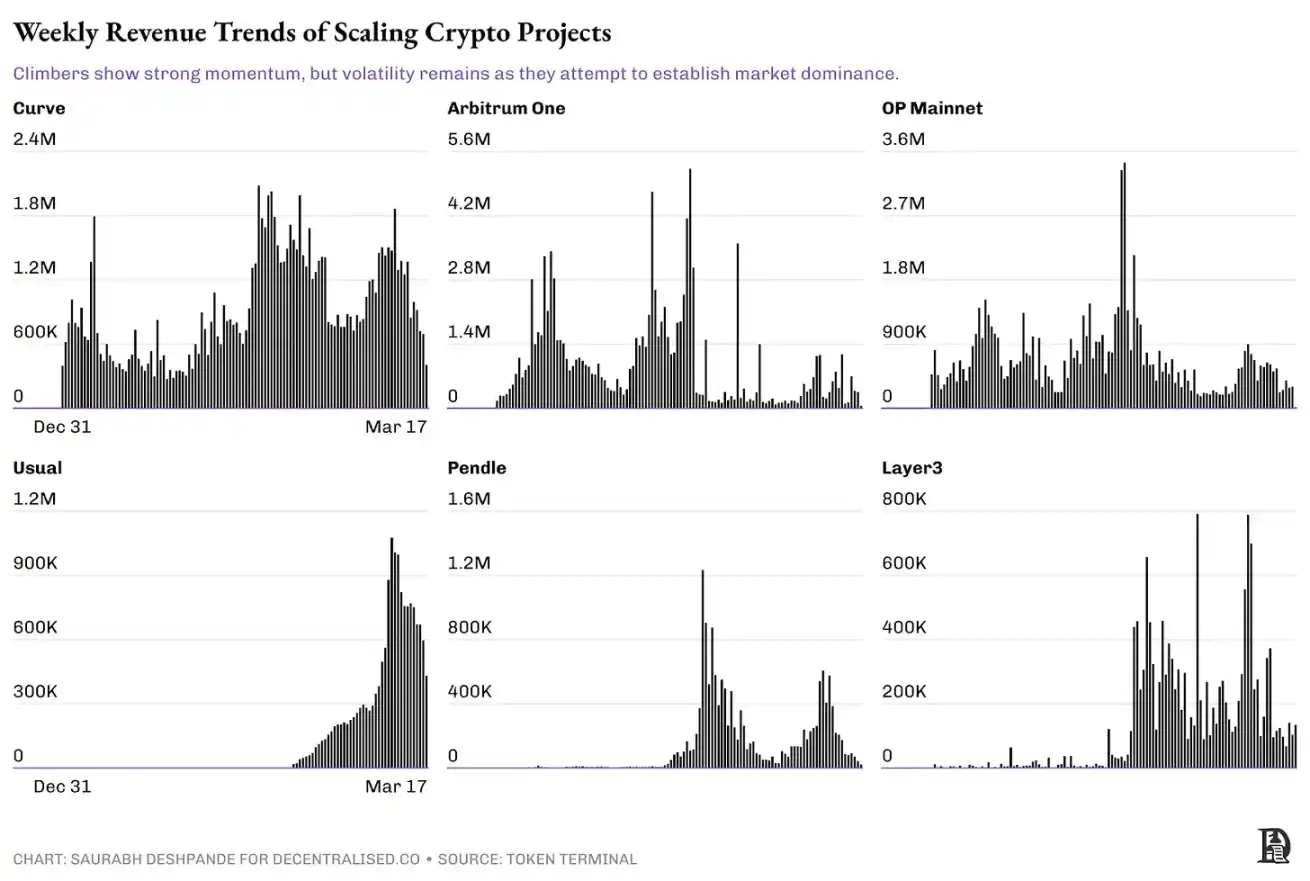
The above chart records the weekly revenue of projects in the Climber phase in the cryptocurrency space. These protocols have gained some traction but are still in the process of solidifying their long-term position. Unlike the early Explorer phase, these projects have visible revenue, but the growth trajectory remains unstable.
Projects like Curve and Arbitrum One show relatively stable revenue flows with noticeable peaks and troughs, indicating fluctuations influenced by market cycles and incentive measures. OP Mainnet also exhibits a similar trend where surges suggest periods of high demand followed by slowdowns. Meanwhile, Usual's revenue shows exponential growth, indicating rapid adoption, but the lack of historical data to confirm whether this growth is sustainable. Pendle and Layer3 experience a significant surge in activity, indicating a high level of user engagement currently, but also revealing the challenge of maintaining momentum in the long term.
Many Layer 2 scaling solutions (such as Optimism, Arbitrum), decentralized finance platforms (such as GMX, Lido), and emerging Layer 1 solutions (such as Avalanche, Sui) fall into this category. According to Token Terminal data, currently only 29 projects have annual revenues exceeding $10 million, though the actual number may be slightly higher. These projects are at a turning point, where those consolidating network effects and user retention will move to the next stage, while others may stagnate or decline.
For Climbers, the path forward involves reducing reliance on incentive measures, strengthening network effects, and proving that revenue growth can be sustained without sudden reversals.
(III)Titan Stage
Mature protocols like Uniswap, Aave, and Hyperliquid are in the growth and maturity stage, having achieved product-market fit and generating significant cash flow. These projects are able to implement structured buybacks or dividends, enhancing token holder trust and ensuring long-term sustainability. Their governance is more decentralized, with the community actively participating in upgrades and treasury decisions.
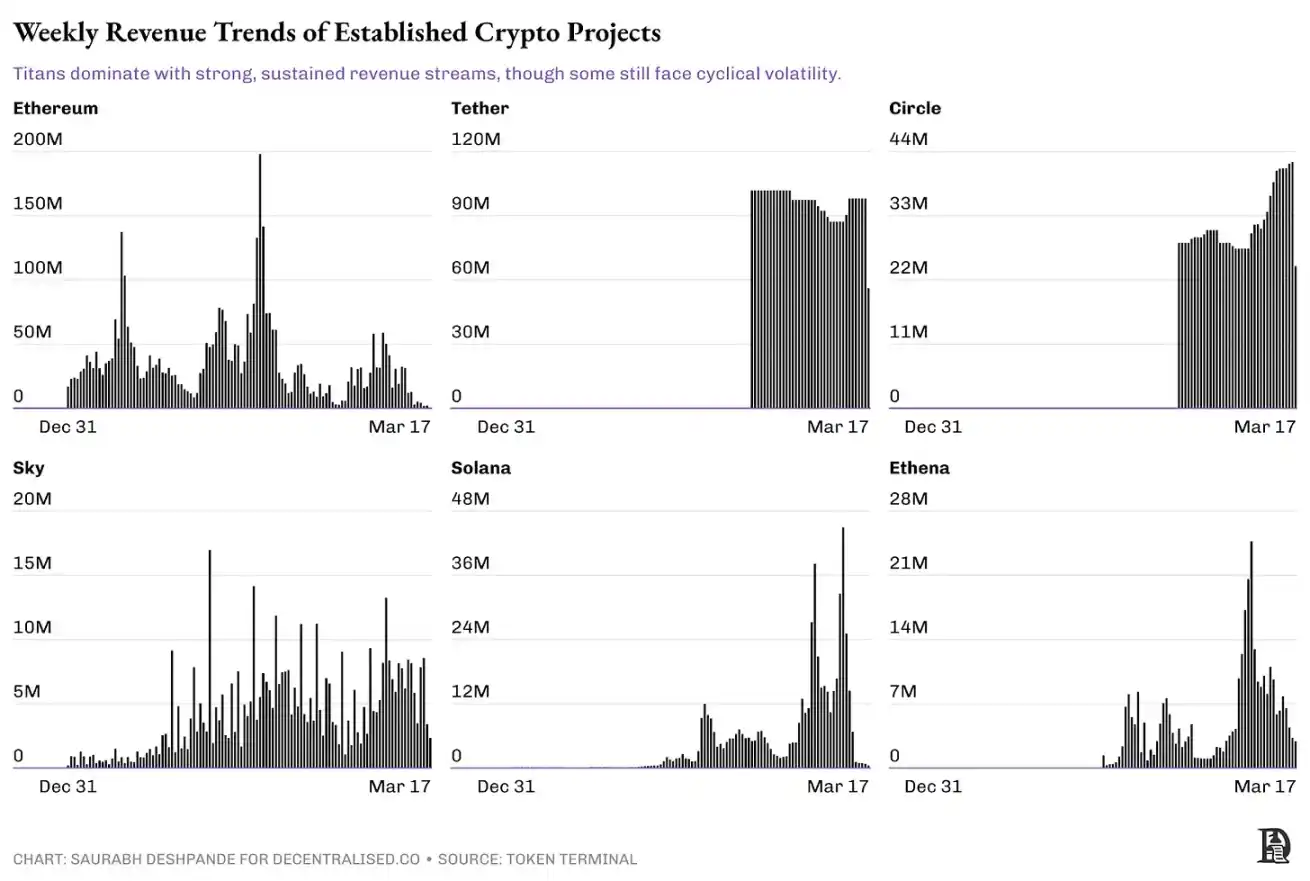
Network effects form a competitive moat, making them hard to replace. Currently, only a few dozen projects can reach this revenue level, meaning very few protocols have truly matured. Unlike projects in the early or growth stages, these protocols do not rely on inflationary token incentives but earn sustainable revenue through transaction fees, lending interest, or staking rewards. Their ability to withstand market cycles further sets them apart from speculative projects.
Differing from early-stage projects or projects in the growth phase, these protocols demonstrate strong network effects, a solid user base, and a deeper market presence.
Ethereum leads in decentralized revenue generation, showing periodic peaks in revenue that align with high network activity. The revenue situation of the two stablecoin giants, Tether and Circle, is different, with a more stable and structured income flow rather than significant fluctuations. While Solana and Ethena have substantial revenue, they still experience noticeable growth and fall-back cycles, reflecting their ever-changing adoption status.
Meanwhile, Sky's revenue is relatively unstable, indicating significant demand volatility rather than sustained dominance.
Although giants stand out in scale, they are not immune to fluctuations. The difference lies in their ability to weather downturns and maintain revenue in the long term.
(4) Seasonal Projects
Some projects undergo rapid but unsustainable growth due to hype, incentive measures, or social trends. Projects like FriendTech and memecoins may generate substantial revenue during peak periods but struggle to retain users long term. Premature revenue-sharing schemes may exacerbate volatility as speculative capital quickly exits once incentives dry up. Their governance is often weak or centralized, the ecosystem is fragile, decentralized application adoption is limited, or long-term viability is lacking.
While these projects may temporarily achieve high valuations, they are prone to collapse when market sentiment shifts, leaving investors disappointed. Many speculative platforms rely on unsustainable token issuance, false trading, or inflated yields to create artificial demand. Although some projects can move past this stage, most fail to establish a sustainable business model and are inherently high-risk investments.
Profit-Sharing Models of Publicly Traded Companies
Observing how publicly traded companies handle profit sharing can teach us more.
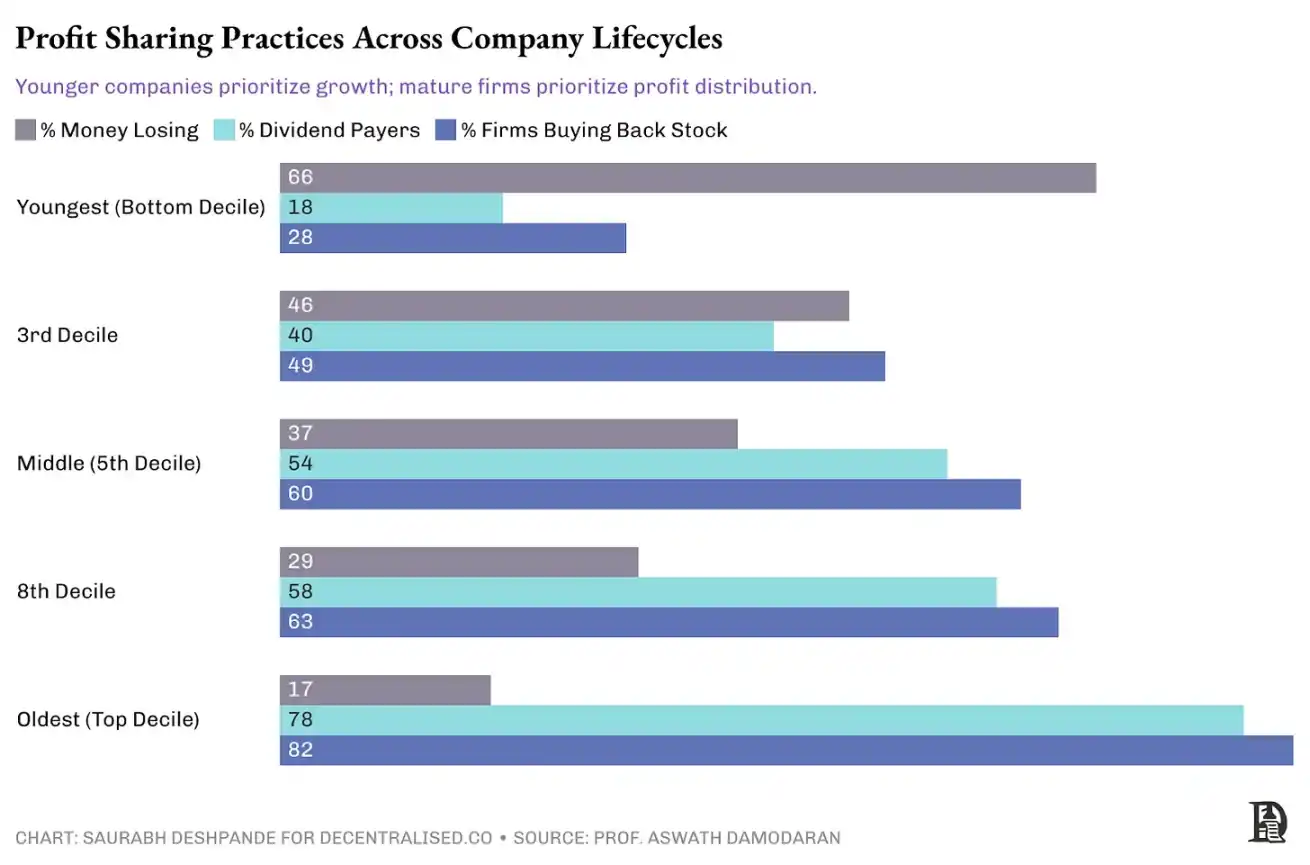
This chart illustrates how the profit-sharing behavior of traditional companies evolves as their maturity increases. Young companies face significant financial losses (66%) and tend to retain profits for reinvestment rather than distributing dividends (18%) or engaging in stock buybacks (28%). As companies mature, profitability typically stabilizes, and dividend payments and buybacks increase accordingly. Mature companies often distribute profits, with dividends (78%) and buybacks (82%) becoming common.
These trends parallel the lifecycle of crypto projects. Like young traditional companies, early-stage crypto "explorers" typically focus on reinvestment to find the product-market fit. Conversely, mature crypto "giants," like established stable traditional companies, have the capacity to distribute income through token buybacks or dividends, enhancing investor confidence and project long-term viability.
The relationship between company age and profit-sharing strategy naturally extends to the practices of specific industries. While young companies typically prioritize reinvestment, mature companies adjust their strategies based on the characteristics of the industry they operate in. Cash-rich industries tend to favor predictable dividends, while industries characterized by innovation and volatility prefer the flexibility offered by stock buybacks. Understanding these subtle differences helps cryptocurrency project founders effectively adjust their revenue distribution strategies to align with the project's lifecycle stage and industry characteristics, meeting investor expectations.
The following chart highlights the unique profit distribution strategies of different industries. Traditional and stable industries like Utilities (80% of companies pay dividends, 21% engage in buybacks) and Consumer Staples (72% of companies pay dividends, 22% engage in buybacks) strongly favor dividends due to their predictable revenue streams. In contrast, technology-focused industries such as Information Technology (27% engage in buybacks, with the highest cash return through buybacks at 58%) lean towards buybacks to provide flexibility during revenue fluctuations.
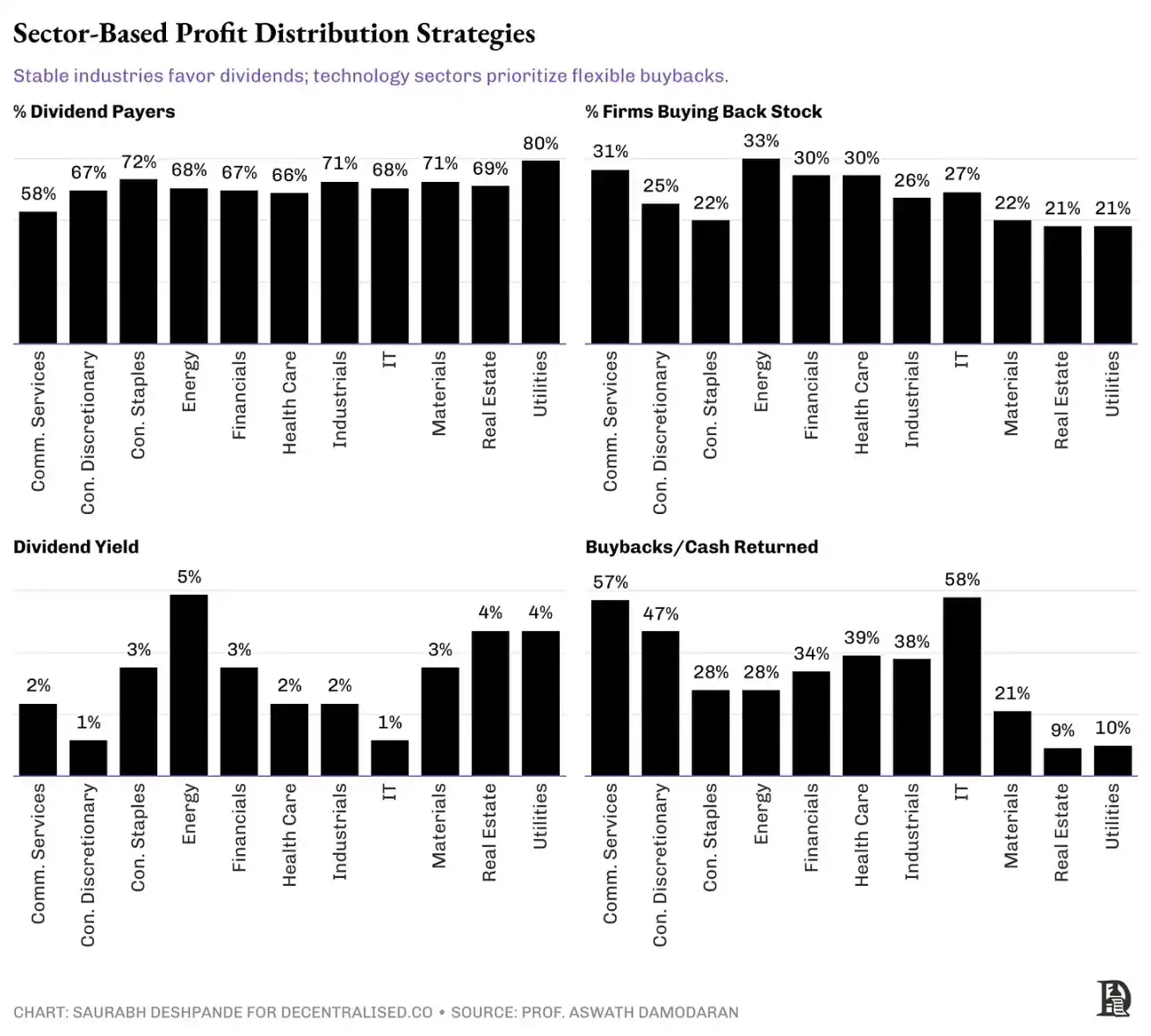
These considerations directly impact cryptocurrency projects. Protocols with stable, predictable income, such as stablecoin providers or mature DeFi platforms, may be best suited for a dividend-like continuous payment approach. Conversely, high-growth, innovation-focused cryptocurrency projects, especially those in DeFi and infrastructure layers, can adopt a flexible token buyback approach, mimicking strategies seen in the traditional tech industry to adapt to volatile and rapidly changing market conditions.
Dividends vs. Buybacks
Each method has its pros and cons, but buybacks have recently been favored over dividends. Buybacks offer more flexibility, while dividends have stickiness. Once you announce a X% dividend, investors expect you to do so every quarter. Therefore, buybacks provide strategic leeway to companies, not just in how much profit is returned but also when, allowing them to adapt to market cycles without being confined to a rigid dividend payment schedule. Buybacks do not set fixed expectations like dividends, being viewed as one-time endeavors.
However, buybacks are a wealth transfer mechanism and a zero-sum game. Dividends create value for each shareholder, so both have their place.
Recent trends show that buybacks are increasingly favored due to the reasons mentioned above.
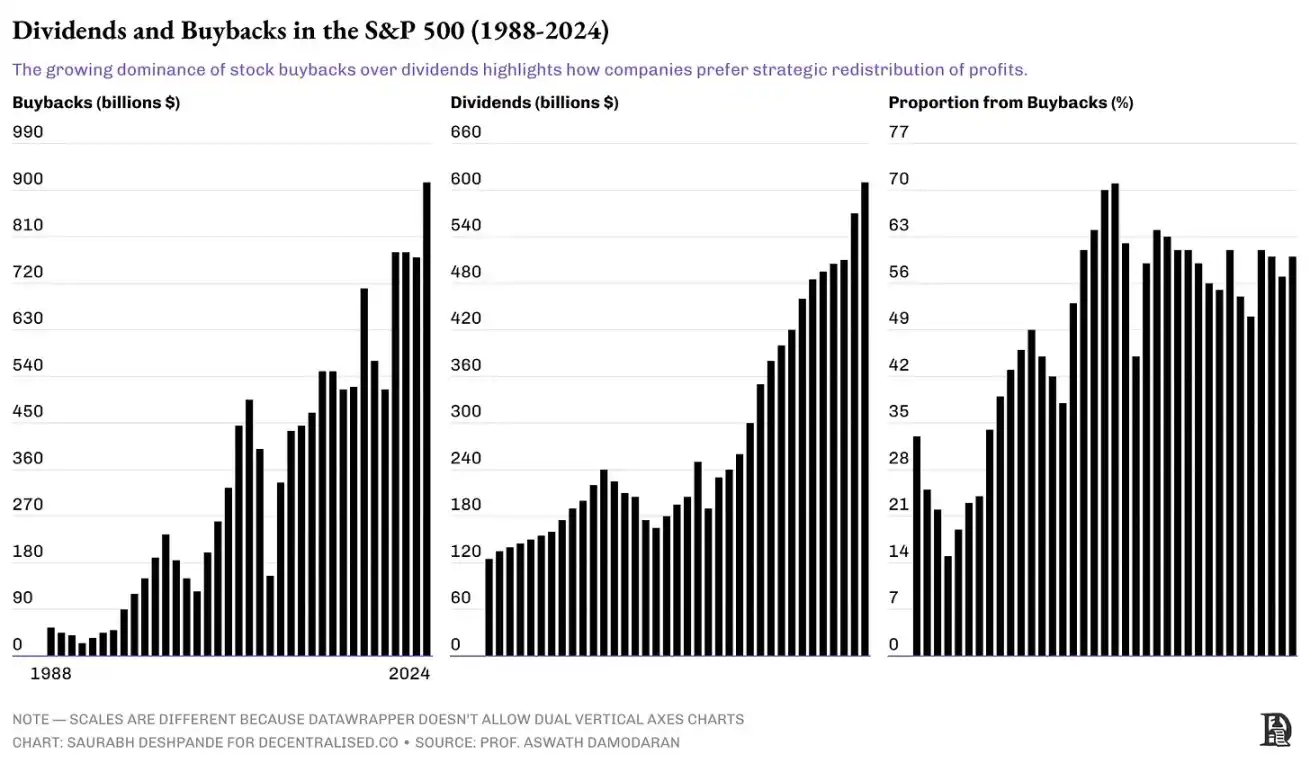
In the early 1990s, only about 20% of profits were distributed through buybacks. By 2024, approximately 60% of profit distribution is done through buybacks. In dollar terms, buybacks surpassed dividends in 1999 and have since maintained the lead.
From a governance perspective, share buybacks require careful valuation assessment to avoid inadvertently transferring wealth from long-term shareholders to those who sold the stock at inflated prices. When a company buys back its stock, it (ideally) believes the stock is undervalued. Conversely, investors choosing to sell the stock believe it is overvalued. These two views cannot both be correct simultaneously. It is generally believed that the company knows its plans better than shareholders, so those selling their stock during buybacks may miss out on higher potential profits.
According to a paper from Harvard Law School, current disclosure practices often lack timeliness, making it difficult for shareholders to assess the progress of buybacks and maintain their ownership percentage. Additionally, when compensation is tied to metrics such as earnings per share, buybacks can impact executive pay, potentially incentivizing executives to prioritize short-term stock performance over the company's long-term growth.
Despite these governance challenges, buybacks remain attractive to many companies, especially U.S. tech firms, due to the flexibility of buyback operations, autonomy in investment decisions, and lower future expectations compared to dividends.
Cryptocurrency Revenue Generation and Distribution
According to Token Terminal data, there are 27 projects in the crypto space that can generate $1 million in revenue monthly. This is not comprehensive as it excludes projects like PumpFun, BullX, etc., but I think it's not far off. I researched 10 of these projects to observe how they handle revenue. The key point is that most crypto projects should not even consider distributing revenue or profits to token holders. In this regard, I admire Jupiter. They explicitly stated at the token announcement stage their lack of intent to share direct revenue (e.g., dividends). Only after user growth exceeds tenfold does Jupiter initiate a mechanism similar to a buyback to distribute value to token holders.
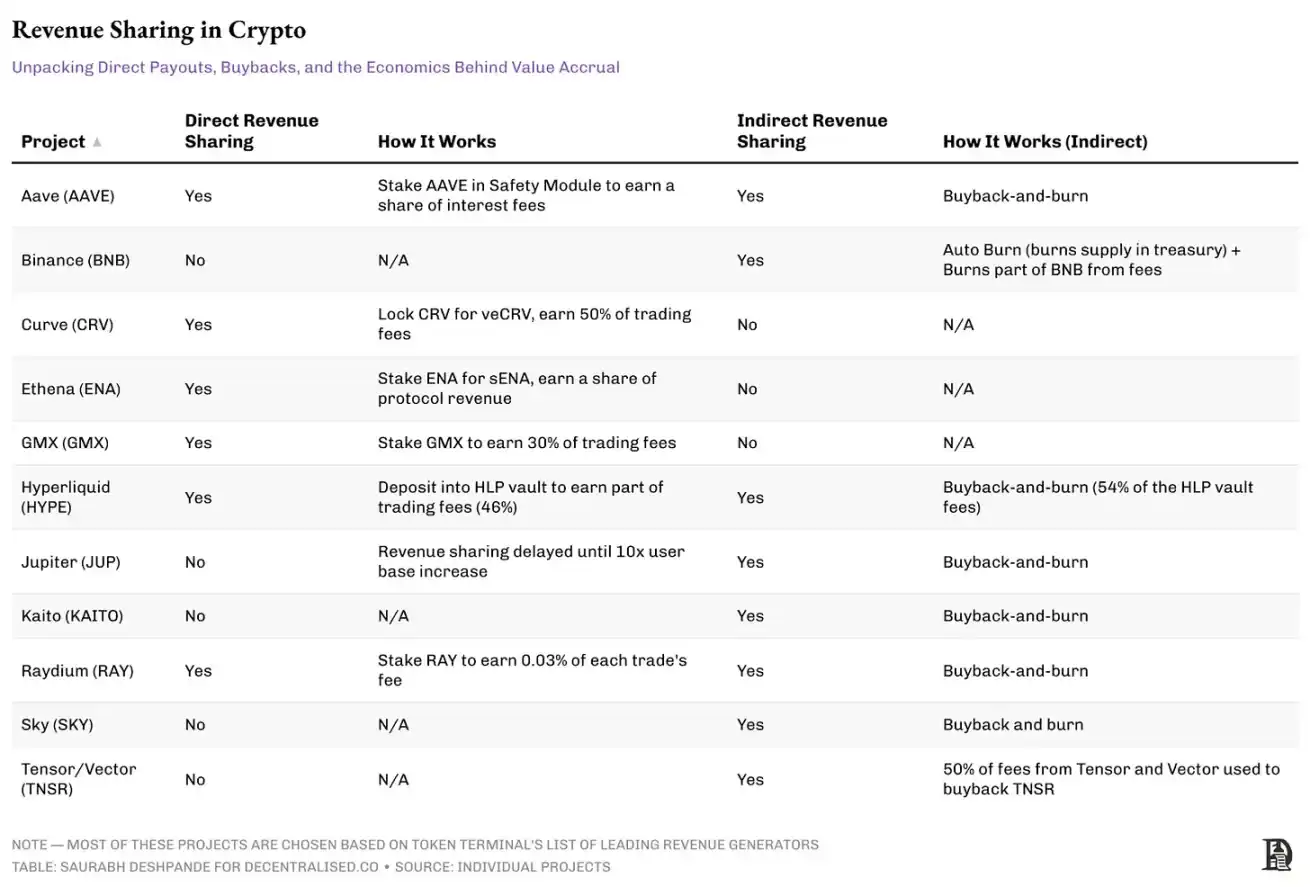
Revenue Sharing in Crypto Projects
Crypto projects must rethink how they share value with token holders, drawing inspiration from traditional corporate practices while employing unique approaches to navigate regulatory scrutiny. Unlike stocks, tokens offer an innovative opportunity to directly integrate into the product ecosystem. Projects are not merely distributing revenue to token holders but actively incentivizing key ecosystem activities.
For example, even before initiating buybacks, Aave rewarded token stakers providing critical liquidity. Similarly, Hyperliquid strategically shares 46% of its revenue with liquidity providers, akin to traditional consumer loyalty models in established enterprises.
In addition to these token integration strategies, some projects adopt a more direct revenue-sharing approach, reminiscent of traditional public equity practices. However, even in a direct revenue-sharing model, caution must be exercised to avoid being classified as securities, striking a balance between rewarding token holders and complying with regulations. Projects like Hyperliquid, based outside the United States, often have more operational flexibility when implementing a revenue-sharing approach.
Jupiter presents a more creative value-sharing example. They do not engage in traditional buybacks but instead leverage a third-party entity called the Litterbox Trust, which receives JUP tokens programmatically, equivalent to half of the Jupiter Protocol's revenue. As of March 26, it has accumulated approximately 18 million JUP, valued at around $9.7 million. This mechanism directly aligns token holders with the project's success while circumventing regulatory issues associated with traditional buybacks.
It is essential to remember that Jupiter embarked on the path of rewarding token holders with value only after establishing a robust stablecoin treasury sufficient to sustain the project's operations for several years.
The reason for distributing 50% of the revenue to this accumulation plan is straightforward. Jupiter follows a guiding principle of balancing ownership between the team and the community, fostering clear alignment and shared incentives. This approach also encourages token holders to actively promote the protocol, linking their financial interests directly to the product's growth and success.
Aave recently launched a token buyback following a structured governance process. The protocol boasts a healthy treasury of over $95 million (excluding its token holdings) and initiated the buyback plan in early 2025 after detailed governance proposals. The plan named "Purchase and Distribute" allocates $1 million weekly for buybacks, following extensive community discussions around tokenomics, treasury management, and token price stability. Aave's treasury growth and financial strength have enabled this initiative without compromising operational capabilities.
Hyperliquid uses 54% of its revenue to buy back HYPE tokens, with the remaining 46% allocated to incentivize the liquidity of the trading platform. Buybacks are facilitated through the Hyperliquid Support Fund. Since the inception of this plan, the Support Fund has purchased over 18 million HYPE tokens. As of March 26, its value exceeds $250 million.
Hyperliquid stands out as a unique case where the team avoided venture capital and most likely self-funded development, now allocating 100% of its revenue to reward liquidity providers or repurchase tokens. Replicating this for other teams may not be easy. However, Jupiter and Aave both exemplify a crucial aspect: their financial position is robust enough to initiate token buybacks without impacting core operations, reflecting prudent financial management and strategic foresight. This is a model that every project can emulate. Sufficient reserves should be in place before initiating buybacks or dividends.
Token as a Product
Kyle made a great point that cryptocurrency projects need to establish Investor Relations (IR) roles. In an industry built on transparency, cryptocurrency projects ironically fall short when it comes to operational transparency. Most external communications are done through sporadic Discord announcements or Twitter posts, financial metrics are selectively shared, and expense allocations are largely opaque.
When the token price continues to fall, users quickly lose interest in the underlying product unless it has already built a strong moat. This sets up a vicious cycle: price drop leads to waning interest, further depressing the price. Projects need to give token holders ample reasons to hold and non-holders reasons to buy in.
Clear and consistent communication about development progress and fund utilization can itself confer a competitive advantage in today's market.
In traditional markets, the Investor Relations (IR) department bridges the communication gap between the company and investors by regularly releasing financial reports, conducting analyst earnings calls, and providing performance guidance. The cryptocurrency industry can adopt this model while leveraging its unique technological advantages. Quarterly reporting of revenue, operating costs, and development milestones, coupled with on-chain validation of treasury fund flows and buybacks, will greatly enhance stakeholders' confidence.
The biggest transparency gap lies in expenses. Publicly disclosing team salaries, expense breakdowns, and grant allocations can preemptively address questions that only arise when a project collapses: "Where did the ICO money go?" and "How much does the founder pay themselves?"
The strategic advantages from robust IR practices go beyond transparency. They reduce volatility by minimizing information asymmetry, expand the investor base by making it easier for institutional capital to enter, nurture long-term holders who are well-versed in operations and can withstand market cycles, and build community trust that can help the project weather storms.
Forward-thinking projects like Kaito, Uniswap Labs, and Sky (formerly MakerDAO) have already moved in this direction by regularly publishing transparent reports. As Joel pointed out in his article, the cryptocurrency industry must break free from speculative cycles. By adopting professional IR practices, projects can shed the "casino" reputation and become, as envisioned by Kyle, "compounding assets" that can continuously create long-term value.
In an increasingly discerning market, transparent communication will become a survival imperative.
You may also like

Token Cannot Compound, Where Is the Real Investment Opportunity?

February 6th Market Key Intelligence, How Much Did You Miss?

China's Central Bank and Eight Other Departments' Latest Regulatory Focus: Key Attention to RWA Tokenized Asset Risk
Foreword: Today, the People's Bank of China's website published the "Notice of the People's Bank of China, National Development and Reform Commission, Ministry of Industry and Information Technology, Ministry of Public Security, State Administration for Market Regulation, China Banking and Insurance Regulatory Commission, China Securities Regulatory Commission, State Administration of Foreign Exchange on Further Preventing and Dealing with Risks Related to Virtual Currency and Others (Yinfa [2026] No. 42)", the latest regulatory requirements from the eight departments including the central bank, which are basically consistent with the regulatory requirements of recent years. The main focus of the regulation is on speculative activities such as virtual currency trading, exchanges, ICOs, overseas platform services, and this time, regulatory oversight of RWA has been added, explicitly prohibiting RWA tokenization, stablecoins (especially those pegged to the RMB). The following is the full text:
To the people's governments of all provinces, autonomous regions, and municipalities directly under the Central Government, the Xinjiang Production and Construction Corps:
Recently, there have been speculative activities related to virtual currency and Real-World Assets (RWA) tokenization, disrupting the economic and financial order and jeopardizing the property security of the people. In order to further prevent and address the risks related to virtual currency and Real-World Assets tokenization, effectively safeguard national security and social stability, in accordance with the "Law of the People's Republic of China on the People's Bank of China," "Law of the People's Republic of China on Commercial Banks," "Securities Law of the People's Republic of China," "Law of the People's Republic of China on Securities Investment Funds," "Law of the People's Republic of China on Futures and Derivatives," "Cybersecurity Law of the People's Republic of China," "Regulations of the People's Republic of China on the Administration of Renminbi," "Regulations on Prevention and Disposal of Illegal Fundraising," "Regulations of the People's Republic of China on Foreign Exchange Administration," "Telecommunications Regulations of the People's Republic of China," and other provisions, after reaching consensus with the Cyberspace Administration of China, the Supreme People's Court, and the Supreme People's Procuratorate, and with the approval of the State Council, the relevant matters are notified as follows:
(I) Virtual currency does not possess the legal status equivalent to fiat currency. Virtual currencies such as Bitcoin, Ether, Tether, etc., have the main characteristics of being issued by non-monetary authorities, using encryption technology and distributed ledger or similar technology, existing in digital form, etc. They do not have legal tender status, should not and cannot be circulated and used as currency in the market.
The business activities related to virtual currency are classified as illegal financial activities. The exchange of fiat currency and virtual currency within the territory, exchange of virtual currencies, acting as a central counterparty in buying and selling virtual currencies, providing information intermediary and pricing services for virtual currency transactions, token issuance financing, and trading of virtual currency-related financial products, etc., fall under illegal financial activities, such as suspected illegal issuance of token vouchers, unauthorized public issuance of securities, illegal operation of securities and futures business, illegal fundraising, etc., are strictly prohibited across the board and resolutely banned in accordance with the law. Overseas entities and individuals are not allowed to provide virtual currency-related services to domestic entities in any form.
A stablecoin pegged to a fiat currency indirectly fulfills some functions of the fiat currency in circulation. Without the consent of relevant authorities in accordance with the law and regulations, any domestic or foreign entity or individual is not allowed to issue a RMB-pegged stablecoin overseas.
(II)Tokenization of Real-World Assets refers to the use of encryption technology and distributed ledger or similar technologies to transform ownership rights, income rights, etc., of assets into tokens (tokens) or other interests or bond certificates with token (token) characteristics, and carry out issuance and trading activities.
Engaging in the tokenization of real-world assets domestically, as well as providing related intermediary, information technology services, etc., which are suspected of illegal issuance of token vouchers, unauthorized public offering of securities, illegal operation of securities and futures business, illegal fundraising, and other illegal financial activities, shall be prohibited; except for relevant business activities carried out with the approval of the competent authorities in accordance with the law and regulations and relying on specific financial infrastructures. Overseas entities and individuals are not allowed to illegally provide services related to the tokenization of real-world assets to domestic entities in any form.
(III) Inter-agency Coordination. The People's Bank of China, together with the National Development and Reform Commission, the Ministry of Industry and Information Technology, the Ministry of Public Security, the State Administration for Market Regulation, the China Banking and Insurance Regulatory Commission, the China Securities Regulatory Commission, the State Administration of Foreign Exchange, and other departments, will improve the work mechanism, strengthen coordination with the Cyberspace Administration of China, the Supreme People's Court, and the Supreme People's Procuratorate, coordinate efforts, and overall guide regions to carry out risk prevention and disposal of virtual currency-related illegal financial activities.
The China Securities Regulatory Commission, together with the National Development and Reform Commission, the Ministry of Industry and Information Technology, the Ministry of Public Security, the People's Bank of China, the State Administration for Market Regulation, the China Banking and Insurance Regulatory Commission, the State Administration of Foreign Exchange, and other departments, will improve the work mechanism, strengthen coordination with the Cyberspace Administration of China, the Supreme People's Court, and the Supreme People's Procuratorate, coordinate efforts, and overall guide regions to carry out risk prevention and disposal of illegal financial activities related to the tokenization of real-world assets.
(IV) Strengthening Local Implementation. The people's governments at the provincial level are overall responsible for the prevention and disposal of risks related to virtual currencies and the tokenization of real-world assets in their respective administrative regions. The specific leading department is the local financial regulatory department, with participation from branches and dispatched institutions of the State Council's financial regulatory department, telecommunications regulators, public security, market supervision, and other departments, in coordination with cyberspace departments, courts, and procuratorates, to improve the normalization of the work mechanism, effectively connect with the relevant work mechanisms of central departments, form a cooperative and coordinated working pattern between central and local governments, effectively prevent and properly handle risks related to virtual currencies and the tokenization of real-world assets, and maintain economic and financial order and social stability.
(5) Enhanced Risk Monitoring. The People's Bank of China, China Securities Regulatory Commission, National Development and Reform Commission, Ministry of Industry and Information Technology, Ministry of Public Security, State Administration of Foreign Exchange, Cyberspace Administration of China, and other departments continue to improve monitoring techniques and system support, enhance cross-departmental data analysis and sharing, establish sound information sharing and cross-validation mechanisms, promptly grasp the risk situation of activities related to virtual currency and real-world asset tokenization. Local governments at all levels give full play to the role of local monitoring and early warning mechanisms. Local financial regulatory authorities, together with branches and agencies of the State Council's financial regulatory authorities, as well as departments of cyberspace and public security, ensure effective connection between online monitoring, offline investigation, and fund tracking, efficiently and accurately identify activities related to virtual currency and real-world asset tokenization, promptly share risk information, improve early warning information dissemination, verification, and rapid response mechanisms.
(6) Strengthened Oversight of Financial Institutions, Intermediaries, and Technology Service Providers. Financial institutions (including non-bank payment institutions) are prohibited from providing account opening, fund transfer, and clearing services for virtual currency-related business activities, issuing and selling financial products related to virtual currency, including virtual currency and related financial products in the scope of collateral, conducting insurance business related to virtual currency, or including virtual currency in the scope of insurance liability. Financial institutions (including non-bank payment institutions) are prohibited from providing custody, clearing, and settlement services for unauthorized real-world asset tokenization-related business and related financial products. Relevant intermediary institutions and information technology service providers are prohibited from providing intermediary, technical, or other services for unauthorized real-world asset tokenization-related businesses and related financial products.
(7) Enhanced Management of Internet Information Content and Access. Internet enterprises are prohibited from providing online business venues, commercial displays, marketing, advertising, or paid traffic diversion services for virtual currency and real-world asset tokenization-related business activities. Upon discovering clues of illegal activities, they should promptly report to relevant departments and provide technical support and assistance for related investigations and inquiries. Based on the clues transferred by the financial regulatory authorities, the cyberspace administration, telecommunications authorities, and public security departments should promptly close and deal with websites, mobile applications (including mini-programs), and public accounts engaged in virtual currency and real-world asset tokenization-related business activities in accordance with the law.
(8) Strengthened Entity Registration and Advertisement Management. Market supervision departments strengthen entity registration and management, and enterprise and individual business registrations must not contain terms such as "virtual currency," "virtual asset," "cryptocurrency," "crypto asset," "stablecoin," "real-world asset tokenization," or "RWA" in their names or business scopes. Market supervision departments, together with financial regulatory authorities, legally enhance the supervision of advertisements related to virtual currency and real-world asset tokenization, promptly investigating and handling relevant illegal advertisements.
(IX) Continued Rectification of Virtual Currency Mining Activities. The National Development and Reform Commission, together with relevant departments, strictly controls virtual currency mining activities, continuously promotes the rectification of virtual currency mining activities. The people's governments of various provinces take overall responsibility for the rectification of "mining" within their respective administrative regions. In accordance with the requirements of the National Development and Reform Commission and other departments in the "Notice on the Rectification of Virtual Currency Mining Activities" (NDRC Energy-saving Building [2021] No. 1283) and the provisions of the "Guidance Catalog for Industrial Structure Adjustment (2024 Edition)," a comprehensive review, investigation, and closure of existing virtual currency mining projects are conducted, new mining projects are strictly prohibited, and mining machine production enterprises are strictly prohibited from providing mining machine sales and other services within the country.
(X) Severe Crackdown on Related Illegal Financial Activities. Upon discovering clues to illegal financial activities related to virtual currency and the tokenization of real-world assets, local financial regulatory authorities, branches of the State Council's financial regulatory authorities, and other relevant departments promptly investigate, determine, and properly handle the issues in accordance with the law, and seriously hold the relevant entities and individuals legally responsible. Those suspected of crimes are transferred to the judicial authorities for processing according to the law.
(XI) Severe Crackdown on Related Illegal and Criminal Activities. The Ministry of Public Security, the People's Bank of China, the State Administration for Market Regulation, the China Banking and Insurance Regulatory Commission, the China Securities Regulatory Commission, as well as judicial and procuratorial organs, in accordance with their respective responsibilities, rigorously crack down on illegal and criminal activities related to virtual currency, the tokenization of real-world assets, such as fraud, money laundering, illegal business operations, pyramid schemes, illegal fundraising, and other illegal and criminal activities carried out under the guise of virtual currency, the tokenization of real-world assets, etc.
(XII) Strengthen Industry Self-discipline. Relevant industry associations should enhance membership management and policy advocacy, based on their own responsibilities, advocate and urge member units to resist illegal financial activities related to virtual currency and the tokenization of real-world assets. Member units that violate regulatory policies and industry self-discipline rules are to be disciplined in accordance with relevant self-regulatory management regulations. By leveraging various industry infrastructure, conduct risk monitoring related to virtual currency, the tokenization of real-world assets, and promptly transfer issue clues to relevant departments.
(XIII) Without the approval of relevant departments in accordance with the law and regulations, domestic entities and foreign entities controlled by them may not issue virtual currency overseas.
(XIV) Domestic entities engaging directly or indirectly in overseas external debt-based tokenization of real-world assets, or conducting asset securitization activities abroad based on domestic ownership rights, income rights, etc. (hereinafter referred to as domestic equity), should be strictly regulated in accordance with the principles of "same business, same risk, same rules." The National Development and Reform Commission, the China Securities Regulatory Commission, the State Administration of Foreign Exchange, and other relevant departments regulate it according to their respective responsibilities. For other forms of overseas real-world asset tokenization activities based on domestic equity by domestic entities, the China Securities Regulatory Commission, together with relevant departments, supervise according to their division of responsibilities. Without the consent and filing of relevant departments, no unit or individual may engage in the above-mentioned business.
(15) Overseas subsidiaries and branches of domestic financial institutions providing Real World Asset Tokenization-related services overseas shall do so legally and prudently. They shall have professional personnel and systems in place to effectively mitigate business risks, strictly implement customer onboarding, suitability management, anti-money laundering requirements, and incorporate them into the domestic financial institutions' compliance and risk management system. Intermediaries and information technology service providers offering Real World Asset Tokenization services abroad based on domestic equity or conducting Real World Asset Tokenization business in the form of overseas debt for domestic entities directly or indirectly venturing abroad must strictly comply with relevant laws and regulations. They should establish and improve relevant compliance and internal control systems in accordance with relevant normative requirements, strengthen business and risk control, and report the business developments to the relevant regulatory authorities for approval or filing.
(16) Strengthen organizational leadership and overall coordination. All departments and regions should attach great importance to the prevention of risks related to virtual currencies and Real World Asset Tokenization, strengthen organizational leadership, clarify work responsibilities, form a long-term effective working mechanism with centralized coordination, local implementation, and shared responsibilities, maintain high pressure, dynamically monitor risks, effectively prevent and mitigate risks in an orderly and efficient manner, legally protect the property security of the people, and make every effort to maintain economic and financial order and social stability.
(17) Widely carry out publicity and education. All departments, regions, and industry associations should make full use of various media and other communication channels to disseminate information through legal and policy interpretation, analysis of typical cases, and education on investment risks, etc. They should promote the illegality and harm of virtual currencies and Real World Asset Tokenization-related businesses and their manifestations, fully alert to potential risks and hidden dangers, and enhance public awareness and identification capabilities for risk prevention.
(18) Engaging in illegal financial activities related to virtual currencies and Real World Asset Tokenization in violation of this notice, as well as providing services for virtual currencies and Real World Asset Tokenization-related businesses, shall be punished in accordance with relevant regulations. If it constitutes a crime, criminal liability shall be pursued according to the law. For domestic entities and individuals who knowingly or should have known that overseas entities illegally provided virtual currency or Real World Asset Tokenization-related services to domestic entities and still assisted them, relevant responsibilities shall be pursued according to the law. If it constitutes a crime, criminal liability shall be pursued according to the law.
(19) If any unit or individual invests in virtual currencies, Real World Asset Tokens, and related financial products against public order and good customs, the relevant civil legal actions shall be invalid, and any resulting losses shall be borne by them. If there are suspicions of disrupting financial order and jeopardizing financial security, the relevant departments shall deal with them according to the law.
This notice shall enter into force upon the date of its issuance. The People's Bank of China and ten other departments' "Notice on Further Preventing and Dealing with the Risks of Virtual Currency Trading Speculation" (Yinfa [2021] No. 237) is hereby repealed.

Former Partner's Perspective on Multicoin: Kyle's Exit, But the Game He Left Behind Just Getting Started
Why Bitcoin Is Falling Now: The Real Reasons Behind BTC's Crash & WEEX's Smart Profit Playbook
Bitcoin's ongoing crash explained: Discover the 5 hidden triggers behind BTC's plunge & how WEEX's Auto Earn and Trade to Earn strategies help traders profit from crypto market volatility.

Wall Street's Hottest Trades See Exodus

Vitalik Discusses Ethereum Scaling Path, Circle Announces Partnership with Polymarket, What's the Overseas Crypto Community Talking About Today?

Believing in the Capital Markets - The Essence and Core Value of Cryptocurrency

Polymarket's 'Weatherman': Predict Temperature, Win Million-Dollar Payout
$15K+ Profits: The 4 AI Trading Secrets WEEX Hackathon Prelim Winners Used to Dominate Volatile Crypto Markets
How WEEX Hackathon's top AI trading strategies made $15K+ in crypto markets: 4 proven rules for ETH/BTC trading, market structure analysis, and risk management in volatile conditions.

A nearly 20% one-day plunge, how long has it been since you last saw a $60,000 Bitcoin?

Raoul Pal: I've seen every single panic, and they are never the end.

Key Market Information Discrepancy on February 6th - A Must-Read! | Alpha Morning Report

2026 Crypto Industry's First Snowfall

The Harsh Reality Behind the $26 Billion Crypto Liquidation: Liquidity Is Killing the Market

Why Is Gold, US Stocks, Bitcoin All Falling?

Key Market Intelligence for February 5th, how much did you miss out on?

Wintermute: By 2026, crypto had gradually become the settlement layer of the Internet economy
Token Cannot Compound, Where Is the Real Investment Opportunity?
February 6th Market Key Intelligence, How Much Did You Miss?
China's Central Bank and Eight Other Departments' Latest Regulatory Focus: Key Attention to RWA Tokenized Asset Risk
Foreword: Today, the People's Bank of China's website published the "Notice of the People's Bank of China, National Development and Reform Commission, Ministry of Industry and Information Technology, Ministry of Public Security, State Administration for Market Regulation, China Banking and Insurance Regulatory Commission, China Securities Regulatory Commission, State Administration of Foreign Exchange on Further Preventing and Dealing with Risks Related to Virtual Currency and Others (Yinfa [2026] No. 42)", the latest regulatory requirements from the eight departments including the central bank, which are basically consistent with the regulatory requirements of recent years. The main focus of the regulation is on speculative activities such as virtual currency trading, exchanges, ICOs, overseas platform services, and this time, regulatory oversight of RWA has been added, explicitly prohibiting RWA tokenization, stablecoins (especially those pegged to the RMB). The following is the full text:
To the people's governments of all provinces, autonomous regions, and municipalities directly under the Central Government, the Xinjiang Production and Construction Corps:
Recently, there have been speculative activities related to virtual currency and Real-World Assets (RWA) tokenization, disrupting the economic and financial order and jeopardizing the property security of the people. In order to further prevent and address the risks related to virtual currency and Real-World Assets tokenization, effectively safeguard national security and social stability, in accordance with the "Law of the People's Republic of China on the People's Bank of China," "Law of the People's Republic of China on Commercial Banks," "Securities Law of the People's Republic of China," "Law of the People's Republic of China on Securities Investment Funds," "Law of the People's Republic of China on Futures and Derivatives," "Cybersecurity Law of the People's Republic of China," "Regulations of the People's Republic of China on the Administration of Renminbi," "Regulations on Prevention and Disposal of Illegal Fundraising," "Regulations of the People's Republic of China on Foreign Exchange Administration," "Telecommunications Regulations of the People's Republic of China," and other provisions, after reaching consensus with the Cyberspace Administration of China, the Supreme People's Court, and the Supreme People's Procuratorate, and with the approval of the State Council, the relevant matters are notified as follows:
(I) Virtual currency does not possess the legal status equivalent to fiat currency. Virtual currencies such as Bitcoin, Ether, Tether, etc., have the main characteristics of being issued by non-monetary authorities, using encryption technology and distributed ledger or similar technology, existing in digital form, etc. They do not have legal tender status, should not and cannot be circulated and used as currency in the market.
The business activities related to virtual currency are classified as illegal financial activities. The exchange of fiat currency and virtual currency within the territory, exchange of virtual currencies, acting as a central counterparty in buying and selling virtual currencies, providing information intermediary and pricing services for virtual currency transactions, token issuance financing, and trading of virtual currency-related financial products, etc., fall under illegal financial activities, such as suspected illegal issuance of token vouchers, unauthorized public issuance of securities, illegal operation of securities and futures business, illegal fundraising, etc., are strictly prohibited across the board and resolutely banned in accordance with the law. Overseas entities and individuals are not allowed to provide virtual currency-related services to domestic entities in any form.
A stablecoin pegged to a fiat currency indirectly fulfills some functions of the fiat currency in circulation. Without the consent of relevant authorities in accordance with the law and regulations, any domestic or foreign entity or individual is not allowed to issue a RMB-pegged stablecoin overseas.
(II)Tokenization of Real-World Assets refers to the use of encryption technology and distributed ledger or similar technologies to transform ownership rights, income rights, etc., of assets into tokens (tokens) or other interests or bond certificates with token (token) characteristics, and carry out issuance and trading activities.
Engaging in the tokenization of real-world assets domestically, as well as providing related intermediary, information technology services, etc., which are suspected of illegal issuance of token vouchers, unauthorized public offering of securities, illegal operation of securities and futures business, illegal fundraising, and other illegal financial activities, shall be prohibited; except for relevant business activities carried out with the approval of the competent authorities in accordance with the law and regulations and relying on specific financial infrastructures. Overseas entities and individuals are not allowed to illegally provide services related to the tokenization of real-world assets to domestic entities in any form.
(III) Inter-agency Coordination. The People's Bank of China, together with the National Development and Reform Commission, the Ministry of Industry and Information Technology, the Ministry of Public Security, the State Administration for Market Regulation, the China Banking and Insurance Regulatory Commission, the China Securities Regulatory Commission, the State Administration of Foreign Exchange, and other departments, will improve the work mechanism, strengthen coordination with the Cyberspace Administration of China, the Supreme People's Court, and the Supreme People's Procuratorate, coordinate efforts, and overall guide regions to carry out risk prevention and disposal of virtual currency-related illegal financial activities.
The China Securities Regulatory Commission, together with the National Development and Reform Commission, the Ministry of Industry and Information Technology, the Ministry of Public Security, the People's Bank of China, the State Administration for Market Regulation, the China Banking and Insurance Regulatory Commission, the State Administration of Foreign Exchange, and other departments, will improve the work mechanism, strengthen coordination with the Cyberspace Administration of China, the Supreme People's Court, and the Supreme People's Procuratorate, coordinate efforts, and overall guide regions to carry out risk prevention and disposal of illegal financial activities related to the tokenization of real-world assets.
(IV) Strengthening Local Implementation. The people's governments at the provincial level are overall responsible for the prevention and disposal of risks related to virtual currencies and the tokenization of real-world assets in their respective administrative regions. The specific leading department is the local financial regulatory department, with participation from branches and dispatched institutions of the State Council's financial regulatory department, telecommunications regulators, public security, market supervision, and other departments, in coordination with cyberspace departments, courts, and procuratorates, to improve the normalization of the work mechanism, effectively connect with the relevant work mechanisms of central departments, form a cooperative and coordinated working pattern between central and local governments, effectively prevent and properly handle risks related to virtual currencies and the tokenization of real-world assets, and maintain economic and financial order and social stability.
(5) Enhanced Risk Monitoring. The People's Bank of China, China Securities Regulatory Commission, National Development and Reform Commission, Ministry of Industry and Information Technology, Ministry of Public Security, State Administration of Foreign Exchange, Cyberspace Administration of China, and other departments continue to improve monitoring techniques and system support, enhance cross-departmental data analysis and sharing, establish sound information sharing and cross-validation mechanisms, promptly grasp the risk situation of activities related to virtual currency and real-world asset tokenization. Local governments at all levels give full play to the role of local monitoring and early warning mechanisms. Local financial regulatory authorities, together with branches and agencies of the State Council's financial regulatory authorities, as well as departments of cyberspace and public security, ensure effective connection between online monitoring, offline investigation, and fund tracking, efficiently and accurately identify activities related to virtual currency and real-world asset tokenization, promptly share risk information, improve early warning information dissemination, verification, and rapid response mechanisms.
(6) Strengthened Oversight of Financial Institutions, Intermediaries, and Technology Service Providers. Financial institutions (including non-bank payment institutions) are prohibited from providing account opening, fund transfer, and clearing services for virtual currency-related business activities, issuing and selling financial products related to virtual currency, including virtual currency and related financial products in the scope of collateral, conducting insurance business related to virtual currency, or including virtual currency in the scope of insurance liability. Financial institutions (including non-bank payment institutions) are prohibited from providing custody, clearing, and settlement services for unauthorized real-world asset tokenization-related business and related financial products. Relevant intermediary institutions and information technology service providers are prohibited from providing intermediary, technical, or other services for unauthorized real-world asset tokenization-related businesses and related financial products.
(7) Enhanced Management of Internet Information Content and Access. Internet enterprises are prohibited from providing online business venues, commercial displays, marketing, advertising, or paid traffic diversion services for virtual currency and real-world asset tokenization-related business activities. Upon discovering clues of illegal activities, they should promptly report to relevant departments and provide technical support and assistance for related investigations and inquiries. Based on the clues transferred by the financial regulatory authorities, the cyberspace administration, telecommunications authorities, and public security departments should promptly close and deal with websites, mobile applications (including mini-programs), and public accounts engaged in virtual currency and real-world asset tokenization-related business activities in accordance with the law.
(8) Strengthened Entity Registration and Advertisement Management. Market supervision departments strengthen entity registration and management, and enterprise and individual business registrations must not contain terms such as "virtual currency," "virtual asset," "cryptocurrency," "crypto asset," "stablecoin," "real-world asset tokenization," or "RWA" in their names or business scopes. Market supervision departments, together with financial regulatory authorities, legally enhance the supervision of advertisements related to virtual currency and real-world asset tokenization, promptly investigating and handling relevant illegal advertisements.
(IX) Continued Rectification of Virtual Currency Mining Activities. The National Development and Reform Commission, together with relevant departments, strictly controls virtual currency mining activities, continuously promotes the rectification of virtual currency mining activities. The people's governments of various provinces take overall responsibility for the rectification of "mining" within their respective administrative regions. In accordance with the requirements of the National Development and Reform Commission and other departments in the "Notice on the Rectification of Virtual Currency Mining Activities" (NDRC Energy-saving Building [2021] No. 1283) and the provisions of the "Guidance Catalog for Industrial Structure Adjustment (2024 Edition)," a comprehensive review, investigation, and closure of existing virtual currency mining projects are conducted, new mining projects are strictly prohibited, and mining machine production enterprises are strictly prohibited from providing mining machine sales and other services within the country.
(X) Severe Crackdown on Related Illegal Financial Activities. Upon discovering clues to illegal financial activities related to virtual currency and the tokenization of real-world assets, local financial regulatory authorities, branches of the State Council's financial regulatory authorities, and other relevant departments promptly investigate, determine, and properly handle the issues in accordance with the law, and seriously hold the relevant entities and individuals legally responsible. Those suspected of crimes are transferred to the judicial authorities for processing according to the law.
(XI) Severe Crackdown on Related Illegal and Criminal Activities. The Ministry of Public Security, the People's Bank of China, the State Administration for Market Regulation, the China Banking and Insurance Regulatory Commission, the China Securities Regulatory Commission, as well as judicial and procuratorial organs, in accordance with their respective responsibilities, rigorously crack down on illegal and criminal activities related to virtual currency, the tokenization of real-world assets, such as fraud, money laundering, illegal business operations, pyramid schemes, illegal fundraising, and other illegal and criminal activities carried out under the guise of virtual currency, the tokenization of real-world assets, etc.
(XII) Strengthen Industry Self-discipline. Relevant industry associations should enhance membership management and policy advocacy, based on their own responsibilities, advocate and urge member units to resist illegal financial activities related to virtual currency and the tokenization of real-world assets. Member units that violate regulatory policies and industry self-discipline rules are to be disciplined in accordance with relevant self-regulatory management regulations. By leveraging various industry infrastructure, conduct risk monitoring related to virtual currency, the tokenization of real-world assets, and promptly transfer issue clues to relevant departments.
(XIII) Without the approval of relevant departments in accordance with the law and regulations, domestic entities and foreign entities controlled by them may not issue virtual currency overseas.
(XIV) Domestic entities engaging directly or indirectly in overseas external debt-based tokenization of real-world assets, or conducting asset securitization activities abroad based on domestic ownership rights, income rights, etc. (hereinafter referred to as domestic equity), should be strictly regulated in accordance with the principles of "same business, same risk, same rules." The National Development and Reform Commission, the China Securities Regulatory Commission, the State Administration of Foreign Exchange, and other relevant departments regulate it according to their respective responsibilities. For other forms of overseas real-world asset tokenization activities based on domestic equity by domestic entities, the China Securities Regulatory Commission, together with relevant departments, supervise according to their division of responsibilities. Without the consent and filing of relevant departments, no unit or individual may engage in the above-mentioned business.
(15) Overseas subsidiaries and branches of domestic financial institutions providing Real World Asset Tokenization-related services overseas shall do so legally and prudently. They shall have professional personnel and systems in place to effectively mitigate business risks, strictly implement customer onboarding, suitability management, anti-money laundering requirements, and incorporate them into the domestic financial institutions' compliance and risk management system. Intermediaries and information technology service providers offering Real World Asset Tokenization services abroad based on domestic equity or conducting Real World Asset Tokenization business in the form of overseas debt for domestic entities directly or indirectly venturing abroad must strictly comply with relevant laws and regulations. They should establish and improve relevant compliance and internal control systems in accordance with relevant normative requirements, strengthen business and risk control, and report the business developments to the relevant regulatory authorities for approval or filing.
(16) Strengthen organizational leadership and overall coordination. All departments and regions should attach great importance to the prevention of risks related to virtual currencies and Real World Asset Tokenization, strengthen organizational leadership, clarify work responsibilities, form a long-term effective working mechanism with centralized coordination, local implementation, and shared responsibilities, maintain high pressure, dynamically monitor risks, effectively prevent and mitigate risks in an orderly and efficient manner, legally protect the property security of the people, and make every effort to maintain economic and financial order and social stability.
(17) Widely carry out publicity and education. All departments, regions, and industry associations should make full use of various media and other communication channels to disseminate information through legal and policy interpretation, analysis of typical cases, and education on investment risks, etc. They should promote the illegality and harm of virtual currencies and Real World Asset Tokenization-related businesses and their manifestations, fully alert to potential risks and hidden dangers, and enhance public awareness and identification capabilities for risk prevention.
(18) Engaging in illegal financial activities related to virtual currencies and Real World Asset Tokenization in violation of this notice, as well as providing services for virtual currencies and Real World Asset Tokenization-related businesses, shall be punished in accordance with relevant regulations. If it constitutes a crime, criminal liability shall be pursued according to the law. For domestic entities and individuals who knowingly or should have known that overseas entities illegally provided virtual currency or Real World Asset Tokenization-related services to domestic entities and still assisted them, relevant responsibilities shall be pursued according to the law. If it constitutes a crime, criminal liability shall be pursued according to the law.
(19) If any unit or individual invests in virtual currencies, Real World Asset Tokens, and related financial products against public order and good customs, the relevant civil legal actions shall be invalid, and any resulting losses shall be borne by them. If there are suspicions of disrupting financial order and jeopardizing financial security, the relevant departments shall deal with them according to the law.
This notice shall enter into force upon the date of its issuance. The People's Bank of China and ten other departments' "Notice on Further Preventing and Dealing with the Risks of Virtual Currency Trading Speculation" (Yinfa [2021] No. 237) is hereby repealed.
Former Partner's Perspective on Multicoin: Kyle's Exit, But the Game He Left Behind Just Getting Started
Why Bitcoin Is Falling Now: The Real Reasons Behind BTC's Crash & WEEX's Smart Profit Playbook
Bitcoin's ongoing crash explained: Discover the 5 hidden triggers behind BTC's plunge & how WEEX's Auto Earn and Trade to Earn strategies help traders profit from crypto market volatility.