Malicious Node Earns 1000 SOL from a Single Transaction, Why Has Solana Become an MEV Hotspot?

By: blockbeats|2025/03/17 14:15:03
0
Share
copy

The recent crypto market has experienced consecutive "bloodbaths," with Solana not only failing to see a price increase after the meme coin frenzy subsided but also having users flocking to social media to complain about being "sandwiched."

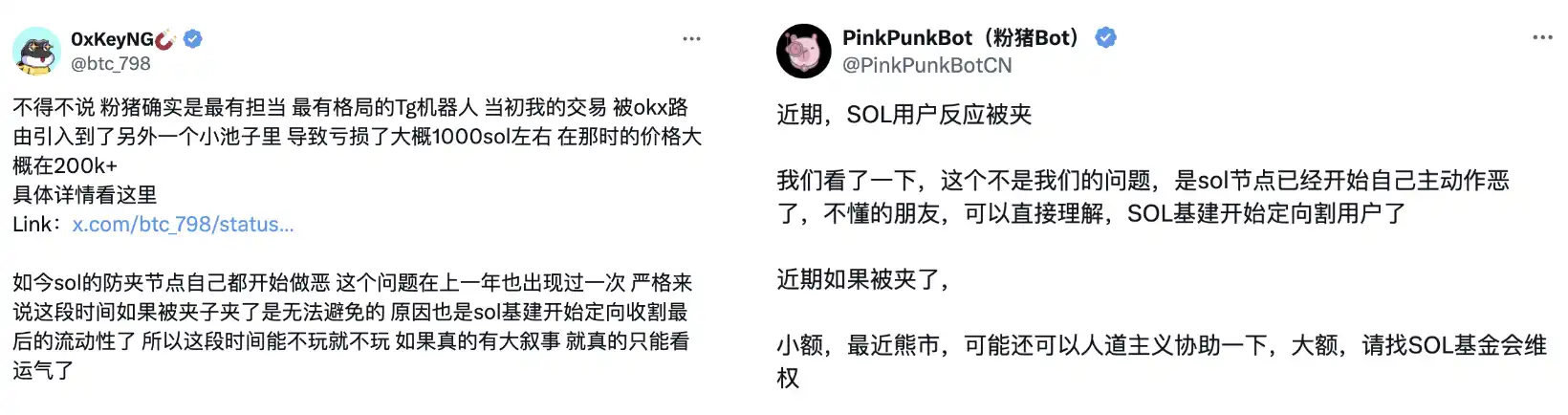
User X @btc_798 claimed that after buying the $GANG token on the Solana blockchain, the token's price surged by 100 times, and they subsequently sold their position. However, due to the routing service selecting the low-liquidity Raydium pool (only 100 SOL) instead of the more optimal Orca pool (4000 SOL), the sell price was much lower than the market price, resulting in the trader earning about 1000 SOL less. "Even Solana's anti-sandwich node has started to act maliciously." @PinkPunkBotCN also suggested that the recent sandwiching phenomenon might be nodes intentionally "liquidating users."

Malicious Node Earns 1000 SOL from a Single Transaction, Why Has Solana Become an MEV Hotspot?


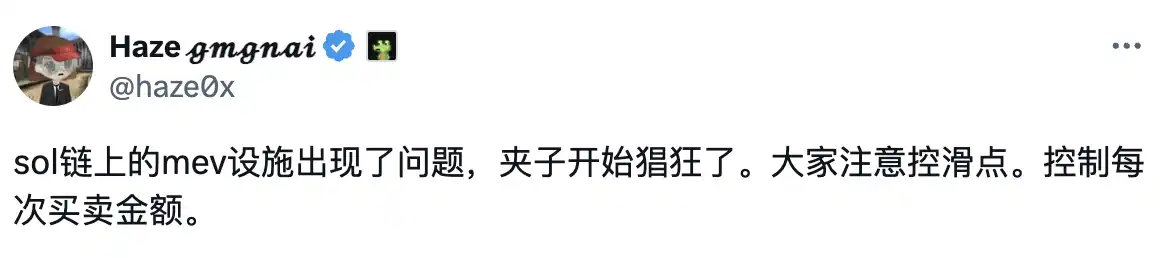
GMGN Co-founder @haze0x also specifically posted a reminder: "Issues have arisen with MEV facilities on SOL's blockchain, and sandwich attacks have begun to run rampant."
In response to these events, crypto analyst @PepeBoost888 pointed out that some Jito validators recently experienced data leaks to sandwichers, allowing sandwichers to obtain data on anti-sandwich transactions in advance. According to @solstatz's data, on just March 15, Raydium reported 10,633 attacks resulting in a total loss of 916.63 SOL, and Pump Fun reported 1770 attacks resulting in a total loss of 314.85 SOL.

Where is the Problem?

In fact, "sandwiching" is not the first time it has occurred on Solana. Sandwiching, or sandwich attack, is a common MEV (Maximal Extractable Value) strategy and a prevalent issue in the AMM market. In this type of attack, bots detect the transaction before it is included in a block, execute a buy order beforehand to drive up the price, and then immediately place a sell order after the transaction completes to profit from the price difference. This forces users to buy tokens at a higher price, while the bots effortlessly make a profit. Although fundamentally MEV is not without value—it can prevent spam attacks through mechanisms like priority fees and help maintain the stability of the blockchain network—Solana appears to have left a vulnerability to sandwich attacks due to its mechanism.

The MEV on Solana was not particularly noticeable until Jito introduced the MEV reward protocol, which brought it into the limelight. Today, over 66% of validators have adopted the Jito-Solana client, which allows users to prioritize their transactions by paying a "tip." Additionally, Jito operates a mempool, which has enabled sandwich attackers to monitor user transactions. Although Jito attempted to reduce such attacks by closing the mempool in March 2024, MEV bots can still continue to monitor transactions by running RPC nodes, and the attacks have not ceased.

In June 2024, Tim Garcia, the Solana Foundation's Validator Relations lead, announced on Discord a decision to take aggressive action to remove over 30 validators participating in sandwich attacks in an attempt to curb the issue. However, this action did not completely solve the problem of frequent attacks. For instance, the notorious "arsc" bot managed to profit over $30 million within two months and continues to earn substantial profits through sandwich attacks even after the Foundation's intervention. Attackers quickly adapt to network changes and may bypass restrictions by running their RPC nodes to continue monitoring and frontrunning user transactions.

Related Reading: "Earning $30 Million in 2 Months, Why the 'Sandwich Attack' on Solana Persists"

Today, sandwich attacks remain a persistent issue on Solana. Users commonly report that even after paying tips, they cannot completely avoid being sandwiched. This situation mirrors past occurrences where attackers exploit Solana's high transaction processing speed and relatively predictable transaction ordering to continuously target transactions.

How Does This Differ from Ethereum's 'Sandwiching'?

In fact, "sandwiching" is not uncommon in the blockchain world, as Ethereum has also suffered from sandwich attacks. The reason why sandwich attacks on Solana have become a persistent issue is closely related to its network design and operational mechanisms, which differ significantly from Ethereum.

On Ethereum, the origin of MEV is mainly related to the visibility of unprocessed transactions. Due to the existence of a shared mempool, anyone can see the transaction information waiting to be included in a block. It's like knowing in advance which goods are about to be bought in a public market. Consequently, savvy traders can leverage this "foresight" to profit through arbitrage or transaction reordering. Attackers might spend more gas fees to front-run transaction sequencing, utilizing fee competition to carry out attacks.

Contrastingly, Solana does not have a Mempool, which means that information about unprocessed transactions is not publicly available as it is on Ethereum, making it much harder to access this information. However, there is still an opportunity for validators. Validators are responsible for processing a specific round of transactions, during which they can clearly see which transactions have not yet been included in a block. At this point, validators have a secret "ace up their sleeve": they can conduct a "sandwich attack" similar to players on Ethereum and profit from it. However, this advantage is private, known only to the "malicious" validator themselves, with other validators being unaware.

When it comes to combating sandwich attacks, Ethereum and Solana have notably different measures. Ethereum outsources transaction ordering to professional builders through the MEV-Boost system, limiting validators' ability to manipulate transaction order and effectively reducing the occurrence of attacks. In contrast, Solana's Jito system attempts a similar mechanism, but attackers can still find loopholes and use private nodes to bypass the restrictions. It could be said that Ethereum's MEV-Boost successfully constrains validator behavior, while Solana's Jito system seems somewhat inadequate in curtailing attacks.

Furthermore, the network structures of Solana and Ethereum also determine the level of difficulty in prevention. Solana has only around 2,000 validators, making its power relatively centralized, where a few malicious nodes could influence transaction ordering, offering attackers an opportunity. On the other hand, Ethereum has over 500,000 validators, with a highly decentralized network, making it difficult for attackers to control enough nodes to carry out an attack, acting as a natural defense barrier.

Related Reading: "Solana Node Dialogue: Who is Quietly Making Money with memecoin?"

In summary, Solana is fast but centralized, allowing attackers to exploit private nodes and bypassing the Jito system. Ethereum relies on fee competition and MEV-Boost, coupled with a decentralized structure, for more effective prevention. For Solana to address these issues, optimization of mechanisms and decentralization of power are necessary.

How to Avoid "Sandwich Attacks"?

In the current situation where Solana's mechanism cannot be changed, it is crucial for users to understand how to effectively prevent sandwich attacks in transactions.

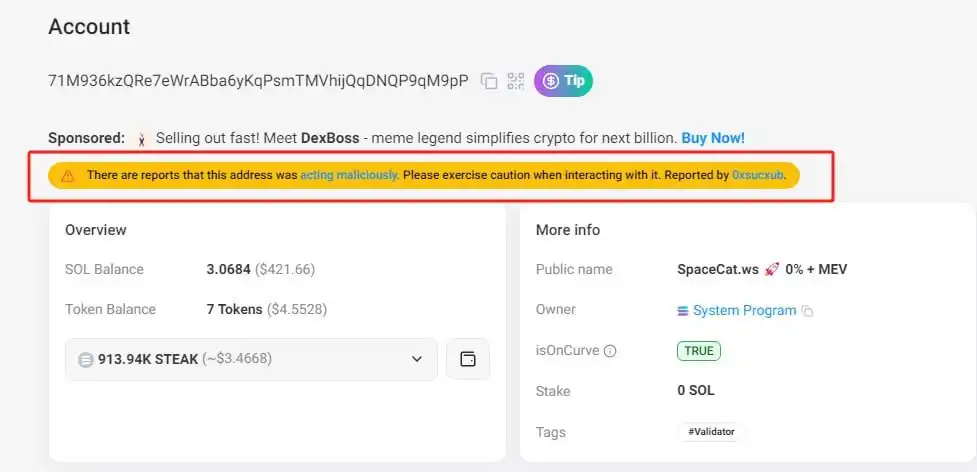
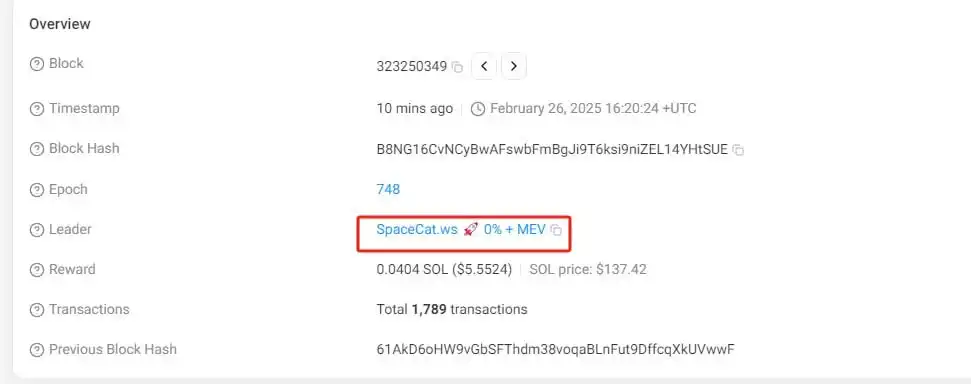
Cryptocurrency analyst @PepeBoost888 suggests that to determine if your transaction has been sandwich attacked by a malicious validator, you can check by: first clicking on the block number of the corresponding transaction in the Solscan blockchain explorer, then in the block details page, find the "Leader" field to view the information of the validator node responsible for packing that block. Some malicious validators have already been reported by the community and marked with risk warnings on the Solscan platform. Users can also cross-reference the validator address with the public list of malicious nodes maintained by @0xsucxub to confirm the risk.
For junior Punks, the primary principle when swapping on-chain is to avoid setting a too high slippage tolerance. It is recommended to rationally set a 0.5%-1% reasonable slippage tolerance range based on market volatility. If using an AMM for transactions, one should actively enable MEV protection. This mechanism, through techniques such as transaction path obfuscation and broadcast delay, can significantly reduce the possibility of transactions being front-run by malicious bots.

Related reading: "GMGN Co-creation teaches you how to become a qualified Junior Punk"

The "sandwiching" phenomenon has once again sounded the alarm for the Solana ecosystem. This is not a unique issue to Solana but rather a growing pain that most public blockchains may encounter. However, if "sandwiching" becomes the norm, Solana's reputation could be affected. After all, it has always been hailed as an "Ethereum killer" based on its high-speed performance and user experience. If users feel that this high-speed road is plagued by various tolls, packing fees, and protection fees that are rampant, who would still be willing to use it? Especially in key areas like DeFi, trust is the highest cost.

You may also like

Token Cannot Compound, Where Is the Real Investment Opportunity?

The next chapter in the crypto industry will undoubtedly be written by Crypto-empowered Stocks.

February 6th Market Key Intelligence, How Much Did You Miss?

1. On-chain Flows: $508.2M USD inflow to Ethereum today; $390.8M USD outflow from Arbitrum 2. Biggest Gainers/Losers: $HBTC, $AIO 3. Top News: Current Bitcoin weekly RSI oversold signal comparable to June 2022

China's Central Bank and Eight Other Departments' Latest Regulatory Focus: Key Attention to RWA Tokenized Asset Risk


Foreword: Today, the People's Bank of China's website published the "Notice of the People's Bank of China, National Development and Reform Commission, Ministry of Industry and Information Technology, Ministry of Public Security, State Administration for Market Regulation, China Banking and Insurance Regulatory Commission, China Securities Regulatory Commission, State Administration of Foreign Exchange on Further Preventing and Dealing with Risks Related to Virtual Currency and Others (Yinfa [2026] No. 42)", the latest regulatory requirements from the eight departments including the central bank, which are basically consistent with the regulatory requirements of recent years. The main focus of the regulation is on speculative activities such as virtual currency trading, exchanges, ICOs, overseas platform services, and this time, regulatory oversight of RWA has been added, explicitly prohibiting RWA tokenization, stablecoins (especially those pegged to the RMB). The following is the full text:


To the people's governments of all provinces, autonomous regions, and municipalities directly under the Central Government, the Xinjiang Production and Construction Corps:


  Recently, there have been speculative activities related to virtual currency and Real-World Assets (RWA) tokenization, disrupting the economic and financial order and jeopardizing the property security of the people. In order to further prevent and address the risks related to virtual currency and Real-World Assets tokenization, effectively safeguard national security and social stability, in accordance with the "Law of the People's Republic of China on the People's Bank of China," "Law of the People's Republic of China on Commercial Banks," "Securities Law of the People's Republic of China," "Law of the People's Republic of China on Securities Investment Funds," "Law of the People's Republic of China on Futures and Derivatives," "Cybersecurity Law of the People's Republic of China," "Regulations of the People's Republic of China on the Administration of Renminbi," "Regulations on Prevention and Disposal of Illegal Fundraising," "Regulations of the People's Republic of China on Foreign Exchange Administration," "Telecommunications Regulations of the People's Republic of China," and other provisions, after reaching consensus with the Cyberspace Administration of China, the Supreme People's Court, and the Supreme People's Procuratorate, and with the approval of the State Council, the relevant matters are notified as follows:


  I. Clarify the essential attributes of virtual currency, Real-World Assets tokenization, and related business activities


  (I) Virtual currency does not possess the legal status equivalent to fiat currency. Virtual currencies such as Bitcoin, Ether, Tether, etc., have the main characteristics of being issued by non-monetary authorities, using encryption technology and distributed ledger or similar technology, existing in digital form, etc. They do not have legal tender status, should not and cannot be circulated and used as currency in the market.


  The business activities related to virtual currency are classified as illegal financial activities. The exchange of fiat currency and virtual currency within the territory, exchange of virtual currencies, acting as a central counterparty in buying and selling virtual currencies, providing information intermediary and pricing services for virtual currency transactions, token issuance financing, and trading of virtual currency-related financial products, etc., fall under illegal financial activities, such as suspected illegal issuance of token vouchers, unauthorized public issuance of securities, illegal operation of securities and futures business, illegal fundraising, etc., are strictly prohibited across the board and resolutely banned in accordance with the law. Overseas entities and individuals are not allowed to provide virtual currency-related services to domestic entities in any form.


  A stablecoin pegged to a fiat currency indirectly fulfills some functions of the fiat currency in circulation. Without the consent of relevant authorities in accordance with the law and regulations, any domestic or foreign entity or individual is not allowed to issue a RMB-pegged stablecoin overseas.


(II)Tokenization of Real-World Assets refers to the use of encryption technology and distributed ledger or similar technologies to transform ownership rights, income rights, etc., of assets into tokens (tokens) or other interests or bond certificates with token (token) characteristics, and carry out issuance and trading activities.


  Engaging in the tokenization of real-world assets domestically, as well as providing related intermediary, information technology services, etc., which are suspected of illegal issuance of token vouchers, unauthorized public offering of securities, illegal operation of securities and futures business, illegal fundraising, and other illegal financial activities, shall be prohibited; except for relevant business activities carried out with the approval of the competent authorities in accordance with the law and regulations and relying on specific financial infrastructures. Overseas entities and individuals are not allowed to illegally provide services related to the tokenization of real-world assets to domestic entities in any form.


  II. Sound Work Mechanism


  (III) Inter-agency Coordination. The People's Bank of China, together with the National Development and Reform Commission, the Ministry of Industry and Information Technology, the Ministry of Public Security, the State Administration for Market Regulation, the China Banking and Insurance Regulatory Commission, the China Securities Regulatory Commission, the State Administration of Foreign Exchange, and other departments, will improve the work mechanism, strengthen coordination with the Cyberspace Administration of China, the Supreme People's Court, and the Supreme People's Procuratorate, coordinate efforts, and overall guide regions to carry out risk prevention and disposal of virtual currency-related illegal financial activities.


  The China Securities Regulatory Commission, together with the National Development and Reform Commission, the Ministry of Industry and Information Technology, the Ministry of Public Security, the People's Bank of China, the State Administration for Market Regulation, the China Banking and Insurance Regulatory Commission, the State Administration of Foreign Exchange, and other departments, will improve the work mechanism, strengthen coordination with the Cyberspace Administration of China, the Supreme People's Court, and the Supreme People's Procuratorate, coordinate efforts, and overall guide regions to carry out risk prevention and disposal of illegal financial activities related to the tokenization of real-world assets.


  (IV) Strengthening Local Implementation. The people's governments at the provincial level are overall responsible for the prevention and disposal of risks related to virtual currencies and the tokenization of real-world assets in their respective administrative regions. The specific leading department is the local financial regulatory department, with participation from branches and dispatched institutions of the State Council's financial regulatory department, telecommunications regulators, public security, market supervision, and other departments, in coordination with cyberspace departments, courts, and procuratorates, to improve the normalization of the work mechanism, effectively connect with the relevant work mechanisms of central departments, form a cooperative and coordinated working pattern between central and local governments, effectively prevent and properly handle risks related to virtual currencies and the tokenization of real-world assets, and maintain economic and financial order and social stability.


  III. Strengthened Risk Monitoring, Prevention, and Disposal


  (5) Enhanced Risk Monitoring. The People's Bank of China, China Securities Regulatory Commission, National Development and Reform Commission, Ministry of Industry and Information Technology, Ministry of Public Security, State Administration of Foreign Exchange, Cyberspace Administration of China, and other departments continue to improve monitoring techniques and system support, enhance cross-departmental data analysis and sharing, establish sound information sharing and cross-validation mechanisms, promptly grasp the risk situation of activities related to virtual currency and real-world asset tokenization. Local governments at all levels give full play to the role of local monitoring and early warning mechanisms. Local financial regulatory authorities, together with branches and agencies of the State Council's financial regulatory authorities, as well as departments of cyberspace and public security, ensure effective connection between online monitoring, offline investigation, and fund tracking, efficiently and accurately identify activities related to virtual currency and real-world asset tokenization, promptly share risk information, improve early warning information dissemination, verification, and rapid response mechanisms.


  (6) Strengthened Oversight of Financial Institutions, Intermediaries, and Technology Service Providers. Financial institutions (including non-bank payment institutions) are prohibited from providing account opening, fund transfer, and clearing services for virtual currency-related business activities, issuing and selling financial products related to virtual currency, including virtual currency and related financial products in the scope of collateral, conducting insurance business related to virtual currency, or including virtual currency in the scope of insurance liability. Financial institutions (including non-bank payment institutions) are prohibited from providing custody, clearing, and settlement services for unauthorized real-world asset tokenization-related business and related financial products. Relevant intermediary institutions and information technology service providers are prohibited from providing intermediary, technical, or other services for unauthorized real-world asset tokenization-related businesses and related financial products.


  (7) Enhanced Management of Internet Information Content and Access. Internet enterprises are prohibited from providing online business venues, commercial displays, marketing, advertising, or paid traffic diversion services for virtual currency and real-world asset tokenization-related business activities. Upon discovering clues of illegal activities, they should promptly report to relevant departments and provide technical support and assistance for related investigations and inquiries. Based on the clues transferred by the financial regulatory authorities, the cyberspace administration, telecommunications authorities, and public security departments should promptly close and deal with websites, mobile applications (including mini-programs), and public accounts engaged in virtual currency and real-world asset tokenization-related business activities in accordance with the law.


  (8) Strengthened Entity Registration and Advertisement Management. Market supervision departments strengthen entity registration and management, and enterprise and individual business registrations must not contain terms such as "virtual currency," "virtual asset," "cryptocurrency," "crypto asset," "stablecoin," "real-world asset tokenization," or "RWA" in their names or business scopes. Market supervision departments, together with financial regulatory authorities, legally enhance the supervision of advertisements related to virtual currency and real-world asset tokenization, promptly investigating and handling relevant illegal advertisements.


  (IX) Continued Rectification of Virtual Currency Mining Activities. The National Development and Reform Commission, together with relevant departments, strictly controls virtual currency mining activities, continuously promotes the rectification of virtual currency mining activities. The people's governments of various provinces take overall responsibility for the rectification of "mining" within their respective administrative regions. In accordance with the requirements of the National Development and Reform Commission and other departments in the "Notice on the Rectification of Virtual Currency Mining Activities" (NDRC Energy-saving Building [2021] No. 1283) and the provisions of the "Guidance Catalog for Industrial Structure Adjustment (2024 Edition)," a comprehensive review, investigation, and closure of existing virtual currency mining projects are conducted, new mining projects are strictly prohibited, and mining machine production enterprises are strictly prohibited from providing mining machine sales and other services within the country.


  (X) Severe Crackdown on Related Illegal Financial Activities. Upon discovering clues to illegal financial activities related to virtual currency and the tokenization of real-world assets, local financial regulatory authorities, branches of the State Council's financial regulatory authorities, and other relevant departments promptly investigate, determine, and properly handle the issues in accordance with the law, and seriously hold the relevant entities and individuals legally responsible. Those suspected of crimes are transferred to the judicial authorities for processing according to the law.


 (XI) Severe Crackdown on Related Illegal and Criminal Activities. The Ministry of Public Security, the People's Bank of China, the State Administration for Market Regulation, the China Banking and Insurance Regulatory Commission, the China Securities Regulatory Commission, as well as judicial and procuratorial organs, in accordance with their respective responsibilities, rigorously crack down on illegal and criminal activities related to virtual currency, the tokenization of real-world assets, such as fraud, money laundering, illegal business operations, pyramid schemes, illegal fundraising, and other illegal and criminal activities carried out under the guise of virtual currency, the tokenization of real-world assets, etc.


  (XII) Strengthen Industry Self-discipline. Relevant industry associations should enhance membership management and policy advocacy, based on their own responsibilities, advocate and urge member units to resist illegal financial activities related to virtual currency and the tokenization of real-world assets. Member units that violate regulatory policies and industry self-discipline rules are to be disciplined in accordance with relevant self-regulatory management regulations. By leveraging various industry infrastructure, conduct risk monitoring related to virtual currency, the tokenization of real-world assets, and promptly transfer issue clues to relevant departments.


  IV. Strict Supervision of Domestic Entities Engaging in Overseas Business Activities


(XIII) Without the approval of relevant departments in accordance with the law and regulations, domestic entities and foreign entities controlled by them may not issue virtual currency overseas.


  (XIV) Domestic entities engaging directly or indirectly in overseas external debt-based tokenization of real-world assets, or conducting asset securitization activities abroad based on domestic ownership rights, income rights, etc. (hereinafter referred to as domestic equity), should be strictly regulated in accordance with the principles of "same business, same risk, same rules." The National Development and Reform Commission, the China Securities Regulatory Commission, the State Administration of Foreign Exchange, and other relevant departments regulate it according to their respective responsibilities. For other forms of overseas real-world asset tokenization activities based on domestic equity by domestic entities, the China Securities Regulatory Commission, together with relevant departments, supervise according to their division of responsibilities. Without the consent and filing of relevant departments, no unit or individual may engage in the above-mentioned business.


  (15) Overseas subsidiaries and branches of domestic financial institutions providing Real World Asset Tokenization-related services overseas shall do so legally and prudently. They shall have professional personnel and systems in place to effectively mitigate business risks, strictly implement customer onboarding, suitability management, anti-money laundering requirements, and incorporate them into the domestic financial institutions' compliance and risk management system. Intermediaries and information technology service providers offering Real World Asset Tokenization services abroad based on domestic equity or conducting Real World Asset Tokenization business in the form of overseas debt for domestic entities directly or indirectly venturing abroad must strictly comply with relevant laws and regulations. They should establish and improve relevant compliance and internal control systems in accordance with relevant normative requirements, strengthen business and risk control, and report the business developments to the relevant regulatory authorities for approval or filing.


  V. Strengthen Organizational Implementation


  (16) Strengthen organizational leadership and overall coordination. All departments and regions should attach great importance to the prevention of risks related to virtual currencies and Real World Asset Tokenization, strengthen organizational leadership, clarify work responsibilities, form a long-term effective working mechanism with centralized coordination, local implementation, and shared responsibilities, maintain high pressure, dynamically monitor risks, effectively prevent and mitigate risks in an orderly and efficient manner, legally protect the property security of the people, and make every effort to maintain economic and financial order and social stability.


  (17) Widely carry out publicity and education. All departments, regions, and industry associations should make full use of various media and other communication channels to disseminate information through legal and policy interpretation, analysis of typical cases, and education on investment risks, etc. They should promote the illegality and harm of virtual currencies and Real World Asset Tokenization-related businesses and their manifestations, fully alert to potential risks and hidden dangers, and enhance public awareness and identification capabilities for risk prevention.


  VI. Legal Responsibility


  (18) Engaging in illegal financial activities related to virtual currencies and Real World Asset Tokenization in violation of this notice, as well as providing services for virtual currencies and Real World Asset Tokenization-related businesses, shall be punished in accordance with relevant regulations. If it constitutes a crime, criminal liability shall be pursued according to the law. For domestic entities and individuals who knowingly or should have known that overseas entities illegally provided virtual currency or Real World Asset Tokenization-related services to domestic entities and still assisted them, relevant responsibilities shall be pursued according to the law. If it constitutes a crime, criminal liability shall be pursued according to the law.


  (19) If any unit or individual invests in virtual currencies, Real World Asset Tokens, and related financial products against public order and good customs, the relevant civil legal actions shall be invalid, and any resulting losses shall be borne by them. If there are suspicions of disrupting financial order and jeopardizing financial security, the relevant departments shall deal with them according to the law.


  This notice shall enter into force upon the date of its issuance. The People's Bank of China and ten other departments' "Notice on Further Preventing and Dealing with the Risks of Virtual Currency Trading Speculation" (Yinfa [2021] No. 237) is hereby repealed.


Former Partner's Perspective on Multicoin: Kyle's Exit, But the Game He Left Behind Just Getting Started

Kyle knew his game, so he decided to focus on playing the game he was good at and interested in.

Why Bitcoin Is Falling Now: The Real Reasons Behind BTC's Crash & WEEX's Smart Profit Playbook

Bitcoin's ongoing crash explained: Discover the 5 hidden triggers behind BTC's plunge & how WEEX's Auto Earn and Trade to Earn strategies help traders profit from crypto market volatility.

Wall Street's Hottest Trades See Exodus

This time there is no single triggering factor, but rather market anxiety about asset valuation, with many already skeptical of these valuations being too high, leading to investors choosing to retreat almost simultaneously.

Popular coins

Latest Crypto News

Read more