
Market Maintains Sideways Movement, BNB Chain Meme Trend Emerges




Original Article Title: "Market Maintains Volatile Trend, BNB Chain Meme Trend Emerges | Frontier Lab Crypto Market Weekly Report"
Original Source: Frontier Lab
Market Overview
Overall Market Summary
This week, the cryptocurrency market experienced a trending uptrend within a volatile range, with the market sentiment index rising from 8% to 11%. The stablecoin market value continued to grow (USDT reaching $143.7 billion, USDC reaching $59.2 billion, with increases of 0.18% and 1.39% respectively), indicating that institutional funds continued to enter the market during the downturn, maintaining the growth trend of the past three weeks. The rise was primarily driven by US funds (USDC), showing that American investors, after experiencing the recent weeks of decline, continued their high-speed entry from last week. The mid-week rebound in the market was mainly due to the limited-term 30-day ceasefire agreement in the Russia-Ukraine war, as well as the Federal Reserve maintaining the current interest rate as expected, reducing the scale of QT from $250 billion per month to $50 billion per month, and stating that the US economy is not in recession. This helped to alleviate market sentiment to some extent, resulting in a generally strong performance of Altcoins compared to the benchmark index.
Next Week Predictions
Bullish Targets: UNI, BNB, EUL
UNI: $1.655 Billion Ecosystem Fund Allocation and DeFi Leadership Reshaping
Empowering Strategic Funds
The Uniswap community, through a historically large $1.655 billion funding, provided ample financial support for Uniswap v4 and Unichain, with $45 million allocated to liquidity incentives and $95.4 million for developer ecosystem development. This decisive investment will significantly enhance the protocol's competitiveness and lay a solid foundation for token value creation.
Innovating the Tokenomics
The potential implementation of the "Fee Switch" mechanism will completely transform the UNI tokenomics, allowing token holders to directly share protocol revenue. Unichain has also committed to distributing 65% of on-chain net revenue to validators and stakers, enhancing the income incentives to attract more long-term investors. It's worth noting that Uniswap's annual revenue has already exceeded $90 million, and if 65% of it is distributed, validators and stakers could receive $58.5 million in profits.
Technological Innovation and Ecosystem Expansion
Uniswap v4 has significantly lowered the development barrier through innovative "hook" systems, attracting over 1000 developers to create over 150 prototypes. Unichain, optimized for DeFi, will provide efficient infrastructure for the ecosystem. This technological advantage will solidify Uniswap's core position in the DeFi space.
Governance Structure Optimization
Uniswap is actively driving towards governance decentralization, planning to introduce a "Core Contributor" program and legal entity to reduce reliance on a single entity. The protocol commits to enhancing transparency, establishing a representative council for oversight, and fostering a more sustainable development model and stronger community cohesion.
BNB: The Rise of the BNB Chain Ecosystem and Value Reframing
On-chain Data Continual Growth
Within a week, BSC chain TVL has grown by 12.95%, reaching a scale of $54.48 billion, demonstrating substantial traffic growth and value accumulation on the BNB Chain driven by the Meme trend.
Successful Marketing Strategy
Binance cleverly tapped into the UAE sovereign wealth fund investment opportunity, crafted a Middle Eastern cultural Meme narrative, had the executive team engage in community interactions, and established an "official meme creation-community adoption-token monetization" model, converting personal influence into market momentum.
PancakeSwap Trading Volume
Recently, PancakeSwap's trading volume has seen a significant increase, peaking at a daily trading volume of $31.5 billion. As the largest DEX on the BNB Chain, PancakeSwap reflects the ecosystem's status on the BNB Chain.
Technological and Policy Innovation
Introduced zero-fee transactions, an "anti-front running compensation" mechanism, and an Alpha section as technological innovations, simplifying the BEP20 token issuance process. This establishes a dual-drive model of "exchange + public chain," creating a low barrier, high liquidity Meme ecosystem for the BNB Chain.
Strategic Transformation Path
Binance is currently undergoing a strategic transformation from an exchange token to a Web3 infrastructure value capture tool. Learning from Solana's experience, it is guiding Meme users to DeFi projects through high APY strategies to achieve user value retention.
Regulatory Environment Improvement
With the SEC dropping its appeal against Ripple, the possibility of Binance reaching a final settlement with the SEC has increased. The reduced regulatory risk has provided a clearer development outlook for BNB.
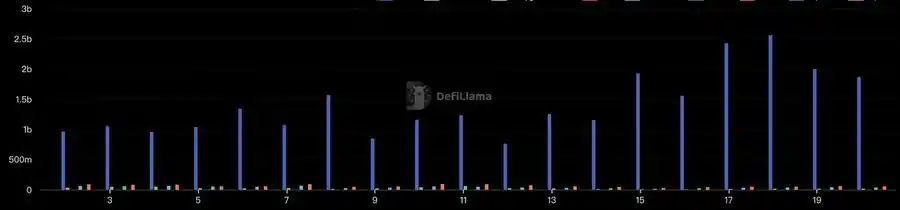
Pancakeswap Daily Trading Volume
EUL: TVL Hits All-Time High, Cross-Chain Expansion, and 54% High Yield Drive DeFi Growth
Rapid TVL Growth
This week, Euler saw a TVL growth rate of 30.56%, reaching $5.01 billion, setting a new record high. This growth was mainly due to ecosystem expansion, improved capital utilization, and optimized yield strategies.
Offering High-Yield Products
Euler provides users with high-yield lending pools, with the stablecoin pool sUSDC/USDC offering a maximum net asset yield of up to 54.77%. The depth continues to increase, surpassing $31 million, making it very attractive to stablecoin holders.
Strategic Ecosystem Expansion and Partnerships
Euler is actively collaborating with other ecosystems. This week, Euler announced a partnership with Berachain and launched a $150,000 BERA token reward program. On the second day of entering the Berachain ecosystem, the TVL increased by $25 million.
Providing User Incentive Mechanisms
Euler continues to introduce incentive programs, including the latest $300,000 incentive measure to encourage users to provide WETH or USDC to earn rEUL. These incentive mechanisms effectively attract new users, retain existing users, and enhance platform liquidity, creating a virtuous cycle of ecosystem growth.
Bearish Targets: ALT, NFP, EDU
ALT: Altlayer Faces Cooling Market and Large Token Unlock
Market Sentiment Cooling Off
Altlayer, as a RaaS project focused on modularity and the Layer 2 track, is facing a harsh market environment. During this bull market cycle, the overall performance of the Ethereum ecosystem fell below expectations, especially with Layer 2 projects being viewed negatively by the market in their role as "Ethereum vampires." This shift in market sentiment has caused the modularity and Layer 2 track to lose investor attention and funds inflow, leading to a significant decrease in popularity for projects including Altlayer, leaving them in a state of neglect.
ALT Token Unlock Sell Pressure
Altlayer is set to unlock 195 million ALT tokens on March 25, accounting for 1.95% of the total locked amount. This unlock is sizable, and the recipients are primarily early investment institutions and project team members. Against the backdrop of waning project interest, these investment institutions are likely to sell off tokens to recoup funds, thereby exerting significant selling pressure on the ALT token price.
NFP: NFPrompt Track Losing Heat, Facing Large Unlock Next Week
NFT and AI Tracks Falling Out of Favor
NFPrompt, as a platform integrating AI and NFT art creation, is facing a challenging market environment. Since the end of the previous bull market, the NFT track has been in a slump, especially being overshadowed by the Meme coin craze in this market cycle. At the same time, the recent overall market downturn has rapidly cooled off the AI track, with most AI-related projects experiencing over a 50% decline. This dual cooling of the NFT and AI tracks has significantly reduced NFPrompt's popularity in the current market, making it difficult to attract investor attention.
Large Token Unlock Could Exacerbate Sell-off Risk
NFPrompt is scheduled to unlock 14.51 million NFP tokens on March 26, representing 1.45% of the total locked amount. Considering NFP's current circulation rate of only 41%, this unlock size is relatively large, with recipients mainly being project team members. Against the backdrop of a noticeable decline in project popularity, the project team is likely to sell off tokens to realize project profits, thereby exerting significant selling pressure on the NFP token price and further exacerbating the project's market woes.
EDU: Stratis Market Sentiment Weak, Token Unlocking May Trigger Selling Pressure
Open Campus is a decentralized education solution that has not received market attention since its launch. Its token, EDU, will have 19.07 million tokens unlocked on March 28, accounting for 1.91% of the total locked amount. This unlocking is relatively large, and considering that the project's current circulation rate is 47%, coupled with the fact that the main recipients of this unlocking are early investment institutions, without the project regaining market attention, they are likely to sell off. This is expected to have a certain impact on EDU's price.
Market Sentiment Index Analysis
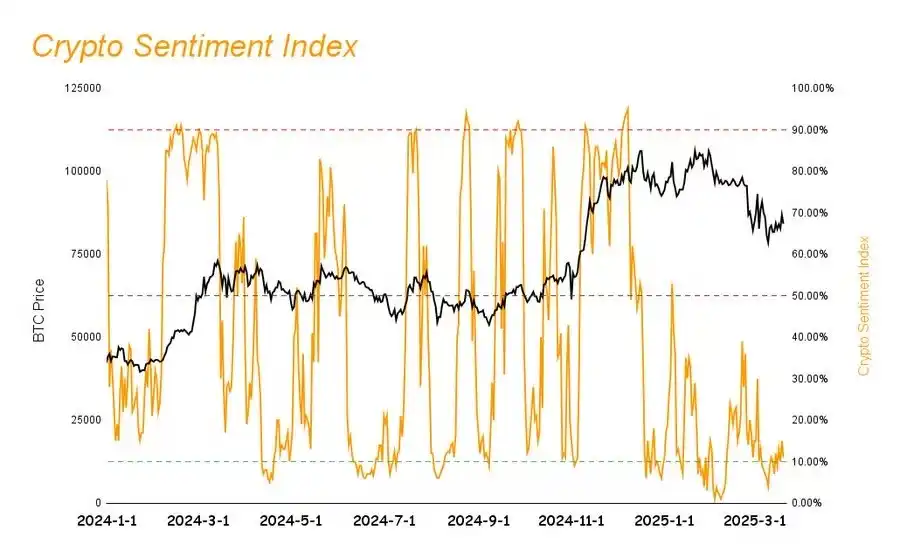
The market sentiment index has risen from 8% last week to 11%, with little overall change, still fluctuating above the extreme fear line.
Hot Topic Track
BNB Chain Revives Meme Craze on Chain
Current Situation
In the first quarter of 2025, the meme ecosystem of BNB Chain showed an explosive growth trend, from the initial test token TST in an educational video to CZ's "unofficial but tacit" approval. Within 3 days, the market value surged 100 times to $5 billion. This was called the "TST Token Experiment," which began to show an explosive trend. More recently, after Binance received a $2 billion investment from the UAE sovereign fund MGX, CZ's post with the term Mubarak triggered a wave of BNB Chain memes. Additionally, with Binance launching the Binance Wallet with zero transaction fees, "Anti-Sandwich Full Compensation + 24-hour Protection" policy, and adding an Alpha section to the main Binance site for easy user purchases, the BNB Chain meme wave reached its peak. Almost overnight, the entire network's attention and funds all converged on BNB Chain.
Specific Analysis
Reasons for the BNB Chain Meme Craze
BNB Chain had been lukewarm before 2025, lagging behind Ethereum in the DeFi field and Solana in the meme field. Therefore, for BNB Chain to break through, it had to choose a direction for breakthrough. Given the current trend in the crypto industry, which is primarily focused on the attention economy, BNB Chain chose the meme track for its breakthrough.
Marketing Reasons
Binance has successfully captured market attention and funds into the BNB Chain through a series of marketing strategies and the wealth effect.
Firstly, Binance seized the opportunity of the UAE sovereign fund MGX investing $2 billion in Binance and actively built a Middle Eastern cultural narrative, transforming Arabic elements such as "mubarak" and "Mashallah" into meme tokens. CZ even changed his profile picture to a Muslim robe image, creating a new cultural symbol system and investment logic.
Secondly, the Binance executive team actively participated in meme hype, with CZ personally buying mubarak and TST tokens and announcing it on Twitter. He Yi, on the other hand, interacted with users in a self-deprecating humorous manner and even joined meme coin WeChat groups to discuss projects, creating a sense of celebrity in the crypto world and making users feel like they were investing alongside these figures, successfully converting personal influence into market momentum.
Thirdly, Binance designed a pattern of "official meme initiation-community meme adoption-token monetization," stimulating user engagement and achieving broader dissemination through whitespace marketing and community remix activities.
Lastly, through executive self-deprecation, meme playing, and deep interaction, Binance enhanced user inclusivity and community belonging. These strategies drove the formation of a Binance-centered community culture and provided sustained momentum for the meme trend.
Technical and Policy Reasons
Building on Solana's success, Binance introduced a series of innovative technologies and policies to create a low-barrier, high-liquidity meme token ecosystem on the BNB Chain.
Firstly, it implemented a zero-fee strategy, sub-second block confirmations, and an "anti-sandwich attack" mechanism, significantly reducing user transaction costs and enhancing security to create a user-friendly trading environment.
Secondly, Binance bridged on-chain and off-chain liquidity by introducing the Alpha section for innovations and direct fund purchases on the main platform.
Thirdly, by simplifying the BEP20 token issuance process, providing detailed development tutorials, and establishing the "BNB Goodwill Alliance," Binance effectively lowered the development threshold, encouraging developers to respond quickly to market demand and achieve rapid token launches.
Finally, leveraging Binance's massive user base and traffic advantage, we have further built an ecological closed loop by attracting liquidity and fund inflow to the BNB ecosystem, achieving the collaborative development of the exchange and public chain.
Pros and Cons of BNB Chain Compared to Solana
BNB Chain aims to make a mark in the Meme field, with Solana as its most direct competitor. As the initiator of the Meme trend, Solana is an unavoidable giant in the Meme field, and the market and users will compare BNB Chain to Solana.
Pros
First, BNB Chain, relying on Binance, has a "exchange + public chain" mutual flow model that provides sufficient liquidity for BNB Chain, combined with mechanisms such as the Alpha sector to build an ecological closed loop. Second, the implementation of zero fees, fast confirmations, and features like "Anti-MEV" have optimized the user's trading experience, reducing entry barriers. Third, Binance executives can enhance community cohesion and traffic attraction through interactive methods. Finally, BNB Chain attracts more developers by simplifying the BEP20 token issuance process and supporting plans.
Cons
First, Solana's chain performance is very superior, processing 65,000 transactions per second and demonstrating its efficient on-chain transaction processing capabilities in events like TRUMP. In terms of performance, BNB Chain cannot compare to Solana.
Second, Solana has a more advanced programming model and richer development tools, with significant technological innovation that is superior to the more simplified technology used by BNB Chain.
Third, because Solana is a U.S.-based chain, it has more recognition in the United States, where the main users in the current Crypto industry are U.S. users.
Lastly, the security flaw in BNB Chain can be seen through the Four.Meme event. Solana's Pump.fun has undergone more market tests without a security crisis, making it easier to gain trust from on-chain users.
Future Development Direction of BNB Chain
The representative of the Meme Wave is Solana, which, influenced by the Meme Wave, has a thriving on-chain ecosystem. However, it failed to effectively convert Meme traffic, so the ecosystem was greatly impacted when the Meme Wave receded. Because no matter how significant the Meme Wave is, it will eventually recede, the future development strategy of the BNB Chain should focus on Meme as a growth point for traffic, converting Meme traffic into the value precipitation of AI+DeFi. This involves building user conversion, technology conversion, and capital conversion. After attracting new users through Meme, it is essential to effectively guide them into AI data platforms such as Alaya and DeFi protocols like PancakeSwap, ensuring a higher retention of high-value users. Furthermore, the BNB Chain should expand its efficient transaction infrastructure designed for Meme tokens to more complex financial scenarios, such as derivatives trading.
The BNB Chain should create a complete value loop ecosystem of "Meme Traffic Diversion - Supporting Infrastructure - Enhanced Business Applications," thus achieving a strategic upgrade from an exchange-affiliated public chain to a globally leading Web3 infrastructure.
Market Theme Overview
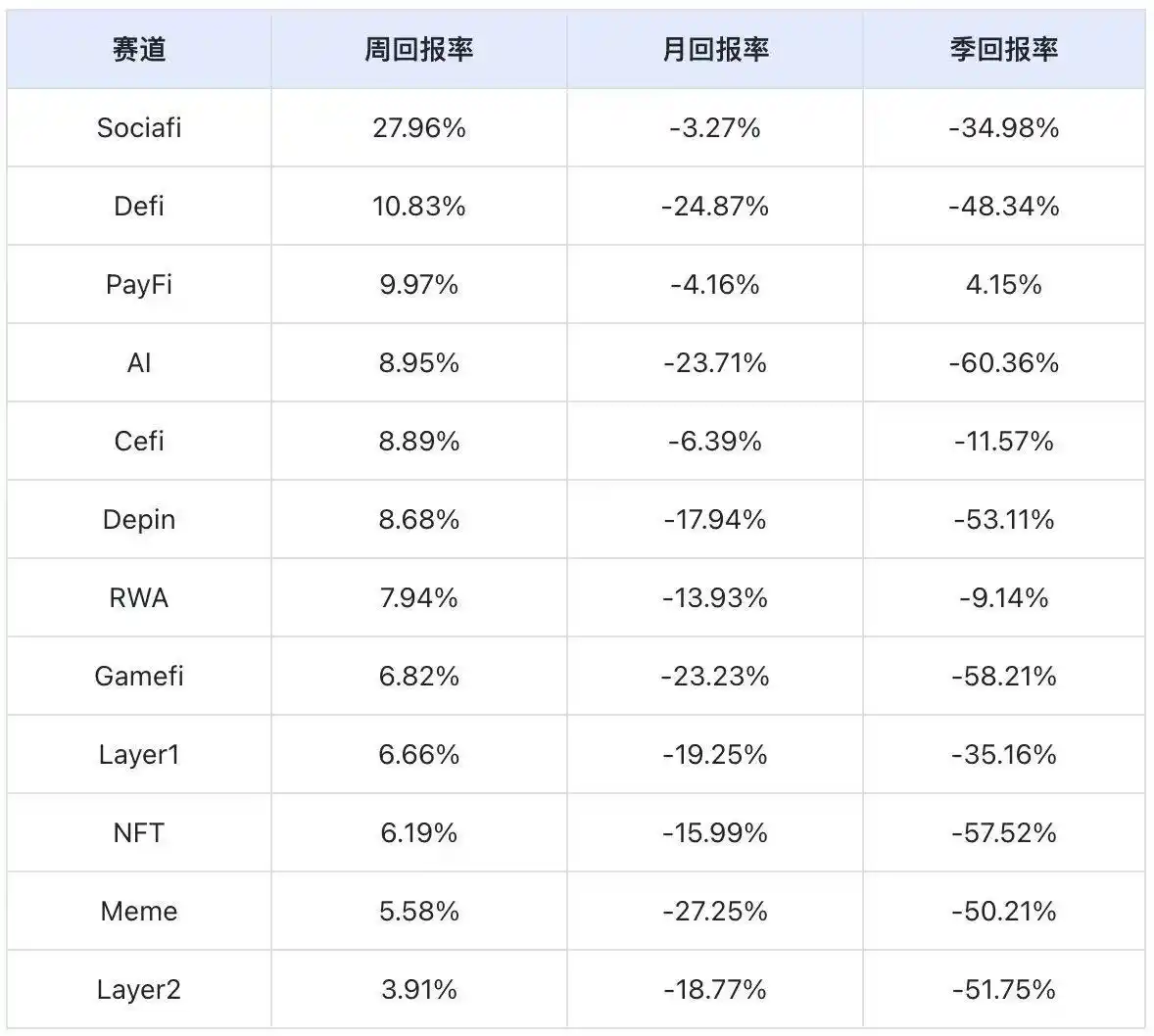
Data Source: SoSoValue
According to weekly return rate statistics, the Sociafi track performed the best, while the Layer2 track performed the worst.
· Sociafi Track: In the Sociafi track, TON and CHZ account for a significant proportion, totaling 95.31%. Their respective growth rates this week were 29.51% and 6.21%. TON, with the highest proportion and the highest growth rate, contributed to the best performance of the Sociafi track.
· Layer2 Track: MNT, POL, TIA, ARB, OP hold a significant share in the Layer2 track, totaling 72.04%. Their weekly price changes were 7.12%, -1.67%, -6.36%, 6.98%, and 3.31% respectively, resulting in the poorest overall performance of the Layer2 track.
Next Week's Crypto Major Events Preview
Monday (March 24) GMove Cooper: Movement's APAC Tour 2025 - Chengdu Stop
Tuesday (March 25) Mining Disrupt Conference & Expo 2025
Friday (March 28) US February Core PCE Price Index YoY
Summary
In summary, the cryptocurrency market was overall in a volatile upward trend this week. The market sentiment index rose from 8% to 11%, still in the extreme fear zone but showing signs of moderation. The continued growth of stablecoin market cap, especially the 1.39% increase in USDC, indicates that US investors are consistently entering the market during the downturn, providing solid support. Positive news such as the Russia-Ukraine 30-day ceasefire agreement and the Fed keeping interest rates unchanged while significantly reducing the QT scale were the main catalysts for this week's market rebound, leading to a stronger performance of most Altcoins compared to the benchmark index.
In terms of track performance, SocialFi led the market due to the strong performance of TON, with a weekly return rate of 27.96%; the DeFi track showed impressive performance with a 10.83% weekly return rate, reflecting a trend of value resurgence. Meanwhile, the BNB Chain ecosystem became the highlight of the week, triggering a new wave of meme frenzy through precise marketing and technical policy innovation.
Next week, investors should remain cautious of projects facing large unlockings such as ALT, NFP, and EDU, which may bring selling pressure risks. They should also pay attention to potential opportunities for fundamental improvements in UNI, BNB, and EUL. As market sentiment gradually recovers and stablecoin funds continue to flow in, the market may see more positive factors, but caution should still be exercised. It is essential to closely monitor changes in macroeconomic data and geopolitical situations to develop a more prudent investment strategy.
You may also like

The impossible triangle is simply a pseudo problem

Stablecoins Finally Find Real Returns: On-Chain Reinsurance Re Explained | Interview with Re Founder Karan Saroya

The AI gamble of mining companies: Valuations enter a phase of differentiation, and it's hard to turn the tide

A letter from Alliance to entrepreneurs: Written on the occasion of Cursor selling for 60 billion dollars

Will MicroStrategy fall into a death spiral? What will the macro trend be in the second half of the year?

Blockchain Capital Partner: The Core Secret of Arbitrage

STRC unanchored by 11%, can the perpetual motion machine of Strategy still operate?

Bitcoin Market Analysis 2026: Can BTC Reach $150K by Year-End?

Bitcoin ETF Outflows Hit a Record $4.4 Billion: What Are Traders Doing With Their Cash?

WEEX App Just Got Smarter – New Tabs for Faster Trades & Easy Asset Management

WEEX All-New Search Features: Find, Trade & Earn Faster Than Ever

Morning Report | Illinois signs the strictest digital asset tax law in the U.S.; RWA tokenization market size surpasses $43 billion, institutions accelerate the migration of on-chain assets

Full version of the debut Q&A! Federal Reserve Chairman Waller: Sticking to the 2% inflation target, establishing five special working groups, individual did not submit the dot plot

From Disruptor to Shadow Market: The Crypto Market is Becoming a Colony of Traditional Finance
Dalio's important long article: How to position in the current market environment?
OKX Star analyzes Binance's competitive advantages: when regulation levels the playing field, competition has just begun

New gameplay for participating in initial offerings on cryptocurrency exchanges
Why Is Bitcoin Down Today? What the Hawkish FOMC Means for SpaceX, Gold and Nasdaq
The impossible triangle is simply a pseudo problem
Stablecoins Finally Find Real Returns: On-Chain Reinsurance Re Explained | Interview with Re Founder Karan Saroya
The AI gamble of mining companies: Valuations enter a phase of differentiation, and it's hard to turn the tide
A letter from Alliance to entrepreneurs: Written on the occasion of Cursor selling for 60 billion dollars
Will MicroStrategy fall into a death spiral? What will the macro trend be in the second half of the year?
Blockchain Capital Partner: The Core Secret of Arbitrage


