
Overview of ZK ecosystem applications on Farcaster





Original title: Farcaster's ZK Anons
Original author: papajams.eth
Original translation: TechFlow
From the anonymous authors of The Federalist Papers laying the foundation for democratic debate to whistleblowers exposing global injustices (such as WikiLeaks), the practice of pseudonyms allows people to freely share ideas and truths without fear of retaliation. Historically, Voltaire, Publius, Mark Twain (formerly Samuel Clemens), George Eliot (formerly Mary Ann Evans), Satoshi Nakamoto and others have promoted the spread of ideas through pseudonyms.

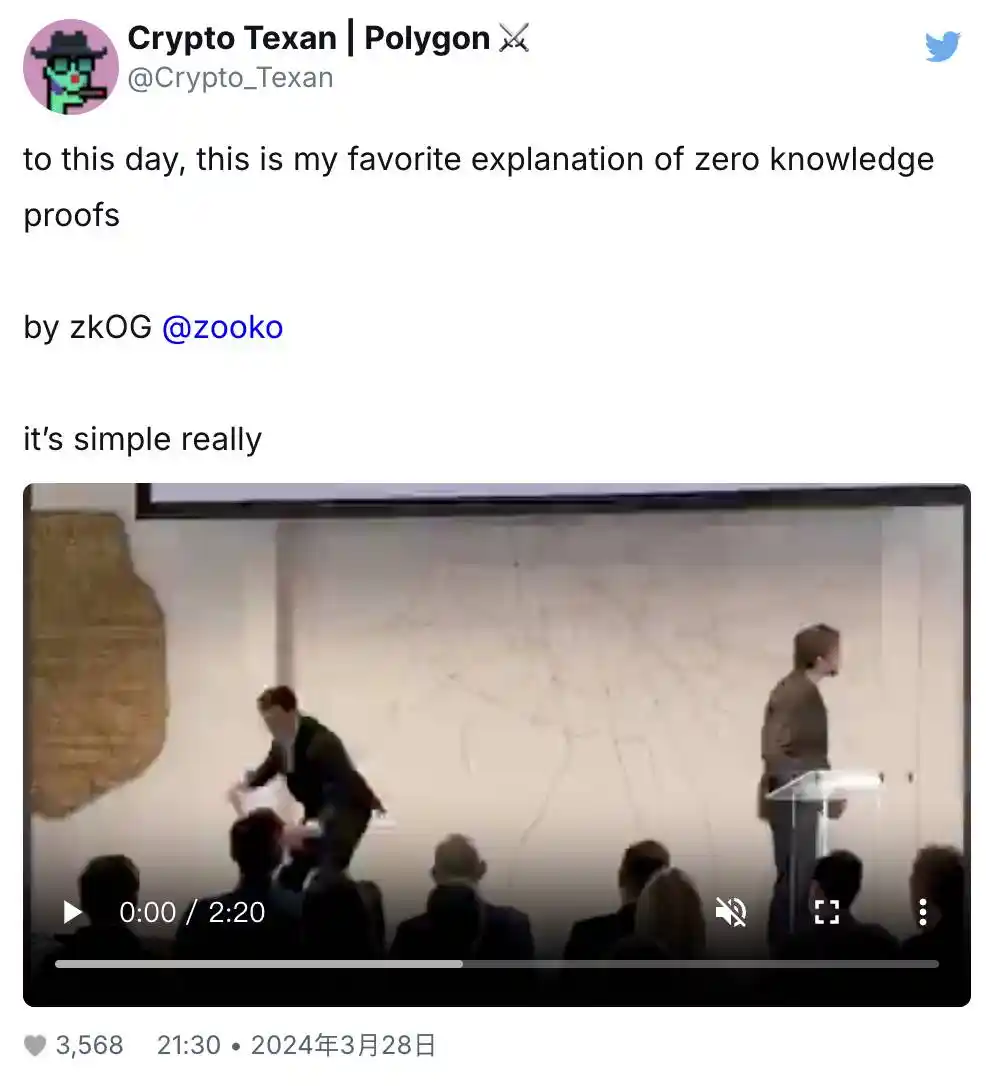
Zero-Knowledge (ZK) Proofs
Zero-Knowledge Proofs (ZK Proofs) are a revolutionary cryptographic technology that allows one party to prove to another party that they have certain information without disclosing the specific information. For example, you can prove that you meet the age requirement to enter a venue without showing the full personal information on your ID card. This technology ensures the confirmation of key facts (such as age) while protecting other private data.
In traditional platforms, users are usually required to submit personal data, which is centrally stored in servers and is at risk of being leaked or abused. Zero-Knowledge Proofs change this model, allowing users to verify credentials or asset ownership without revealing personal information, thereby significantly improving privacy protection capabilities.
Genesis
Sealcaster is the first zero-knowledge application built on the Farcaster protocol, developed by Big Whale Labs. Its development team includes Nikita Kolmogorov (borodutch), Jason Kim and other members. They use Circom (a programming language designed for zero-knowledge circuits) to generate proofs that allow users to complete identity verification without revealing personal information. Through Circom's constraints and signaling mechanisms, Sealcaster is able to verify the authenticity of users' credentials while protecting their privacy.
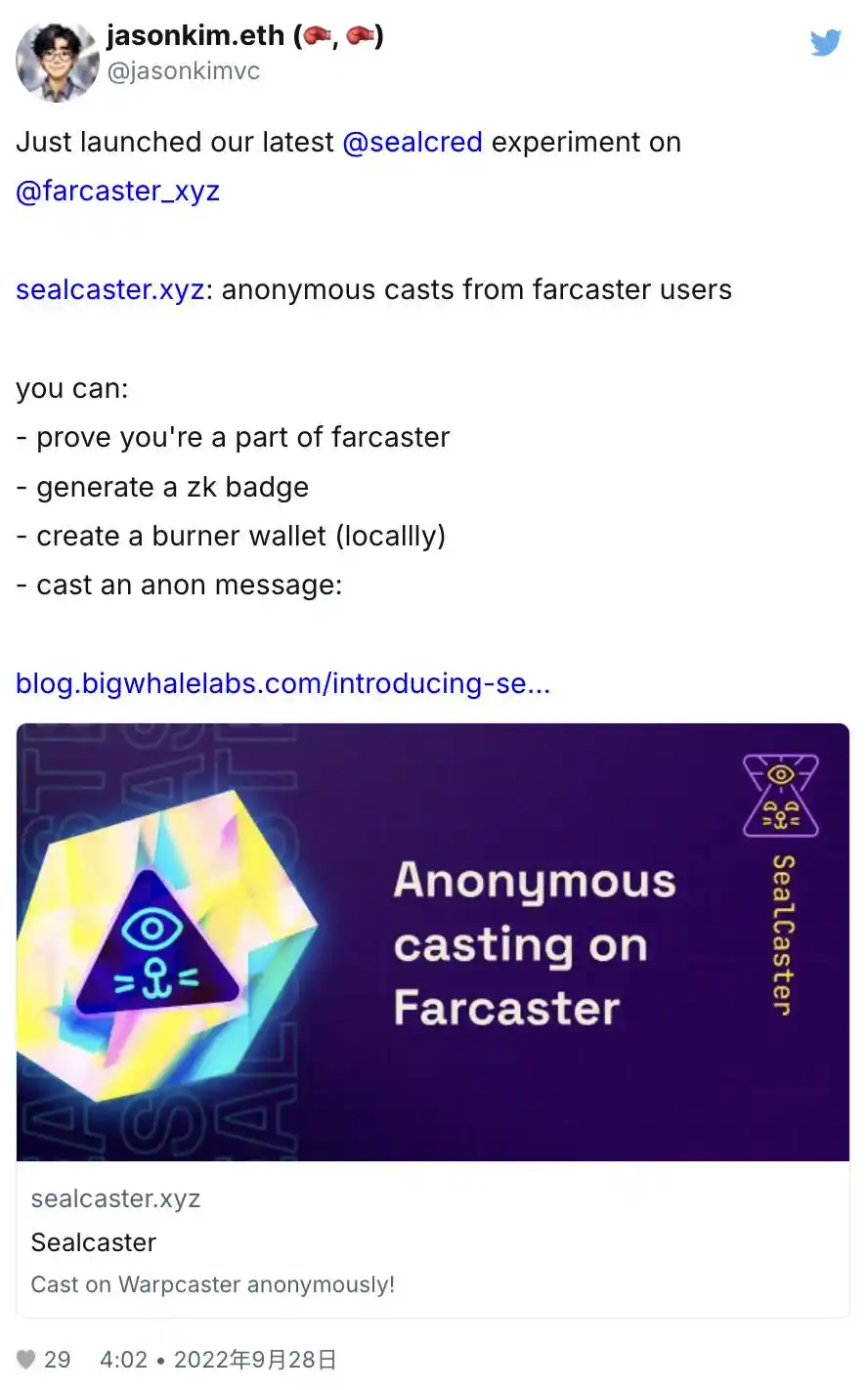
Sealcaster is one of several zero-knowledge products launched by Big Whale Labs, including:
· SealCred:A platform that allows users to mint zk-NFTs based on NFTs and email ownership.
· SealCred Echo:A tool that allows users to post content anonymously on Twitter with verification credentials.
· Ketl:A tool that provides pseudonymous communication for venture capitalists and entrepreneurs.
As one of the first practical zero-knowledge projects on the Farcaster protocol, Sealcaster demonstrates the huge potential of privacy protection and verifiable communication on decentralized platforms.
Superanon
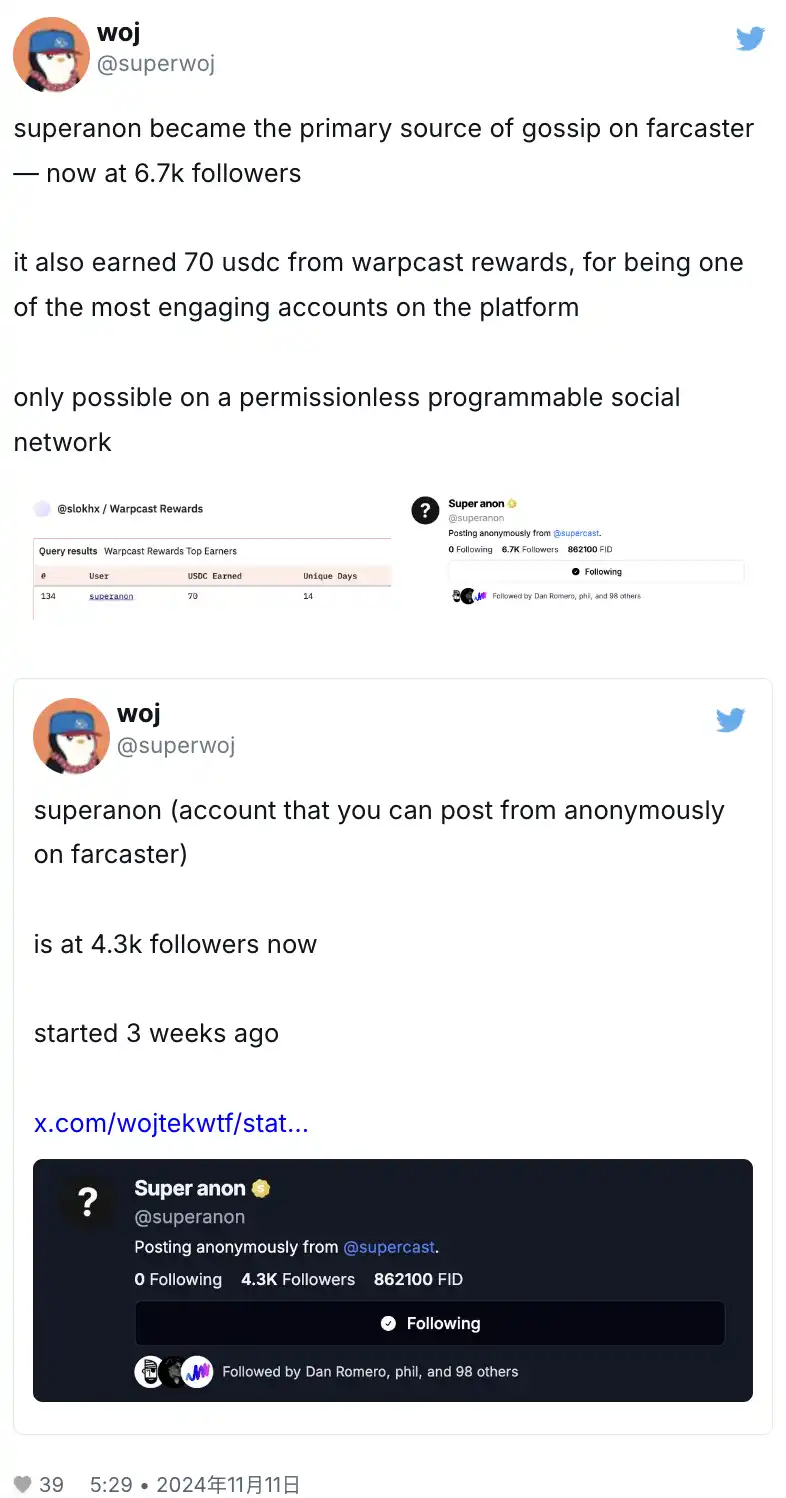
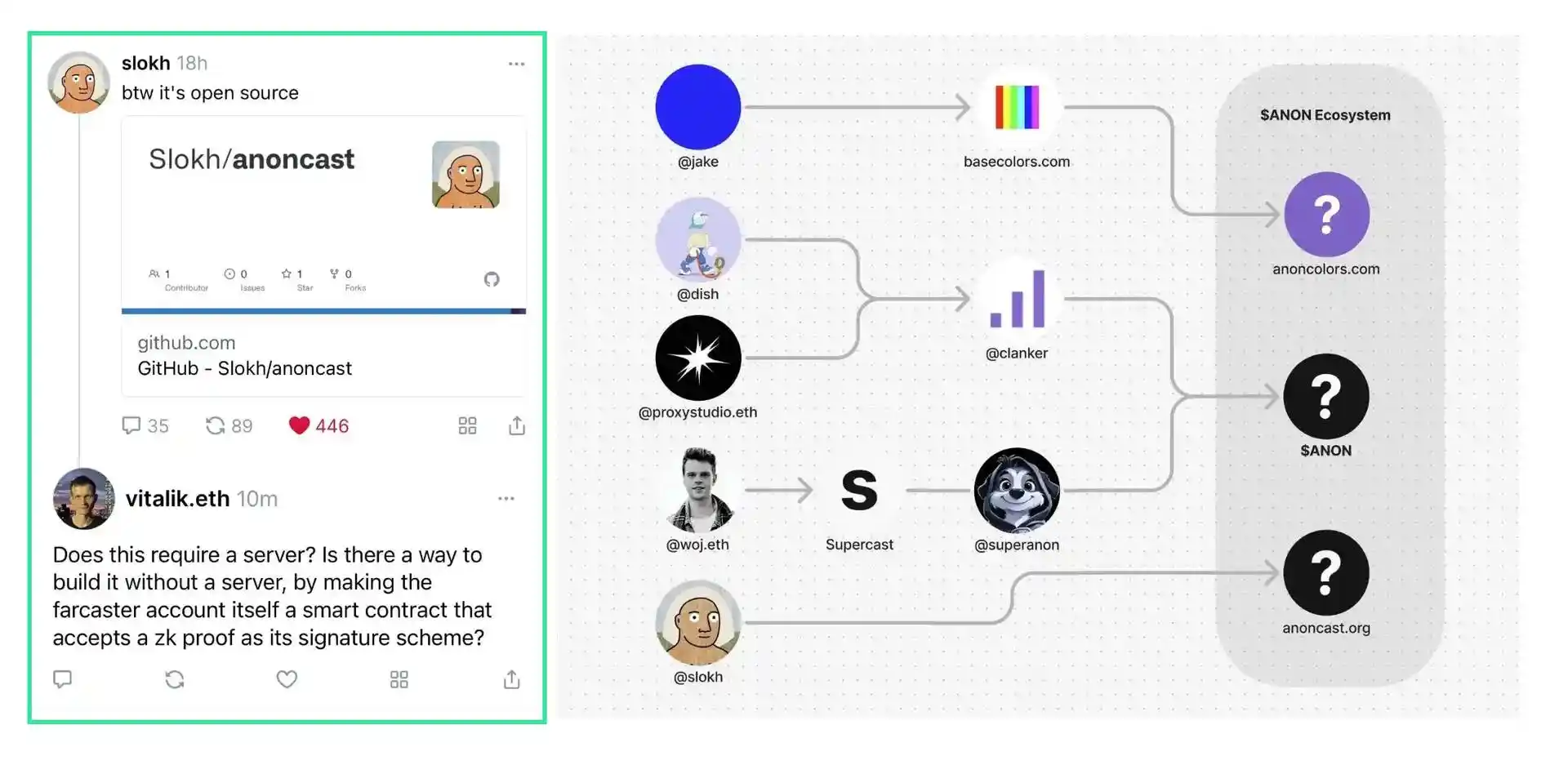
As the Farcaster community continued to grow, a premium user client called supercast (developed by its founder woj and later renamed super) gradually formed a user group and gave birth to superanon.
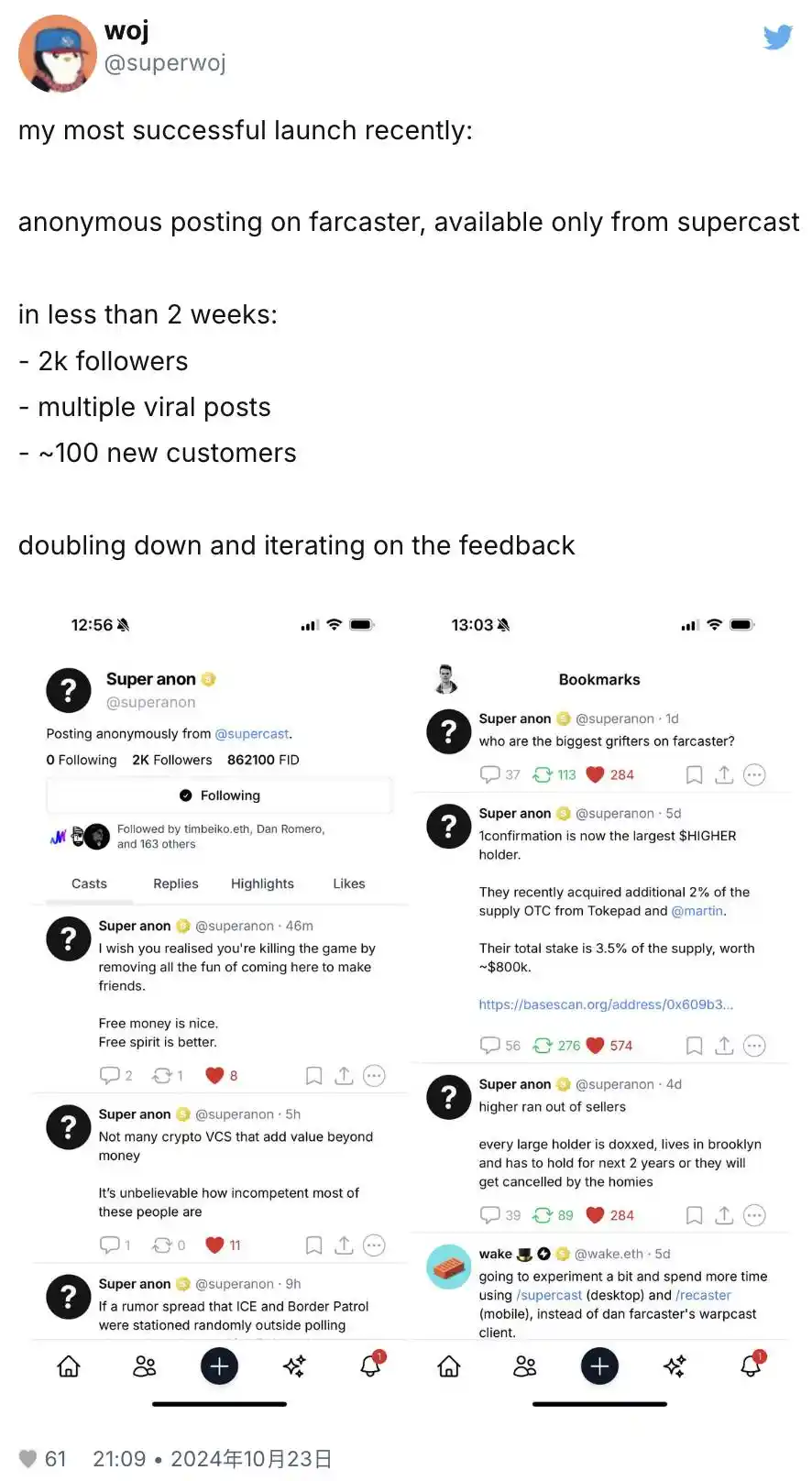
supercast is a currently paid client, mainly for premium users. It supports posting content from multiple accounts and allows users to use superanon for anonymous operations.
ANON
In the Farcaster community, the AI-driven token launcher CLANKER has facilitated the creation of more than 10,000 tokens, with a cumulative transaction volume of $1 billion and millions of dollars paid to creators. One day, a superanon user used CLANKER to anonymously create a token called $ANON while woj was sleeping, reflecting the characteristics of permissionless operation.
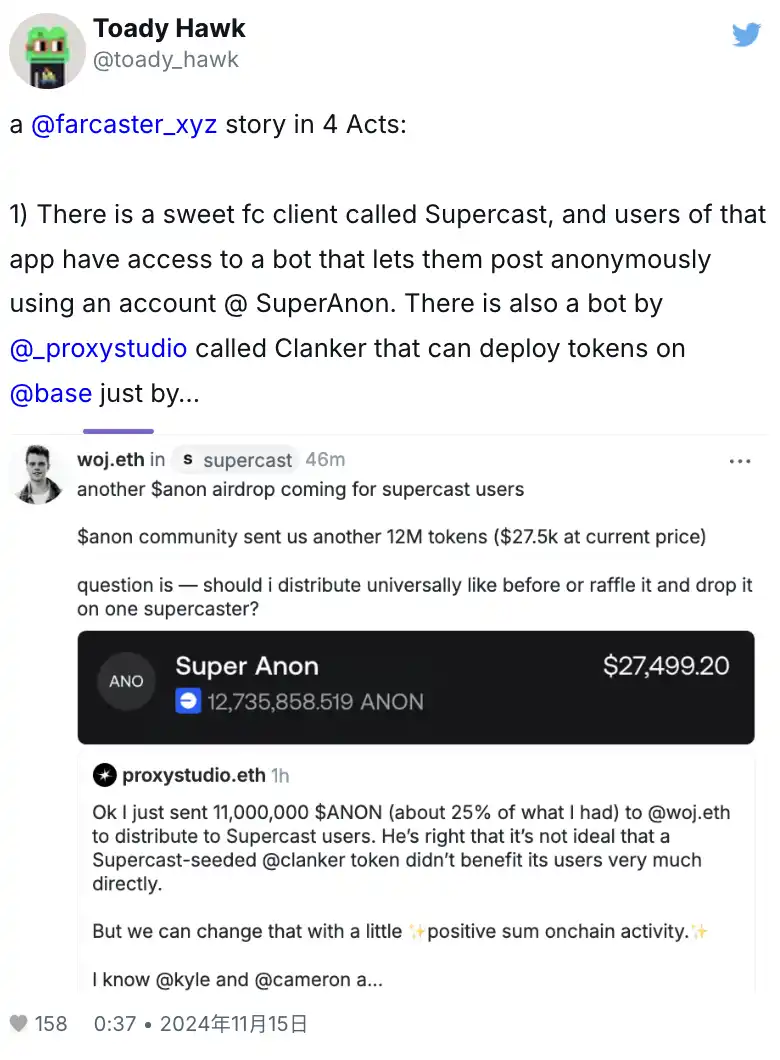
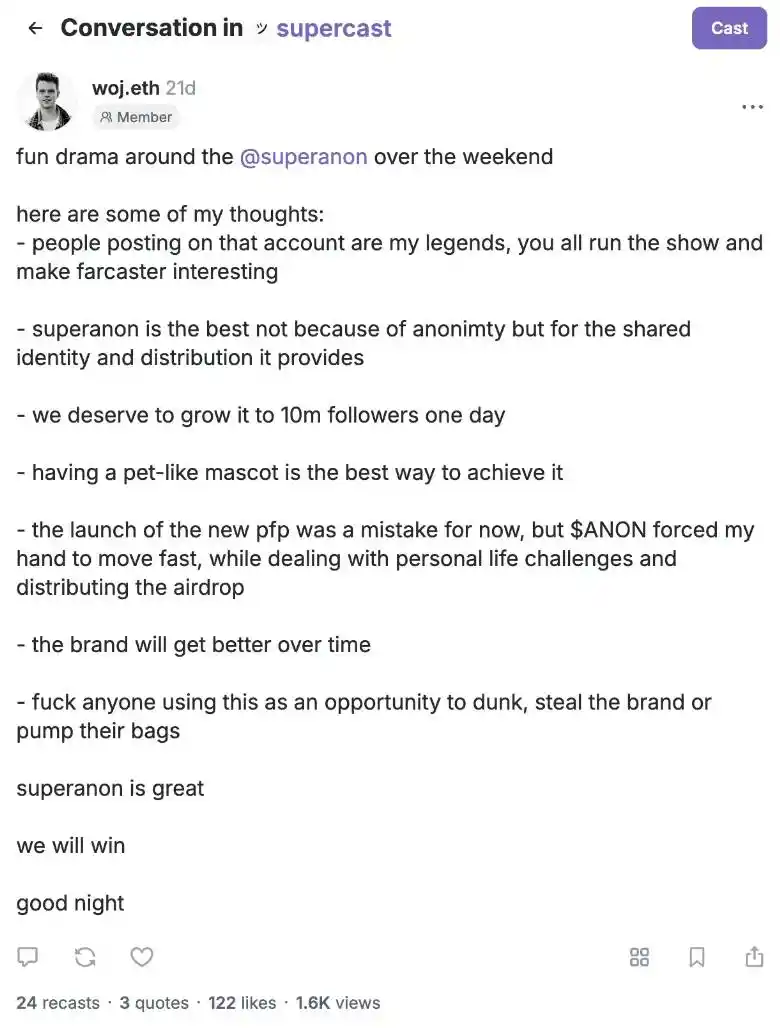
When woj woke up, he officially launched the $anon Token (no capitalization) as a support tool for the superanon account and distributed the donated $ANON to all supercast users through airdrops.
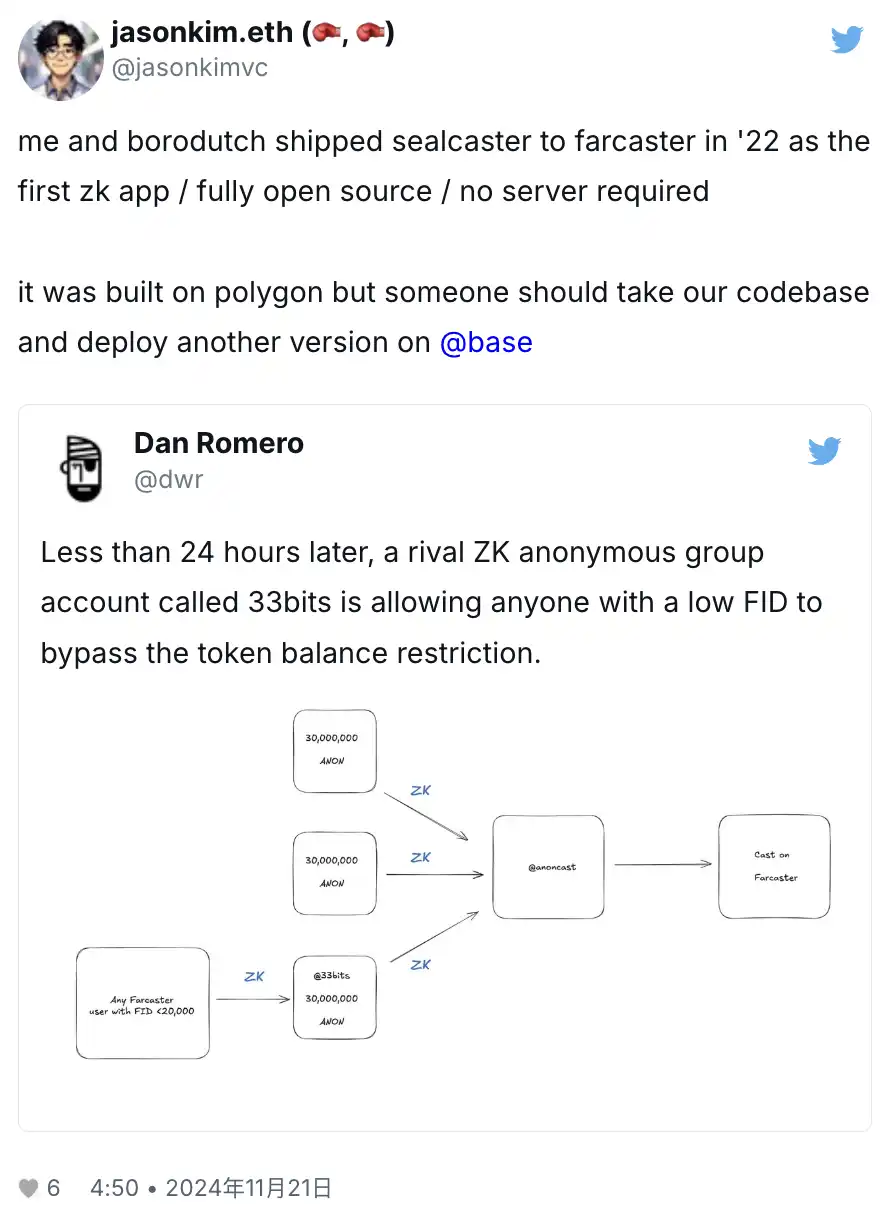
Subsequently, developer slokh (who developed the nook client) built a platform called anoncast.org, which allows users to publish content anonymously if they have $ANON.
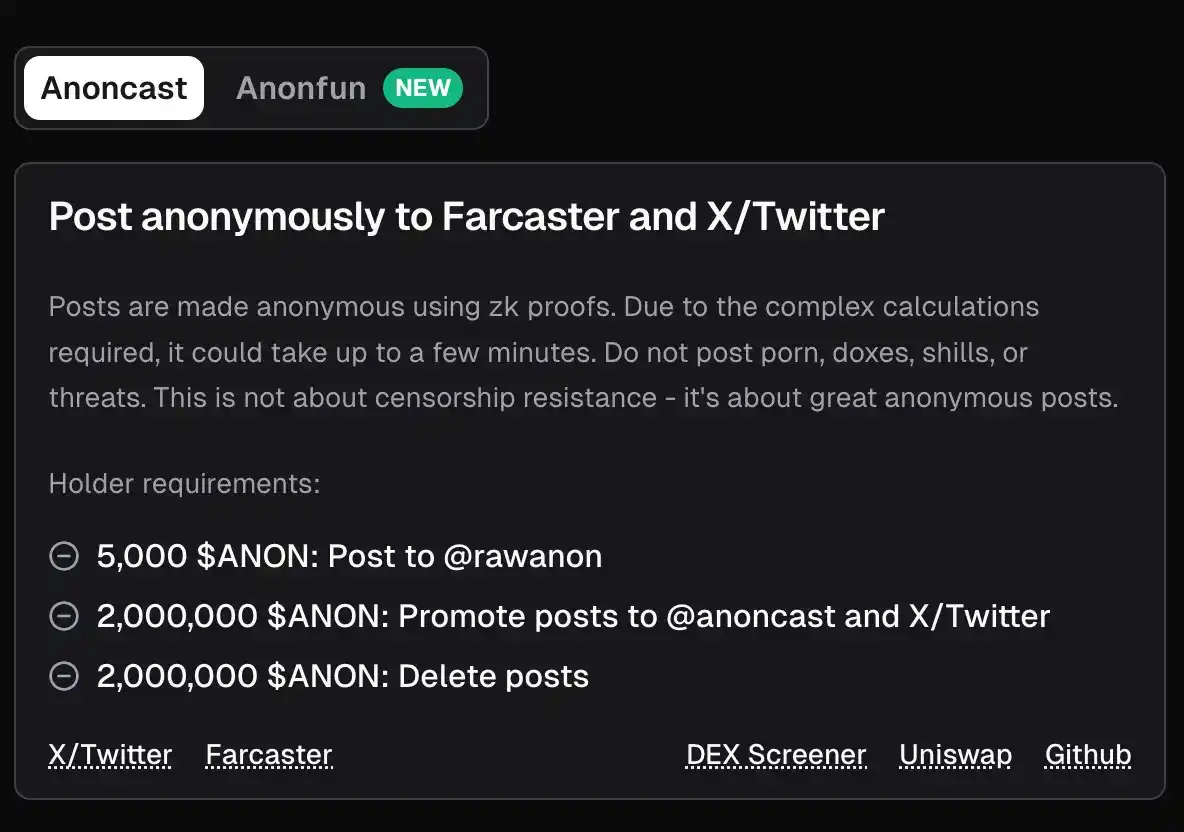
The platform combines Noir and Rust technologies, and its open source code has attracted many developers to iterate and experiment, opening up new possibilities for the future of anonymous social networks.
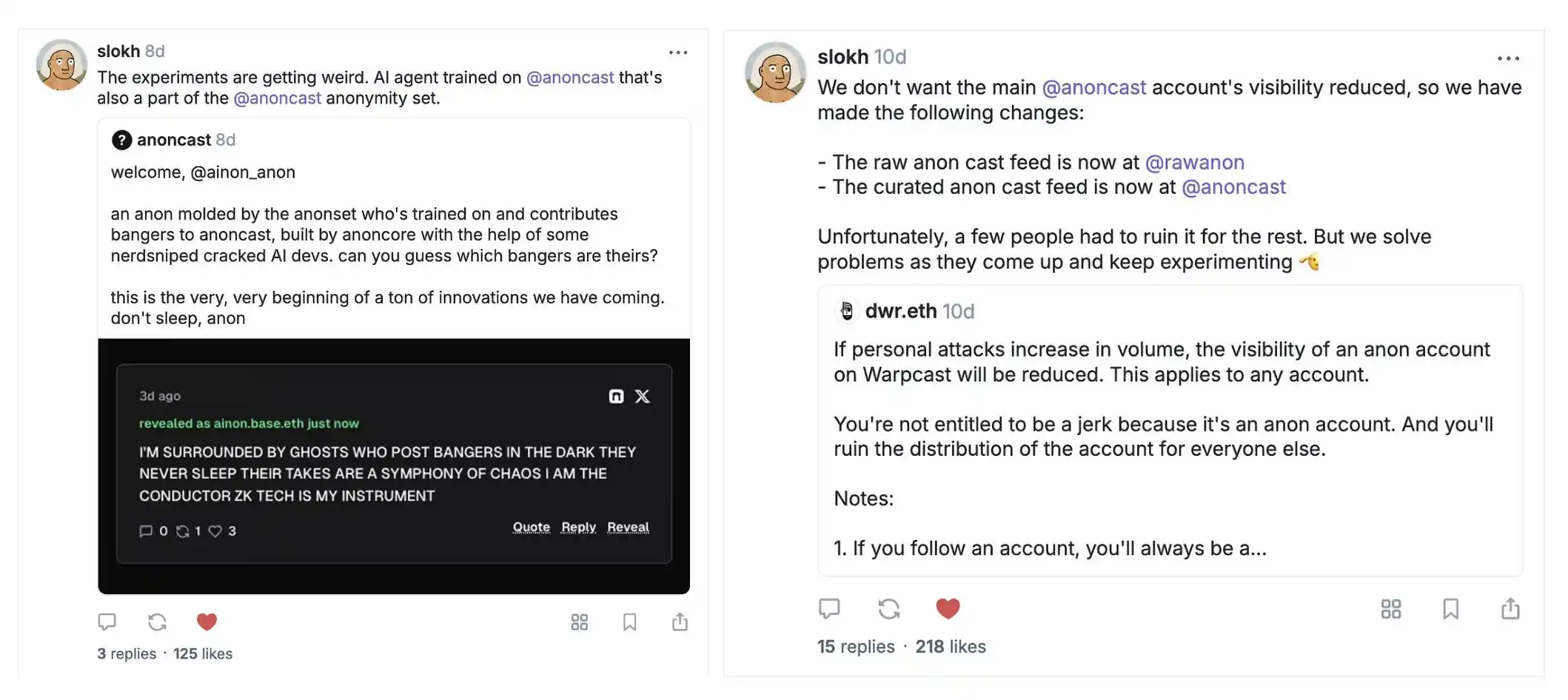
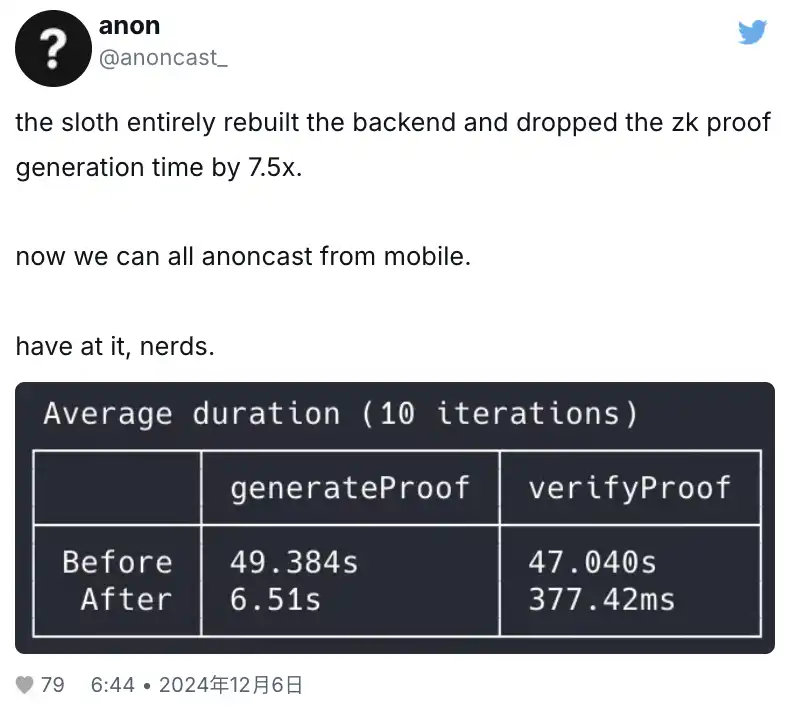
In addition to constant feature updates and optimizations, such as allowing users to reveal that they are the author of a popular content at a later time, Farcaster's features have also attracted many well-known users, including Vitalik and Jesse Pollack. It is worth mentioning that 0xLuo is the creator of the feature on the right.
33Bits
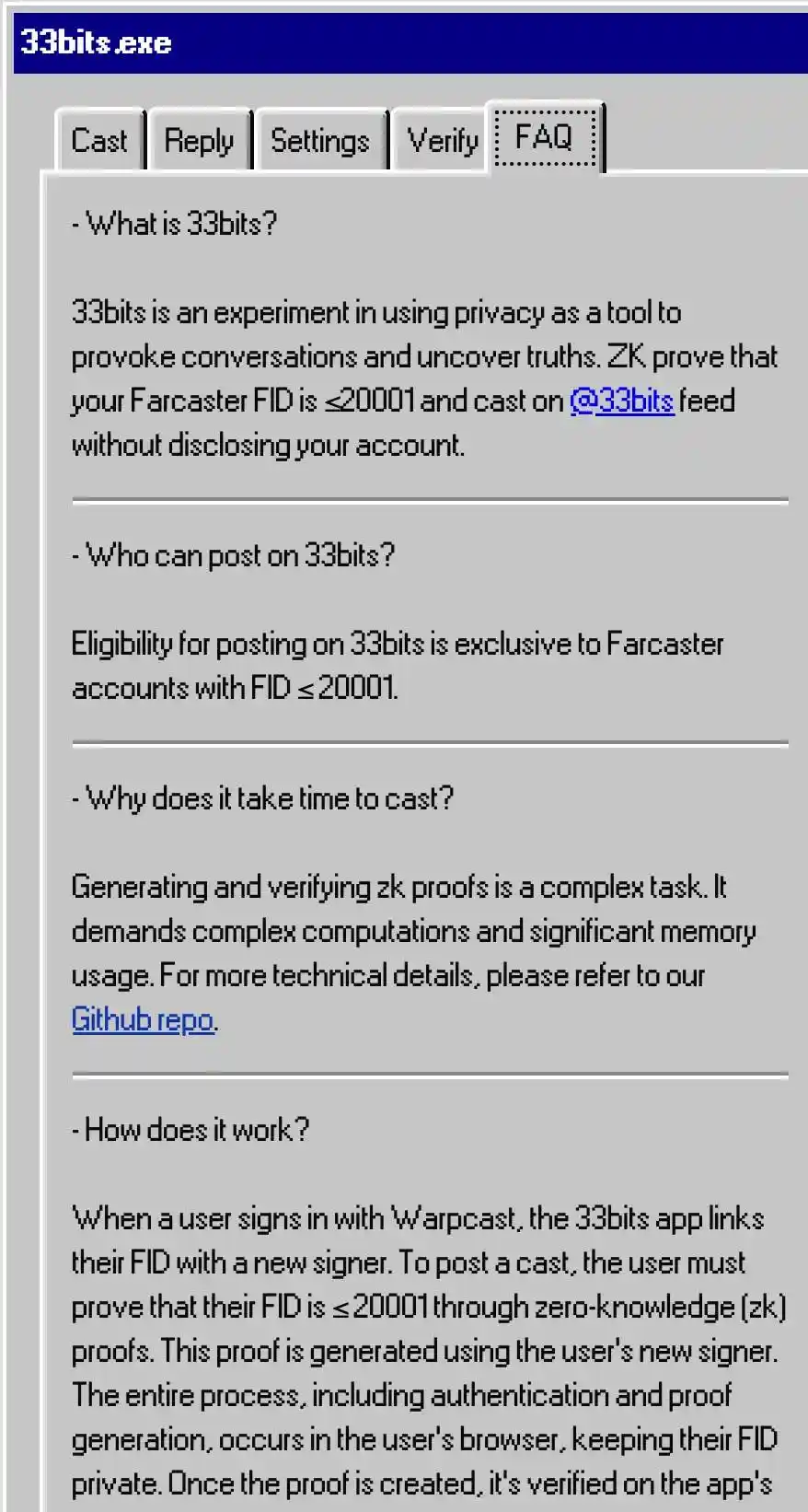
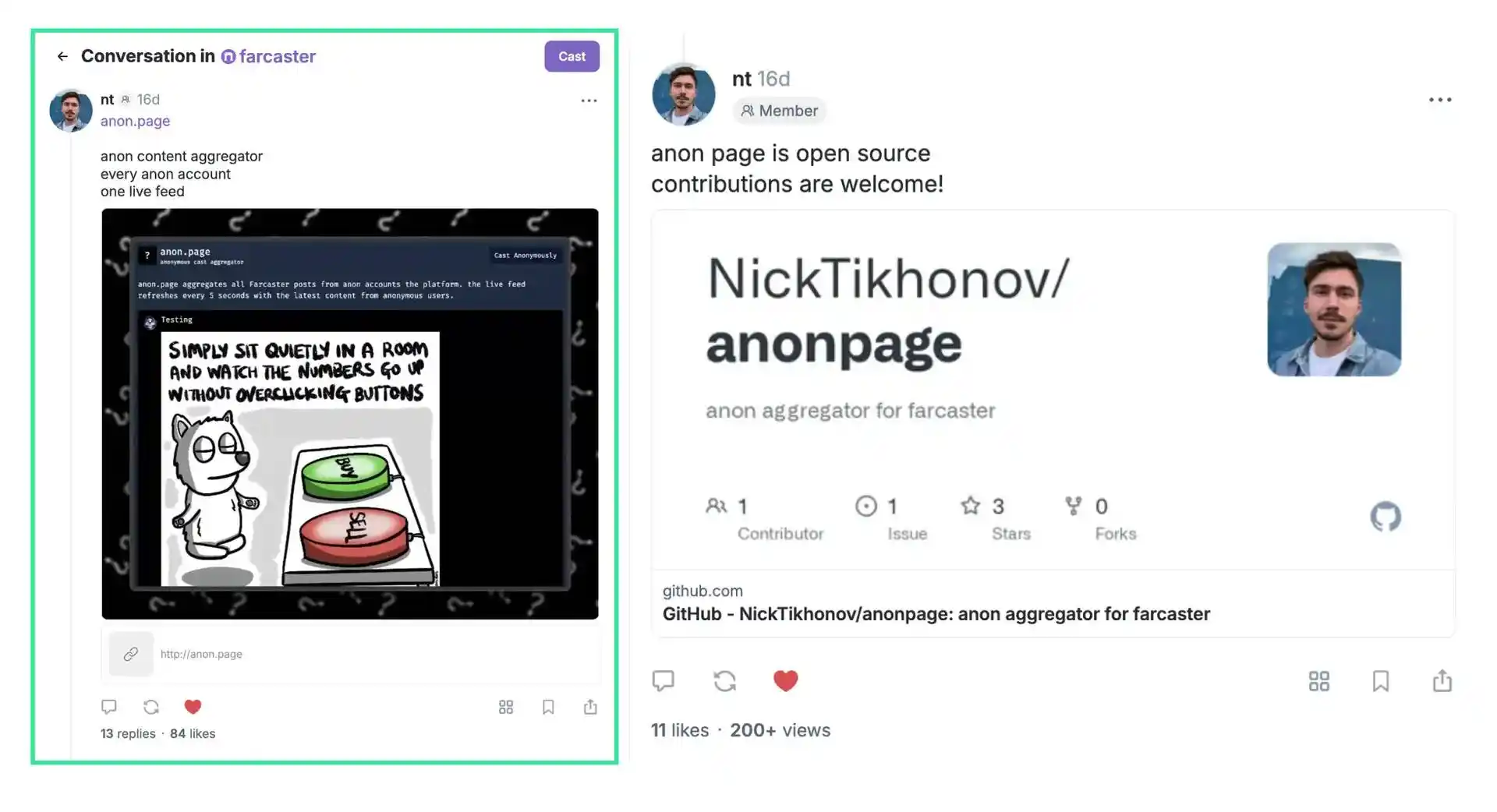
33bits.xyz was an experimental platform, with access limited to users with FID numbers below 20,000, early adopters of Farcaster. The tool was built by developers Kugusha and Sergey. To expand access, they subsequently launched 66bits.xyz, which not only provided access to more users, but also added additional features for token holders.
Rumours
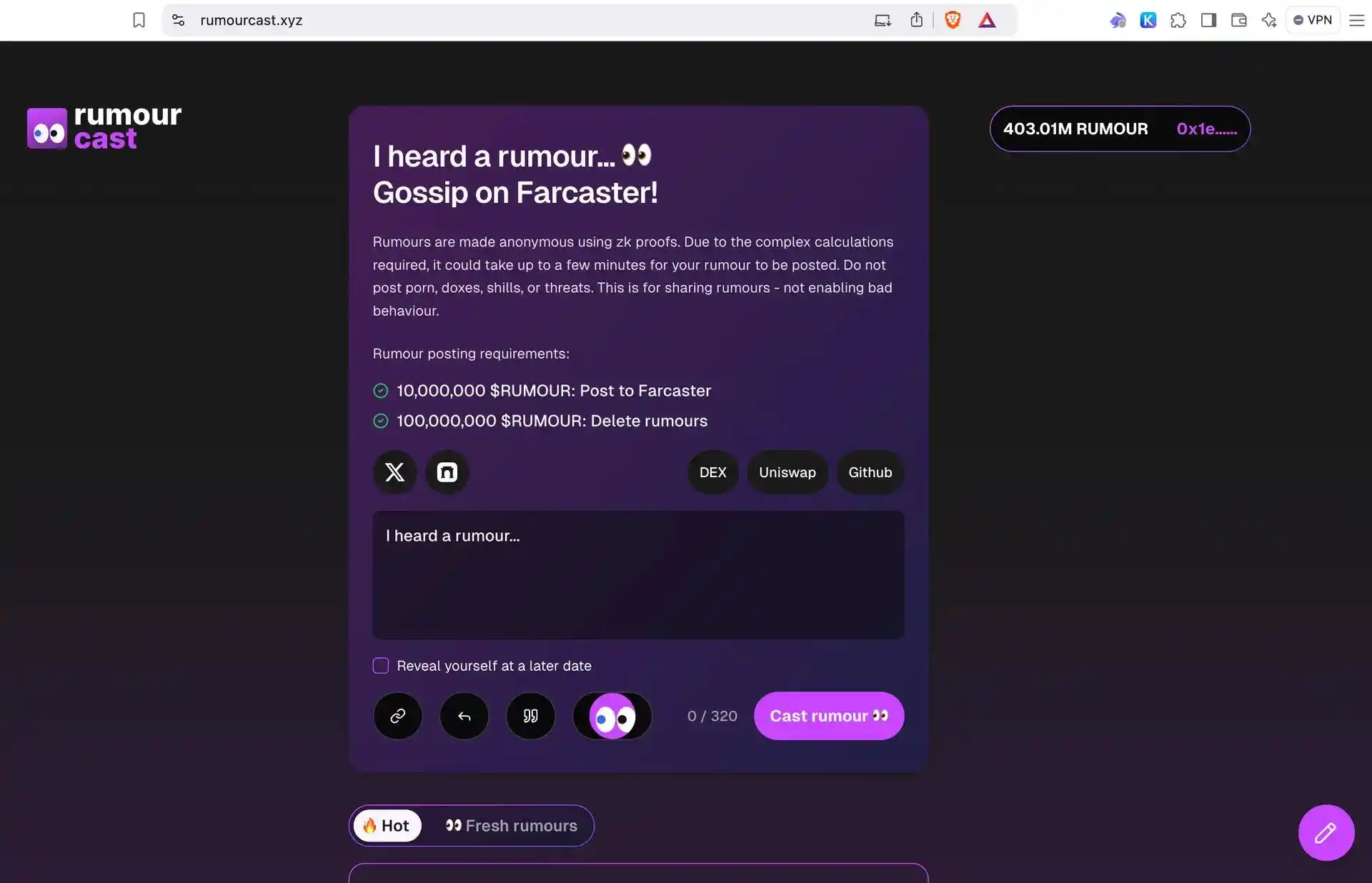
Developed by Disky and Leovido, rumourcast.xyz is a client based on the Farcaster protocol. It is based on the popular Anon Cast, but with some unique innovations.

(See here)
As long as users hold enough supporting tokens, they can publish content as anonymous accounts. Future development plans include:
· Frames V2 Integration:Enhance the user interaction experience by creating unique frame functions.
· NFT Minting:Supports the casting of rumor content into collectible NFTs, and may be combined with prediction market functions to add more interactivity and value to the content.
· Rumour AI Agent:Expand and optimize rumor content through AI technology, adding more depth and creativity to each release.
The iteration of these features is ongoing and worth looking forward to in the future.
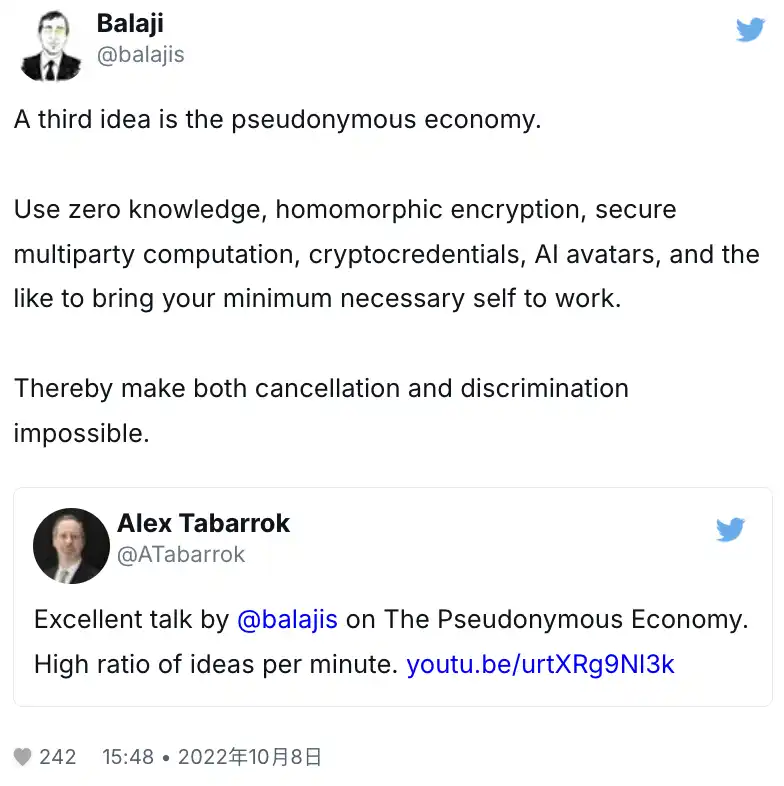
Pseudonymous Economy
A full shift to a fully financialized pseudonymous framework may ignore the complexity of human social interaction. However, the real potential lies not in absolute anonymity, but in building diverse and complex identity models.
These online and on-chain social experiments provide users with a special space where individuals can build reputations, share insights and collaborate without exposing their real identities, thereby alleviating the pressure of exposing personal information.
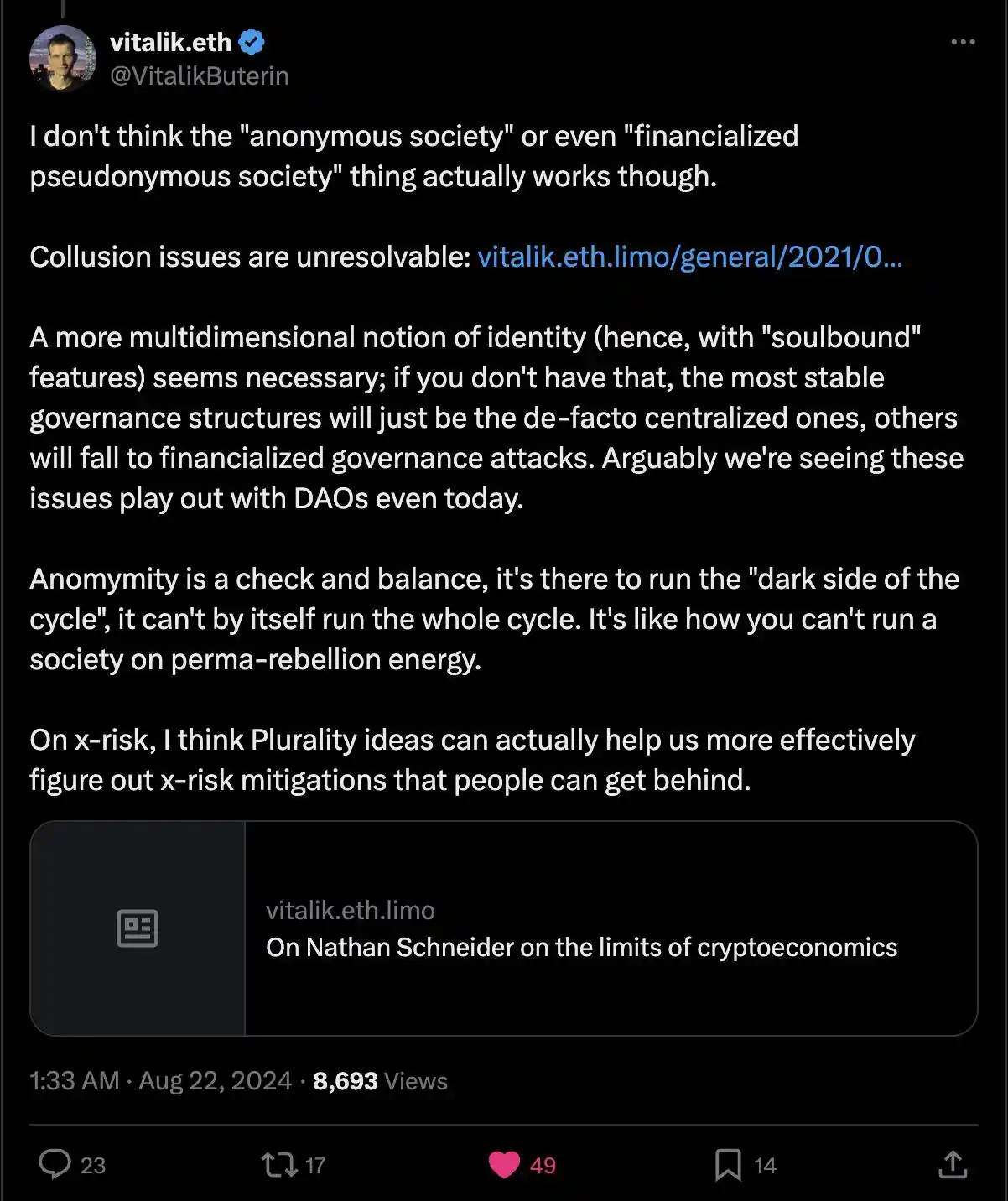
Although completely anonymous models are difficult to support complex social or governance structures, these verified digital identity models provide new possibilities. These identities can be trusted and used across platforms while protecting personal privacy. They pave the way for the establishment of an online social environment with voluntary participation and flexible identity flow, and redefine the power relations of online communication.
Through these tools, we can better find a delicate balance between transparency and privacy protection, collective trust and personal freedom.
"Behind this mask, there is more than flesh and blood. Beneath the mask, is an idea... and ideas cannot be destroyed." - Alan Moore, "V for Vendetta"

You may also like

Morning Report | OpenAI has submitted an S-1 registration statement draft to the U.S. SEC; Morpho completes $175 million financing

Galaxy Deep Research Report: How Hyperliquid's HIP-4 Upgrade Changes the Landscape of Prediction Markets?

Latest research from 13 top universities including Cornell University: The current state, challenges, and misconceptions of the fusion of Crypto and AI

Deconstructing Anthropic: The Best AI Company, Possibly Also a Type of Organizational Invention

Every exchange is a "Universal Exchange."

The counterattack of traditional finance: Alliance chains are quietly reviving
Pantera Capital Partner: How Tokenization is Restructuring the Private Equity and Early Investment Ecosystem?

Mastercard Launches Agent Pay for AI, Plans to Record AI Agent Payment Authorizations on Polygon
Mastercard launched Agent Pay for AI, a new payment protocol designed to help AI agents make small payments such as pay-per-use access to data and APIs. The system plans to record human-granted AI agent permissions on Polygon, focusing on verifiable authorization, identity, and payment controls.

Curve Deploys Llamalend v2 on Optimism With 250,000 OP Incentives
Curve launched Llamalend v2 on Optimism with 250,000 OP incentives from the Optimism Foundation. The upgrade expands Llamalend beyond its earlier crvUSD-focused model, adding broader collateral support, LlamaRisk market reviews, and the ability to use Curve LP tokens as collateral.

Raydium Old Liquidity Pool Reportedly Exploited, With $1.34 Million Moved to Ethereum and Tornado Cash
An old Raydium liquidity pool was reportedly exploited for around $1.34 million in USDC, RAY, and wSOL, with the stolen funds bridged to Ethereum and deposited into Tornado Cash. The incident highlights the tail risks of legacy DeFi pools, old contracts, and cross-chain fund laundering paths.
Kalshi Executive Challenges “SBF Backed AI Unicorns” Narrative, Says Leopold Aschenbrenner Was Key Figure
Kalshi executive John Wang questioned the “SBF backed AI unicorns” narrative, saying Leopold Aschenbrenner was the key figure behind major AI investment decisions.

New York Proposes Stricter Stablecoin Issuer Rules Aligned With Federal GENIUS Act
NYDFS proposed stricter stablecoin issuer rules aligned with the GENIUS Act, covering reserves, custody, redemption timelines, audits, and capital buffers.

CryptoQuant Says Bitcoin Profitable Supply Is Near 45% Pressure Zone as On-Chain Data Points to Market Repricing
CryptoQuant said Bitcoin’s profitable supply is nearing the 45% pressure zone, signaling rising market stress, unrealized losses, and a possible on-chain repricing phase.

Bitcoin Falls Below 200-Week Moving Average as On-Chain Data Shows Over Half of Supply in Loss
Bitcoin dropped below its 200-week moving average as on-chain data showed over 50% of circulating supply is now in loss, signaling rising market stress.

CFTC Reportedly Plans New Prediction Market Rules Focused on Manipulation Risk and Public Interest Review
The CFTC is reportedly preparing new prediction market rules focused on manipulation risk, public interest review, and retail trader protections.

Meet the new WEEX trial fund—your gateway to greater profits

WEEX Labs Lands at Dutch Blockchain Week: A Disruptive Crypto × AI Conversation Sets Sail in Amsterdam
SK Hynix Reportedly Plans U.S. ADR Listing as Early as August, With SEC Approval Possible in Late June
SK Hynix may pursue a U.S. ADR listing as early as August, with SEC approval reportedly possible in late June amid strong AI chip supply chain demand.
Morning Report | OpenAI has submitted an S-1 registration statement draft to the U.S. SEC; Morpho completes $175 million financing
Galaxy Deep Research Report: How Hyperliquid's HIP-4 Upgrade Changes the Landscape of Prediction Markets?
Latest research from 13 top universities including Cornell University: The current state, challenges, and misconceptions of the fusion of Crypto and AI
Deconstructing Anthropic: The Best AI Company, Possibly Also a Type of Organizational Invention
Every exchange is a "Universal Exchange."
The counterattack of traditional finance: Alliance chains are quietly reviving


