
Political Passion in the Trump Era: Where to Rebuild After the Destruction?
Original Article Title: This thing will fail
Original Article Author: Noah Smith
Translated Article: Block unicorn

“Men don’t care what’s on TV. They only care what else is on TV.” —Jerry Seinfeld
N.S. Leons is a popular essayist in the "national conservative" tradition. His Substack, "The Upheaval," is recommended reading, although I disagree with less than half of what he writes. But he is well-read, broad-minded, able to integrate information from multiple fields, and unafraid to think deeply about historical questions in real time. Reading his work will help you understand the beliefs of the modern right. On many issues, his information is urgently needed by people in the MAGA world.
In a recent article titled "America's Mighty God," Leons pointed out what I think is a profound truth of our current historical moment. He wrote, "The long 20th century is over, a period defined by liberalism (social, political, and economic), anchored in the rejection of Adolf Hitler:
I believe what we are seeing today is indeed the end of an era, a epochal upheaval of the world we know, the full meaning and impact of which has not yet truly touched us.
More specifically, I believe Donald Trump marks the belated end of the "long 20th century"...
Our "long 20th century" got off to a late start, not fully solidified until 1945, but in the following 80 years, its spirit dominated our civilization's entire understanding of the world order and its rightful face...After the terror of the Second World War, the leadership of America and Europe naturally made 'never let history repeat itself' the core of its ideological system. They were determined, together, never to let fascism, war, and genocide again threaten humanity...
The anti-fascism of the 20th century evolved into a great crusade...By making 'never let history repeat itself' the ultimate priority, the ideology of the open society placed the 'greatest evil' (summum malum) at the core, rather than the 'highest good' (summum bonum). This unique figure of Hitler not only lurked in the depths of 20th-century thought; he also dominated people's subconscious, becoming a secular Satan...As René Girard mockingly called it, this 'Adolf Hitler's second profession' provided a quasi-religious justification for the open society consensus and the entire post-war liberal order: to prevent the resurrection of the immortal leader...
The “Long Twentieth Century” was characterized by three interrelated post-war projects: the gradual opening of society through the deconstruction of norms and boundaries, the consolidation of the managerial state, and the hegemony of a free international order. It was hoped that these three projects could together lay the foundation for ultimately achieving world peace and harmonious coexistence of all humanity.
Like all great articles, this article is somewhat hyperbolic. The post-war American-led liberalism was not a purely defensive project. The motivations behind the United Nations Charter and the Universal Declaration of Human Rights were not fueled by a fear of Hitler’s return but by a desire to extend the boundaries of human freedom and dignity to unprecedented levels. Ronald Reagan did not need Hitler as a bogeyman to promote his vision of American freedom but rather saw it as a universal ideal.
However, in some important sense, Lyons is correct. The shocking terror and spectacular failure of the Hitler regime provided a moral anchor for liberals, allowing them to always invoke a larger liberalism based on this. Advocates of the Civil Rights Act in the United States and other liberalizing laws often used Nazi Germany as a rhetorical foil. Anti-communism briefly provided another Satan for the right, but its influence was never quite the same, as the U.S. had been Stalin’s ally in World War II; anti-communism was soon forgotten after the Soviet Union's collapse, but Hitler and the Nazis were not.
Lyons is right in saying that the Trump era marked the end of Hitler as the Western cultural “evil”—at least in the U.S. The two most popular media personalities on the American right, Joe Rogan and Tucker Carlson, invited Daryl Cooper—a historical revisionist who downplays Nazi atrocities and considers Winston Churchill the real villain of World War II—to speak on their shows. Here is a (now-deleted) tweet from Cooper for reference:

This tweet, I believe, showcases the mindset of the American right. It is wrong to say that the Trump movement or modern national conservatism represents full-throated support for Nazism. However, it is undisputed that the American right believes that “awokeness” poses a greater threat than the potential return of Hitler.
Why has the legend of Hitler lost its terror? There are several reasons. The generation that defeated the Nazis has largely passed away, meaning that for most Americans, Hitler is just a character in movies and books; like Tamerlane or Genghis Khan, over time, the fear of a mass murderer has gradually faded. The Palestinian movement effectively removed Jews from the list of minority groups protected by the left, those whose rights might be defended through riots. Social media has led to an overuse of the “Nazi” label, giving rise to the popular saying “everyone I don’t like is Hitler.”
Leontes's attitude toward this transformation is far more optimistic than mine. Personally, I think demonizing Hitler is a good idea. As a general moral principle, "don't be Hitler" does indeed seem quite reliable. Even if you only care about the strength of Western civilization, someone who, out of ideological motivations, initiated military actions, led to the end of the European global empire, massacred over 20 million Slavic people, ended Germany's great power status, and solidified Soviet control over half of Europe, seems like a case to be avoided.
But Leontes believes that the end of anti-Nazi-ism as a guiding Western principle will pave the way for the return of morality, community, roots, faith, and civilizational pride—things conservatives like:
Highly influential liberal thinkers such as Karl Popper and Theodor Adorno helped convince the post-war ideologically compliant establishment that the fundamental source of authoritarianism and conflict in the world is the "closed society." This society was marked by characteristics that Reno calls the "god of the strong": strong beliefs and truth claims, strong moral codes, strong interpersonal bonds, strong community identities and connections to place and the past—ultimately, all these "objects of human affection and loyalty… are the source of a community's passions and loyalties."
Now, the unifying power of the god of the strong is seen as dangerous, a hellish source of fanaticism, oppression, hatred, and violence. Bonds of faith, family, and especially meaningful national identity are now seen as suspicious and worrisome regressive temptations leading back to fascism…
The open society consensus and its flimsy divinities have not produced a utopian world of peace and progress but rather led to the disintegration and despair of civilization. As expected, the god of the strong in history was exiled, religious traditions and moral norms were laid bare, community bonds and loyalties weakened, distinctions and boundaries dismantled, autonomous disciplines handed over to top-down technocratic management. It is hardly surprising that this has resulted in a lack of cohesion in nation-states and wider civilizations, let alone the ability to resist external threats from closed, delusional societies. In short, the radical self-denial movement pursued by the post-war open society consensus has effectively become a collective suicide pact for Western liberal democratic nations.
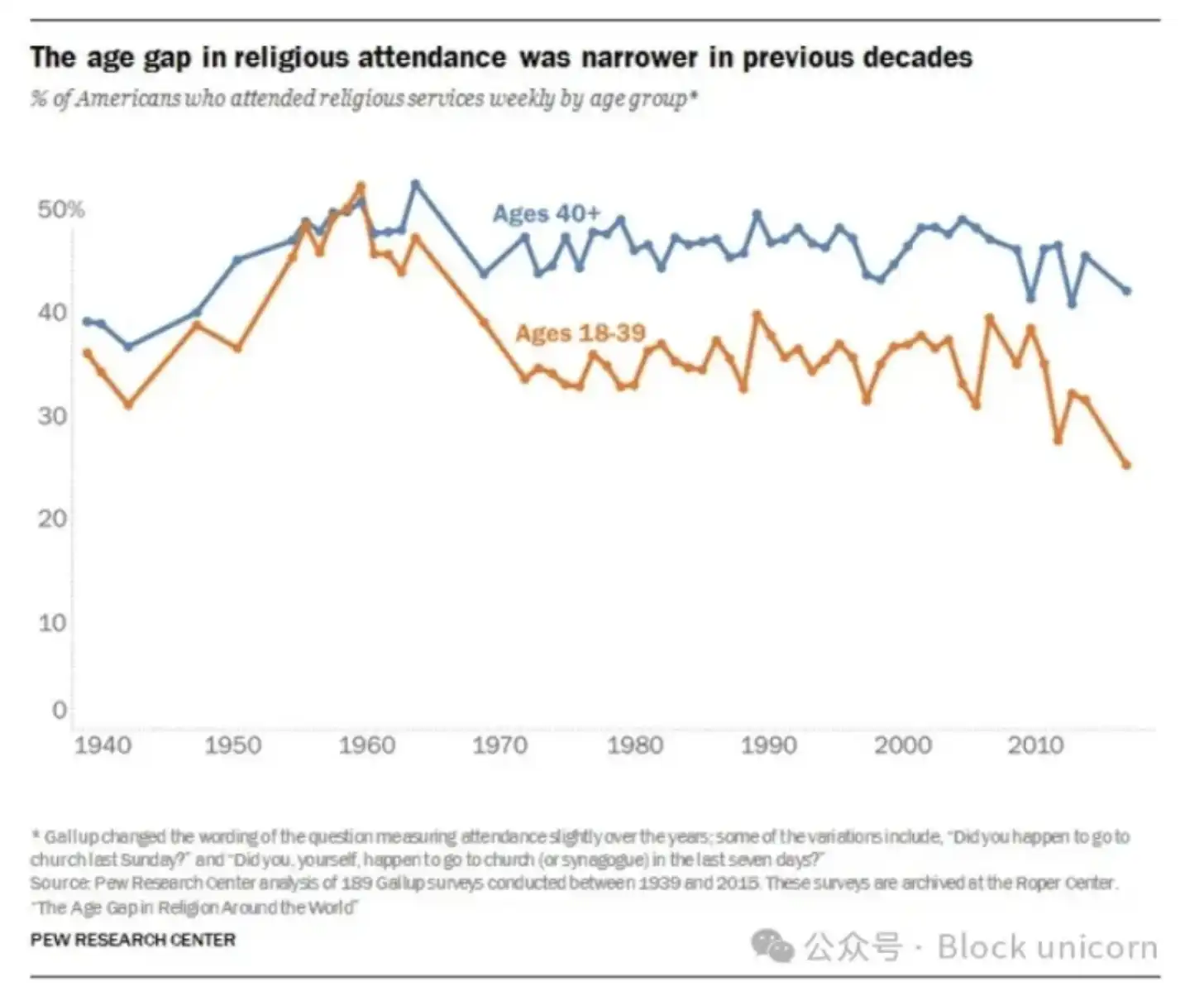
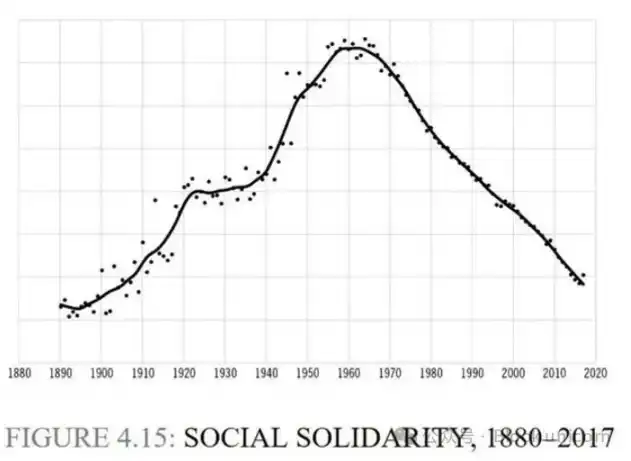
I'm not entirely sure if Leontes's interpretation of history is correct. After all, as Robert Putnam documented in his book "Bowling Alone," the post-war decades in America witnessed the largest surge in church attendance, civic engagement, family formation, and social cohesion since the early days of the Republic. Here are the data on church attendance, which skyrocketed after World War II and remained high especially among those over 40 in the 2010s:
Here is Putnam's index of social capital, combining measures of civic and religious engagement along with family formation:
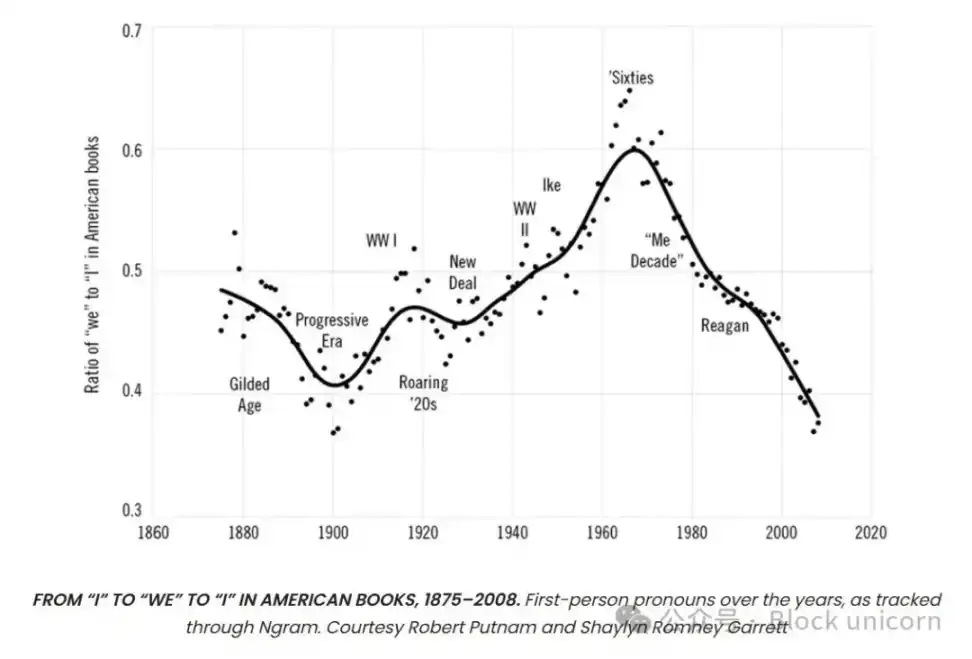
The New Deal and the post-war period even witnessed a substantial growth in the use of the word "we" over "I" in American books:
The "god-like figure" has never been as potent as in the American generation that grew up listening to Roosevelt preach liberalism on the radio and continued to grind Adolf Hitler into the dust. From the unified struggle of World War II to the subsequent great American unity, a causal line is not difficult to draw.
The greatest generation wholeheartedly believed that Hitler was Satan on Earth. But they did not see the need to crush family, community, and tradition to preserve an open society. In fact, their society was both open and deeply rooted. My grandparents knew the name and life story of every neighbor until the day they died; how many "national conservative" intellectuals and die-hard Trump fans can say the same?
Nevertheless, the American "god-like figure" did eventually fade. Lions believes that Trump is bringing them back:
Mary Harrington recently observed that the Trumpian revolution seems both political and archetypal, noting that the widespread "excited response" among men to Elon Musk and his "young tech-bro cadre" recent work reflects a phenomenon that can be "understood from an archetypal perspective as their engaging in combat with a vast, fog-like enemy with the objective of destroying male heroism itself" when breaking down the entrenched bureaucratic system. This masculine-tinted spirit of "thymotic vitality" was suppressed throughout the "long 20th century," but now it is back...
Today's populism is... a long-suppressed desire for thymotic aspiration, a desire to take the actions that should have been taken long ago, to break free from the suffocating lethargy brought about by proceduralism, and to fight passionately for collective survival and self-interest. This is politics returning to politics. It demands a restoration of ancient virtues, including a vital sense of the nation and civilization's self-worth...
This is what Trump, with all his ruggedness, represents: the powerful deity has escaped exile and returned to America... Trump himself is a man of action, not of contemplation... he... is the embodiment of the entire rebellious new world spirit that is overturning the old order... The boldness of Trump's actions reflects not only partisan political gamesmanship—it represents the overturning of the old paradigm; now "you can just get things done."
Here, the term "thumotic" refers to Harvey Mansfield's use of the Greek word "thumos" to denote a political passion and drive. Francis Fukuyama spells it as "thymos" and as early as 1992 predicted that Donald Trump could be the perfect embodiment of the "thumotic" impulse of Americans to dismantle the liberal establishment.
Therefore, Leonhardt sees Trumpism as a reassertion of a wild, unapologetically male-driven force in the style of "Fight Club" — just different from Tyler Durden in that while he directed it towards anarchy, Leonhardt sees Trump and Musk indulging in their masculine fervor in dismantling the bureaucratic system.
Yet Leonhardt never specifically explains how this destructive impulse would bring about the return of the "strongman" he desires. He views the bureaucratic system and other post-war American institutions as obstacles to revival — foundations of family, community, and faith — but he never truly moves beyond the shattering of these so-called barriers to envision actual rebuilding. He simply assumes it will happen naturally or considers it a future problem.
I believe he will be disappointed. Trump's movement has existed for a decade now, and during this time, it has built nothing at all. There are no Trump Youth. No Trump community centers, Trump neighborhood associations, or Trump business clubs. Trump supporters have not flocked to traditional religion either; while Christianity's decline halted since the pandemic, feelings of Christian identity and church attendance remain well below levels seen at the turn of the century. Republicans still have more children than Democrats, but red-state birth rates are also declining.
In Trump's first term, right-wing efforts to organize civic engagement were almost laughably sparse. A few hundred "proud boys" gathered, brawling with antifascists on the streets of Berkeley and Portland. There were some smaller right-wing anti-lockdown protests in 2020. About two thousand people participated in the January 6th riot — mostly middle-aged. None of these formed the kind of enduring grassroots organizations common in the 1950s.
For a few, Trump's first term was a live-action role-playing game; for others, it was just a YouTube channel.
And what about Trump's second term to date? Nothing at all. Even rally attendance has sharply declined. National conservatives who might have gone out in 2017 to meet up are now curled up alone in their living rooms, flipping between X, OnlyFans, and DraftKings, throwing punches in the air when they read about Elon Musk and his tech-nerd squad firing employees or Trump cutting aid to Ukraine. "You can just get things done," yet hardly any of Trump's supporters are actually doing anything, except passively cheering for their team in name only. Unless you are one of the few geeks helping Musk dismantle the bureaucracy, this "vision" is entirely secondhand.
You see, the MAGA movement is an online phenomenon. It is another vertical online community — a group of disconnected, atomized individuals weakly connected over vast distances through the illusory bonds of ideology and identity. It has no sense of family, community, or rootedness to a place. It is a digital commodity. It is a subforum. It is a fan club.
N.S. Léonce and the National Conservatives completely misunderstand the reasons why America abandoned its roots, community, family, and faith. We didn't abandon these "strong gods" because the liberals were too harsh on old Adolf (Hitler). We abandoned them because of technology.
In the 1920s, America saw a surge in widespread prosperity along with the emergence of technology that granted individuals unprecedented autonomy and control over their physical location and access to information. The ownership of cars allowed Americans to travel anywhere, anytime, freeing them from their ties to specific locations. Telephone ownership enabled people to communicate over long distances. Television and radio exposed them to new ideas and cultures, while the internet exposed them to even more.
Then came social media and smartphones. Suddenly, "society" no longer meant the people in your physical surroundings—your neighbors, coworkers, workout partners, and so on. First, "society" turned into a group of avatars typing messages to you on a small glass screen in your pocket. Your phone became the place where you met and conversed with friends and loved ones, as well as where you argued about politics and ideas. People's roots shifted from physical space to digital space.
Increasing evidence indicates that smartphone-enabled social media is linked to isolation and alienation, loneliness, declining religious belief, decreased family formation, and reduced birth rates. The technologies of the 20th century—cars, phones, TV, and the internet—made American society somewhat disjointed, but they managed to partially resist and retain remnants of the roots. However, social media enabled by smartphones broke through these final resistance barriers, turning us into free particles floating in the intangible space of memes, identities, and distractions.
Indeed, the mighty gods are more fragile than the new gods made of silicon.
The people who have achieved this feat are more or less the ones N.S. Léonce is now cheering for. Of course, not Elon Musk himself; he only makes cars and rockets. But Steve Jobs, Jack Dorsey, Zhang Yiming, and a large group of entrepreneurs who follow their "grand visions" to pursue immense wealth have built the virtual world that has become our most real home.
I'm not saying what they did is evil. Technology has a way of progressing in an advanced society; if it can be done, it's likely it will be done. No one could have foreseen its downsides. But the ironic part is that N.S. Léonce now believes that the group of people who will usher in a new era of roots and community is the same group that destroyed the old era.
Regardless, yes, this thing will fail because nothing was built up. Yes, every ideological movement assures us that after the old order is completely overturned, a utopia will take its place. Somehow, the utopia never seems to arrive. Instead, the so-called temporary period of pain and sacrifice gets longer and longer, and the ideologues in charge become increasingly enthusiastic about blaming enemies and purging revolutionary foes. At some point, people will see clearly that the promise of utopia was just an excuse to eliminate enemies—the "grand vision" itself has become the purpose.
The former U.S. Treasury Secretary has already told us that the economic pain caused by Trump is just a "detox period." Trump has blamed the stock market drop on "globalists," and Trump's Department of Justice has attributed egg prices to hoarders and speculators. If you can't recognize this storyline, then you must not follow the news or history very closely.
Mere destruction of the old order itself will not create anything. The Visigoths and Vandals built nothing on the ruins of Rome. They indulged in their "greatness," plundered wealth for a while, and then vanished into myth and memory.
Over the past fifteen years, I have watched in dismay as the real-world communities and families I knew in my youth have been torn apart, replaced by a bunch of fictional online identity movements. I am still waiting for someone to figure out how to put society back together — how to do what Roosevelt and the Greatest Generation did a century ago. Watching the MAGA movement, I am pretty sure this is not the answer.
You may also like

Token Cannot Compound, Where Is the Real Investment Opportunity?

February 6th Market Key Intelligence, How Much Did You Miss?

China's Central Bank and Eight Other Departments' Latest Regulatory Focus: Key Attention to RWA Tokenized Asset Risk
Foreword: Today, the People's Bank of China's website published the "Notice of the People's Bank of China, National Development and Reform Commission, Ministry of Industry and Information Technology, Ministry of Public Security, State Administration for Market Regulation, China Banking and Insurance Regulatory Commission, China Securities Regulatory Commission, State Administration of Foreign Exchange on Further Preventing and Dealing with Risks Related to Virtual Currency and Others (Yinfa [2026] No. 42)", the latest regulatory requirements from the eight departments including the central bank, which are basically consistent with the regulatory requirements of recent years. The main focus of the regulation is on speculative activities such as virtual currency trading, exchanges, ICOs, overseas platform services, and this time, regulatory oversight of RWA has been added, explicitly prohibiting RWA tokenization, stablecoins (especially those pegged to the RMB). The following is the full text:
To the people's governments of all provinces, autonomous regions, and municipalities directly under the Central Government, the Xinjiang Production and Construction Corps:
Recently, there have been speculative activities related to virtual currency and Real-World Assets (RWA) tokenization, disrupting the economic and financial order and jeopardizing the property security of the people. In order to further prevent and address the risks related to virtual currency and Real-World Assets tokenization, effectively safeguard national security and social stability, in accordance with the "Law of the People's Republic of China on the People's Bank of China," "Law of the People's Republic of China on Commercial Banks," "Securities Law of the People's Republic of China," "Law of the People's Republic of China on Securities Investment Funds," "Law of the People's Republic of China on Futures and Derivatives," "Cybersecurity Law of the People's Republic of China," "Regulations of the People's Republic of China on the Administration of Renminbi," "Regulations on Prevention and Disposal of Illegal Fundraising," "Regulations of the People's Republic of China on Foreign Exchange Administration," "Telecommunications Regulations of the People's Republic of China," and other provisions, after reaching consensus with the Cyberspace Administration of China, the Supreme People's Court, and the Supreme People's Procuratorate, and with the approval of the State Council, the relevant matters are notified as follows:
(I) Virtual currency does not possess the legal status equivalent to fiat currency. Virtual currencies such as Bitcoin, Ether, Tether, etc., have the main characteristics of being issued by non-monetary authorities, using encryption technology and distributed ledger or similar technology, existing in digital form, etc. They do not have legal tender status, should not and cannot be circulated and used as currency in the market.
The business activities related to virtual currency are classified as illegal financial activities. The exchange of fiat currency and virtual currency within the territory, exchange of virtual currencies, acting as a central counterparty in buying and selling virtual currencies, providing information intermediary and pricing services for virtual currency transactions, token issuance financing, and trading of virtual currency-related financial products, etc., fall under illegal financial activities, such as suspected illegal issuance of token vouchers, unauthorized public issuance of securities, illegal operation of securities and futures business, illegal fundraising, etc., are strictly prohibited across the board and resolutely banned in accordance with the law. Overseas entities and individuals are not allowed to provide virtual currency-related services to domestic entities in any form.
A stablecoin pegged to a fiat currency indirectly fulfills some functions of the fiat currency in circulation. Without the consent of relevant authorities in accordance with the law and regulations, any domestic or foreign entity or individual is not allowed to issue a RMB-pegged stablecoin overseas.
(II)Tokenization of Real-World Assets refers to the use of encryption technology and distributed ledger or similar technologies to transform ownership rights, income rights, etc., of assets into tokens (tokens) or other interests or bond certificates with token (token) characteristics, and carry out issuance and trading activities.
Engaging in the tokenization of real-world assets domestically, as well as providing related intermediary, information technology services, etc., which are suspected of illegal issuance of token vouchers, unauthorized public offering of securities, illegal operation of securities and futures business, illegal fundraising, and other illegal financial activities, shall be prohibited; except for relevant business activities carried out with the approval of the competent authorities in accordance with the law and regulations and relying on specific financial infrastructures. Overseas entities and individuals are not allowed to illegally provide services related to the tokenization of real-world assets to domestic entities in any form.
(III) Inter-agency Coordination. The People's Bank of China, together with the National Development and Reform Commission, the Ministry of Industry and Information Technology, the Ministry of Public Security, the State Administration for Market Regulation, the China Banking and Insurance Regulatory Commission, the China Securities Regulatory Commission, the State Administration of Foreign Exchange, and other departments, will improve the work mechanism, strengthen coordination with the Cyberspace Administration of China, the Supreme People's Court, and the Supreme People's Procuratorate, coordinate efforts, and overall guide regions to carry out risk prevention and disposal of virtual currency-related illegal financial activities.
The China Securities Regulatory Commission, together with the National Development and Reform Commission, the Ministry of Industry and Information Technology, the Ministry of Public Security, the People's Bank of China, the State Administration for Market Regulation, the China Banking and Insurance Regulatory Commission, the State Administration of Foreign Exchange, and other departments, will improve the work mechanism, strengthen coordination with the Cyberspace Administration of China, the Supreme People's Court, and the Supreme People's Procuratorate, coordinate efforts, and overall guide regions to carry out risk prevention and disposal of illegal financial activities related to the tokenization of real-world assets.
(IV) Strengthening Local Implementation. The people's governments at the provincial level are overall responsible for the prevention and disposal of risks related to virtual currencies and the tokenization of real-world assets in their respective administrative regions. The specific leading department is the local financial regulatory department, with participation from branches and dispatched institutions of the State Council's financial regulatory department, telecommunications regulators, public security, market supervision, and other departments, in coordination with cyberspace departments, courts, and procuratorates, to improve the normalization of the work mechanism, effectively connect with the relevant work mechanisms of central departments, form a cooperative and coordinated working pattern between central and local governments, effectively prevent and properly handle risks related to virtual currencies and the tokenization of real-world assets, and maintain economic and financial order and social stability.
(5) Enhanced Risk Monitoring. The People's Bank of China, China Securities Regulatory Commission, National Development and Reform Commission, Ministry of Industry and Information Technology, Ministry of Public Security, State Administration of Foreign Exchange, Cyberspace Administration of China, and other departments continue to improve monitoring techniques and system support, enhance cross-departmental data analysis and sharing, establish sound information sharing and cross-validation mechanisms, promptly grasp the risk situation of activities related to virtual currency and real-world asset tokenization. Local governments at all levels give full play to the role of local monitoring and early warning mechanisms. Local financial regulatory authorities, together with branches and agencies of the State Council's financial regulatory authorities, as well as departments of cyberspace and public security, ensure effective connection between online monitoring, offline investigation, and fund tracking, efficiently and accurately identify activities related to virtual currency and real-world asset tokenization, promptly share risk information, improve early warning information dissemination, verification, and rapid response mechanisms.
(6) Strengthened Oversight of Financial Institutions, Intermediaries, and Technology Service Providers. Financial institutions (including non-bank payment institutions) are prohibited from providing account opening, fund transfer, and clearing services for virtual currency-related business activities, issuing and selling financial products related to virtual currency, including virtual currency and related financial products in the scope of collateral, conducting insurance business related to virtual currency, or including virtual currency in the scope of insurance liability. Financial institutions (including non-bank payment institutions) are prohibited from providing custody, clearing, and settlement services for unauthorized real-world asset tokenization-related business and related financial products. Relevant intermediary institutions and information technology service providers are prohibited from providing intermediary, technical, or other services for unauthorized real-world asset tokenization-related businesses and related financial products.
(7) Enhanced Management of Internet Information Content and Access. Internet enterprises are prohibited from providing online business venues, commercial displays, marketing, advertising, or paid traffic diversion services for virtual currency and real-world asset tokenization-related business activities. Upon discovering clues of illegal activities, they should promptly report to relevant departments and provide technical support and assistance for related investigations and inquiries. Based on the clues transferred by the financial regulatory authorities, the cyberspace administration, telecommunications authorities, and public security departments should promptly close and deal with websites, mobile applications (including mini-programs), and public accounts engaged in virtual currency and real-world asset tokenization-related business activities in accordance with the law.
(8) Strengthened Entity Registration and Advertisement Management. Market supervision departments strengthen entity registration and management, and enterprise and individual business registrations must not contain terms such as "virtual currency," "virtual asset," "cryptocurrency," "crypto asset," "stablecoin," "real-world asset tokenization," or "RWA" in their names or business scopes. Market supervision departments, together with financial regulatory authorities, legally enhance the supervision of advertisements related to virtual currency and real-world asset tokenization, promptly investigating and handling relevant illegal advertisements.
(IX) Continued Rectification of Virtual Currency Mining Activities. The National Development and Reform Commission, together with relevant departments, strictly controls virtual currency mining activities, continuously promotes the rectification of virtual currency mining activities. The people's governments of various provinces take overall responsibility for the rectification of "mining" within their respective administrative regions. In accordance with the requirements of the National Development and Reform Commission and other departments in the "Notice on the Rectification of Virtual Currency Mining Activities" (NDRC Energy-saving Building [2021] No. 1283) and the provisions of the "Guidance Catalog for Industrial Structure Adjustment (2024 Edition)," a comprehensive review, investigation, and closure of existing virtual currency mining projects are conducted, new mining projects are strictly prohibited, and mining machine production enterprises are strictly prohibited from providing mining machine sales and other services within the country.
(X) Severe Crackdown on Related Illegal Financial Activities. Upon discovering clues to illegal financial activities related to virtual currency and the tokenization of real-world assets, local financial regulatory authorities, branches of the State Council's financial regulatory authorities, and other relevant departments promptly investigate, determine, and properly handle the issues in accordance with the law, and seriously hold the relevant entities and individuals legally responsible. Those suspected of crimes are transferred to the judicial authorities for processing according to the law.
(XI) Severe Crackdown on Related Illegal and Criminal Activities. The Ministry of Public Security, the People's Bank of China, the State Administration for Market Regulation, the China Banking and Insurance Regulatory Commission, the China Securities Regulatory Commission, as well as judicial and procuratorial organs, in accordance with their respective responsibilities, rigorously crack down on illegal and criminal activities related to virtual currency, the tokenization of real-world assets, such as fraud, money laundering, illegal business operations, pyramid schemes, illegal fundraising, and other illegal and criminal activities carried out under the guise of virtual currency, the tokenization of real-world assets, etc.
(XII) Strengthen Industry Self-discipline. Relevant industry associations should enhance membership management and policy advocacy, based on their own responsibilities, advocate and urge member units to resist illegal financial activities related to virtual currency and the tokenization of real-world assets. Member units that violate regulatory policies and industry self-discipline rules are to be disciplined in accordance with relevant self-regulatory management regulations. By leveraging various industry infrastructure, conduct risk monitoring related to virtual currency, the tokenization of real-world assets, and promptly transfer issue clues to relevant departments.
(XIII) Without the approval of relevant departments in accordance with the law and regulations, domestic entities and foreign entities controlled by them may not issue virtual currency overseas.
(XIV) Domestic entities engaging directly or indirectly in overseas external debt-based tokenization of real-world assets, or conducting asset securitization activities abroad based on domestic ownership rights, income rights, etc. (hereinafter referred to as domestic equity), should be strictly regulated in accordance with the principles of "same business, same risk, same rules." The National Development and Reform Commission, the China Securities Regulatory Commission, the State Administration of Foreign Exchange, and other relevant departments regulate it according to their respective responsibilities. For other forms of overseas real-world asset tokenization activities based on domestic equity by domestic entities, the China Securities Regulatory Commission, together with relevant departments, supervise according to their division of responsibilities. Without the consent and filing of relevant departments, no unit or individual may engage in the above-mentioned business.
(15) Overseas subsidiaries and branches of domestic financial institutions providing Real World Asset Tokenization-related services overseas shall do so legally and prudently. They shall have professional personnel and systems in place to effectively mitigate business risks, strictly implement customer onboarding, suitability management, anti-money laundering requirements, and incorporate them into the domestic financial institutions' compliance and risk management system. Intermediaries and information technology service providers offering Real World Asset Tokenization services abroad based on domestic equity or conducting Real World Asset Tokenization business in the form of overseas debt for domestic entities directly or indirectly venturing abroad must strictly comply with relevant laws and regulations. They should establish and improve relevant compliance and internal control systems in accordance with relevant normative requirements, strengthen business and risk control, and report the business developments to the relevant regulatory authorities for approval or filing.
(16) Strengthen organizational leadership and overall coordination. All departments and regions should attach great importance to the prevention of risks related to virtual currencies and Real World Asset Tokenization, strengthen organizational leadership, clarify work responsibilities, form a long-term effective working mechanism with centralized coordination, local implementation, and shared responsibilities, maintain high pressure, dynamically monitor risks, effectively prevent and mitigate risks in an orderly and efficient manner, legally protect the property security of the people, and make every effort to maintain economic and financial order and social stability.
(17) Widely carry out publicity and education. All departments, regions, and industry associations should make full use of various media and other communication channels to disseminate information through legal and policy interpretation, analysis of typical cases, and education on investment risks, etc. They should promote the illegality and harm of virtual currencies and Real World Asset Tokenization-related businesses and their manifestations, fully alert to potential risks and hidden dangers, and enhance public awareness and identification capabilities for risk prevention.
(18) Engaging in illegal financial activities related to virtual currencies and Real World Asset Tokenization in violation of this notice, as well as providing services for virtual currencies and Real World Asset Tokenization-related businesses, shall be punished in accordance with relevant regulations. If it constitutes a crime, criminal liability shall be pursued according to the law. For domestic entities and individuals who knowingly or should have known that overseas entities illegally provided virtual currency or Real World Asset Tokenization-related services to domestic entities and still assisted them, relevant responsibilities shall be pursued according to the law. If it constitutes a crime, criminal liability shall be pursued according to the law.
(19) If any unit or individual invests in virtual currencies, Real World Asset Tokens, and related financial products against public order and good customs, the relevant civil legal actions shall be invalid, and any resulting losses shall be borne by them. If there are suspicions of disrupting financial order and jeopardizing financial security, the relevant departments shall deal with them according to the law.
This notice shall enter into force upon the date of its issuance. The People's Bank of China and ten other departments' "Notice on Further Preventing and Dealing with the Risks of Virtual Currency Trading Speculation" (Yinfa [2021] No. 237) is hereby repealed.

Former Partner's Perspective on Multicoin: Kyle's Exit, But the Game He Left Behind Just Getting Started
Why Bitcoin Is Falling Now: The Real Reasons Behind BTC's Crash & WEEX's Smart Profit Playbook
Bitcoin's ongoing crash explained: Discover the 5 hidden triggers behind BTC's plunge & how WEEX's Auto Earn and Trade to Earn strategies help traders profit from crypto market volatility.

Wall Street's Hottest Trades See Exodus

Vitalik Discusses Ethereum Scaling Path, Circle Announces Partnership with Polymarket, What's the Overseas Crypto Community Talking About Today?

Believing in the Capital Markets - The Essence and Core Value of Cryptocurrency

Polymarket's 'Weatherman': Predict Temperature, Win Million-Dollar Payout
$15K+ Profits: The 4 AI Trading Secrets WEEX Hackathon Prelim Winners Used to Dominate Volatile Crypto Markets
How WEEX Hackathon's top AI trading strategies made $15K+ in crypto markets: 4 proven rules for ETH/BTC trading, market structure analysis, and risk management in volatile conditions.

A nearly 20% one-day plunge, how long has it been since you last saw a $60,000 Bitcoin?

Raoul Pal: I've seen every single panic, and they are never the end.

Key Market Information Discrepancy on February 6th - A Must-Read! | Alpha Morning Report

2026 Crypto Industry's First Snowfall

The Harsh Reality Behind the $26 Billion Crypto Liquidation: Liquidity Is Killing the Market

Why Is Gold, US Stocks, Bitcoin All Falling?

Key Market Intelligence for February 5th, how much did you miss out on?

Wintermute: By 2026, crypto had gradually become the settlement layer of the Internet economy
Token Cannot Compound, Where Is the Real Investment Opportunity?
February 6th Market Key Intelligence, How Much Did You Miss?
China's Central Bank and Eight Other Departments' Latest Regulatory Focus: Key Attention to RWA Tokenized Asset Risk
Foreword: Today, the People's Bank of China's website published the "Notice of the People's Bank of China, National Development and Reform Commission, Ministry of Industry and Information Technology, Ministry of Public Security, State Administration for Market Regulation, China Banking and Insurance Regulatory Commission, China Securities Regulatory Commission, State Administration of Foreign Exchange on Further Preventing and Dealing with Risks Related to Virtual Currency and Others (Yinfa [2026] No. 42)", the latest regulatory requirements from the eight departments including the central bank, which are basically consistent with the regulatory requirements of recent years. The main focus of the regulation is on speculative activities such as virtual currency trading, exchanges, ICOs, overseas platform services, and this time, regulatory oversight of RWA has been added, explicitly prohibiting RWA tokenization, stablecoins (especially those pegged to the RMB). The following is the full text:
To the people's governments of all provinces, autonomous regions, and municipalities directly under the Central Government, the Xinjiang Production and Construction Corps:
Recently, there have been speculative activities related to virtual currency and Real-World Assets (RWA) tokenization, disrupting the economic and financial order and jeopardizing the property security of the people. In order to further prevent and address the risks related to virtual currency and Real-World Assets tokenization, effectively safeguard national security and social stability, in accordance with the "Law of the People's Republic of China on the People's Bank of China," "Law of the People's Republic of China on Commercial Banks," "Securities Law of the People's Republic of China," "Law of the People's Republic of China on Securities Investment Funds," "Law of the People's Republic of China on Futures and Derivatives," "Cybersecurity Law of the People's Republic of China," "Regulations of the People's Republic of China on the Administration of Renminbi," "Regulations on Prevention and Disposal of Illegal Fundraising," "Regulations of the People's Republic of China on Foreign Exchange Administration," "Telecommunications Regulations of the People's Republic of China," and other provisions, after reaching consensus with the Cyberspace Administration of China, the Supreme People's Court, and the Supreme People's Procuratorate, and with the approval of the State Council, the relevant matters are notified as follows:
(I) Virtual currency does not possess the legal status equivalent to fiat currency. Virtual currencies such as Bitcoin, Ether, Tether, etc., have the main characteristics of being issued by non-monetary authorities, using encryption technology and distributed ledger or similar technology, existing in digital form, etc. They do not have legal tender status, should not and cannot be circulated and used as currency in the market.
The business activities related to virtual currency are classified as illegal financial activities. The exchange of fiat currency and virtual currency within the territory, exchange of virtual currencies, acting as a central counterparty in buying and selling virtual currencies, providing information intermediary and pricing services for virtual currency transactions, token issuance financing, and trading of virtual currency-related financial products, etc., fall under illegal financial activities, such as suspected illegal issuance of token vouchers, unauthorized public issuance of securities, illegal operation of securities and futures business, illegal fundraising, etc., are strictly prohibited across the board and resolutely banned in accordance with the law. Overseas entities and individuals are not allowed to provide virtual currency-related services to domestic entities in any form.
A stablecoin pegged to a fiat currency indirectly fulfills some functions of the fiat currency in circulation. Without the consent of relevant authorities in accordance with the law and regulations, any domestic or foreign entity or individual is not allowed to issue a RMB-pegged stablecoin overseas.
(II)Tokenization of Real-World Assets refers to the use of encryption technology and distributed ledger or similar technologies to transform ownership rights, income rights, etc., of assets into tokens (tokens) or other interests or bond certificates with token (token) characteristics, and carry out issuance and trading activities.
Engaging in the tokenization of real-world assets domestically, as well as providing related intermediary, information technology services, etc., which are suspected of illegal issuance of token vouchers, unauthorized public offering of securities, illegal operation of securities and futures business, illegal fundraising, and other illegal financial activities, shall be prohibited; except for relevant business activities carried out with the approval of the competent authorities in accordance with the law and regulations and relying on specific financial infrastructures. Overseas entities and individuals are not allowed to illegally provide services related to the tokenization of real-world assets to domestic entities in any form.
(III) Inter-agency Coordination. The People's Bank of China, together with the National Development and Reform Commission, the Ministry of Industry and Information Technology, the Ministry of Public Security, the State Administration for Market Regulation, the China Banking and Insurance Regulatory Commission, the China Securities Regulatory Commission, the State Administration of Foreign Exchange, and other departments, will improve the work mechanism, strengthen coordination with the Cyberspace Administration of China, the Supreme People's Court, and the Supreme People's Procuratorate, coordinate efforts, and overall guide regions to carry out risk prevention and disposal of virtual currency-related illegal financial activities.
The China Securities Regulatory Commission, together with the National Development and Reform Commission, the Ministry of Industry and Information Technology, the Ministry of Public Security, the People's Bank of China, the State Administration for Market Regulation, the China Banking and Insurance Regulatory Commission, the State Administration of Foreign Exchange, and other departments, will improve the work mechanism, strengthen coordination with the Cyberspace Administration of China, the Supreme People's Court, and the Supreme People's Procuratorate, coordinate efforts, and overall guide regions to carry out risk prevention and disposal of illegal financial activities related to the tokenization of real-world assets.
(IV) Strengthening Local Implementation. The people's governments at the provincial level are overall responsible for the prevention and disposal of risks related to virtual currencies and the tokenization of real-world assets in their respective administrative regions. The specific leading department is the local financial regulatory department, with participation from branches and dispatched institutions of the State Council's financial regulatory department, telecommunications regulators, public security, market supervision, and other departments, in coordination with cyberspace departments, courts, and procuratorates, to improve the normalization of the work mechanism, effectively connect with the relevant work mechanisms of central departments, form a cooperative and coordinated working pattern between central and local governments, effectively prevent and properly handle risks related to virtual currencies and the tokenization of real-world assets, and maintain economic and financial order and social stability.
(5) Enhanced Risk Monitoring. The People's Bank of China, China Securities Regulatory Commission, National Development and Reform Commission, Ministry of Industry and Information Technology, Ministry of Public Security, State Administration of Foreign Exchange, Cyberspace Administration of China, and other departments continue to improve monitoring techniques and system support, enhance cross-departmental data analysis and sharing, establish sound information sharing and cross-validation mechanisms, promptly grasp the risk situation of activities related to virtual currency and real-world asset tokenization. Local governments at all levels give full play to the role of local monitoring and early warning mechanisms. Local financial regulatory authorities, together with branches and agencies of the State Council's financial regulatory authorities, as well as departments of cyberspace and public security, ensure effective connection between online monitoring, offline investigation, and fund tracking, efficiently and accurately identify activities related to virtual currency and real-world asset tokenization, promptly share risk information, improve early warning information dissemination, verification, and rapid response mechanisms.
(6) Strengthened Oversight of Financial Institutions, Intermediaries, and Technology Service Providers. Financial institutions (including non-bank payment institutions) are prohibited from providing account opening, fund transfer, and clearing services for virtual currency-related business activities, issuing and selling financial products related to virtual currency, including virtual currency and related financial products in the scope of collateral, conducting insurance business related to virtual currency, or including virtual currency in the scope of insurance liability. Financial institutions (including non-bank payment institutions) are prohibited from providing custody, clearing, and settlement services for unauthorized real-world asset tokenization-related business and related financial products. Relevant intermediary institutions and information technology service providers are prohibited from providing intermediary, technical, or other services for unauthorized real-world asset tokenization-related businesses and related financial products.
(7) Enhanced Management of Internet Information Content and Access. Internet enterprises are prohibited from providing online business venues, commercial displays, marketing, advertising, or paid traffic diversion services for virtual currency and real-world asset tokenization-related business activities. Upon discovering clues of illegal activities, they should promptly report to relevant departments and provide technical support and assistance for related investigations and inquiries. Based on the clues transferred by the financial regulatory authorities, the cyberspace administration, telecommunications authorities, and public security departments should promptly close and deal with websites, mobile applications (including mini-programs), and public accounts engaged in virtual currency and real-world asset tokenization-related business activities in accordance with the law.
(8) Strengthened Entity Registration and Advertisement Management. Market supervision departments strengthen entity registration and management, and enterprise and individual business registrations must not contain terms such as "virtual currency," "virtual asset," "cryptocurrency," "crypto asset," "stablecoin," "real-world asset tokenization," or "RWA" in their names or business scopes. Market supervision departments, together with financial regulatory authorities, legally enhance the supervision of advertisements related to virtual currency and real-world asset tokenization, promptly investigating and handling relevant illegal advertisements.
(IX) Continued Rectification of Virtual Currency Mining Activities. The National Development and Reform Commission, together with relevant departments, strictly controls virtual currency mining activities, continuously promotes the rectification of virtual currency mining activities. The people's governments of various provinces take overall responsibility for the rectification of "mining" within their respective administrative regions. In accordance with the requirements of the National Development and Reform Commission and other departments in the "Notice on the Rectification of Virtual Currency Mining Activities" (NDRC Energy-saving Building [2021] No. 1283) and the provisions of the "Guidance Catalog for Industrial Structure Adjustment (2024 Edition)," a comprehensive review, investigation, and closure of existing virtual currency mining projects are conducted, new mining projects are strictly prohibited, and mining machine production enterprises are strictly prohibited from providing mining machine sales and other services within the country.
(X) Severe Crackdown on Related Illegal Financial Activities. Upon discovering clues to illegal financial activities related to virtual currency and the tokenization of real-world assets, local financial regulatory authorities, branches of the State Council's financial regulatory authorities, and other relevant departments promptly investigate, determine, and properly handle the issues in accordance with the law, and seriously hold the relevant entities and individuals legally responsible. Those suspected of crimes are transferred to the judicial authorities for processing according to the law.
(XI) Severe Crackdown on Related Illegal and Criminal Activities. The Ministry of Public Security, the People's Bank of China, the State Administration for Market Regulation, the China Banking and Insurance Regulatory Commission, the China Securities Regulatory Commission, as well as judicial and procuratorial organs, in accordance with their respective responsibilities, rigorously crack down on illegal and criminal activities related to virtual currency, the tokenization of real-world assets, such as fraud, money laundering, illegal business operations, pyramid schemes, illegal fundraising, and other illegal and criminal activities carried out under the guise of virtual currency, the tokenization of real-world assets, etc.
(XII) Strengthen Industry Self-discipline. Relevant industry associations should enhance membership management and policy advocacy, based on their own responsibilities, advocate and urge member units to resist illegal financial activities related to virtual currency and the tokenization of real-world assets. Member units that violate regulatory policies and industry self-discipline rules are to be disciplined in accordance with relevant self-regulatory management regulations. By leveraging various industry infrastructure, conduct risk monitoring related to virtual currency, the tokenization of real-world assets, and promptly transfer issue clues to relevant departments.
(XIII) Without the approval of relevant departments in accordance with the law and regulations, domestic entities and foreign entities controlled by them may not issue virtual currency overseas.
(XIV) Domestic entities engaging directly or indirectly in overseas external debt-based tokenization of real-world assets, or conducting asset securitization activities abroad based on domestic ownership rights, income rights, etc. (hereinafter referred to as domestic equity), should be strictly regulated in accordance with the principles of "same business, same risk, same rules." The National Development and Reform Commission, the China Securities Regulatory Commission, the State Administration of Foreign Exchange, and other relevant departments regulate it according to their respective responsibilities. For other forms of overseas real-world asset tokenization activities based on domestic equity by domestic entities, the China Securities Regulatory Commission, together with relevant departments, supervise according to their division of responsibilities. Without the consent and filing of relevant departments, no unit or individual may engage in the above-mentioned business.
(15) Overseas subsidiaries and branches of domestic financial institutions providing Real World Asset Tokenization-related services overseas shall do so legally and prudently. They shall have professional personnel and systems in place to effectively mitigate business risks, strictly implement customer onboarding, suitability management, anti-money laundering requirements, and incorporate them into the domestic financial institutions' compliance and risk management system. Intermediaries and information technology service providers offering Real World Asset Tokenization services abroad based on domestic equity or conducting Real World Asset Tokenization business in the form of overseas debt for domestic entities directly or indirectly venturing abroad must strictly comply with relevant laws and regulations. They should establish and improve relevant compliance and internal control systems in accordance with relevant normative requirements, strengthen business and risk control, and report the business developments to the relevant regulatory authorities for approval or filing.
(16) Strengthen organizational leadership and overall coordination. All departments and regions should attach great importance to the prevention of risks related to virtual currencies and Real World Asset Tokenization, strengthen organizational leadership, clarify work responsibilities, form a long-term effective working mechanism with centralized coordination, local implementation, and shared responsibilities, maintain high pressure, dynamically monitor risks, effectively prevent and mitigate risks in an orderly and efficient manner, legally protect the property security of the people, and make every effort to maintain economic and financial order and social stability.
(17) Widely carry out publicity and education. All departments, regions, and industry associations should make full use of various media and other communication channels to disseminate information through legal and policy interpretation, analysis of typical cases, and education on investment risks, etc. They should promote the illegality and harm of virtual currencies and Real World Asset Tokenization-related businesses and their manifestations, fully alert to potential risks and hidden dangers, and enhance public awareness and identification capabilities for risk prevention.
(18) Engaging in illegal financial activities related to virtual currencies and Real World Asset Tokenization in violation of this notice, as well as providing services for virtual currencies and Real World Asset Tokenization-related businesses, shall be punished in accordance with relevant regulations. If it constitutes a crime, criminal liability shall be pursued according to the law. For domestic entities and individuals who knowingly or should have known that overseas entities illegally provided virtual currency or Real World Asset Tokenization-related services to domestic entities and still assisted them, relevant responsibilities shall be pursued according to the law. If it constitutes a crime, criminal liability shall be pursued according to the law.
(19) If any unit or individual invests in virtual currencies, Real World Asset Tokens, and related financial products against public order and good customs, the relevant civil legal actions shall be invalid, and any resulting losses shall be borne by them. If there are suspicions of disrupting financial order and jeopardizing financial security, the relevant departments shall deal with them according to the law.
This notice shall enter into force upon the date of its issuance. The People's Bank of China and ten other departments' "Notice on Further Preventing and Dealing with the Risks of Virtual Currency Trading Speculation" (Yinfa [2021] No. 237) is hereby repealed.
Former Partner's Perspective on Multicoin: Kyle's Exit, But the Game He Left Behind Just Getting Started
Why Bitcoin Is Falling Now: The Real Reasons Behind BTC's Crash & WEEX's Smart Profit Playbook
Bitcoin's ongoing crash explained: Discover the 5 hidden triggers behind BTC's plunge & how WEEX's Auto Earn and Trade to Earn strategies help traders profit from crypto market volatility.
