
- Buy Crypto
- Markets
- Futures
- Spot
- Copy Trade
 Earn
Earn- More
Polymarket Sponsors Golden Joystick Awards, Predicts How Hollywood Turns into Odds Table

Original Title: Polymarket's eye-watering brush with the 1958 Onion Futures Act
Original Authors: George Steer and Anna Nicolaou, Financial Times
Translation: Peggy, BlockBeats
Editor's Note: As the red carpet of the Golden Globe Awards increasingly resembles a "carefully choreographed business of eyeballs," this year's biggest innovation was its sponsorship by the prediction market Polymarket. Starting from this collaboration, this article traces back to the history of the "Onion Futures Act" and the ban on box office futures, revealing how prediction markets navigate regulatory boundaries through both US-based and offshore platforms.
The following is the original text:
Sunday's Golden Globe Awards ceremony proceeded as usual, with tired jokes and political performances. Perhaps the only novelty this year was the sponsorship of this "performance" by the betting site Polymarket.
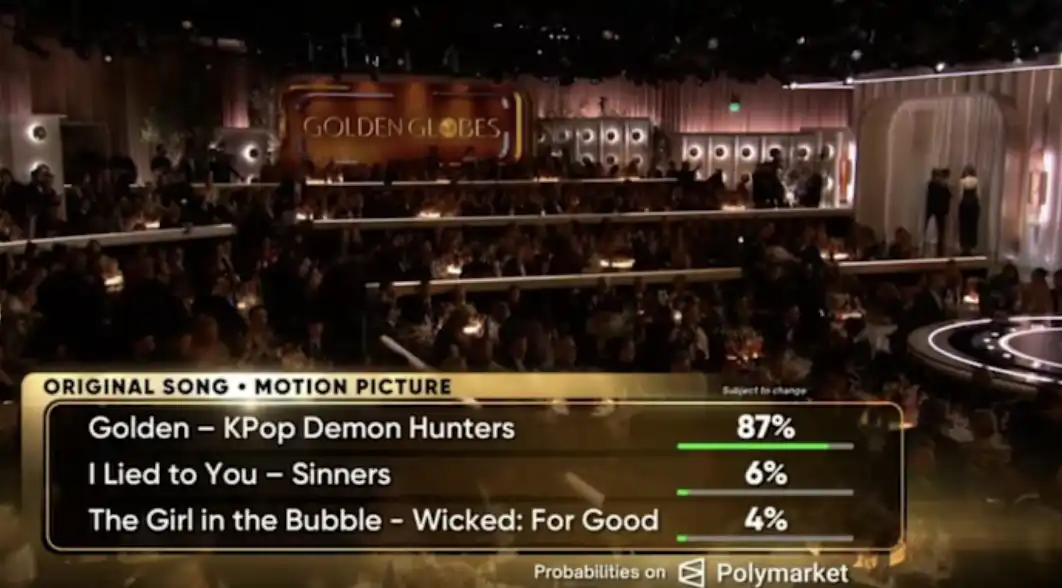
For the tens of viewers watching the live broadcast at home, the presence of Polymarket as the ceremony's "exclusive prediction market partner" was hard to overlook:
“Our partnership with Polymarket has ushered in a groundbreaking new frontier, redefining how audiences interact and connect with the content they love.” said Craig Perreault, CEO of Penske Media Corporation. © Golden Globe Awards
How did things come to this?
In 2023, after a series of scandals, the Golden Globes were sold by the Hollywood Foreign Press Association to a joint venture formed by sports industry tycoon Todd Boehly's Eldridge Industries and Penske Media.
By then, Jay Penske (whose father amassed a huge fortune through motorsports) had already acquired multiple media assets, including key Hollywood trade publications. This means that Penske now not only controls the Golden Globes ceremony but also owns the major media outlets reporting on the Golden Globes, such as Variety, The Hollywood Reporter, and Deadline, raising questions about the impartiality of reporting and fairness of coverage.
During Sunday night's TV broadcast, the "Penske Takeover" imprint was evident: the show featured a skit where a "security guard" was tasked with protecting the star of Heated Rivalry, which was actually a UFC promotion, conveniently in partnership with Golden Globe Awards broadcaster CBS.
But there was more. In a red carpet pre-show led by Variety, senior editor Angelique Jackson and Marc Malkin repeatedly urged viewers to "get your predictions in," while at the same time, the lower-thirds continued to display Polymarket's probability predictions for the award outcomes.
The real "fun" was happening on Polymarket's website: in the end, the bet just on "who will win Best Picture" approached $250,000. Another contract betting on "what will be mentioned during the ceremony," with options including "Venezuela/Maduro" (not mentioned), "Jesus" (mentioned), and "Epstein" (not mentioned), also attracted $86,000 in bets.
However, what caught our attention the most were several other film-related contracts on Polymarket.
For example, bets on how much box office revenue Greenland 2 or the latest installment of Avatar would earn by the end of January seemed harmless enough. But you wouldn't see similar betting pools on the US-regulated competitor, Kalshi, for good reason, with the root of this traced back to the 1955 manipulation of the US onion market.
Onion Futures Act
Vincent Kosuga, born in New York State, was a hobbyist pilot who was said to carry a nightstick with him wherever he went. He reportedly started trading onion futures at the Chicago Mercantile Exchange in the late 1940s or early 1950s and quickly became an expert.
By the end of 1955, Kosuga and his business partner held approximately 1,000 "carlots" of onion inventory, with each carlot containing 600 bags of 50-pound "spot" onions, which were vegetables deliverable through the spot market, ready for immediate delivery. According to a fascinating case file from the US Commodity Futures Trading Commission (CFTC) released five years later, this inventory represented a staggering 98% of the deliverable onion supply in Chicago.
A summary description of Sherwood Financial Partners stated that Kosuga then did this: he sat down with other onion growers to negotiate, telling them that unless everyone agreed to raise onion prices collectively, he would flood the market with onions. Other growers/shippers agreed and began buying Kosuga's stock at these inflated prices.
Upon identifying another opportunity to capitalize on in the market, Kosuga and his partners swiftly took short positions on a large number of onion contracts.
They then, going back on their word, proceeded to dump all the onions they had stored in various local warehouses onto the market. At one point, onion prices plummeted to such an extent that the canvas bags used to hold the onions were worth more than the onions themselves. The situation deteriorated to the point where entire truckloads of onions were dumped into the Chicago River.
The losses incurred were so substantial that in the summer of 1956, Congress held hearings to discuss whether to outright ban onion futures trading. The result was the Onion Futures Act, signed into law two years later, which indeed did just that.
History turned into legend, legend turned into myth. For the next 52 years, onions became the only commodity in the United States prohibited from futures trading.
Everything changed in 2010 when, under the lobbying of the Motion Picture Association of America, the ban on onion derivatives was revised to include a provision prohibiting any futures trading based on movie box office revenue—reasoning that betting on a movie's box office performance could influence audiences' decision to see a movie and incentivize studios to engage in various "shenanigans."
Today, the law stipulates that anyone caught trading "contracts for the sale of movie box office receipts (or any index, measure, value, or data related to such receipts) or onion futures for future delivery" will, upon conviction, be subject to a "fine not exceeding $5,000."
Of course, the event contracts Polymarket offered during the Golden Globes were around award outcomes and did not involve box office receipts, so there were no issues.
However, some other contracts related to movies on the Polymarket website—such as bets on the box office receipts of movies like "Avatar," "Greenland 2," and others before a certain point in time—while not featured in the awards ceremony TV broadcast, could potentially cross the red line set by the 2010 revision.
So why can Polymarket still offer this prediction market? As always, the answer lies in: it operates offshore.
Keep Your Onions
Despite receiving approval from the Commodity Futures Trading Commission (CFTC) last year and being able to re-enter the U.S. market, Polymarket's current U.S. operation is a limited version of the website, focusing mainly on relatively "non-controversial" events, such as sports match outcomes, or sensational topics like which country Trump may "acquire" next.
Provisions in the Dodd-Frank Act banning futures contracts based on movie box office revenues remain in effect. However, by providing two separate platforms for U.S. and non-U.S. users, Polymarket is able to comply with regulatory boundaries in different jurisdictions.
Therefore, bets related to movies like "Avatar" or "Greenland 2" can only appear on Polymarket's main site, which is the version not subject to U.S. regulations. U.S. bettors are blocked and cannot access the platform, in accordance with the CFTC's order issued in 2022: at that time, Polymarket paid a $1.4 million fine and agreed to cease providing certain services to U.S. customers, as well as close non-compliant markets.
"This is a bit like the common disclaimer: 'void where prohibited by law,'" said lawyer and former Wall Street regulator Bill Singer. "If Polymarket were to accept bets from U.S. customers onshore, it would appear illegal until the company provides a strong clarification."
Polymarket did not respond to a request for comment. One source said that Kalshi does not offer box office futures or onion derivatives.
FTAV, on the other hand, plans to sail into international waters and begin trading both types of contracts, regardless of how much your VPN tries to bypass restrictions.
You may also like

AI Trading's Ultimate Test: Empower Your AI Strategy with Tencent Cloud to Win $1.88M & a Bentley
AI traders! Win $1.88M & a Bentley by crushing WEEX's live-market challenge. Tencent Cloud powers your AI Trading bot - can it survive the Feb 9 finals?

Russia’s Largest Bitcoin Miner BitRiver Faces Bankruptcy Crisis – What Went Wrong?
Key Takeaways BitRiver, the largest Bitcoin mining operator in Russia, faces a bankruptcy crisis due to unresolved debts…

Polymarket Predicts Over 70% Chance Bitcoin Will Drop Below $65K
Key Takeaways Polymarket bettors forecast a 71% chance for Bitcoin to fall below $65,000 by 2026. Strong bearish…

BitMine Reports 4.285M ETH Holdings, Expands Staked Position With Massive Reward Outlook
Key Takeaways BitMine Immersion Technologies holds 4,285,125 ETH, which is approximately 3.55% of Ethereum’s total supply. The company…

US Liquidity Crisis Sparked $250B Crash, Not a ‘Broken’ Crypto Market: Analyst
Key Takeaways: A massive $250 billion crash shook the cryptocurrency markets, attributed largely to liquidity issues in the…

Vitalik Advocates for Anonymous Voting in Ethereum’s Governance — A Solution to Attacks?
Key Takeaways Vitalik Buterin proposes a two-layer governance framework utilizing anonymous voting to address collusion and capture attacks,…

South Korea Utilizes AI to Pursue Unfair Crypto Trading: Offenders Face Severe Penalties
Key Takeaways South Korea is intensifying its use of AI to crack down on unfair cryptocurrency trading practices.…

Average Bitcoin ETF Investor Turns Underwater After Major Outflows
Key Takeaways: U.S. spot Bitcoin ETFs hold approximately $113 billion in assets, equivalent to around 1.28 million BTC.…

Japan’s Biggest Wealth Manager Adjusts Crypto Strategy After Q3 Setbacks
Key Takeaways Nomura Holdings, Japan’s leading wealth management firm, scales back its crypto involvement following significant third-quarter losses.…
CFTC Regulatory Shift Could Unlock New Opportunities for Coinbase Prediction Markets
Key Takeaways: The U.S. Commodity Futures Trading Commission (CFTC) is focusing on clearer regulations for crypto-linked prediction markets,…
Hong Kong Set to Approve First Stablecoin Licenses in March — Who’s In?
Key Takeaways Hong Kong’s financial regulator, the Hong Kong Monetary Authority (HKMA), is on the verge of approving…

BitRiver Founder and CEO Igor Runets Detained Over Tax Evasion Charges
Key Takeaways: Russian authorities have detained Igor Runets, CEO of BitRiver, on allegations of tax evasion. Runets is…

Crypto Investment Products Struggle with $1.7B Outflows Amid Market Turmoil
Key Takeaways: The recent $1.7 billion outflow in the crypto investment sector represents a second consecutive week of…

Why Is Crypto Down Today? – February 2, 2026
Key Takeaways: The crypto market has seen a downturn today, with a significant decrease of 2.9% in the…

Nevada Court Temporarily Bars Polymarket From Offering Contracts in the State
Key Takeaways A Nevada state court has temporarily restrained Polymarket from offering event contracts in the state, citing…

Bitcoin Falls Below $80K As Warsh Named Fed Chair, Triggers $2.5B Liquidation
Key Takeaways Bitcoin’s price tumbled below the crucial $80,000 mark following the announcement of Kevin Warsh as the…

Strategy’s Bitcoin Holdings Face $900M in Losses as BTC Slips Below $76K
Key Takeaways Strategy Inc., led by Michael Saylor, faces over $900 million in unrealized losses as Bitcoin price…
Trump-Linked Crypto Company Secures $500M UAE Investment, Sparking Conflict Concerns
Key Takeaways A Trump-affiliated crypto company, World Liberty Financial, has garnered $500 million from UAE investors, igniting conflict…
AI Trading's Ultimate Test: Empower Your AI Strategy with Tencent Cloud to Win $1.88M & a Bentley
AI traders! Win $1.88M & a Bentley by crushing WEEX's live-market challenge. Tencent Cloud powers your AI Trading bot - can it survive the Feb 9 finals?
Russia’s Largest Bitcoin Miner BitRiver Faces Bankruptcy Crisis – What Went Wrong?
Key Takeaways BitRiver, the largest Bitcoin mining operator in Russia, faces a bankruptcy crisis due to unresolved debts…
Polymarket Predicts Over 70% Chance Bitcoin Will Drop Below $65K
Key Takeaways Polymarket bettors forecast a 71% chance for Bitcoin to fall below $65,000 by 2026. Strong bearish…
BitMine Reports 4.285M ETH Holdings, Expands Staked Position With Massive Reward Outlook
Key Takeaways BitMine Immersion Technologies holds 4,285,125 ETH, which is approximately 3.55% of Ethereum’s total supply. The company…
US Liquidity Crisis Sparked $250B Crash, Not a ‘Broken’ Crypto Market: Analyst
Key Takeaways: A massive $250 billion crash shook the cryptocurrency markets, attributed largely to liquidity issues in the…
Vitalik Advocates for Anonymous Voting in Ethereum’s Governance — A Solution to Attacks?
Key Takeaways Vitalik Buterin proposes a two-layer governance framework utilizing anonymous voting to address collusion and capture attacks,…


 App
App