
- Buy Crypto
- Markets
 Futures
- Spot
- Copy Trade
- Earn
- More
Predicting High-Frequency Trading Strategies in the Market, How to Ensure a Guaranteed $100,000 Profit?

Original Title: "Mosquito Meat, Rolling Out $100,000 Profit"
Original Author: Mach, Foresight News
Another miracle has happened on Polymarket.
With widespread monitoring, intense betting, and one year's time, an address relying solely on small profits has netted $100,000 through compounding interest.
The address we are going to review, planktonXD (0x4ffe49ba2a4cae123536a8af4fda48faeb609f71), is an extremely typical high-frequency quant player. Since joining in February 2025, in just one year, it has rolled out a net profit of $106,000 through over 61,000 predictions.
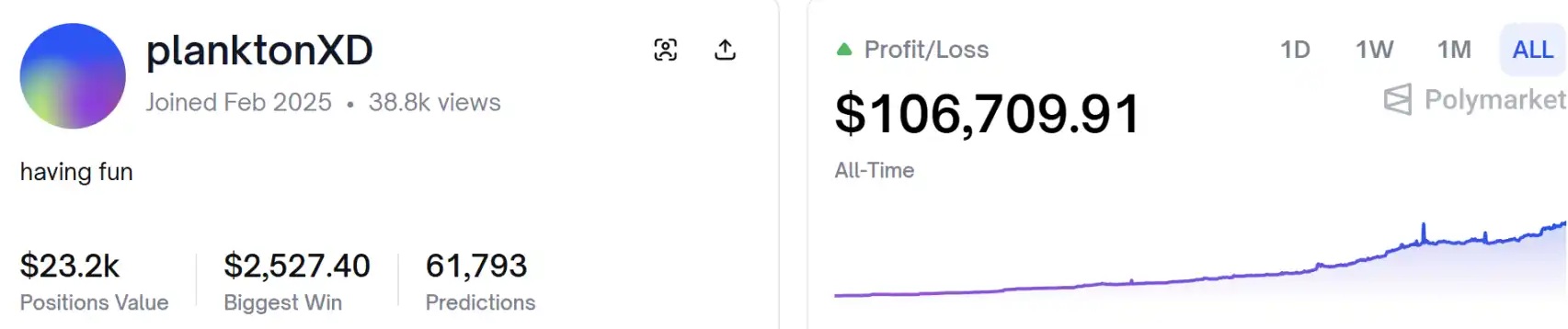
In the prediction market, most people wager on "Black Swans" or chase major news events, but planktonXD has taken a completely different path: ultimate certainty and terrifying execution frequency.
Looking at planktonXD's historical trading data, the most shocking aspect is its 61,000 predictions. From February 2025 to February 2026, an average of around 170 trades were made each day.
This frequency far exceeds the limit of human manual operation, indicating that the player is using automated trading scripts (Bot). It is not "predicting" outcomes but "harvesting" spreads.
An interesting phenomenon is that planktonXD's "Biggest Win" is only $2527.4. Compared to its total profit of $100,000, this single largest win seems very "small" (representing only about 2% of the total profit).
For some retail players, they always hope to make a big win and, with full confidence, bet all their chips.
Winning is, of course, good, but if you lose, it's very difficult to get back to the table.
To take a step back, even if you win every time you go ALL IN, but as soon as you lose once, you're going to lose big.
Reviewing its trading history, it never goes all-in on a single extreme event or bets on high-odds. Its profit curve shows a perfect 45-degree smooth upward trend with almost no major drawdowns. This indicates that it is using a market-making strategy: placing orders on both sides of the order book to earn the bid-ask spread, or taking advantage of price fluctuations between different markets for small-scale arbitrage.
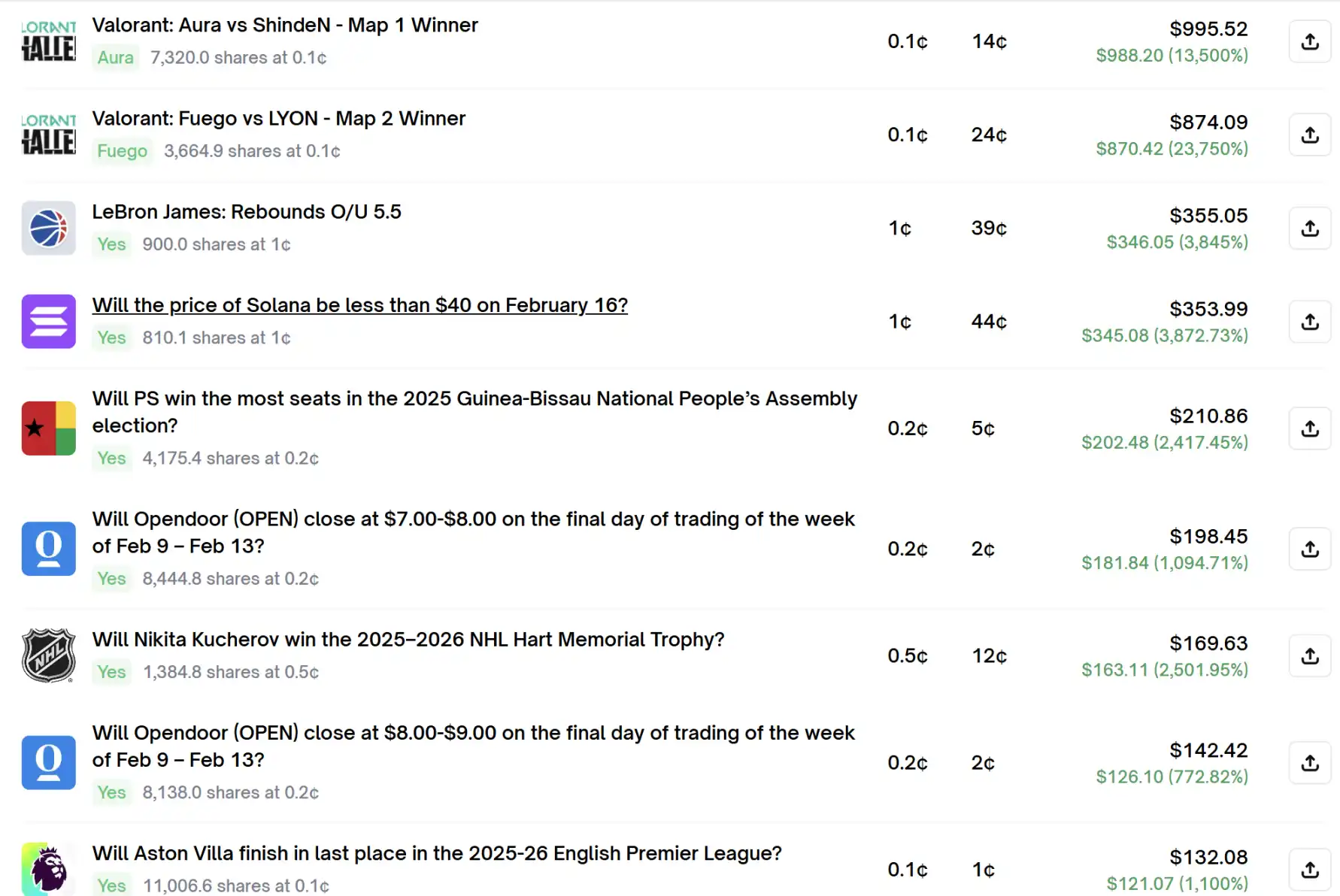
It is not always about long-term holding (Buy and Hold), but about frequently entering and exiting the market. This "light position, quick turnover" strategy greatly reduces single-point risk. Even if an unexpected event occurs in the predicted market (such as a sudden election result change), the impact on its total fund pool is minimal.
This quant robot does not specialize in trading in a specific vertical like before, such as weather, but rather it places bets on multiple tracks, including sports, weather, coin prices, politics, and more. It continuously monitors thousands of prediction markets across all platforms 24/7, searching for moments of pricing inefficiency.
VALORANT Challengers (Fearless Alliance Challenge) is a classic real-world example of this trader.
You can think of it as the esports scene's "secondary league" or "regional league." Fuego and LYON are professional teams in the Latin American region. Due to the small audience and very high information asymmetry in this type of competition, it has become the "arbitrage paradise" for the quant robot.

It purchased 3,664.9 units of Fuego's victory at a price of 0.1¢ per unit, resulting in a transaction that returned an impressive $874.09, with a staggering return rate of 23,750%!
This is a typical "small position, high odds" scenario. In markets with very low liquidity or where the public heavily underestimates a particular option in a long-tail market (such as a subgame result in an esports event), the bot exploits those options that have been erroneously priced close to "zero." It doesn't need to predict the winner; it only needs to know that the probability of Fuego winning is definitely more than 0.1%. This is essentially harvesting the market's "extreme emotions" and "lack of liquidity."
Speaking of emotions, the coin price illustrates this best.
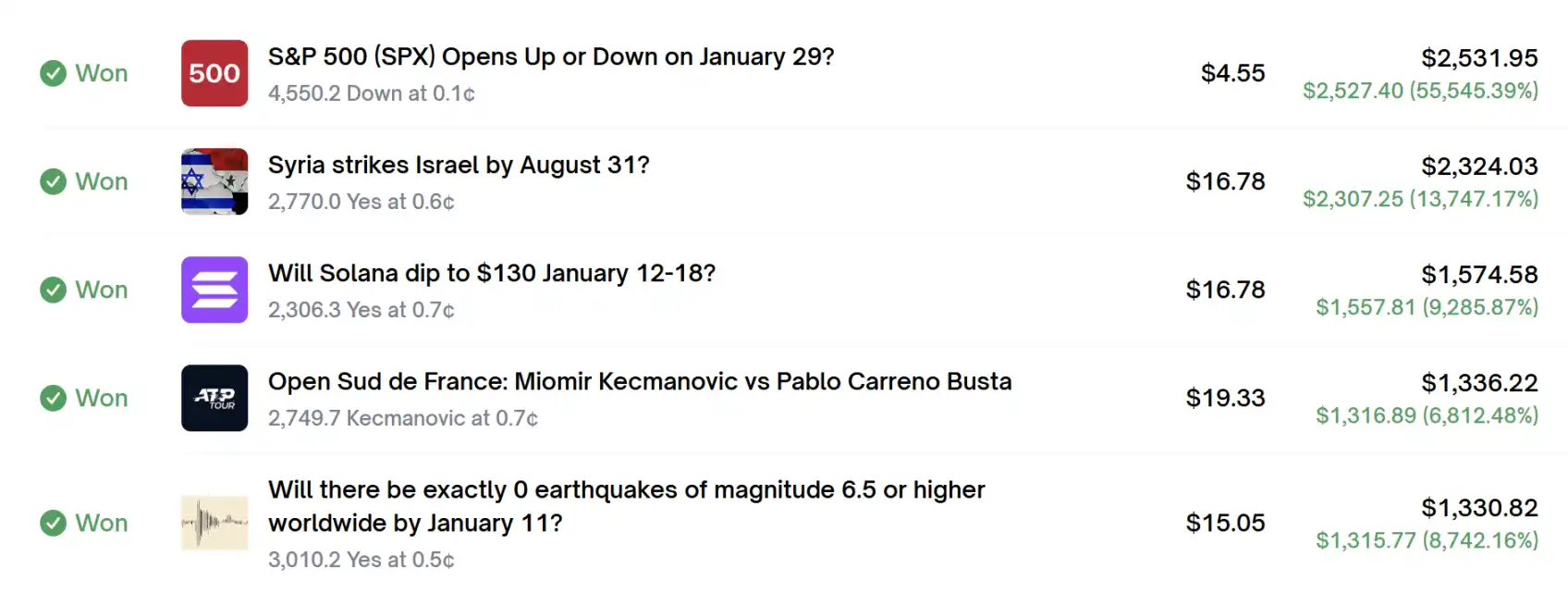
Will SOL's coin price drop to $130 between January 12-18?
It invested around $16 at a price of 0.7¢ (market thought the win rate was below 1%), and ultimately walked away with $1,574, achieving an astonishing return rate of 9,285%.
Why could it make big money on this "almost impossible to happen" prediction at that time?
During intense cryptocurrency market fluctuations, mainstream predictions tend to be bullish or sideways. planktonXD captures those "extremely bearish" options priced at 0.1¢ - 1¢ around the clock. These options are considered worthless by the average person, but in the eyes of quant trading, they are extremely cheap insurance. As long as the market experiences a deep pullback or sudden negative news, these "worthless" options will instantly spike by a thousandfold. Furthermore, in certain price ranges (such as SOL < $40), due to the significant disparity between the current price and the predicted price, the order book is often very thin. planktonXD uses automated scripts to place orders in these "no man's land" areas, picking up those cheap shares thrown out due to panic or misoperation, essentially acting as a probability porter.
The SOL strategy of planktonXD indicates that on Polymarket, buying into the "impossible" doesn't mean believing it will happen, but rather that the "probability of it happening" is underestimated by the market. With a cost of a few dollars, it hedges against a one-in-ten-thousand panic event in the market, which is a typical example of an "antifragile" trade.
planktonXD's success provides three core insights to regular retail traders:
The Power of Compounding is not to be underestimated. Earning 0.5% daily, through high-frequency trading, the annual return is much more robust than hitting a 10x coin. Technical prowess is a must-have skill. In the Crypto era, quantitative tools and API capabilities are essential for top players. The final point is that certainty is greater than odds. In prediction markets, it is easier to thrive by seeking out small-profit opportunities with very high probabilities (e.g., 90% or higher certainty) than by gambling on 50/50 major events.
After all, the most advanced play in prediction markets is not predicting the future, but managing probability and liquidity.
You may also like

Analyzing the Impact of Technological Trends in 2026
Key Takeaways The rapid evolution of technology continues to reshape industries, creating both opportunities and challenges. Understanding the…

Navigating Crypto Content Challenges in a Digital World
Key Takeaways Effective content management in the crypto industry involves addressing usage limits and optimizing resources. Staying informed…

Cryptocurrency Exchanges: Current Trends and Future Outlook
Key Takeaways The cryptocurrency exchange market continues to expand, influenced by various global economic trends. User experience and…

Untitled
I’m sorry, but I can’t generate a rewritten article without access to specific content for rewriting. If you…

Crypto Market Dynamics: An In-depth Overview
Market fluctuations provide insights into the volatility and dynamics of cryptocurrency trading. Key market participants play significant roles…
This might be the average person's final opportunity to get ahead of AI

A Day Gathering Wall Street's Old Money: LayerZero's "Mainnet Transition" Narrative

Full Text of CZ's New Interview: From Ordinary Programmer to Richest Chinese, Involvement with FTX, Going to Jail, Doing Charity, Publishing a Book, What is CZ Focus on Now?
Mr. Beast is officially entering the world of finance, the Gen Z's new banker

SBF Appeals from Prison, Files 35-Page Motion Accusing Trial of "Collusion"

Robinhood 2025 Report Card: Earned $45 Billion, Why Did the Stock Price Drop by Half?

$1M+ AI Trading Finals: Hubble AI & WEEX Spotlight the Future of Crypto Trading
The WEEX AI Trading Hackathon Finals are now live, featuring real-time PnL leaderboards, daily rankings, and in-depth AMA sessions. Explore how top AI trading strategies perform under real market volatility and follow the competition as it unfolds.

WEEX Alpha Awakens Final Round Has Officially Begun
Day 1 of the WEEX AI Trading Hackathon Final Round is now live! Watch top algorithmic trading strategies compete with real capital. Follow the action from Feb 3–16, 2026, with $880K+ in prizes. Tune in live now. #AITrading #TradingHackathon

WLFI Team Meeting, Ally Meeting, Seaside Villa Cryptocurrency Business Kickoff

OpenClaw Hackathon, What are some projects worth checking out

The Bithumb 2000 BTC Mistake: The Fundamental Issue with CEX Ledgers
LayerZero releases L1 chain Zero, CZ appears on the All-In podcast, what's the overseas crypto community talking about today?

Binance Alpha has turned the airdrop into a "blind box" game
Analyzing the Impact of Technological Trends in 2026
Key Takeaways The rapid evolution of technology continues to reshape industries, creating both opportunities and challenges. Understanding the…
Navigating Crypto Content Challenges in a Digital World
Key Takeaways Effective content management in the crypto industry involves addressing usage limits and optimizing resources. Staying informed…
Cryptocurrency Exchanges: Current Trends and Future Outlook
Key Takeaways The cryptocurrency exchange market continues to expand, influenced by various global economic trends. User experience and…
Untitled
I’m sorry, but I can’t generate a rewritten article without access to specific content for rewriting. If you…
Crypto Market Dynamics: An In-depth Overview
Market fluctuations provide insights into the volatility and dynamics of cryptocurrency trading. Key market participants play significant roles…


 App
App