
- Buy Crypto
- Markets
 Futures
- Spot
- Copy Trade
 Earn
Earn- More
The US can't control Latin America, so they took out Maduro

Original Article Title: "The US Could Not Control Latin America, So They Took Away Maduro"
Original Article Author: Sleepy.txt, Watcher Beating
In the 1980s, the total external debt of the entire Latin America accounted for nearly 50% of its GDP, a metric Washington used to measure loyalty and control when overseeing its backyard.
Today, this number has dropped to 20%.
However, this 22-percentage-point difference does not mean that the Latin American people are becoming richer day by day. To no longer be subject to others' currency and rules, they are still struggling in the old order and paying a heavy price for it.
This is a struggle between "being controllable" and "being uncontrollable." The United States is trying to control the economic lifeline of this continent through debt, currency, and sanctions. However, when this control is pushed to the limit, the system will inevitably trigger an inherent resistance.
Three Weapons the US Uses to Control Latin American Finance
Over the past half-century, the American financial empire's rule over Latin America has primarily relied on three unbeatable weapons.
The first weapon is debt. This is the empire's oldest colonial tool and the most effective financial governance tool.
On August 12, 1982, a plea call from the Mexican Finance Minister was the catalyst for the Latin American debt crisis. As Mexico declared its inability to repay $80 billion in external debt, the first domino fell. Brazil, Argentina, and Venezuela then fell into the abyss of default one after another.
Subsequently, the "Creditor Alliance" composed of the US Treasury, the Federal Reserve, and the IMF entered the scene. The bailout money they provided was incredibly expensive, and behind each round of aid were extremely harsh conditions.
This was later known as the Washington Consensus, which forced these countries to cut government spending, sell off state assets, fully open domestic markets, and remove all capital controls.
It was an era where the US could determine a country's fate for the next decade with just one check. Debt became a noose around the neck of each Latin American country, with the US holding the end of the rope. Behind every aid package, the price of power had actually been set.
The second weapon is dollarization.
When debt control was not thorough enough, a more extreme solution was pushed to the forefront: simply abandon your national currency and directly adopt the US dollar.
First, the United States triggered foreign exchange depletion and hyperinflation in these countries through early-stage debt harvesting, instilling a visceral fear of their own currency in the populace. Subsequently, Washington's think tanks began massively promoting the "Currency Stability Theory" in public opinion, packaging the US dollar as the only safe haven free from volatility.
When providing emergency loans, the United States often implied or even stated outright that only by adopting the US dollar could a country receive long-term financial credit endorsement. In 2000, on the brink of social unrest, Ecuador was forced to abandon its currency; shortly thereafter, countries like El Salvador and Panama followed suit.
This is a very domineering logic; if a country loses control of its own currency, its economic sovereignty is fundamentally in a trusteeship. Giving up one's domestic currency is akin to handing over the keys to one's home. From then on, your inflation rate, your interest rate, can only be determined by others.
The third weapon is sanctions. This is the ultimate, most destructive heavy weapon, specifically designed to deal with those who attempt to depart from the established order and challenge the existing system.
Take Venezuela, for example. The United States has imposed over 900 sanctions on the country, involving 209 key individuals, nearly closing off all survival space for the nation.
Venezuela is actually rich in oil, quite literally "rich in oil." Its oil reserves amount to a staggering 303 billion barrels, even more than Saudi Arabia. However, the issue lies in the fact that much of this oil is heavy crude like asphalt, extremely difficult to extract, requiring external funding, technology, and diluents to turn into money.
The precision of US sanctions has severed these lifelines, leaving Venezuela sitting on the "world's largest oil tank" but unable to monetize it. As a result, Venezuela's oil production plummeted from 3 million barrels per day to less than 500,000 barrels per day in just seven years.
It wasn't until early 2026, when the US used "drug terrorism" and related criminal charges as justification to remove Maduro through a military operation in Venezuela, that Trump announced major oil companies would take over and invest billions of dollars to restore infrastructure, thus finally completing the loop of this sanction's sharp edge.
By first completely paralyzing a country's liquidity through sanctions, one can then boldly enter this wasteland with billions of dollars under the guise of "management and restoration," and achieve the reaping of the global energy landscape.
Debt, dollarization, sanctions – these three shackles formed the United States' half-century-long financial blockade on Latin America. This network was once impenetrable, stretching from Mexico City all the way to Buenos Aires.
Three Variables
Today, a series of variables is eroding the foundation of imperial hegemony, the three once unbeatable weapons now obsolete in the logic shift of globalized gaming.
The loosening of the debt straitjacket began in the first decade of the 21st century. The biggest variable behind it was China.
In 2001, China joined the WTO, initiating a decade-long commodity supercycle. Latin America, as a major global raw material supplier, became the biggest beneficiary of this feast.
Brazil's iron ore, Chile's copper, Argentina's soybeans, continuously headed eastward, bringing back unprecedented foreign exchange accumulation. This accumulation allowed Latin American countries to catch their breath, gaining the confidence to break free from the IMF's constraints.
In 2005, Brazil and Argentina announced early repayment of all debts owed to the IMF. From 2005 to 2020, China provided Latin America with over $137 billion in non-politically-conditioned loans.
Venezuela received $62 billion, with other major recipient countries including Brazil, Ecuador, and Argentina. These "oil-for-loan" agreements helped countries build much-needed infrastructure and gave them more leverage in negotiations with Western creditors.
Meanwhile, Washington quickly realized it could not control the economic policies of these countries through dollarization. Latin Americans held dollars on a large scale not for the love of the "American Dream" but to hedge against their own currency's collapse. In the streets of Latin America, the dollar was stripped of its political color, reverting to a pure financial tool, a reliable hard currency that wouldn't turn into waste paper tomorrow.
This is the so-called "de-Americanized dollarization."
People needed the stability of the dollar but rejected Washington's rules. The dollar is becoming a global, neutral unit of value, just like gold. It belongs to the world, no longer just the U.S. government.
When a significant amount of dollar transactions spontaneously moved outside the official monitoring system, Washington found that while they could still print money, they increasingly struggled to control other countries' economic lifelines through currency leverage.
As both debt and dollarization began to falter, the U.S. opted for more aggressive sanctions.
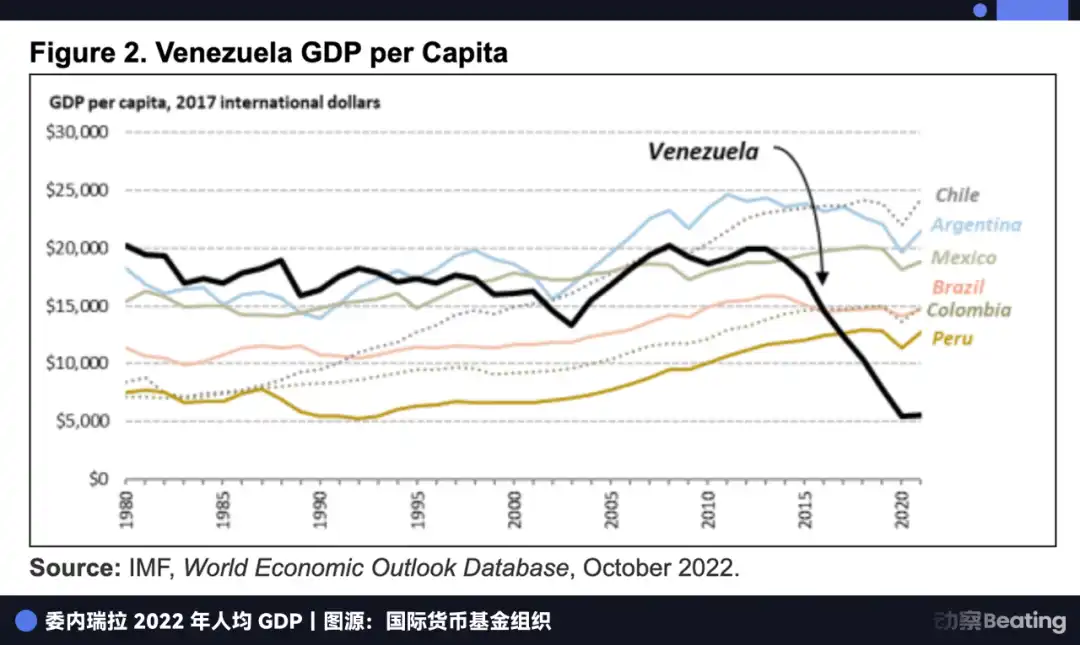
Internally, Venezuela's governance incapacity and corruption led to the collapse of its economic pillars, rendering the local currency practically worthless in hyperinflation; externally, sanctions directly caused its GDP to shrink by about 75%. It's precisely this suffocating sense of an internal and external dilemma that gave rise to a parallel financial ecosystem entirely independent of the dollar-centric closed loop.
Meanwhile, in order to avoid the risk of exorbitant fines from the United States, global large banks have initiated the so-called "de-risking" movement, proactively cutting off business dealings with the Latin American region. According to a report by the Atlantic Council, more than 21 banks in the Caribbean region have lost correspondent banking relationships, and some countries have even lost the ability to process basic dollar trades and migrant remittances.
This defensive financial exclusion has not only failed to strengthen existing hegemony but has instead pushed more innocent individuals and businesses into that emerging parallel financial ecosystem.
The Parallel Financial Ecosystem Beyond the Iron Curtain
In this game of financial sovereignty and survival instinct, Latin America's parallel financial ecosystem, composed of stablecoins, local fintech, non-U.S. trade channels, and the underground economy, is forming a network that is not subject to Washington's will.
In Latin America, stablecoins are no longer mere chips for investment or speculation.
Take Venezuela, for example, where, to evade sanctions, the government has established a shadow financial network. By December 2025, around 80% of the country's oil revenue is received in the form of the USDT stablecoin.
Furthermore, intelligence indicates that through a cross-border gold refining and over-the-counter trading channel spanning Turkey and the UAE, Venezuela may have secretly accumulated a Bitcoin reserve worth as much as $60 billion, a position size rivaling that of MicroStrategy.
However, this alternative to the SWIFT system, traversing gold and cryptocurrency channels via Turkey and the UAE, while circumventing sanctions technically, has also become a key point of Washington's accusations of involvement in illicit fund flows and support for drug trafficking due to its high level of concealment.
For ordinary Latin American people, when their traditional bank accounts are frozen due to sanctions, they no longer pay attention to the cumbersome and politically charged instructions of the settlement system but instead directly move funds across borders through blockchain.
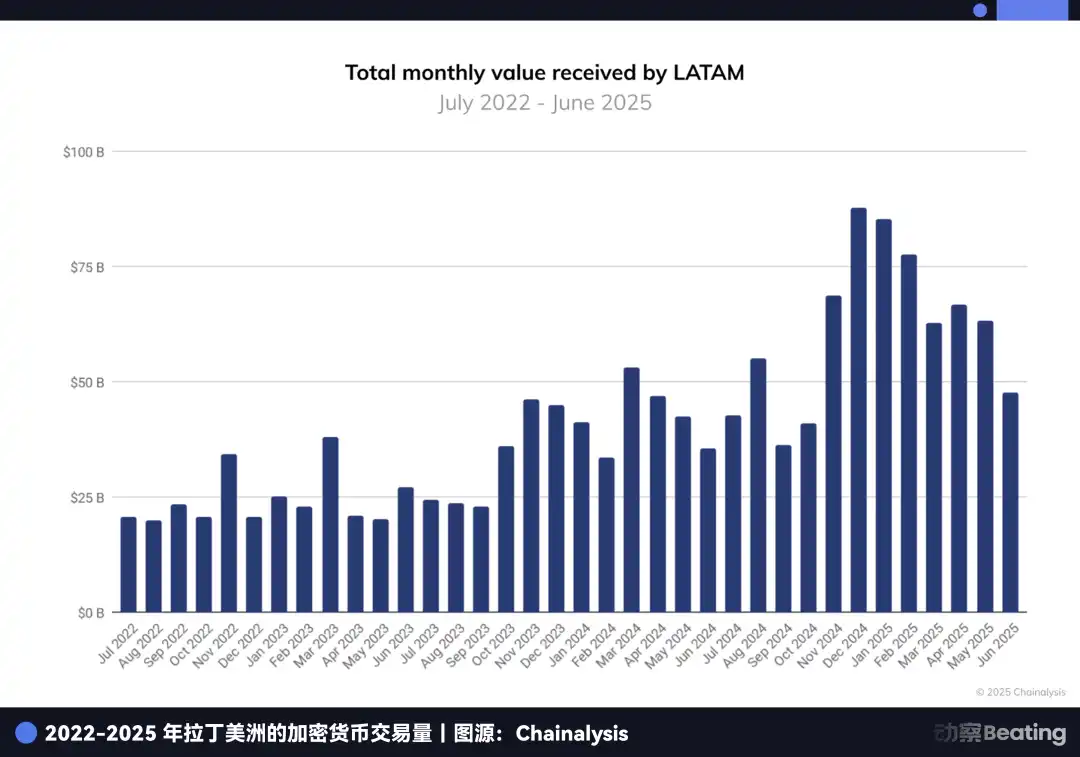
According to Chainalysis data, between 2022 and 2025, Latin American cryptocurrency transactions approached $1.5 trillion, with over 90% of transactions in Brazil involving stablecoins.
Compared to Manhattan bankers accustomed to overseeing from great heights, local fintech companies care more about the ground beneath their feet and the tangible livelihood. Taking Brazil as an example, even though only 60 million people have credit cards, the central bank-led Pix payment system has surprisingly reached 170 million users.
In 2024, Pix's total transaction volume reached $3.8 trillion, 1.7 times Brazil's GDP. Behind this data is the extreme efficiency of fund turnover.
At the same time, digital banking giant Nubank, in just eight years, grew its user base from 1.3 million to 114 million, capturing over 60% of Brazil's adult population and achieving nearly $2 billion in net profit in 2024.
Payment giant Mercado Pago swept $142 billion in payments in Latin America, while the newcomer in the remittance market, Bitso, directly took a 4% share of the US-Mexico remittance market from traditional giants like Western Union.
Furthermore, non-dollar channels and the underground economy are merging. A $5 billion currency swap between Argentina and China, along with the ongoing progress of local currency settlements between China and Brazil, is becoming a symmetric choice amid great power competition. This top-down decoupling is giving Latin American trade a form of breathing room independent of the dollar.
On the streets of Argentina, a black-market exchange rate known as the "Blue Dollar" has become a nationwide economic barometer. The significant spread between it and the official exchange rate starkly reveals the bankruptcy of official credit, giving rise to countless street exchange dealers known as "arbolitos" and "crypto caves" specialized in USDT trading.
The penetration of stablecoins, the penetration rate of local fintech, strategic choices of non-dollar channels, and the rampant growth of the underground economy have woven together a financial network breaking free from centralized control.
Who's Passing the Knife
Any breakout of a species, besides intrinsic survival instincts, often requires a catalyzing external environment. The catalyst for the rise of Latin America's parallel financial system comes precisely from the United States, which seeks to defend the old order.
A series of Washington's operations not only failed to stifle the emergence of the new order but instead provided it with the most abundant nutrients for expansion.
The first thrust came from politicians' forceful expropriation of financial channels.
The Trump administration once proposed a 1% tax on remittances from the United States, which may seem like a minor fee, but when placed against the backdrop of over $150 billion in annual remittances to Latin America, this is enough to shake the lifeline of tens of millions of low-income families.
It's worth noting that within traditional financial channels, sending $200 to Latin America incurs a fee of $6 to $8 just to the likes of Western Union.
This additional 1% tax has become the straw that broke the camel's back. This tax bill has sent an extremely dangerous signal to every worker: traditional remittance channels are not only expensive but can also become a political game's sacrificial lamb at any time.
Trump may have thought he was building a financial wall, but in reality, he has driven tens of millions of users to escape the old system and collectively run into the embrace of stablecoins and local fintech. When the cost of survival is pushed to the limit by politics, users will migrate at an unprecedented speed.
The second push comes from a severe rift among Wall Street elites in interest distribution.
As mentioned earlier, to comply with increasingly strict anti-money laundering regulations, Wall Street giants have launched a "derisking" movement, actively cutting off business ties with Latin America, these "high-risk regions." JPMorgan Chase, in 2014, cited "high risk" as a reason to close the accounts of tens of thousands of Latin American customers.
By the end of 2025, JPMorgan Chase had, on one hand, frozen the bank accounts of two stablecoin companies, BlindPay and Kontigo, operating in Venezuela, playing the role of the most loyal "gatekeeper" of the dollar system. On the other hand, it was frantically hoarding physical precious metals to hedge against dollar risk.
Public data shows that JPMorgan Chase has become the world's largest holder of physical silver. More intriguingly, JPMorgan Chase has transferred a large amount of silver from deliverable to non-deliverable status.
This means that although this silver is lying in warehouses, it is no longer allowed to be used to fulfill futures contract deliveries. In other words, JPMorgan Chase is taking these "chips" off the gambling table and locking them away in its not easily accessible backyard.
While the dollar hegemony is still in effect, these Wall Street elites seek to maximize their financial control within the rules; but at the same time, they are also preparing for the eventual collapse of this system. JPMorgan Chase is both the top defender of the existing dollar system and its biggest "internal short."
Therefore, the more the United States tries to tighten the reins of the dollar, the more the dollar leaps out of bounds in a wild way to find a safer pasture. When core players within a system start preparing exit strategies for the post-dollar era, this control inevitably moves toward its opposite.
The Curse of Hegemony
This dilemma of "control" versus "out of control" is not unique to this era. If we cast our gaze back to the foggy 19th century, in the long river of financial history, we can actually hear a distant and similar echo—a decline of the pound sterling.
In that long century, the pound sterling was once the undisputed world currency. But when a currency truly belongs to the whole world, it no longer exclusively belongs to its home country.
In order to globalize the pound, the UK was forced to maintain a trade deficit for many years, a price that directly led to the hollowing out of its manufacturing industry and the chronic decline of its national strength. In 1931, after enduring three brutal runs on its currency, the UK was forced to abandon the gold standard, and the pound's hegemony fell from grace.
The British Empire paid a hundred years' tuition for a lesson: the more you try to use your currency's status to exploit the world, the more you accelerate its vitality drain.
Today, the US dollar is stepping into the same predicament.
The more Washington wants to wield the dollar as a weapon, using sanctions, taxation, and stringent regulation to encircle and intercept, the more likely the dollar is to accelerate its departure from home. While you take the high road, the public takes the byroads.
Stablecoins, local fintech, non-US trade channels, the rampant growth of the underground economy... all these various choices are essentially covert paths for the dollar to escape Washington's control.
From the recent obsession of central banks around the world with physical gold hoarding to top-tier financial capital locking down on tangible assets, this collective choice is shifting the global financial center of gravity back to the era of hard assets.
This shift is not unfolding in the total collapse of the old empire but in the current surface prosperity of the United States, deconstructed spontaneously by hundreds of millions of individuals and businesses.
The echoes of history are already swirling over Washington, unmistakably resonant.
You may also like

Token Cannot Compound, Where Is the Real Investment Opportunity?

February 6th Market Key Intelligence, How Much Did You Miss?

China's Central Bank and Eight Other Departments' Latest Regulatory Focus: Key Attention to RWA Tokenized Asset Risk
Foreword: Today, the People's Bank of China's website published the "Notice of the People's Bank of China, National Development and Reform Commission, Ministry of Industry and Information Technology, Ministry of Public Security, State Administration for Market Regulation, China Banking and Insurance Regulatory Commission, China Securities Regulatory Commission, State Administration of Foreign Exchange on Further Preventing and Dealing with Risks Related to Virtual Currency and Others (Yinfa [2026] No. 42)", the latest regulatory requirements from the eight departments including the central bank, which are basically consistent with the regulatory requirements of recent years. The main focus of the regulation is on speculative activities such as virtual currency trading, exchanges, ICOs, overseas platform services, and this time, regulatory oversight of RWA has been added, explicitly prohibiting RWA tokenization, stablecoins (especially those pegged to the RMB). The following is the full text:
To the people's governments of all provinces, autonomous regions, and municipalities directly under the Central Government, the Xinjiang Production and Construction Corps:
Recently, there have been speculative activities related to virtual currency and Real-World Assets (RWA) tokenization, disrupting the economic and financial order and jeopardizing the property security of the people. In order to further prevent and address the risks related to virtual currency and Real-World Assets tokenization, effectively safeguard national security and social stability, in accordance with the "Law of the People's Republic of China on the People's Bank of China," "Law of the People's Republic of China on Commercial Banks," "Securities Law of the People's Republic of China," "Law of the People's Republic of China on Securities Investment Funds," "Law of the People's Republic of China on Futures and Derivatives," "Cybersecurity Law of the People's Republic of China," "Regulations of the People's Republic of China on the Administration of Renminbi," "Regulations on Prevention and Disposal of Illegal Fundraising," "Regulations of the People's Republic of China on Foreign Exchange Administration," "Telecommunications Regulations of the People's Republic of China," and other provisions, after reaching consensus with the Cyberspace Administration of China, the Supreme People's Court, and the Supreme People's Procuratorate, and with the approval of the State Council, the relevant matters are notified as follows:
(I) Virtual currency does not possess the legal status equivalent to fiat currency. Virtual currencies such as Bitcoin, Ether, Tether, etc., have the main characteristics of being issued by non-monetary authorities, using encryption technology and distributed ledger or similar technology, existing in digital form, etc. They do not have legal tender status, should not and cannot be circulated and used as currency in the market.
The business activities related to virtual currency are classified as illegal financial activities. The exchange of fiat currency and virtual currency within the territory, exchange of virtual currencies, acting as a central counterparty in buying and selling virtual currencies, providing information intermediary and pricing services for virtual currency transactions, token issuance financing, and trading of virtual currency-related financial products, etc., fall under illegal financial activities, such as suspected illegal issuance of token vouchers, unauthorized public issuance of securities, illegal operation of securities and futures business, illegal fundraising, etc., are strictly prohibited across the board and resolutely banned in accordance with the law. Overseas entities and individuals are not allowed to provide virtual currency-related services to domestic entities in any form.
A stablecoin pegged to a fiat currency indirectly fulfills some functions of the fiat currency in circulation. Without the consent of relevant authorities in accordance with the law and regulations, any domestic or foreign entity or individual is not allowed to issue a RMB-pegged stablecoin overseas.
(II)Tokenization of Real-World Assets refers to the use of encryption technology and distributed ledger or similar technologies to transform ownership rights, income rights, etc., of assets into tokens (tokens) or other interests or bond certificates with token (token) characteristics, and carry out issuance and trading activities.
Engaging in the tokenization of real-world assets domestically, as well as providing related intermediary, information technology services, etc., which are suspected of illegal issuance of token vouchers, unauthorized public offering of securities, illegal operation of securities and futures business, illegal fundraising, and other illegal financial activities, shall be prohibited; except for relevant business activities carried out with the approval of the competent authorities in accordance with the law and regulations and relying on specific financial infrastructures. Overseas entities and individuals are not allowed to illegally provide services related to the tokenization of real-world assets to domestic entities in any form.
(III) Inter-agency Coordination. The People's Bank of China, together with the National Development and Reform Commission, the Ministry of Industry and Information Technology, the Ministry of Public Security, the State Administration for Market Regulation, the China Banking and Insurance Regulatory Commission, the China Securities Regulatory Commission, the State Administration of Foreign Exchange, and other departments, will improve the work mechanism, strengthen coordination with the Cyberspace Administration of China, the Supreme People's Court, and the Supreme People's Procuratorate, coordinate efforts, and overall guide regions to carry out risk prevention and disposal of virtual currency-related illegal financial activities.
The China Securities Regulatory Commission, together with the National Development and Reform Commission, the Ministry of Industry and Information Technology, the Ministry of Public Security, the People's Bank of China, the State Administration for Market Regulation, the China Banking and Insurance Regulatory Commission, the State Administration of Foreign Exchange, and other departments, will improve the work mechanism, strengthen coordination with the Cyberspace Administration of China, the Supreme People's Court, and the Supreme People's Procuratorate, coordinate efforts, and overall guide regions to carry out risk prevention and disposal of illegal financial activities related to the tokenization of real-world assets.
(IV) Strengthening Local Implementation. The people's governments at the provincial level are overall responsible for the prevention and disposal of risks related to virtual currencies and the tokenization of real-world assets in their respective administrative regions. The specific leading department is the local financial regulatory department, with participation from branches and dispatched institutions of the State Council's financial regulatory department, telecommunications regulators, public security, market supervision, and other departments, in coordination with cyberspace departments, courts, and procuratorates, to improve the normalization of the work mechanism, effectively connect with the relevant work mechanisms of central departments, form a cooperative and coordinated working pattern between central and local governments, effectively prevent and properly handle risks related to virtual currencies and the tokenization of real-world assets, and maintain economic and financial order and social stability.
(5) Enhanced Risk Monitoring. The People's Bank of China, China Securities Regulatory Commission, National Development and Reform Commission, Ministry of Industry and Information Technology, Ministry of Public Security, State Administration of Foreign Exchange, Cyberspace Administration of China, and other departments continue to improve monitoring techniques and system support, enhance cross-departmental data analysis and sharing, establish sound information sharing and cross-validation mechanisms, promptly grasp the risk situation of activities related to virtual currency and real-world asset tokenization. Local governments at all levels give full play to the role of local monitoring and early warning mechanisms. Local financial regulatory authorities, together with branches and agencies of the State Council's financial regulatory authorities, as well as departments of cyberspace and public security, ensure effective connection between online monitoring, offline investigation, and fund tracking, efficiently and accurately identify activities related to virtual currency and real-world asset tokenization, promptly share risk information, improve early warning information dissemination, verification, and rapid response mechanisms.
(6) Strengthened Oversight of Financial Institutions, Intermediaries, and Technology Service Providers. Financial institutions (including non-bank payment institutions) are prohibited from providing account opening, fund transfer, and clearing services for virtual currency-related business activities, issuing and selling financial products related to virtual currency, including virtual currency and related financial products in the scope of collateral, conducting insurance business related to virtual currency, or including virtual currency in the scope of insurance liability. Financial institutions (including non-bank payment institutions) are prohibited from providing custody, clearing, and settlement services for unauthorized real-world asset tokenization-related business and related financial products. Relevant intermediary institutions and information technology service providers are prohibited from providing intermediary, technical, or other services for unauthorized real-world asset tokenization-related businesses and related financial products.
(7) Enhanced Management of Internet Information Content and Access. Internet enterprises are prohibited from providing online business venues, commercial displays, marketing, advertising, or paid traffic diversion services for virtual currency and real-world asset tokenization-related business activities. Upon discovering clues of illegal activities, they should promptly report to relevant departments and provide technical support and assistance for related investigations and inquiries. Based on the clues transferred by the financial regulatory authorities, the cyberspace administration, telecommunications authorities, and public security departments should promptly close and deal with websites, mobile applications (including mini-programs), and public accounts engaged in virtual currency and real-world asset tokenization-related business activities in accordance with the law.
(8) Strengthened Entity Registration and Advertisement Management. Market supervision departments strengthen entity registration and management, and enterprise and individual business registrations must not contain terms such as "virtual currency," "virtual asset," "cryptocurrency," "crypto asset," "stablecoin," "real-world asset tokenization," or "RWA" in their names or business scopes. Market supervision departments, together with financial regulatory authorities, legally enhance the supervision of advertisements related to virtual currency and real-world asset tokenization, promptly investigating and handling relevant illegal advertisements.
(IX) Continued Rectification of Virtual Currency Mining Activities. The National Development and Reform Commission, together with relevant departments, strictly controls virtual currency mining activities, continuously promotes the rectification of virtual currency mining activities. The people's governments of various provinces take overall responsibility for the rectification of "mining" within their respective administrative regions. In accordance with the requirements of the National Development and Reform Commission and other departments in the "Notice on the Rectification of Virtual Currency Mining Activities" (NDRC Energy-saving Building [2021] No. 1283) and the provisions of the "Guidance Catalog for Industrial Structure Adjustment (2024 Edition)," a comprehensive review, investigation, and closure of existing virtual currency mining projects are conducted, new mining projects are strictly prohibited, and mining machine production enterprises are strictly prohibited from providing mining machine sales and other services within the country.
(X) Severe Crackdown on Related Illegal Financial Activities. Upon discovering clues to illegal financial activities related to virtual currency and the tokenization of real-world assets, local financial regulatory authorities, branches of the State Council's financial regulatory authorities, and other relevant departments promptly investigate, determine, and properly handle the issues in accordance with the law, and seriously hold the relevant entities and individuals legally responsible. Those suspected of crimes are transferred to the judicial authorities for processing according to the law.
(XI) Severe Crackdown on Related Illegal and Criminal Activities. The Ministry of Public Security, the People's Bank of China, the State Administration for Market Regulation, the China Banking and Insurance Regulatory Commission, the China Securities Regulatory Commission, as well as judicial and procuratorial organs, in accordance with their respective responsibilities, rigorously crack down on illegal and criminal activities related to virtual currency, the tokenization of real-world assets, such as fraud, money laundering, illegal business operations, pyramid schemes, illegal fundraising, and other illegal and criminal activities carried out under the guise of virtual currency, the tokenization of real-world assets, etc.
(XII) Strengthen Industry Self-discipline. Relevant industry associations should enhance membership management and policy advocacy, based on their own responsibilities, advocate and urge member units to resist illegal financial activities related to virtual currency and the tokenization of real-world assets. Member units that violate regulatory policies and industry self-discipline rules are to be disciplined in accordance with relevant self-regulatory management regulations. By leveraging various industry infrastructure, conduct risk monitoring related to virtual currency, the tokenization of real-world assets, and promptly transfer issue clues to relevant departments.
(XIII) Without the approval of relevant departments in accordance with the law and regulations, domestic entities and foreign entities controlled by them may not issue virtual currency overseas.
(XIV) Domestic entities engaging directly or indirectly in overseas external debt-based tokenization of real-world assets, or conducting asset securitization activities abroad based on domestic ownership rights, income rights, etc. (hereinafter referred to as domestic equity), should be strictly regulated in accordance with the principles of "same business, same risk, same rules." The National Development and Reform Commission, the China Securities Regulatory Commission, the State Administration of Foreign Exchange, and other relevant departments regulate it according to their respective responsibilities. For other forms of overseas real-world asset tokenization activities based on domestic equity by domestic entities, the China Securities Regulatory Commission, together with relevant departments, supervise according to their division of responsibilities. Without the consent and filing of relevant departments, no unit or individual may engage in the above-mentioned business.
(15) Overseas subsidiaries and branches of domestic financial institutions providing Real World Asset Tokenization-related services overseas shall do so legally and prudently. They shall have professional personnel and systems in place to effectively mitigate business risks, strictly implement customer onboarding, suitability management, anti-money laundering requirements, and incorporate them into the domestic financial institutions' compliance and risk management system. Intermediaries and information technology service providers offering Real World Asset Tokenization services abroad based on domestic equity or conducting Real World Asset Tokenization business in the form of overseas debt for domestic entities directly or indirectly venturing abroad must strictly comply with relevant laws and regulations. They should establish and improve relevant compliance and internal control systems in accordance with relevant normative requirements, strengthen business and risk control, and report the business developments to the relevant regulatory authorities for approval or filing.
(16) Strengthen organizational leadership and overall coordination. All departments and regions should attach great importance to the prevention of risks related to virtual currencies and Real World Asset Tokenization, strengthen organizational leadership, clarify work responsibilities, form a long-term effective working mechanism with centralized coordination, local implementation, and shared responsibilities, maintain high pressure, dynamically monitor risks, effectively prevent and mitigate risks in an orderly and efficient manner, legally protect the property security of the people, and make every effort to maintain economic and financial order and social stability.
(17) Widely carry out publicity and education. All departments, regions, and industry associations should make full use of various media and other communication channels to disseminate information through legal and policy interpretation, analysis of typical cases, and education on investment risks, etc. They should promote the illegality and harm of virtual currencies and Real World Asset Tokenization-related businesses and their manifestations, fully alert to potential risks and hidden dangers, and enhance public awareness and identification capabilities for risk prevention.
(18) Engaging in illegal financial activities related to virtual currencies and Real World Asset Tokenization in violation of this notice, as well as providing services for virtual currencies and Real World Asset Tokenization-related businesses, shall be punished in accordance with relevant regulations. If it constitutes a crime, criminal liability shall be pursued according to the law. For domestic entities and individuals who knowingly or should have known that overseas entities illegally provided virtual currency or Real World Asset Tokenization-related services to domestic entities and still assisted them, relevant responsibilities shall be pursued according to the law. If it constitutes a crime, criminal liability shall be pursued according to the law.
(19) If any unit or individual invests in virtual currencies, Real World Asset Tokens, and related financial products against public order and good customs, the relevant civil legal actions shall be invalid, and any resulting losses shall be borne by them. If there are suspicions of disrupting financial order and jeopardizing financial security, the relevant departments shall deal with them according to the law.
This notice shall enter into force upon the date of its issuance. The People's Bank of China and ten other departments' "Notice on Further Preventing and Dealing with the Risks of Virtual Currency Trading Speculation" (Yinfa [2021] No. 237) is hereby repealed.

Former Partner's Perspective on Multicoin: Kyle's Exit, But the Game He Left Behind Just Getting Started
Why Bitcoin Is Falling Now: The Real Reasons Behind BTC's Crash & WEEX's Smart Profit Playbook
Bitcoin's ongoing crash explained: Discover the 5 hidden triggers behind BTC's plunge & how WEEX's Auto Earn and Trade to Earn strategies help traders profit from crypto market volatility.

Wall Street's Hottest Trades See Exodus

Vitalik Discusses Ethereum Scaling Path, Circle Announces Partnership with Polymarket, What's the Overseas Crypto Community Talking About Today?

Believing in the Capital Markets - The Essence and Core Value of Cryptocurrency

Polymarket's 'Weatherman': Predict Temperature, Win Million-Dollar Payout

$15K+ Profits: The 4 AI Trading Secrets WEEX Hackathon Prelim Winners Used to Dominate Volatile Crypto Markets
How WEEX Hackathon's top AI trading strategies made $15K+ in crypto markets: 4 proven rules for ETH/BTC trading, market structure analysis, and risk management in volatile conditions.

A nearly 20% one-day plunge, how long has it been since you last saw a $60,000 Bitcoin?

Raoul Pal: I've seen every single panic, and they are never the end.

Key Market Information Discrepancy on February 6th - A Must-Read! | Alpha Morning Report

2026 Crypto Industry's First Snowfall
The Harsh Reality Behind the $26 Billion Crypto Liquidation: Liquidity Is Killing the Market
Why Is Gold, US Stocks, Bitcoin All Falling?

Key Market Intelligence for February 5th, how much did you miss out on?

Wintermute: By 2026, crypto had gradually become the settlement layer of the Internet economy
Token Cannot Compound, Where Is the Real Investment Opportunity?
February 6th Market Key Intelligence, How Much Did You Miss?
China's Central Bank and Eight Other Departments' Latest Regulatory Focus: Key Attention to RWA Tokenized Asset Risk
Foreword: Today, the People's Bank of China's website published the "Notice of the People's Bank of China, National Development and Reform Commission, Ministry of Industry and Information Technology, Ministry of Public Security, State Administration for Market Regulation, China Banking and Insurance Regulatory Commission, China Securities Regulatory Commission, State Administration of Foreign Exchange on Further Preventing and Dealing with Risks Related to Virtual Currency and Others (Yinfa [2026] No. 42)", the latest regulatory requirements from the eight departments including the central bank, which are basically consistent with the regulatory requirements of recent years. The main focus of the regulation is on speculative activities such as virtual currency trading, exchanges, ICOs, overseas platform services, and this time, regulatory oversight of RWA has been added, explicitly prohibiting RWA tokenization, stablecoins (especially those pegged to the RMB). The following is the full text:
To the people's governments of all provinces, autonomous regions, and municipalities directly under the Central Government, the Xinjiang Production and Construction Corps:
Recently, there have been speculative activities related to virtual currency and Real-World Assets (RWA) tokenization, disrupting the economic and financial order and jeopardizing the property security of the people. In order to further prevent and address the risks related to virtual currency and Real-World Assets tokenization, effectively safeguard national security and social stability, in accordance with the "Law of the People's Republic of China on the People's Bank of China," "Law of the People's Republic of China on Commercial Banks," "Securities Law of the People's Republic of China," "Law of the People's Republic of China on Securities Investment Funds," "Law of the People's Republic of China on Futures and Derivatives," "Cybersecurity Law of the People's Republic of China," "Regulations of the People's Republic of China on the Administration of Renminbi," "Regulations on Prevention and Disposal of Illegal Fundraising," "Regulations of the People's Republic of China on Foreign Exchange Administration," "Telecommunications Regulations of the People's Republic of China," and other provisions, after reaching consensus with the Cyberspace Administration of China, the Supreme People's Court, and the Supreme People's Procuratorate, and with the approval of the State Council, the relevant matters are notified as follows:
(I) Virtual currency does not possess the legal status equivalent to fiat currency. Virtual currencies such as Bitcoin, Ether, Tether, etc., have the main characteristics of being issued by non-monetary authorities, using encryption technology and distributed ledger or similar technology, existing in digital form, etc. They do not have legal tender status, should not and cannot be circulated and used as currency in the market.
The business activities related to virtual currency are classified as illegal financial activities. The exchange of fiat currency and virtual currency within the territory, exchange of virtual currencies, acting as a central counterparty in buying and selling virtual currencies, providing information intermediary and pricing services for virtual currency transactions, token issuance financing, and trading of virtual currency-related financial products, etc., fall under illegal financial activities, such as suspected illegal issuance of token vouchers, unauthorized public issuance of securities, illegal operation of securities and futures business, illegal fundraising, etc., are strictly prohibited across the board and resolutely banned in accordance with the law. Overseas entities and individuals are not allowed to provide virtual currency-related services to domestic entities in any form.
A stablecoin pegged to a fiat currency indirectly fulfills some functions of the fiat currency in circulation. Without the consent of relevant authorities in accordance with the law and regulations, any domestic or foreign entity or individual is not allowed to issue a RMB-pegged stablecoin overseas.
(II)Tokenization of Real-World Assets refers to the use of encryption technology and distributed ledger or similar technologies to transform ownership rights, income rights, etc., of assets into tokens (tokens) or other interests or bond certificates with token (token) characteristics, and carry out issuance and trading activities.
Engaging in the tokenization of real-world assets domestically, as well as providing related intermediary, information technology services, etc., which are suspected of illegal issuance of token vouchers, unauthorized public offering of securities, illegal operation of securities and futures business, illegal fundraising, and other illegal financial activities, shall be prohibited; except for relevant business activities carried out with the approval of the competent authorities in accordance with the law and regulations and relying on specific financial infrastructures. Overseas entities and individuals are not allowed to illegally provide services related to the tokenization of real-world assets to domestic entities in any form.
(III) Inter-agency Coordination. The People's Bank of China, together with the National Development and Reform Commission, the Ministry of Industry and Information Technology, the Ministry of Public Security, the State Administration for Market Regulation, the China Banking and Insurance Regulatory Commission, the China Securities Regulatory Commission, the State Administration of Foreign Exchange, and other departments, will improve the work mechanism, strengthen coordination with the Cyberspace Administration of China, the Supreme People's Court, and the Supreme People's Procuratorate, coordinate efforts, and overall guide regions to carry out risk prevention and disposal of virtual currency-related illegal financial activities.
The China Securities Regulatory Commission, together with the National Development and Reform Commission, the Ministry of Industry and Information Technology, the Ministry of Public Security, the People's Bank of China, the State Administration for Market Regulation, the China Banking and Insurance Regulatory Commission, the State Administration of Foreign Exchange, and other departments, will improve the work mechanism, strengthen coordination with the Cyberspace Administration of China, the Supreme People's Court, and the Supreme People's Procuratorate, coordinate efforts, and overall guide regions to carry out risk prevention and disposal of illegal financial activities related to the tokenization of real-world assets.
(IV) Strengthening Local Implementation. The people's governments at the provincial level are overall responsible for the prevention and disposal of risks related to virtual currencies and the tokenization of real-world assets in their respective administrative regions. The specific leading department is the local financial regulatory department, with participation from branches and dispatched institutions of the State Council's financial regulatory department, telecommunications regulators, public security, market supervision, and other departments, in coordination with cyberspace departments, courts, and procuratorates, to improve the normalization of the work mechanism, effectively connect with the relevant work mechanisms of central departments, form a cooperative and coordinated working pattern between central and local governments, effectively prevent and properly handle risks related to virtual currencies and the tokenization of real-world assets, and maintain economic and financial order and social stability.
(5) Enhanced Risk Monitoring. The People's Bank of China, China Securities Regulatory Commission, National Development and Reform Commission, Ministry of Industry and Information Technology, Ministry of Public Security, State Administration of Foreign Exchange, Cyberspace Administration of China, and other departments continue to improve monitoring techniques and system support, enhance cross-departmental data analysis and sharing, establish sound information sharing and cross-validation mechanisms, promptly grasp the risk situation of activities related to virtual currency and real-world asset tokenization. Local governments at all levels give full play to the role of local monitoring and early warning mechanisms. Local financial regulatory authorities, together with branches and agencies of the State Council's financial regulatory authorities, as well as departments of cyberspace and public security, ensure effective connection between online monitoring, offline investigation, and fund tracking, efficiently and accurately identify activities related to virtual currency and real-world asset tokenization, promptly share risk information, improve early warning information dissemination, verification, and rapid response mechanisms.
(6) Strengthened Oversight of Financial Institutions, Intermediaries, and Technology Service Providers. Financial institutions (including non-bank payment institutions) are prohibited from providing account opening, fund transfer, and clearing services for virtual currency-related business activities, issuing and selling financial products related to virtual currency, including virtual currency and related financial products in the scope of collateral, conducting insurance business related to virtual currency, or including virtual currency in the scope of insurance liability. Financial institutions (including non-bank payment institutions) are prohibited from providing custody, clearing, and settlement services for unauthorized real-world asset tokenization-related business and related financial products. Relevant intermediary institutions and information technology service providers are prohibited from providing intermediary, technical, or other services for unauthorized real-world asset tokenization-related businesses and related financial products.
(7) Enhanced Management of Internet Information Content and Access. Internet enterprises are prohibited from providing online business venues, commercial displays, marketing, advertising, or paid traffic diversion services for virtual currency and real-world asset tokenization-related business activities. Upon discovering clues of illegal activities, they should promptly report to relevant departments and provide technical support and assistance for related investigations and inquiries. Based on the clues transferred by the financial regulatory authorities, the cyberspace administration, telecommunications authorities, and public security departments should promptly close and deal with websites, mobile applications (including mini-programs), and public accounts engaged in virtual currency and real-world asset tokenization-related business activities in accordance with the law.
(8) Strengthened Entity Registration and Advertisement Management. Market supervision departments strengthen entity registration and management, and enterprise and individual business registrations must not contain terms such as "virtual currency," "virtual asset," "cryptocurrency," "crypto asset," "stablecoin," "real-world asset tokenization," or "RWA" in their names or business scopes. Market supervision departments, together with financial regulatory authorities, legally enhance the supervision of advertisements related to virtual currency and real-world asset tokenization, promptly investigating and handling relevant illegal advertisements.
(IX) Continued Rectification of Virtual Currency Mining Activities. The National Development and Reform Commission, together with relevant departments, strictly controls virtual currency mining activities, continuously promotes the rectification of virtual currency mining activities. The people's governments of various provinces take overall responsibility for the rectification of "mining" within their respective administrative regions. In accordance with the requirements of the National Development and Reform Commission and other departments in the "Notice on the Rectification of Virtual Currency Mining Activities" (NDRC Energy-saving Building [2021] No. 1283) and the provisions of the "Guidance Catalog for Industrial Structure Adjustment (2024 Edition)," a comprehensive review, investigation, and closure of existing virtual currency mining projects are conducted, new mining projects are strictly prohibited, and mining machine production enterprises are strictly prohibited from providing mining machine sales and other services within the country.
(X) Severe Crackdown on Related Illegal Financial Activities. Upon discovering clues to illegal financial activities related to virtual currency and the tokenization of real-world assets, local financial regulatory authorities, branches of the State Council's financial regulatory authorities, and other relevant departments promptly investigate, determine, and properly handle the issues in accordance with the law, and seriously hold the relevant entities and individuals legally responsible. Those suspected of crimes are transferred to the judicial authorities for processing according to the law.
(XI) Severe Crackdown on Related Illegal and Criminal Activities. The Ministry of Public Security, the People's Bank of China, the State Administration for Market Regulation, the China Banking and Insurance Regulatory Commission, the China Securities Regulatory Commission, as well as judicial and procuratorial organs, in accordance with their respective responsibilities, rigorously crack down on illegal and criminal activities related to virtual currency, the tokenization of real-world assets, such as fraud, money laundering, illegal business operations, pyramid schemes, illegal fundraising, and other illegal and criminal activities carried out under the guise of virtual currency, the tokenization of real-world assets, etc.
(XII) Strengthen Industry Self-discipline. Relevant industry associations should enhance membership management and policy advocacy, based on their own responsibilities, advocate and urge member units to resist illegal financial activities related to virtual currency and the tokenization of real-world assets. Member units that violate regulatory policies and industry self-discipline rules are to be disciplined in accordance with relevant self-regulatory management regulations. By leveraging various industry infrastructure, conduct risk monitoring related to virtual currency, the tokenization of real-world assets, and promptly transfer issue clues to relevant departments.
(XIII) Without the approval of relevant departments in accordance with the law and regulations, domestic entities and foreign entities controlled by them may not issue virtual currency overseas.
(XIV) Domestic entities engaging directly or indirectly in overseas external debt-based tokenization of real-world assets, or conducting asset securitization activities abroad based on domestic ownership rights, income rights, etc. (hereinafter referred to as domestic equity), should be strictly regulated in accordance with the principles of "same business, same risk, same rules." The National Development and Reform Commission, the China Securities Regulatory Commission, the State Administration of Foreign Exchange, and other relevant departments regulate it according to their respective responsibilities. For other forms of overseas real-world asset tokenization activities based on domestic equity by domestic entities, the China Securities Regulatory Commission, together with relevant departments, supervise according to their division of responsibilities. Without the consent and filing of relevant departments, no unit or individual may engage in the above-mentioned business.
(15) Overseas subsidiaries and branches of domestic financial institutions providing Real World Asset Tokenization-related services overseas shall do so legally and prudently. They shall have professional personnel and systems in place to effectively mitigate business risks, strictly implement customer onboarding, suitability management, anti-money laundering requirements, and incorporate them into the domestic financial institutions' compliance and risk management system. Intermediaries and information technology service providers offering Real World Asset Tokenization services abroad based on domestic equity or conducting Real World Asset Tokenization business in the form of overseas debt for domestic entities directly or indirectly venturing abroad must strictly comply with relevant laws and regulations. They should establish and improve relevant compliance and internal control systems in accordance with relevant normative requirements, strengthen business and risk control, and report the business developments to the relevant regulatory authorities for approval or filing.
(16) Strengthen organizational leadership and overall coordination. All departments and regions should attach great importance to the prevention of risks related to virtual currencies and Real World Asset Tokenization, strengthen organizational leadership, clarify work responsibilities, form a long-term effective working mechanism with centralized coordination, local implementation, and shared responsibilities, maintain high pressure, dynamically monitor risks, effectively prevent and mitigate risks in an orderly and efficient manner, legally protect the property security of the people, and make every effort to maintain economic and financial order and social stability.
(17) Widely carry out publicity and education. All departments, regions, and industry associations should make full use of various media and other communication channels to disseminate information through legal and policy interpretation, analysis of typical cases, and education on investment risks, etc. They should promote the illegality and harm of virtual currencies and Real World Asset Tokenization-related businesses and their manifestations, fully alert to potential risks and hidden dangers, and enhance public awareness and identification capabilities for risk prevention.
(18) Engaging in illegal financial activities related to virtual currencies and Real World Asset Tokenization in violation of this notice, as well as providing services for virtual currencies and Real World Asset Tokenization-related businesses, shall be punished in accordance with relevant regulations. If it constitutes a crime, criminal liability shall be pursued according to the law. For domestic entities and individuals who knowingly or should have known that overseas entities illegally provided virtual currency or Real World Asset Tokenization-related services to domestic entities and still assisted them, relevant responsibilities shall be pursued according to the law. If it constitutes a crime, criminal liability shall be pursued according to the law.
(19) If any unit or individual invests in virtual currencies, Real World Asset Tokens, and related financial products against public order and good customs, the relevant civil legal actions shall be invalid, and any resulting losses shall be borne by them. If there are suspicions of disrupting financial order and jeopardizing financial security, the relevant departments shall deal with them according to the law.
This notice shall enter into force upon the date of its issuance. The People's Bank of China and ten other departments' "Notice on Further Preventing and Dealing with the Risks of Virtual Currency Trading Speculation" (Yinfa [2021] No. 237) is hereby repealed.
Former Partner's Perspective on Multicoin: Kyle's Exit, But the Game He Left Behind Just Getting Started
Why Bitcoin Is Falling Now: The Real Reasons Behind BTC's Crash & WEEX's Smart Profit Playbook
Bitcoin's ongoing crash explained: Discover the 5 hidden triggers behind BTC's plunge & how WEEX's Auto Earn and Trade to Earn strategies help traders profit from crypto market volatility.


 App
App