
The Vice President of the United States is also using Signal for "group chat" during wartime, The Encryption Saga of the Privacy Champion Signal

By: blockbeats|2025/03/25 18:30:03
0
Share
copy
Original Article Title: "Even the U.S. Vice President Uses Signal 'Group Chat' for War, The Encryption Story of the Privacy King Signal"
Original Article Author: Deep Tide TechFlow

The world is a stage, and new evidence (material for jokes) has emerged.

We are all used to "group chatting" on various social apps to discuss work, life, and gossip. But have you ever thought that the U.S. high-ranking officials who hold the world's strongest military power are also engaged in a different form of "WeChat group work"?

Recently, Jeffrey Goldberg, the editor-in-chief of The Atlantic, revealed a hilarious story: he was mistakenly added to a Signal group chat named "Houthi PC" by U.S. national security senior officials, witnessing U.S. Vice President Pence and others "mocking" Europe in the group and, two hours before the U.S. military action, personally witnessing the high-ranking officials discussing the details of a military strike against the Houthi armed group in Yemen.

Initially, this veteran media person was deeply skeptical. He couldn't believe that U.S. national security senior officials would discuss such a confidential military operation on a commercial instant messaging app, and he couldn't believe that the Assistant to the President for National Security Affairs would so "recklessly" add a media editor into such discussions.

However, when he saw Secretary of Defense Hedgeseth disclosing in detail the upcoming operational details in the group chat, including the target of the strike, weapon deployment, and the order of attack, and these actions did indeed take place later, he had to accept this absurd reality.

As this event was exposed, Vice President Pence, Secretary of Defense Hedgeseth, Secretary of State Rubio, CIA Director Ratcliffe, and other U.S. senior officials became the targets of group ridicule, and the emoji used by the senior officials in the group chat also became a popular meme on the internet.
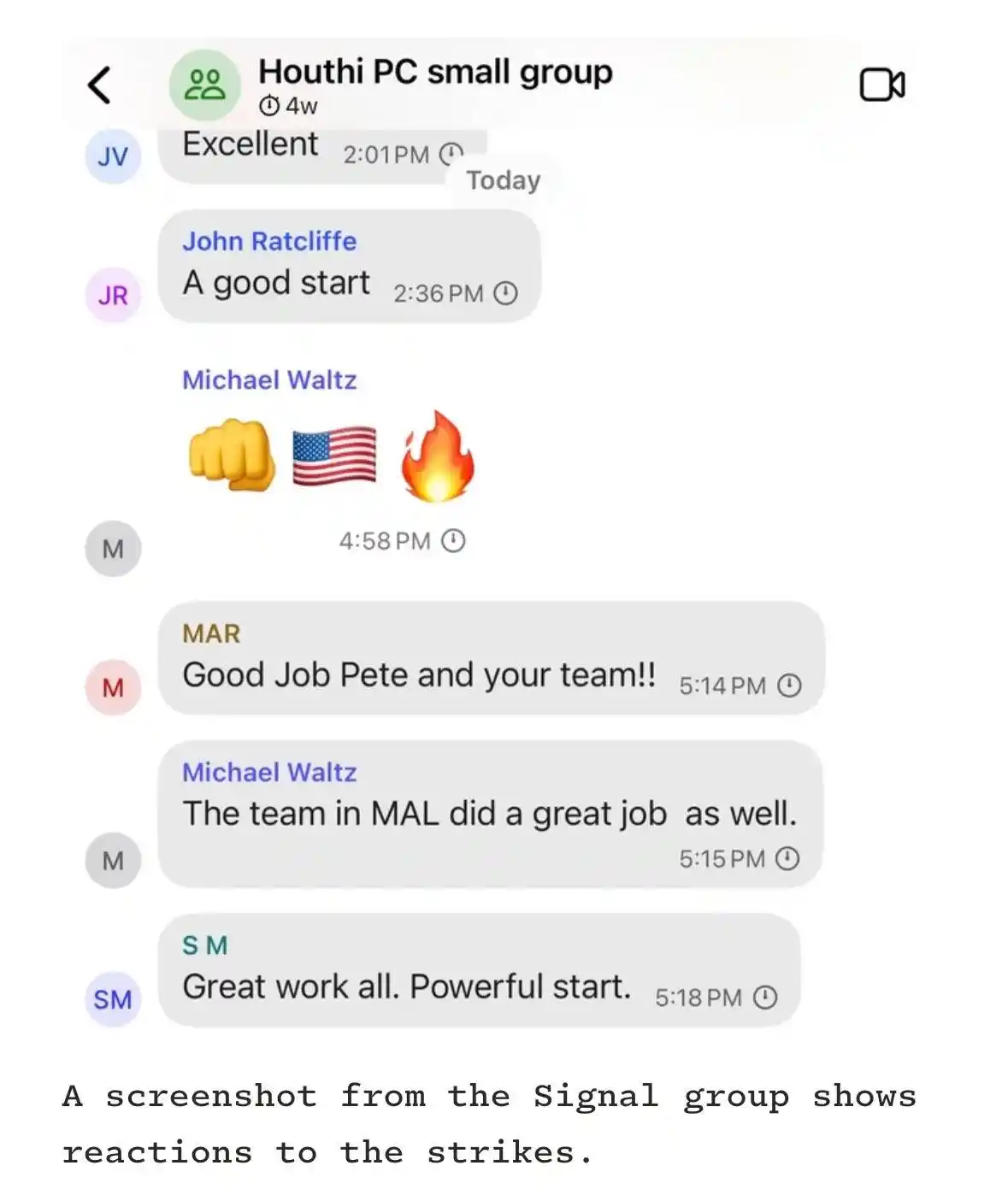
The Vice President of the United States is also using Signal for

This incident perfectly illustrates the so-called "stage theory." What appears to outsiders as a well-organized, authoritative, and solemn power structure may be more chaotic and impromptu on the inside than we imagine. The most powerful government in the world is also conducting group work online, and may even make such low-level mistakes as "adding the wrong person."

Looking at the messaging app they used, Signal, is both unexpected and reasonable.

Signal is no stranger to the spotlight.

Long before becoming an inadvertent "witness platform" for U.S. military operations, this instant messaging app had gained widespread recognition from the tech industry and privacy advocates for its outstanding privacy protection capabilities. Figures such as Tesla CEO Elon Musk and "Prismgate" whistleblower Edward Snowden have openly praised Signal.

At the beginning of 2021, when WhatsApp announced an update to its privacy policy, Musk simply tweeted "Use Signal," prompting a significant surge in Signal downloads that temporarily crashed its verification system.
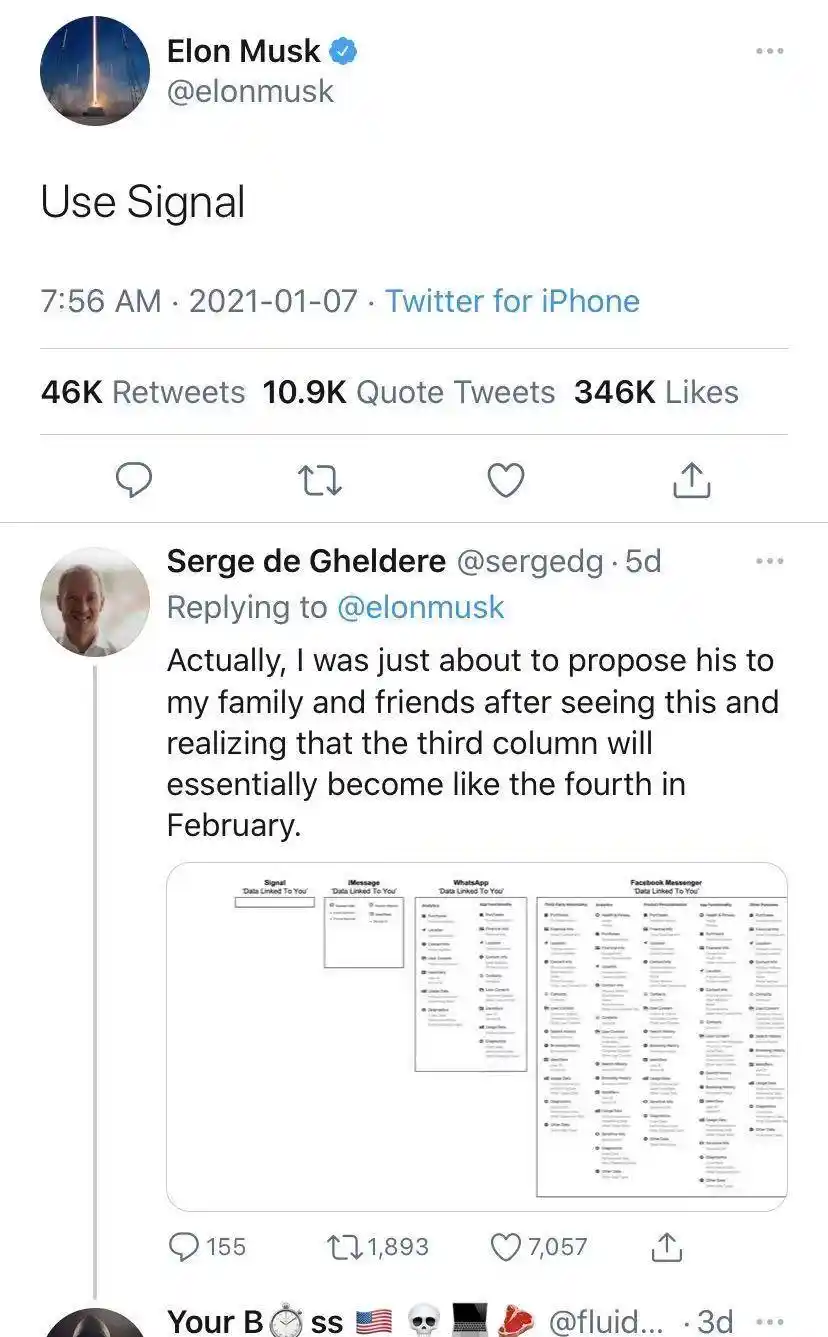
Edward Snowden, seen as a champion of privacy, had already stated back in 2015: "I use Signal every day." He believed Signal to be one of the most secure communication tools on the market.

This event also brought Signal a lot of exposure, with Signal's Android app download surpassing that of WhatsApp and briefly ranking first. The official Signal account posted saying: Sometimes simply saying "thank you" in one language isn't enough, so merci, danke, and bedankt (note: thank you in other languages).
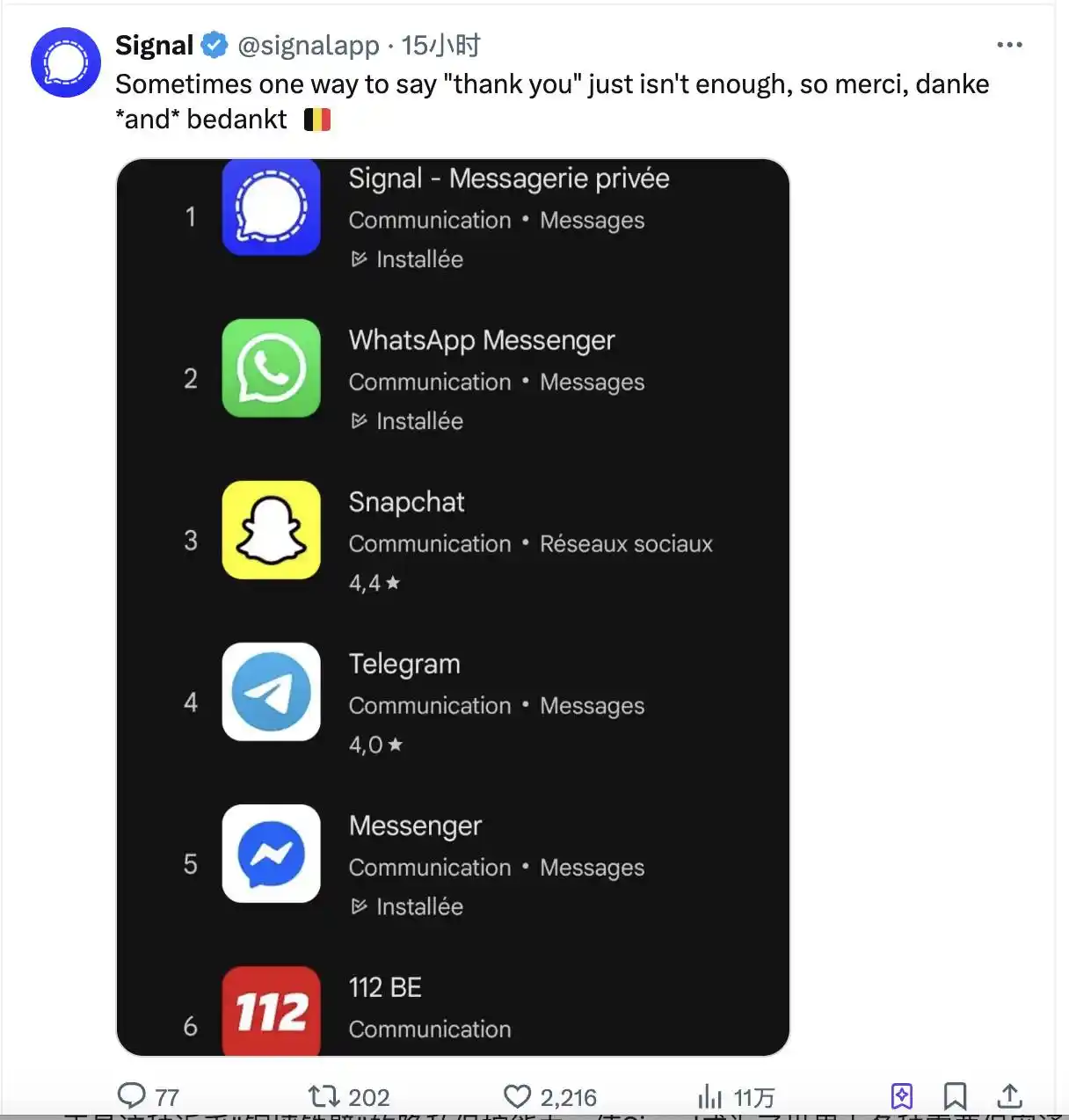
Signal's core strength lies in its advanced end-to-end encryption technology, where all communication content (including text, voice, video, and emojis) can only be deciphered by the sender and the receiver. Even if communication is intercepted, eavesdroppers can only see meaningless strings.

This encryption mechanism is so strong that even Signal itself cannot read users' communication content, does not collect metadata, does not store call records, and does not perform cloud backups, fundamentally eliminating the possibility of data leaks.

It is this nearly "impregnable" privacy protection capability that has made Signal the preferred tool for various individuals requiring secure communication worldwide.

From journalists, human rights activists, and political dissidents to many sensitive-position individuals, Signal is relied upon to safeguard their communication security. In Latin America, there are activists helping women seek abortion rights, defectors evading spies, lawyers from national bar associations, leaders of the "Black Lives Matter" movement, and even former ISIS members—all finding a new user base on Signal, including high-ranking officials from the Trump administration.

When the U.S. government and its adversaries are all "working remotely" on the same communication platform, there is a cyberpunk-esque absurdity: those wielding immense power are using a tool created by an anarchist to exercise their authority.

This anarchist's name is Moxie Marlinspike.

The Most Interesting Person in the World

Signal's founder Moxie Marlinspike is a legendary and mysterious figure in the tech world.

This cryptography genius, whose real name is Matthew Rosenfeld, not only created the world's most secure communication software but also led an incredibly adventurous life, earning the title of "one of the most interesting people on Earth" by Snowden.

Marlinspike grew up in central Georgia, showing dissatisfaction with conventional education and a talent for technology from a young age. He despised the mundane tasks that stifled curiosity in school but found the joy of programming on a rudimentary computer in the school library that had no hard drive and couldn't even save code.

Before the age of ten, he discovered the hacker classic magazine 2600 in a local bookstore, starting his hacker journey. When his mother bought him a cheap desktop computer, the young Marlinspike could already set up "ambushes" on his friends' computers, making messages suddenly appear on the screen to startle them.

In 1999, filled with a yearning for the cyberpunk world, Marlinspike moved to Silicon Valley after high school graduation, only to find that it was a far cry from the future world depicted in William Gibson's novels, with only "office parks and highways."

He soon found a programming job at WebLogic but grew tired of the "40 hours a week in front of a keyboard" life that came with entering the tech industry. Over the next few years, Marlinspike lived a nearly punk lifestyle in the San Francisco Bay Area—from squatting in abandoned buildings to moving into an old post office warehouse, participating in political protests, and reading works by anarchist theorists like Emma Goldman.

These experiences during this period profoundly shaped his critical thinking towards authority.

Unwilling to lead a mundane life, Marlinspike's life was full of incredible adventures.

He once rode a bicycle through San Francisco carrying a 40-foot sailboat mast; self-taught to fly a hot air balloon but crashed in the desert, leading to a month of crutch-assisted recovery; and even had friends witness his miraculous performance of playing rock-paper-scissors for high stakes without ever losing.

In 2003, he decided to learn sailing, spent all his savings on buying a run-down 27-foot Catalina sailboat, and then set off alone from the San Francisco harbor to Mexico, achieving self-taught mastery through repeated trials along the way.

The following year, he even filmed the DIY sailboat documentary Hold Fast, documenting his adventure with three friends sailing a leaky "plague ship" from Florida to the Bahamas, eventually abandoning ship in the Dominican Republic.

Perhaps it is this pursuit of freedom and questioning of authority that led Marlinspike to create Signal.

In 2010, he launched TextSecure (Signal's precursor), beginning his revolutionary work in the field of encrypted communication. In 2015, when Snowden first met Marlinspike in Moscow, he described the cryptographer as "hilarious, awesome, incredibly fun, wild."

Marlinspike has always maintained a high regard for personal privacy, rarely discussing his own personal life, including his age, hometown, or even his real name. This dedication to privacy is also reflected in Signal, the communication tool he created—a tool that does not collect user data, does not store communication records, and is fully end-to-end encrypted.

Unlike many tech founders, Marlinspike is not driven by commercial success. The Signal Foundation operates as a non-profit organization, primarily funded by donations, including an initial $50 million donation from WhatsApp co-founder Brian Acton.

Signal Meets Cryptocurrency, FTX Loses Hundreds of Millions

As a staunch anarchist and privacy advocate, Marlinspike also intersects with cryptocurrency.

The decentralization, censorship resistance, and privacy protection features of cryptocurrencies like Bitcoin align philosophically with Marlinspike's original intent in creating Signal—to provide people with a communication tool that is free from government or corporate surveillance. Both stem from the cypherpunk movement, seeking to protect individual freedom and privacy through cryptographic technology.

In April 2021, the Signal mobile app announced the integration of the privacy-focused payment project MobileCoin, enabling payments with MobileCoin. Following this announcement, the MOB token saw a sustained surge with a 6x increase in 14 days and an 8x increase in 30 days.

The reason behind the surge was later exposed when an FTX customer engaged in heavy leveraged trading on MobileCoin (MOB), causing the coin price to skyrocket from $6 to nearly $70 at its peak and leveraging their large positions for collateralized lending.

However, the MOB price quickly retraced to pre-surge levels, leading Alameda, a market maker also owned by FTX founder SBF, to intervene to protect FTX's liquidity, resulting in Alameda bearing losses of hundreds of millions of dollars.

The integration of MobileCoin into Signal has also sparked significant controversy. Reports have indicated that Marlinspike previously served as a technical advisor to MobileCoin and may hold a significant amount of the coin. This has led some users to question whether Signal is deviating from its nonprofit origins and turning towards a commercialization path.

In response to this, Marlinspike stated that Signal chose MobileCoin because it offers the best privacy protection and user experience, rather than out of personal interest.

Despite his strong ties to cryptocurrency, Marlinspike is also a critic of cryptocurrency.

In early 2022, he published a widely circulated article on his personal blog titled "My first impressions of web3," questioning the decentralization promises of Web3 and blockchain technology.

He pointed out that while blockchain protocols themselves are decentralized, the way users access these protocols is often highly centralized, such as relying on wallets like MetaMask and infrastructure services like Infura.

Marlinspike also conducted an experiment: he listed an NFT that would change its appearance based on where you viewed it from. When browsing on OpenSea or Rarible, it appeared as artwork; but after purchasing and viewing it from a wallet, it showed an emoji of poop!

Subsequently, this NFT was inexplicably taken down by OpenSea, leaving him speechless. What's more, after the NFT was delisted, the NFT he had in his wallet (which he purchased himself) also disappeared!

Marlinspike believes that a truly decentralized system should be one where people "can participate directly in a system without requiring any third-party permission or mediation."

Ethereum founder Vitalik Buterin quickly responded to this article on Reddit, broadly agreeing with Marlinspike's points and considering it a fair critique of the current situation. However, he also mentioned that there are many developers and researchers looking to use cryptography to improve the entire ecosystem and realize the decentralization ideal.

The current trend towards centralization is mainly because it is a simpler and quicker approach, while the slower development towards decentralization is due to a lack of technical resources and funding, along with encountering various technical challenges along the way. However, most of the major challenges have now been overcome, so Vitalik remains optimistic about the future development.

Although Marlinspike does hold some criticisms of cryptocurrency, the story of Signal intertwined with the world of cryptocurrency continues, both sharing a mission to protect user privacy and resist centralised control.

In this era of constant struggle between encryption and decryption, privacy and surveillance, Signal has become a unique presence—it is both a symbol of resistance and a tool of power; both a fortress of privacy and a stage for unexpected leaks.

Signal, this ship, carries passengers of all kinds, from government officials to anarchists, from cryptocurrency enthusiasts to regular users, sailing towards a more chaotic future.

Original Article Link

You may also like

Token Cannot Compound, Where Is the Real Investment Opportunity?

The next chapter in the crypto industry will undoubtedly be written by Crypto-empowered Stocks.

February 6th Market Key Intelligence, How Much Did You Miss?

1. On-chain Flows: $508.2M USD inflow to Ethereum today; $390.8M USD outflow from Arbitrum 2. Biggest Gainers/Losers: $HBTC, $AIO 3. Top News: Current Bitcoin weekly RSI oversold signal comparable to June 2022

China's Central Bank and Eight Other Departments' Latest Regulatory Focus: Key Attention to RWA Tokenized Asset Risk


Foreword: Today, the People's Bank of China's website published the "Notice of the People's Bank of China, National Development and Reform Commission, Ministry of Industry and Information Technology, Ministry of Public Security, State Administration for Market Regulation, China Banking and Insurance Regulatory Commission, China Securities Regulatory Commission, State Administration of Foreign Exchange on Further Preventing and Dealing with Risks Related to Virtual Currency and Others (Yinfa [2026] No. 42)", the latest regulatory requirements from the eight departments including the central bank, which are basically consistent with the regulatory requirements of recent years. The main focus of the regulation is on speculative activities such as virtual currency trading, exchanges, ICOs, overseas platform services, and this time, regulatory oversight of RWA has been added, explicitly prohibiting RWA tokenization, stablecoins (especially those pegged to the RMB). The following is the full text:


To the people's governments of all provinces, autonomous regions, and municipalities directly under the Central Government, the Xinjiang Production and Construction Corps:


  Recently, there have been speculative activities related to virtual currency and Real-World Assets (RWA) tokenization, disrupting the economic and financial order and jeopardizing the property security of the people. In order to further prevent and address the risks related to virtual currency and Real-World Assets tokenization, effectively safeguard national security and social stability, in accordance with the "Law of the People's Republic of China on the People's Bank of China," "Law of the People's Republic of China on Commercial Banks," "Securities Law of the People's Republic of China," "Law of the People's Republic of China on Securities Investment Funds," "Law of the People's Republic of China on Futures and Derivatives," "Cybersecurity Law of the People's Republic of China," "Regulations of the People's Republic of China on the Administration of Renminbi," "Regulations on Prevention and Disposal of Illegal Fundraising," "Regulations of the People's Republic of China on Foreign Exchange Administration," "Telecommunications Regulations of the People's Republic of China," and other provisions, after reaching consensus with the Cyberspace Administration of China, the Supreme People's Court, and the Supreme People's Procuratorate, and with the approval of the State Council, the relevant matters are notified as follows:


  I. Clarify the essential attributes of virtual currency, Real-World Assets tokenization, and related business activities


  (I) Virtual currency does not possess the legal status equivalent to fiat currency. Virtual currencies such as Bitcoin, Ether, Tether, etc., have the main characteristics of being issued by non-monetary authorities, using encryption technology and distributed ledger or similar technology, existing in digital form, etc. They do not have legal tender status, should not and cannot be circulated and used as currency in the market.


  The business activities related to virtual currency are classified as illegal financial activities. The exchange of fiat currency and virtual currency within the territory, exchange of virtual currencies, acting as a central counterparty in buying and selling virtual currencies, providing information intermediary and pricing services for virtual currency transactions, token issuance financing, and trading of virtual currency-related financial products, etc., fall under illegal financial activities, such as suspected illegal issuance of token vouchers, unauthorized public issuance of securities, illegal operation of securities and futures business, illegal fundraising, etc., are strictly prohibited across the board and resolutely banned in accordance with the law. Overseas entities and individuals are not allowed to provide virtual currency-related services to domestic entities in any form.


  A stablecoin pegged to a fiat currency indirectly fulfills some functions of the fiat currency in circulation. Without the consent of relevant authorities in accordance with the law and regulations, any domestic or foreign entity or individual is not allowed to issue a RMB-pegged stablecoin overseas.


(II)Tokenization of Real-World Assets refers to the use of encryption technology and distributed ledger or similar technologies to transform ownership rights, income rights, etc., of assets into tokens (tokens) or other interests or bond certificates with token (token) characteristics, and carry out issuance and trading activities.


  Engaging in the tokenization of real-world assets domestically, as well as providing related intermediary, information technology services, etc., which are suspected of illegal issuance of token vouchers, unauthorized public offering of securities, illegal operation of securities and futures business, illegal fundraising, and other illegal financial activities, shall be prohibited; except for relevant business activities carried out with the approval of the competent authorities in accordance with the law and regulations and relying on specific financial infrastructures. Overseas entities and individuals are not allowed to illegally provide services related to the tokenization of real-world assets to domestic entities in any form.


  II. Sound Work Mechanism


  (III) Inter-agency Coordination. The People's Bank of China, together with the National Development and Reform Commission, the Ministry of Industry and Information Technology, the Ministry of Public Security, the State Administration for Market Regulation, the China Banking and Insurance Regulatory Commission, the China Securities Regulatory Commission, the State Administration of Foreign Exchange, and other departments, will improve the work mechanism, strengthen coordination with the Cyberspace Administration of China, the Supreme People's Court, and the Supreme People's Procuratorate, coordinate efforts, and overall guide regions to carry out risk prevention and disposal of virtual currency-related illegal financial activities.


  The China Securities Regulatory Commission, together with the National Development and Reform Commission, the Ministry of Industry and Information Technology, the Ministry of Public Security, the People's Bank of China, the State Administration for Market Regulation, the China Banking and Insurance Regulatory Commission, the State Administration of Foreign Exchange, and other departments, will improve the work mechanism, strengthen coordination with the Cyberspace Administration of China, the Supreme People's Court, and the Supreme People's Procuratorate, coordinate efforts, and overall guide regions to carry out risk prevention and disposal of illegal financial activities related to the tokenization of real-world assets.


  (IV) Strengthening Local Implementation. The people's governments at the provincial level are overall responsible for the prevention and disposal of risks related to virtual currencies and the tokenization of real-world assets in their respective administrative regions. The specific leading department is the local financial regulatory department, with participation from branches and dispatched institutions of the State Council's financial regulatory department, telecommunications regulators, public security, market supervision, and other departments, in coordination with cyberspace departments, courts, and procuratorates, to improve the normalization of the work mechanism, effectively connect with the relevant work mechanisms of central departments, form a cooperative and coordinated working pattern between central and local governments, effectively prevent and properly handle risks related to virtual currencies and the tokenization of real-world assets, and maintain economic and financial order and social stability.


  III. Strengthened Risk Monitoring, Prevention, and Disposal


  (5) Enhanced Risk Monitoring. The People's Bank of China, China Securities Regulatory Commission, National Development and Reform Commission, Ministry of Industry and Information Technology, Ministry of Public Security, State Administration of Foreign Exchange, Cyberspace Administration of China, and other departments continue to improve monitoring techniques and system support, enhance cross-departmental data analysis and sharing, establish sound information sharing and cross-validation mechanisms, promptly grasp the risk situation of activities related to virtual currency and real-world asset tokenization. Local governments at all levels give full play to the role of local monitoring and early warning mechanisms. Local financial regulatory authorities, together with branches and agencies of the State Council's financial regulatory authorities, as well as departments of cyberspace and public security, ensure effective connection between online monitoring, offline investigation, and fund tracking, efficiently and accurately identify activities related to virtual currency and real-world asset tokenization, promptly share risk information, improve early warning information dissemination, verification, and rapid response mechanisms.


  (6) Strengthened Oversight of Financial Institutions, Intermediaries, and Technology Service Providers. Financial institutions (including non-bank payment institutions) are prohibited from providing account opening, fund transfer, and clearing services for virtual currency-related business activities, issuing and selling financial products related to virtual currency, including virtual currency and related financial products in the scope of collateral, conducting insurance business related to virtual currency, or including virtual currency in the scope of insurance liability. Financial institutions (including non-bank payment institutions) are prohibited from providing custody, clearing, and settlement services for unauthorized real-world asset tokenization-related business and related financial products. Relevant intermediary institutions and information technology service providers are prohibited from providing intermediary, technical, or other services for unauthorized real-world asset tokenization-related businesses and related financial products.


  (7) Enhanced Management of Internet Information Content and Access. Internet enterprises are prohibited from providing online business venues, commercial displays, marketing, advertising, or paid traffic diversion services for virtual currency and real-world asset tokenization-related business activities. Upon discovering clues of illegal activities, they should promptly report to relevant departments and provide technical support and assistance for related investigations and inquiries. Based on the clues transferred by the financial regulatory authorities, the cyberspace administration, telecommunications authorities, and public security departments should promptly close and deal with websites, mobile applications (including mini-programs), and public accounts engaged in virtual currency and real-world asset tokenization-related business activities in accordance with the law.


  (8) Strengthened Entity Registration and Advertisement Management. Market supervision departments strengthen entity registration and management, and enterprise and individual business registrations must not contain terms such as "virtual currency," "virtual asset," "cryptocurrency," "crypto asset," "stablecoin," "real-world asset tokenization," or "RWA" in their names or business scopes. Market supervision departments, together with financial regulatory authorities, legally enhance the supervision of advertisements related to virtual currency and real-world asset tokenization, promptly investigating and handling relevant illegal advertisements.


  (IX) Continued Rectification of Virtual Currency Mining Activities. The National Development and Reform Commission, together with relevant departments, strictly controls virtual currency mining activities, continuously promotes the rectification of virtual currency mining activities. The people's governments of various provinces take overall responsibility for the rectification of "mining" within their respective administrative regions. In accordance with the requirements of the National Development and Reform Commission and other departments in the "Notice on the Rectification of Virtual Currency Mining Activities" (NDRC Energy-saving Building [2021] No. 1283) and the provisions of the "Guidance Catalog for Industrial Structure Adjustment (2024 Edition)," a comprehensive review, investigation, and closure of existing virtual currency mining projects are conducted, new mining projects are strictly prohibited, and mining machine production enterprises are strictly prohibited from providing mining machine sales and other services within the country.


  (X) Severe Crackdown on Related Illegal Financial Activities. Upon discovering clues to illegal financial activities related to virtual currency and the tokenization of real-world assets, local financial regulatory authorities, branches of the State Council's financial regulatory authorities, and other relevant departments promptly investigate, determine, and properly handle the issues in accordance with the law, and seriously hold the relevant entities and individuals legally responsible. Those suspected of crimes are transferred to the judicial authorities for processing according to the law.


 (XI) Severe Crackdown on Related Illegal and Criminal Activities. The Ministry of Public Security, the People's Bank of China, the State Administration for Market Regulation, the China Banking and Insurance Regulatory Commission, the China Securities Regulatory Commission, as well as judicial and procuratorial organs, in accordance with their respective responsibilities, rigorously crack down on illegal and criminal activities related to virtual currency, the tokenization of real-world assets, such as fraud, money laundering, illegal business operations, pyramid schemes, illegal fundraising, and other illegal and criminal activities carried out under the guise of virtual currency, the tokenization of real-world assets, etc.


  (XII) Strengthen Industry Self-discipline. Relevant industry associations should enhance membership management and policy advocacy, based on their own responsibilities, advocate and urge member units to resist illegal financial activities related to virtual currency and the tokenization of real-world assets. Member units that violate regulatory policies and industry self-discipline rules are to be disciplined in accordance with relevant self-regulatory management regulations. By leveraging various industry infrastructure, conduct risk monitoring related to virtual currency, the tokenization of real-world assets, and promptly transfer issue clues to relevant departments.


  IV. Strict Supervision of Domestic Entities Engaging in Overseas Business Activities


(XIII) Without the approval of relevant departments in accordance with the law and regulations, domestic entities and foreign entities controlled by them may not issue virtual currency overseas.


  (XIV) Domestic entities engaging directly or indirectly in overseas external debt-based tokenization of real-world assets, or conducting asset securitization activities abroad based on domestic ownership rights, income rights, etc. (hereinafter referred to as domestic equity), should be strictly regulated in accordance with the principles of "same business, same risk, same rules." The National Development and Reform Commission, the China Securities Regulatory Commission, the State Administration of Foreign Exchange, and other relevant departments regulate it according to their respective responsibilities. For other forms of overseas real-world asset tokenization activities based on domestic equity by domestic entities, the China Securities Regulatory Commission, together with relevant departments, supervise according to their division of responsibilities. Without the consent and filing of relevant departments, no unit or individual may engage in the above-mentioned business.


  (15) Overseas subsidiaries and branches of domestic financial institutions providing Real World Asset Tokenization-related services overseas shall do so legally and prudently. They shall have professional personnel and systems in place to effectively mitigate business risks, strictly implement customer onboarding, suitability management, anti-money laundering requirements, and incorporate them into the domestic financial institutions' compliance and risk management system. Intermediaries and information technology service providers offering Real World Asset Tokenization services abroad based on domestic equity or conducting Real World Asset Tokenization business in the form of overseas debt for domestic entities directly or indirectly venturing abroad must strictly comply with relevant laws and regulations. They should establish and improve relevant compliance and internal control systems in accordance with relevant normative requirements, strengthen business and risk control, and report the business developments to the relevant regulatory authorities for approval or filing.


  V. Strengthen Organizational Implementation


  (16) Strengthen organizational leadership and overall coordination. All departments and regions should attach great importance to the prevention of risks related to virtual currencies and Real World Asset Tokenization, strengthen organizational leadership, clarify work responsibilities, form a long-term effective working mechanism with centralized coordination, local implementation, and shared responsibilities, maintain high pressure, dynamically monitor risks, effectively prevent and mitigate risks in an orderly and efficient manner, legally protect the property security of the people, and make every effort to maintain economic and financial order and social stability.


  (17) Widely carry out publicity and education. All departments, regions, and industry associations should make full use of various media and other communication channels to disseminate information through legal and policy interpretation, analysis of typical cases, and education on investment risks, etc. They should promote the illegality and harm of virtual currencies and Real World Asset Tokenization-related businesses and their manifestations, fully alert to potential risks and hidden dangers, and enhance public awareness and identification capabilities for risk prevention.


  VI. Legal Responsibility


  (18) Engaging in illegal financial activities related to virtual currencies and Real World Asset Tokenization in violation of this notice, as well as providing services for virtual currencies and Real World Asset Tokenization-related businesses, shall be punished in accordance with relevant regulations. If it constitutes a crime, criminal liability shall be pursued according to the law. For domestic entities and individuals who knowingly or should have known that overseas entities illegally provided virtual currency or Real World Asset Tokenization-related services to domestic entities and still assisted them, relevant responsibilities shall be pursued according to the law. If it constitutes a crime, criminal liability shall be pursued according to the law.


  (19) If any unit or individual invests in virtual currencies, Real World Asset Tokens, and related financial products against public order and good customs, the relevant civil legal actions shall be invalid, and any resulting losses shall be borne by them. If there are suspicions of disrupting financial order and jeopardizing financial security, the relevant departments shall deal with them according to the law.


  This notice shall enter into force upon the date of its issuance. The People's Bank of China and ten other departments' "Notice on Further Preventing and Dealing with the Risks of Virtual Currency Trading Speculation" (Yinfa [2021] No. 237) is hereby repealed.


Former Partner's Perspective on Multicoin: Kyle's Exit, But the Game He Left Behind Just Getting Started

Kyle knew his game, so he decided to focus on playing the game he was good at and interested in.

Why Bitcoin Is Falling Now: The Real Reasons Behind BTC's Crash & WEEX's Smart Profit Playbook

Bitcoin's ongoing crash explained: Discover the 5 hidden triggers behind BTC's plunge & how WEEX's Auto Earn and Trade to Earn strategies help traders profit from crypto market volatility.

Wall Street's Hottest Trades See Exodus

This time there is no single triggering factor, but rather market anxiety about asset valuation, with many already skeptical of these valuations being too high, leading to investors choosing to retreat almost simultaneously.

Popular coins

Latest Crypto News

Read more
