
What sets Nillion, a decentralized "blind computation" network soon to be launched on Binance, apart?





Original Title: "Airdrop Sparks Discussion, Mainnet Countdown: What Sets Apart Nillion, the Blind Computing Network That Raised $50 Million?"
Original Source: DeepTech TechFlow
On March 20, 2025, the decentralized blind computing network Nillion unveiled the $NIL tokenomics, signaling the start of the TGE and mainnet countdown phase.
The first quarter of 2025 saw many blockbuster TGE projects, but Nillion's TGE still sparked significant discussion.
On one hand, former Uber founding engineer Conrad Whelan entered the Web3 space, positioning Nillion as a star project in the privacy + data + AI arena: in December 2022, it achieved a $180 million valuation and completed a $20 million seed round with Distributed Global as the lead investor; in October 2024, Nillion secured a new $25 million funding round led by Hack VC, bringing the total funding amount to over $50 million.
On the other hand, prior to the TGE, Nillion faced a whirlwind of controversy due to the premature leak of the airdrop plan and early supporters not being rewarded. In response to the uproar, Nillion promptly implemented a series of measures, including CMO Charlie Rogers publishing an article to address community concerns and swiftly releasing a new version of the airdrop lookup tool, demonstrating strong problem-solving abilities and a firm commitment to ensuring rewards truly belong to long-term supporters, ultimately turning the situation around and receiving widespread praise.
Privacy is a fundamental human right.
In the Web2 space, whether it's frequent unwanted calls/texts/emails or identity information, facial recognition data, or shopping records sold indiscriminately in related Telegram bots or groups, it's clear that the issue of privacy breaches has reached a critical point.
Therefore, the Web3 privacy track, which has always aimed to disrupt using decentralized power, has been under close scrutiny.
As a decentralized "blind computing" network, what sets Nillion apart?
With the TGE underway and the mainnet officially launched, will Nillion, entering a new stage of development, lead the innovation paradigm in the privacy track?
This article aims to delve into Nillion, exploring its specific operational logic and strong ecological performance, shedding light on the future development prospects of the project and the blind computation track.
Image Source: Twitter @nillionnetwork
Make Rules Transparent, Make Community Reassured: Nillion Airdrop to Launch Simultaneously with TGE on March 24
In the crypto world, whether an airdrop can proceed smoothly carries some meaning of "success or failure, it is what it is" for a project:
If the airdrop standard is unclear and scammers abound, the ecosystem will be in chaos, and the project will bear enormous public opinion pressure;
If the airdrop rules are transparent, rewards are truly distributed according to contributions, not only can a strong community be rallied, but it also lays a solid foundation for the project's ecosystem's effective circulation and long-term development.
Image Source: Nillion website
Unfortunately, Nillion's airdrop work encountered an unexpected twist at the beginning of its progress: on March 8, a leaked Nillion airdrop plan spread widely in the community ahead of time, and to the community's dissatisfaction, many early Nillion supporters found themselves not on this airdrop list.
Just as negative emotions began to brew, Nillion noticed this issue and quickly took a series of actions:
On the one hand, Nillion's CMO Charlie Rogers provided a detailed explanation of the airdrop rules in an article, including the airdrop's reward recipients, standard definition, and witch prevention, promptly addressing the community's concerns about the airdrop.
On the other hand, Nillion quickly released an updated version of the airdrop allocation checker within a short period, allowing community members to access the page, connect their wallets, and view specific airdrop results, including badges and airdrop levels. Eligible members will all receive a custom card:
· GOLD Level: 1,000 - 3,000 tokens
· DIAMOND Level: 3,000+ tokens
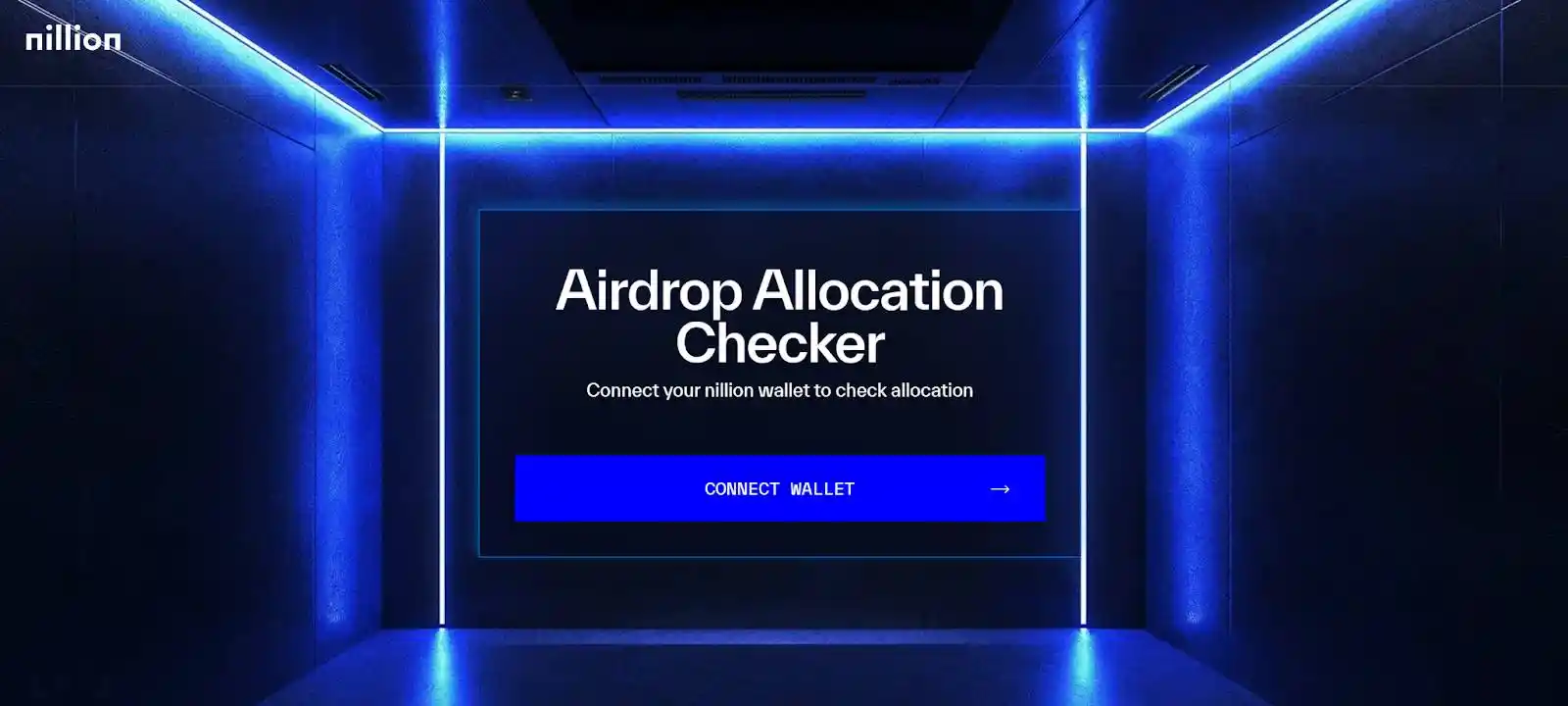
Image Source: Nillion Airdrop Allocation Checker
Meanwhile, Nillion has also canceled the original 90-day pre-staking lockup period. All pre-staking rewards will be unlockable on day one to demonstrate Nillion's commitment to rewarding the community.
In the face of community sentiment, Nillion's decisive and effective handling not only allowed the community to see the project's ample preparation for the airdrop work, but also, through CMO Charlie Rogers' article outlining clear airdrop rules, we felt the project's full respect for ecosystem participants.
Specifically, Nillion's airdrop audience mainly includes the following three major groups, covering both technical and non-technical contributors:
For each group, Nillion has also published specific criteria aimed at accurately identifying long-term participants and true contributors in the ecosystem, ensuring that rewards truly flow to members who bring positive value to the project.
Community Value
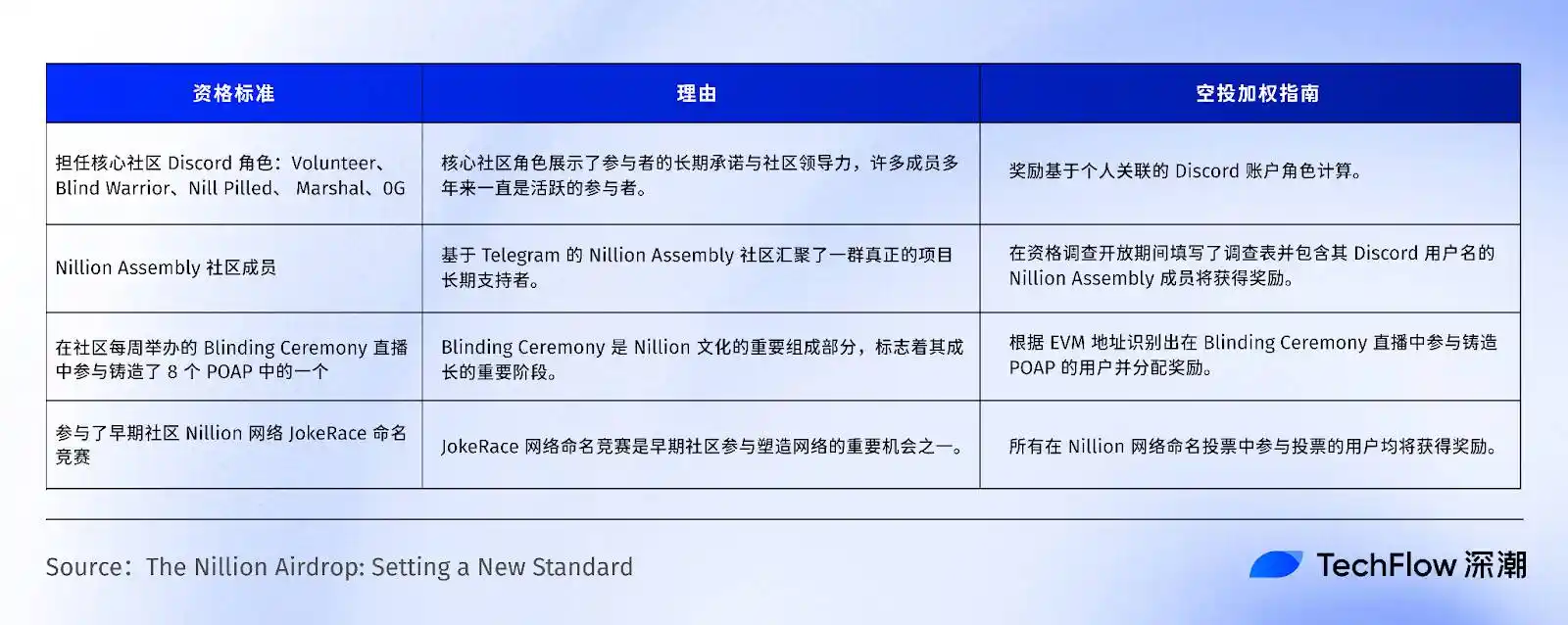
Image Source: Translated from Nillion CMO's Long-form Article "The Nillion Airdrop: Setting a New Standard"
Developers and Open Source Contribution
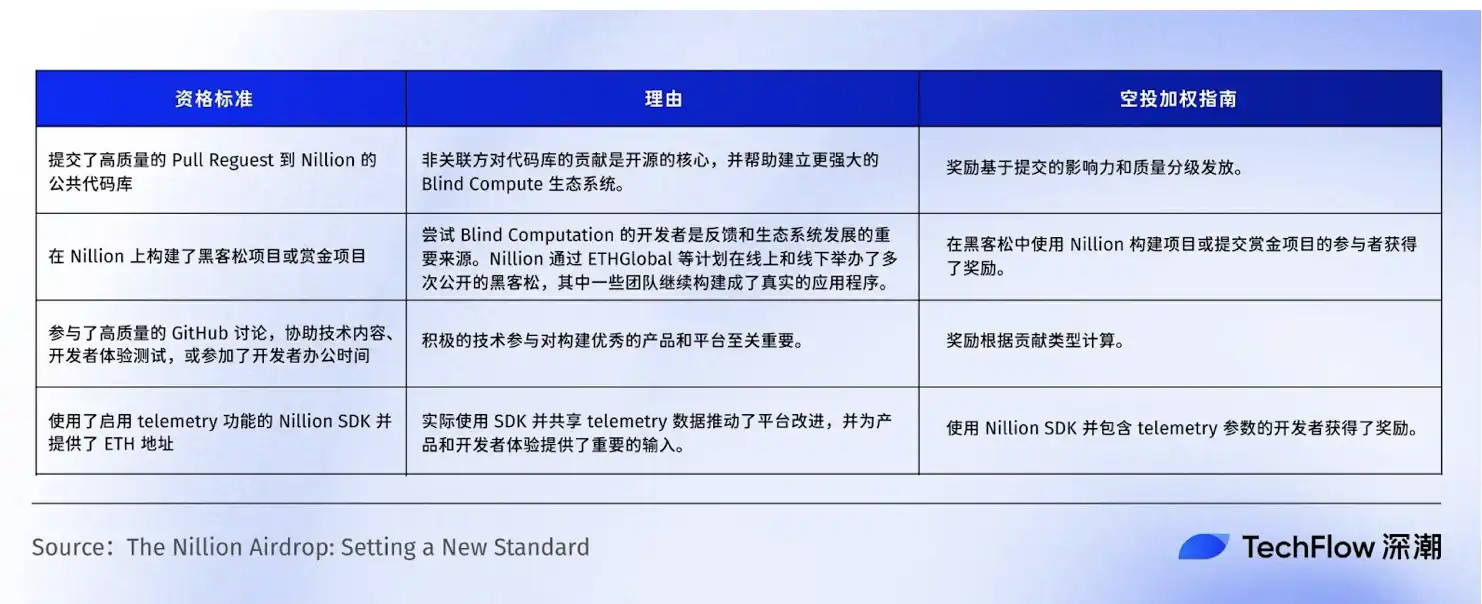
Image Source: Translated from Nillion CMO's Long-form Article "The Nillion Airdrop: Setting a New Standard"
Validator Engagement Plan
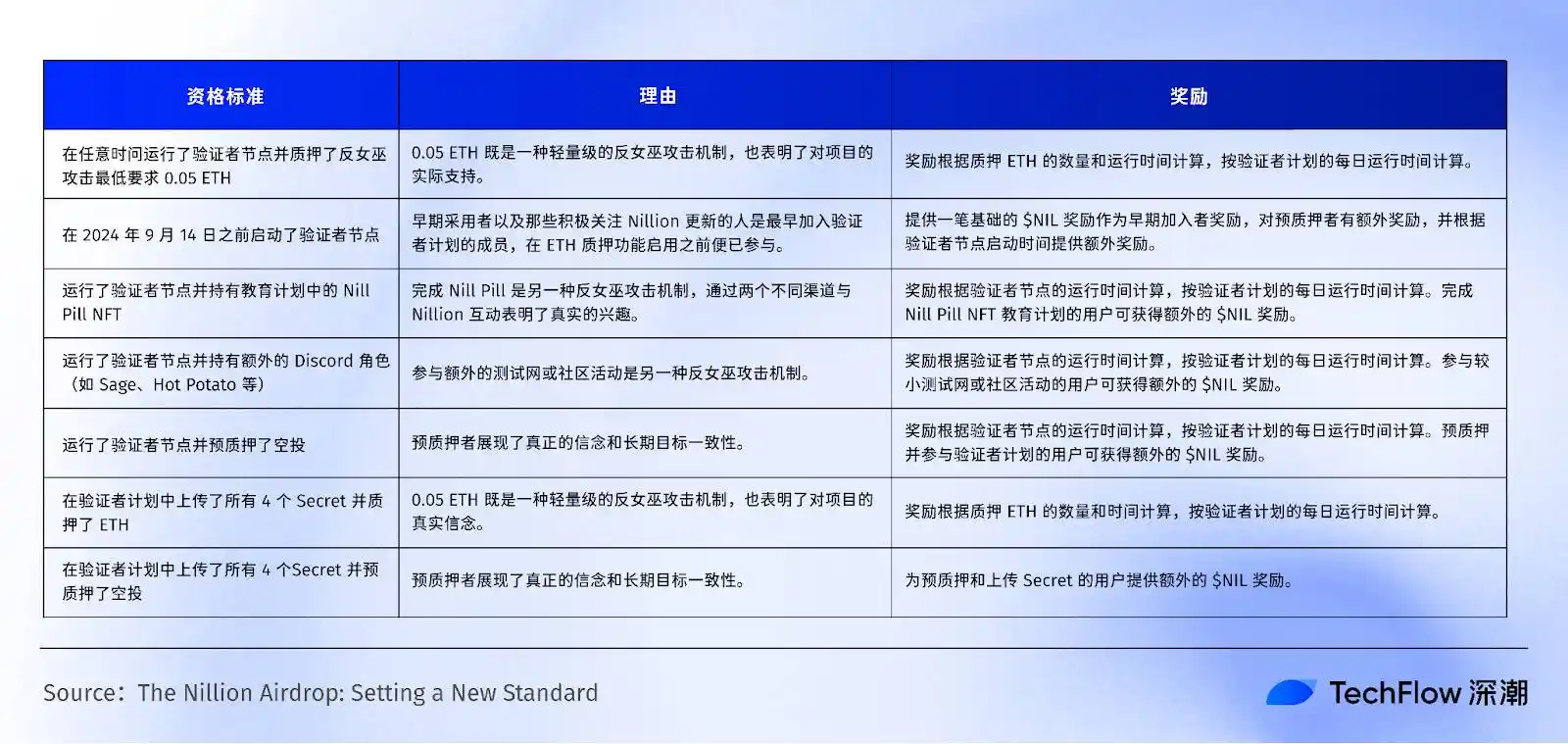
Image Source: Translated from Nillion CMO's Long-form Article "The Nillion Airdrop: Setting a New Standard"
And in the current trend of airdrops becoming industrialized and the ongoing issue of bot farming, Nillion has also introduced corresponding standards, committed to resisting those attempting to simplify the mining process through one-click node services, filtering out pure "freeloaders." According to the information currently released, two types of project participants will be ineligible for the airdrop:
· Low-engagement Secret Submitters: Only submitted 4 Secrets; did not stake any ETH; do not have any Discord roles (including reward roles); do not hold a Nill Pill NFT.
· Low-engagement Late Validators: Joined the validator program after September 14, 2024; did not stake any ETH; do not have any Discord roles (including reward roles); do not hold a Nill Pill NFT.
Although some professional bot farmers have raised doubts on social media, arguing that one-click node services can also be considered a form of ecosystem contribution and should not be excluded in this way, more people still appreciate the series of measures announced by Nillion: clear standards, transparent rules, and a focus on long-term value. Nillion is exploring a new standard for how the crypto community operates.
Currently, Nillion has released the economic model of $NIL, as the native token of the ecosystem, the $NIL token has utility for paying computational and storage fees, incentivizing validators, and may also become an important governance tool for the ecosystem in the future.
The total token supply of $NIL is 1 billion, with an initial circulation of 19.52% (approximately 195.15 million tokens), distributed as follows:
· Ecosystem and R&D: 29%
· Community: 20%
· Protocol Development: 10%
· Early Supporters: 21%
· Core Contributors: 20%
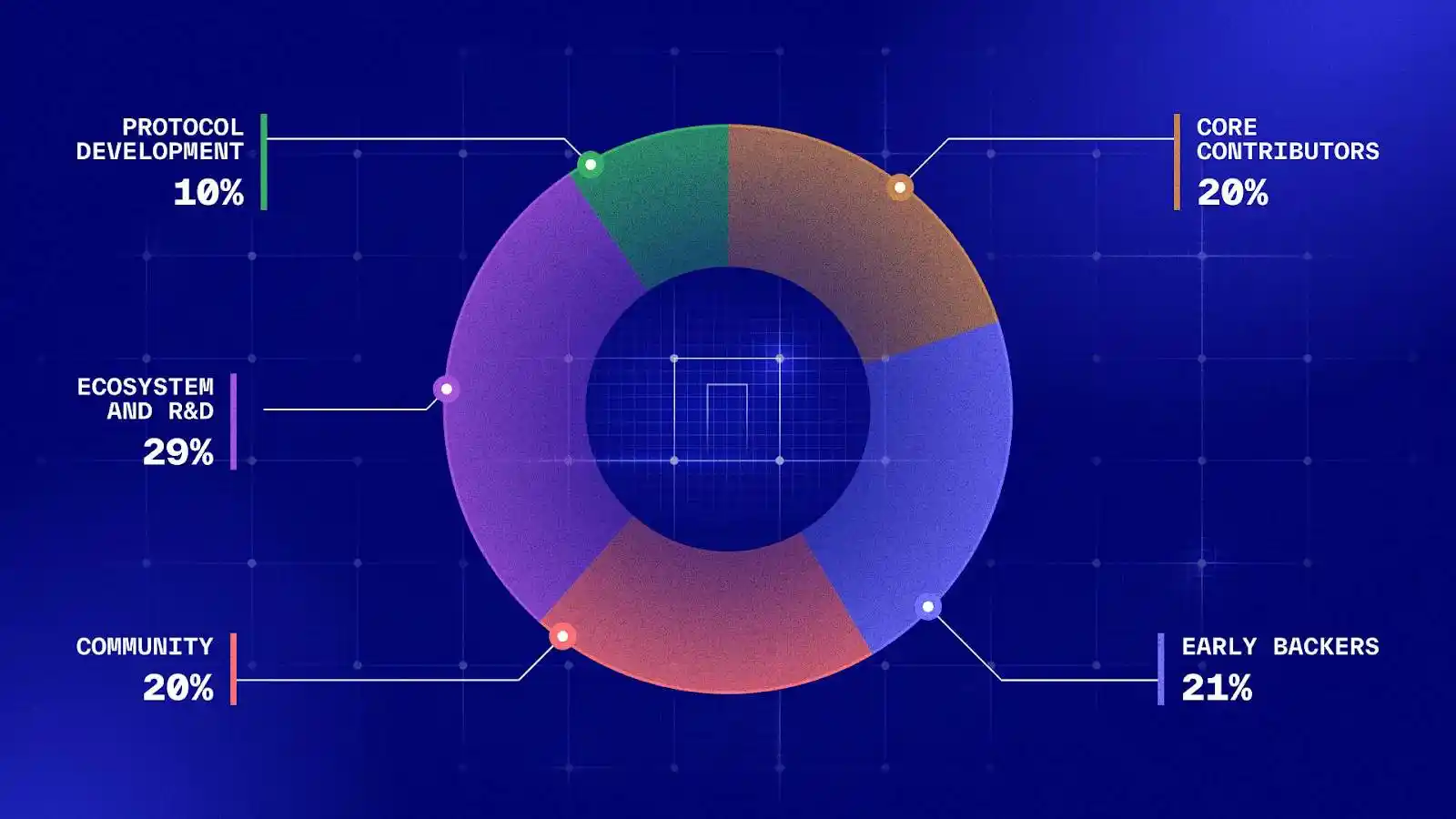
Image Source: Twitter @nillionnetwork
Meanwhile, the release of the $NIL token will coincide with the launch of the Nillion mainnet, Alpha mainnet with blind modules, and community airdrop on March 24. At launch, $NIL will be distributed to the community through airdrops and community round participants with unlocked tokens.
Of course, such a "transparent" airdrop rule has also attracted more attention to Nillion, a privacy track star project, prompting more people to want to delve deeper:
What exactly is Nillion's decentralized blind computation network? How is it different from other privacy solutions?
Focus on High-Value Data, Building a Super Privacy Tool: Stepping into the Nillion Blind Computation Network
A simple one-liner summary of Nillion's goal: High-value data is stored, transmitted, and processed in a fully encrypted state throughout.
This statement can be broken down into two parts:
First: High-Value Data.
The high-value data that Nillion focuses on refers to highly sensitive private data that is of great value to an organization or individual, often capable of significantly impacting a user's life, such as personal medical genetic data. The leakage of this data can often have serious consequences for the data owner, requiring a more robust security line of defense. After achieving "data usability without visibility," these data can further unlock more valuable application scenarios, building a fairer data ecosystem.
Second: Data storage, transmission, and processing in a fully encrypted state.
Many privacy solutions aim to achieve data storage, transmission, and processing in a fully encrypted state. Currently popular blockchain privacy technologies include Zero-Knowledge Proof (ZK), Multi-Party Computation (MPC), Fully Homomorphic Encryption (FHE), and Trusted Execution Environment (TEE).
However, Nillion aims to build a blind computation network where users do not need to trust anyone, and nodes can collaborate to perform calculations on the data. Yet, nodes cannot see the plaintext data locally and know nothing about the input data or output results.
So, what is "blind computation"?
It is actually a broad concept that can be described as various technologies and methods that can "perform calculations without exposing the input data." It is the product of the fusion and development of various cryptographic and secure computing technologies.
In our country's reform and opening up, there is a well-known slogan: It doesn't matter if it's a black cat or a white cat, as long as it catches mice, it's a good cat.
The Nillion blind computation concept has many similarities to this saying:
Various privacy computing methods have their unique advantages and applicable scenarios, but they also have their own dilemmas. For example, MPC often faces communication complexity, FHE faces challenges in breaking through computational overhead, and TEE is criticized for its trusted foundation. A single solution often faces computational complexity and performance limitations, making it difficult to balance efficiency, security, and scalability, and often cannot meet diverse privacy scenarios.
Therefore, Nillion is committed to building a flexible and efficient development environment that aggregates all privacy technologies. Faced with different needs in different scenarios, developers do not need to understand the specifics of privacy technologies. The Nillion compiler will help select the best combination of privacy technologies, thus helping developers easily build privacy-enabled applications.
In this "Blind Computation Network," Nillion adopts a parallel dual-layer architecture with Petnet and NilChain:
NilChain serves as the "scheduling center" and "incentive center" for the entire network:
NilChain is built on the Cosmos SDK and is mainly responsible for node management, task scheduling, inter-cluster coordination, and payment settlement, while also supporting IBC (Inter-Blockchain Communication Protocol) to achieve interoperability with other blockchains. For example, NilChain records node staking and reputation, allocates computing tasks to the appropriate Petnet node cluster, and handles user payments and node rewards.
On the other hand, Petnet is mainly responsible for data storage and computation, consisting of a distributed node network.
As the orchestration layer, Petnet's functionality relies on two key components:
· Compiler: Simplifies the use of privacy technologies by providing different levels of abstraction
· Computing Network: Performs secure computation and manages encrypted data
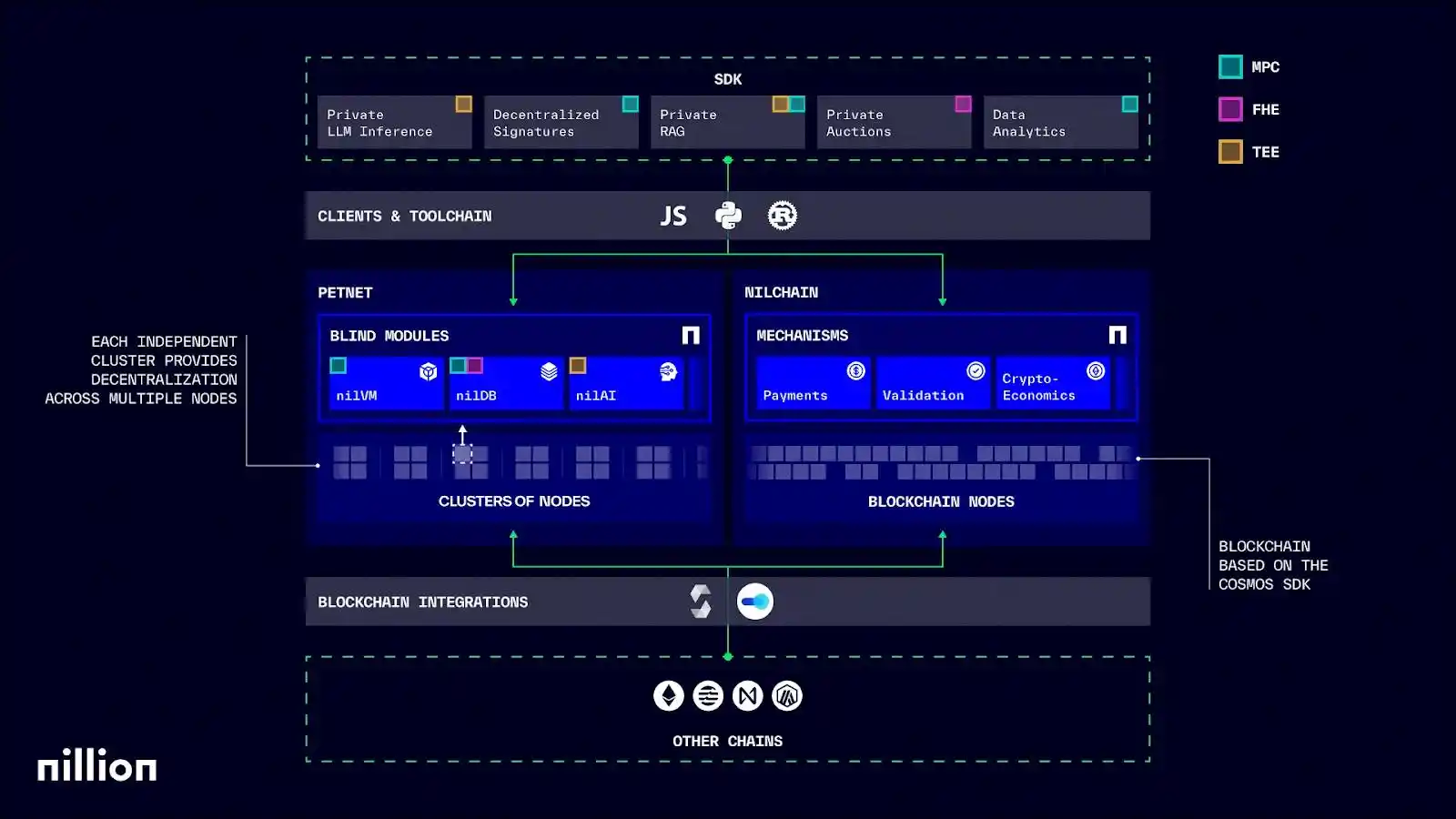
Image Source: Nillion Doc
Petnet integrates various privacy technologies, including ZK, MPC, FHE, and TEE, each running in its independent Blind Module as a core component to perform specific functions. Moreover, Nillion has also introduced a series of utility tools to further lower the privacy barrier and enhance the development experience.
The MPC protocol Curl is based on Linear Secret Sharing Scheme (LSSS), excelling in efficiently handling complex computations and is particularly suitable for addressing real-world issues such as supporting AI Agent development with privacy protection.
Privacy Technology Suite nilAI includes multiple modules such as AIVM, nada-AI, and nilTEE, focusing on supporting the development of Privacy AI.
Virtual Machine nilVM allows developers to use the Nada compiler to compile programs and then upload the compiled programs to the Nillion Network for execution. Nada is Nillion's Python-based open-source Domain Specific Language (DSL) and is developed using the Nillion Software Development Kit (SDK), including components such as nada-AI, nada-numpy, and nada-test, which can significantly reduce the threshold for building privacy applications.
Encrypted Distributed NoSQL database nilDB is designed for secure data storage and computation, enabling encrypted data to be distributed as Secret Shares to multiple nodes to eliminate reliance on a central authority. Furthermore, data owners can authorize others to run SQL-like queries, computation, and privacy-preserving aggregation on the stored data.
When facing complex privacy computation requirements, Petnet internally organizes nodes into clusters to perform specific tasks based on different requirements. Each cluster can be viewed as an independent blind computation unit, providing data sharding across multiple nodes.
Through data sharding technology, data is fragmented into smaller pieces distributed across different nodes, and a single node cannot access the complete dataset. In addition, by introducing MPC and other privacy technologies, multiple nodes can perform collaborative computation without revealing private data, reducing inter-node communication, thereby significantly enhancing security, performance, efficiency, and scalability.
As a blockchain equipped with super privacy tools, the Nillion ecosystem has already taken shape during the testnet phase. The Nillion Blind Computation Network has further confirmed its technical feasibility through in-depth collaboration with major projects. With the upcoming airdrop in March 2025 and the official launch of the mainnet, the next round of growth in the Nillion ecosystem has become a focus of attention for many.
Mainnet Launch Countdown, Exclusive Look at Nillion's Rich Ecosystem Projects in the Privacy Scene
As the highly anticipated Privacy + Data + AI project, Nillion has made very solid preparations for its mainnet debut during the more than eight months of the testnet phase:
Nillion has gone through 200+ investor conference calls, 2 successful testnet iterations, 50+ social media and podcast events, and has posted thousands of tweets. It has also engaged with over 300+ developers and 178 Apps, aiming to further build a developer-friendly environment while closely engaging with the ecosystem and community.
In the previously launched Validator Program, validators will ensure the data integrity of the entire network, playing a key role in maintaining security and the mainnet launch. The program concluded on December 11, 2024, attracting over 500,000 validators in total, collectively processing around 195 million keys, and securing approximately 1050 GB of data.
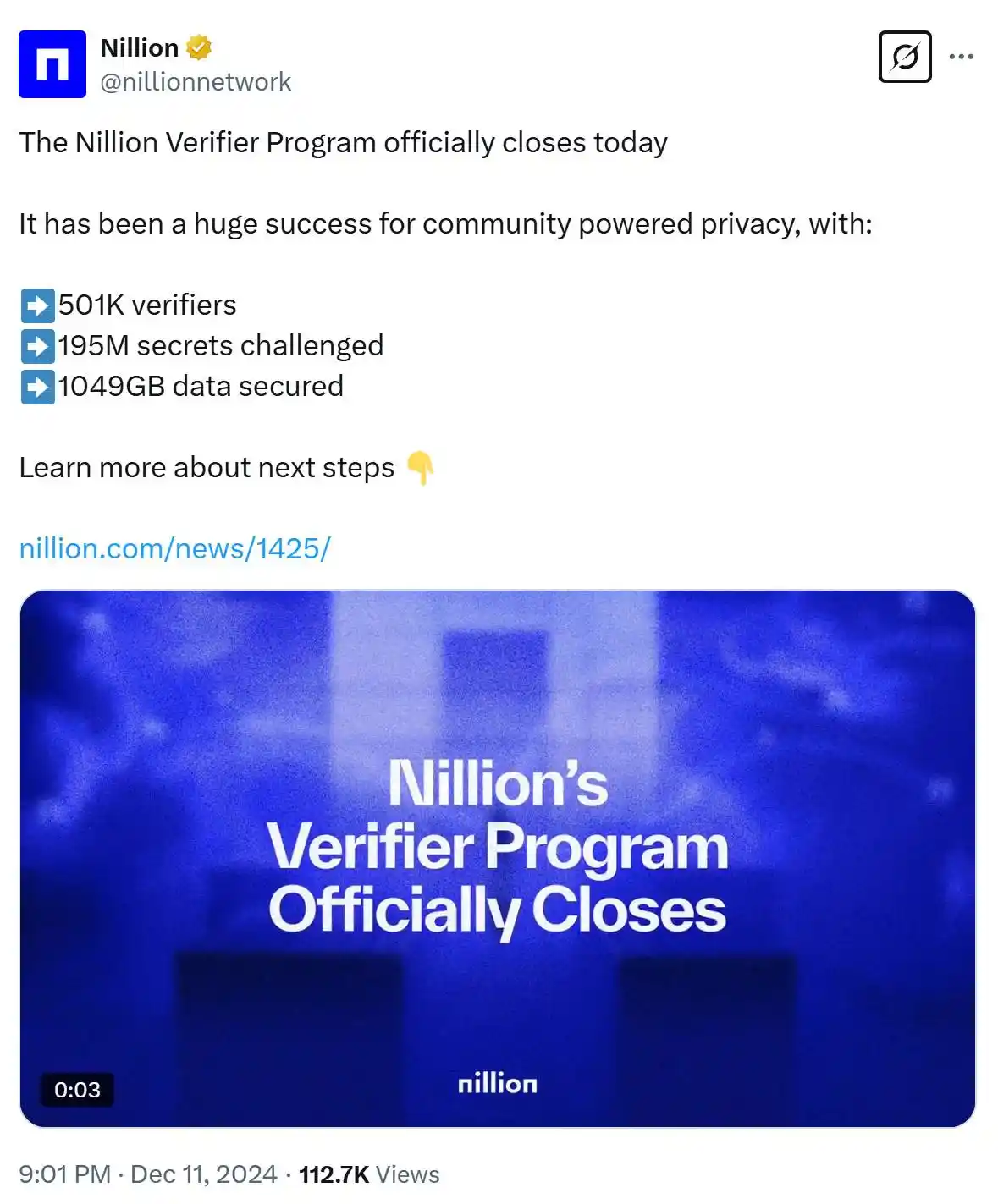
Image Source: Twitter @nillionnetwork
Through the ecosystem overview released by Nillion, we also see Nillion's growing ecosystem map, as Nillion has already partnered with over 50 projects including Aptos, Near, Arbitrum, Mantle, Virtuals, Fractal, covering various sectors such as DeFi, AI, DeSci, public chains, DAOs, among others.
In the current AI-dominated landscape of both Web2 and Web3, Nillion's concept of blind computing naturally aligns with AI development:
Data serves as the fuel for AI development, and through protecting user data, promoting data sharing, optimizing model training, fulfilling ethical responsibilities, and driving technological innovation, Nillion's blind computing network will provide comprehensive support for the sustainable development of AI.
AI is currently a significant pillar of Nillion's ecosystem, with over a dozen AI projects enhancing privacy through collaboration with Nillion.
As the largest multimodal AI agent protocol and framework today, Virtuals Protocol established a partnership with Nillion in June 2024. By leveraging Nillion's secure computing infrastructure, it supports private training and inference of AI models. This ensures that users' private information is protected during interactions with AI agents, preventing sensitive conversations and data from being exposed.
In addition, the Nillion ecosystem AI project includes the decentralized open AI infrastructure network Ritual, the AI agent protocol Crush AI, and more.
Nillion focuses on high-value data, including financial investment data, personal medical data, etc., which also provides opportunities for Nillion in DeFi and DeSci development.
In the DeFi field, the powerful privacy features brought by Nillion not only protect users' data and asset security but will also play an important role in identity compliance, financial innovation, personalized financial services, and Kayra is a very typical case.
As a decentralized dark pool trading platform, Kayra, based on Multi-Party Computation (MPC) technology, aims to provide a privacy-protected trading experience. Currently operating on Aleo, Ethereum Sepolia, and the Nillion testnet, it is committed to providing users with a secure and private trading environment.
Meanwhile, in the field of DeSci (Decentralized Science), the healthcare sector is undoubtedly one of the most promising application scenarios.
Traditional medical research typically faces a prominent challenge: researchers need access to a wide range of diverse datasets to conduct health assessments and analyses, but most people are reluctant to share their health data due to privacy concerns. This not only limits the sample size but also slows down the research process.
Nillion's privacy computing solution provides an innovative answer to this problem: through its technology, researchers can analyze health data without revealing personal information, thereby eliminating trust issues in data sharing.
Currently, this technological feature of Nillion has attracted the attention and collaboration of various healthcare projects:
Space of Mind is a platform focused on providing affordable peer support for individuals experiencing post-traumatic stress disorder (PTSD). Through Nillion, the platform achieves patient data privacy and security management, ensuring that user information is not misused.
Monadic DNA focuses on the security and privacy of personal genomic data, aiming to help users own and manage their genetic information, avoiding the data leakage risks associated with traditional methods. Using Nillion's secure computation technology, users can securely process data and generate a DNA passport after uploading the raw DNA file, while ensuring data privacy is not compromised.
AgeRate is an online platform dedicated to helping people achieve a healthier, longer life. Users simply need to collect a small blood sample and send it back to receive a health score and personalized advice. Through a partnership with Nillion, AgeRate ensures that user privacy is not compromised, allowing users to have a more comprehensive understanding of their health.
Furthermore, Nillion's ecosystem extends to social, DAO, and other consumer applications:
For example, Aloha is an AI-driven dating app designed to help users authentically showcase themselves and efficiently find suitable matches. By integrating Nillion's secure computation technology, Aloha ensures the safety of user data and reduces the risk of data breaches.
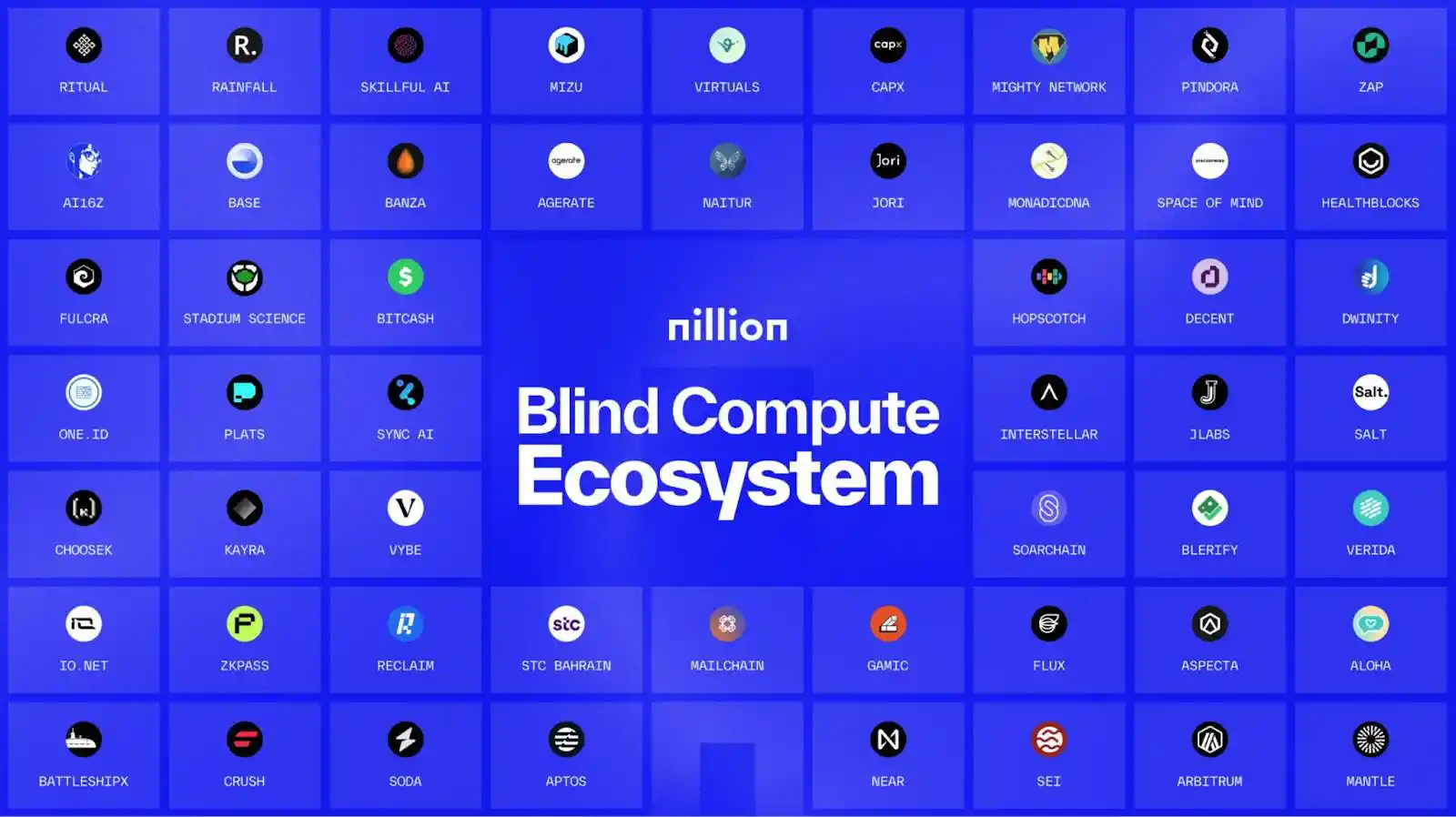
Image Source: Twitter @nillionnetwork
The diverse ecosystem not only demonstrates the high demand for privacy in various niche tracks and the recognition of Nillion's privacy solution but also allows users to have a rich exploration experience early in the mainnet launch.
With Nillion's mainnet officially launching in March 2025, its ecosystem partnerships will further accelerate, bringing innovative privacy and security experiences to more users.
Conclusion
In the future, with the official launch of the mainnet and the start of the TGE, more of Nillion's roadmap plans will also be implemented.
According to its official roadmap, in the early Project Development phase, Nillion will focus on launching the mainnet, followed by driving the coordination and optimization of the secure computation module to achieve the early launch of the universal computing layer to support a wider range of application scenarios.
In the second phase, Nillion's key efforts will focus on initiating the validator plan to ensure the network's security and reliability, continuously enhancing the decentralization of the network, while actively advancing integration with other blockchain projects or ecosystems.
By the third phase, Nillion will center on an audit and certification mechanism, continually enhancing the network's credibility and transparency. In the final fourth phase, Nillion will focus on expanding the ecosystem's scale, aiming to achieve permissionless network expansion to support more users and applications, while launching an ecosystem exploration plan to drive more innovative applications and implementations.
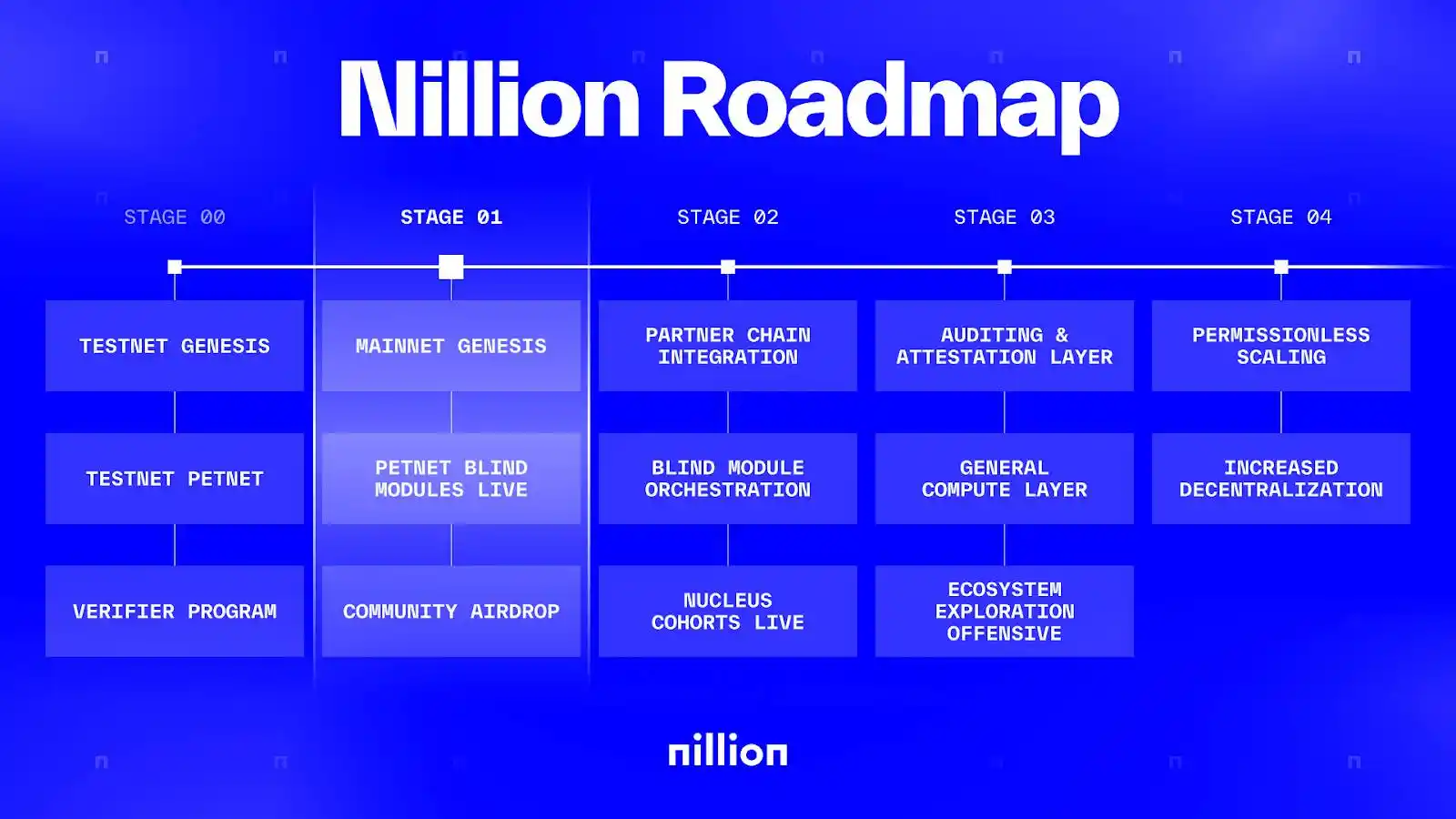
Image Source: Twitter @nillionnetwork
As a privacy project supported by Uber's senior executives and top VCs, we see in Nillion's past performance its foresight in product design, ecosystem expansion, and community building.
Through end-to-end encryption of high-value data storage, transmission, and processing, Nillion aims to build the next-generation privacy infrastructure and is committed to driving secure, efficient, and rapid development in various fields including AI, DeFi, DeSci, and more.
The handling of the airdrop controversy this time and the CMO's publication of a long article addressing community concerns in detail, introducing airdrop rules, have also strengthened the community's confidence in the project's long-term healthy development.
In an era where privacy and data value are equally important, privacy exemplified by Nillion will become a significant force driving the prosperity of the Web3 ecosystem. With the Nillion mainnet officially launched and entering a new stage of ecosystem development, we look forward to Nillion serving as a key player in the Web3 development wave, accelerating the arrival of the privacy era.
You may also like

The impossible triangle is simply a pseudo problem

Stablecoins Finally Find Real Returns: On-Chain Reinsurance Re Explained | Interview with Re Founder Karan Saroya

The AI gamble of mining companies: Valuations enter a phase of differentiation, and it's hard to turn the tide

A letter from Alliance to entrepreneurs: Written on the occasion of Cursor selling for 60 billion dollars

Will MicroStrategy fall into a death spiral? What will the macro trend be in the second half of the year?

Blockchain Capital Partner: The Core Secret of Arbitrage

STRC unanchored by 11%, can the perpetual motion machine of Strategy still operate?

Bitcoin Market Analysis 2026: Can BTC Reach $150K by Year-End?

Bitcoin ETF Outflows Hit a Record $4.4 Billion: What Are Traders Doing With Their Cash?

WEEX App Just Got Smarter – New Tabs for Faster Trades & Easy Asset Management

WEEX All-New Search Features: Find, Trade & Earn Faster Than Ever

Morning Report | Illinois signs the strictest digital asset tax law in the U.S.; RWA tokenization market size surpasses $43 billion, institutions accelerate the migration of on-chain assets

Full version of the debut Q&A! Federal Reserve Chairman Waller: Sticking to the 2% inflation target, establishing five special working groups, individual did not submit the dot plot

From Disruptor to Shadow Market: The Crypto Market is Becoming a Colony of Traditional Finance
Dalio's important long article: How to position in the current market environment?
OKX Star analyzes Binance's competitive advantages: when regulation levels the playing field, competition has just begun

New gameplay for participating in initial offerings on cryptocurrency exchanges
Why Is Bitcoin Down Today? What the Hawkish FOMC Means for SpaceX, Gold and Nasdaq
The impossible triangle is simply a pseudo problem
Stablecoins Finally Find Real Returns: On-Chain Reinsurance Re Explained | Interview with Re Founder Karan Saroya
The AI gamble of mining companies: Valuations enter a phase of differentiation, and it's hard to turn the tide
A letter from Alliance to entrepreneurs: Written on the occasion of Cursor selling for 60 billion dollars
Will MicroStrategy fall into a death spiral? What will the macro trend be in the second half of the year?
Blockchain Capital Partner: The Core Secret of Arbitrage


