
Will Aave Break Its Previous High with Aave-Chainlink Integration?



Original Article Title: "AAVE Surging to New High Again? With Chainlink's Help, Expected to Earn Millions of Dollars Annually"
Original Article Author: Azuma, Odaily Planet Daily
Two leading DeFi projects, Aave (AAVE) and Chainlink (LINK), both saw significant gains today, but not due to the Trump concept WLFI doubling down again (see "Which Assets Could the Trump Project WLFI Buy Next?"), but because the two projects joined forces to drive forward a concrete collaboration that is expected to help both parties earn millions of dollars annually.
According to OKX quotes, as of around 11 a.m. Beijing time, AAVE was trading at 377.69 USDT with a 24-hour increase of 16.66%; LINK was trading at 23.9 USDT with a 24-hour increase of 5.8%.
Chainlink SVR
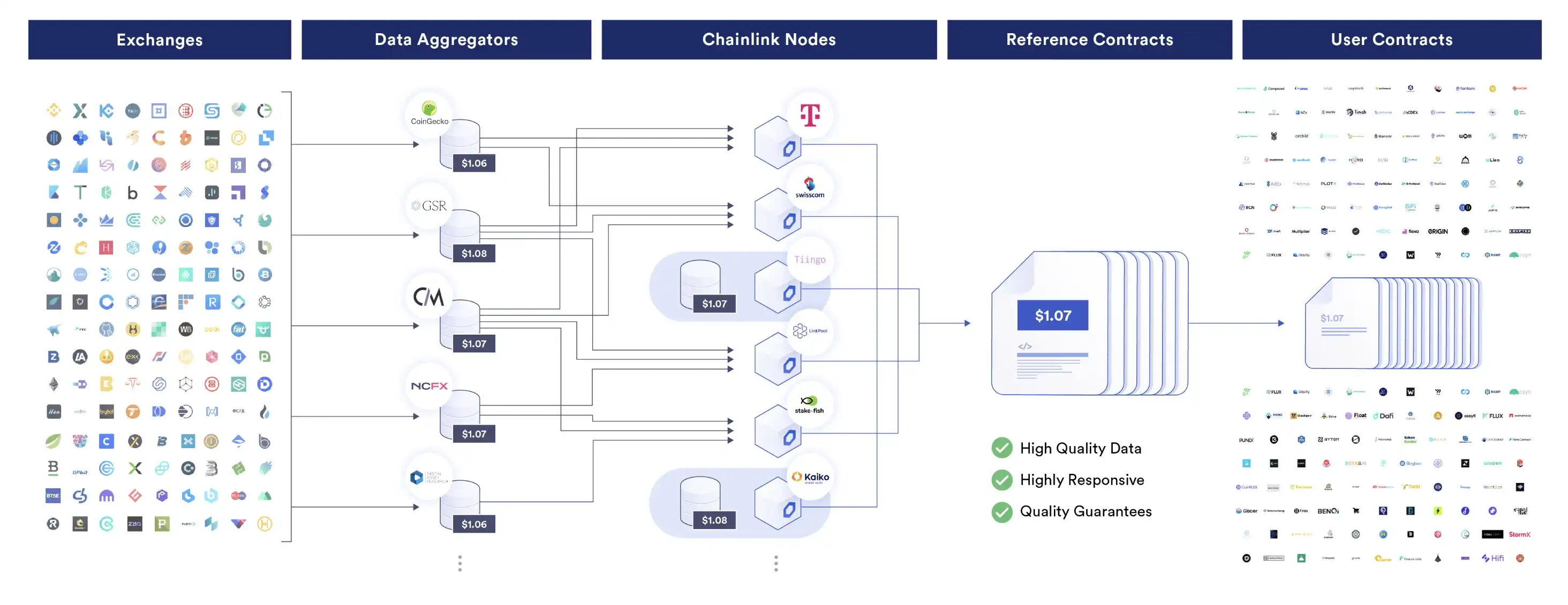
Early this morning Beijing time, Chainlink officially announced the launch of a new service called "Smart Value Recapture (SVR)," which is a novel oracle solution designed to enable DeFi applications to recapture MEV value in a "gas-neutral" manner through Chainlink's price feeds.
MEV, or Maximal Extractable Value, refers to the value that block proposers extract by including, excluding, or reordering transactions in a specific block. As a subset of MEV, OEV (Oracle Extractable Value) refers to the MEV generated when oracle reports are transmitted on-chain and consumed by on-chain applications. The most common OEV opportunities occur in lending protocols, especially during liquidations.
· Odaily Note: The term OEV is actually a misnomer because it does not refer to oracles actively extracting value from users but rather to the MEV associated with oracles.
In the current DeFi operating environment, the value of MEV (especially OEV) is captured by participants in the block construction process, such as searchers, builders, and validators, without being returned to the original creators of the MEV in DeFi protocols, end users, and oracles. Finding a way to recapture this MEV could help redistribute the related value back to its original creators.
This is the original purpose of Chainlink's SVR. From an application perspective, Chainlink SVR cannot be used for frontrunning or sandwich attacks, which are controversial MEV predatory scenarios, but is specifically designed for value recovery scenarios related to settlement, addressing the common OEV issue plaguing lending protocols.
Aave Community Proposal Integration
As one of the collaborators in the development of the initial version of SVR (specifically including BGD Labs, Flashbots, Aave DAO), upon Chainlink's announcement, BGD Labs immediately initiated a preliminary proposal on the Aave community forum, suggesting Aave integrate SVR at the earliest opportunity.
BDG Labs pointed out that Aave's long-standing stable operation has proven the effectiveness of its liquidation mechanism, but there are also significant MEV arbitrage opportunities—In actual liquidation scenarios, builders often receive a considerable profit without doing most of the work; meanwhile, searchers, the protocol users, receive a much smaller share.
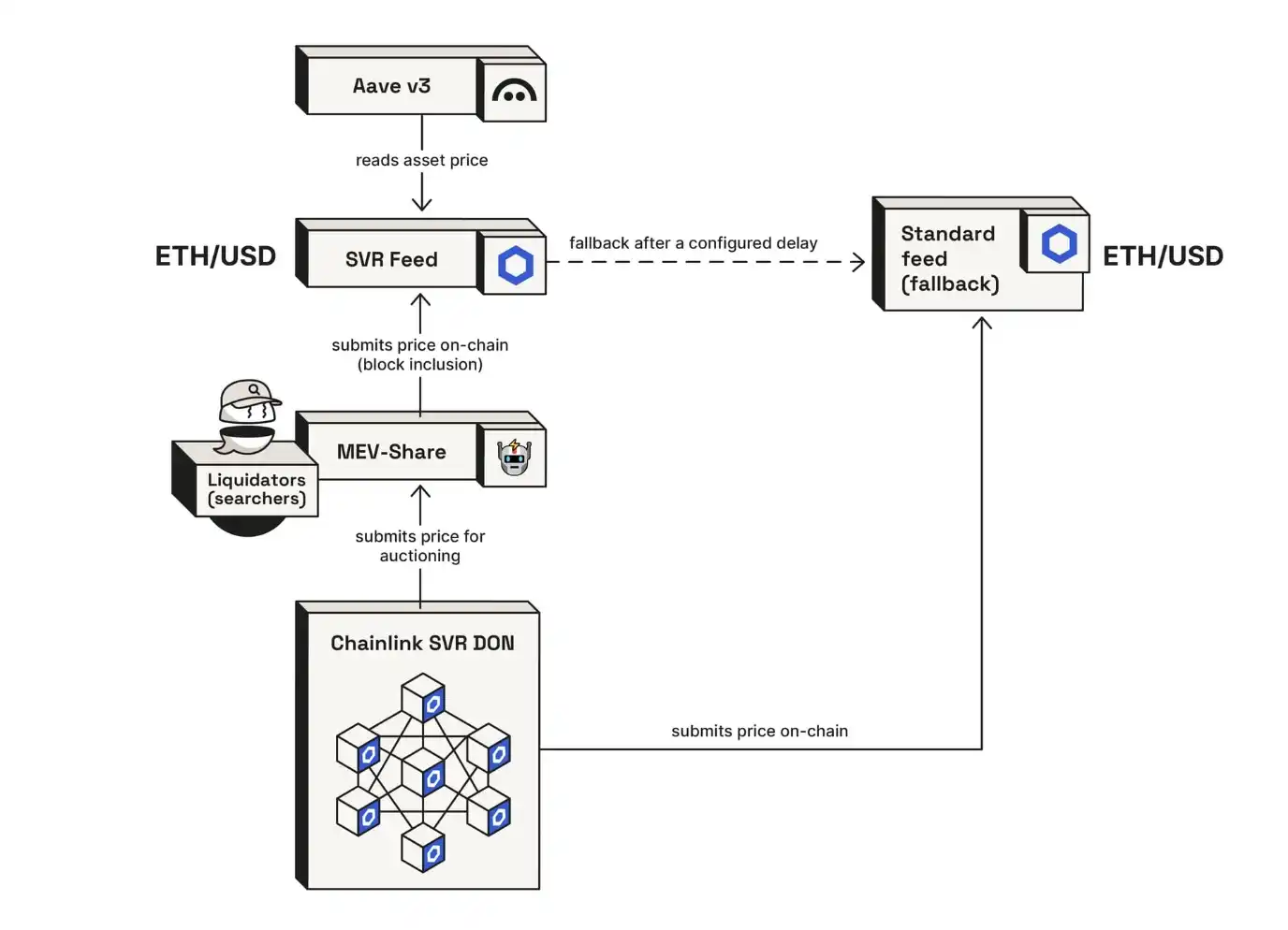
Chainlink's SVR is poised to address this issue adequately and more precisely define who benefits the most from transaction sequencing. Not wanting to sacrifice stability, BGD Labs proposes deploying SVR only for 1-3 assets in the early pilot phase to progress the integration in a controlled manner.
Potential Value Capture Scale
According to Chainlink's data, post-measurement, Chainlink SVR is expected to achieve approximately a 40% actual value recovery rate—recovering $40 for every $100 leaked through liquidation MEV).
Chainlink further states that although some alternative solutions claim to achieve higher liquidation recovery efficiency, the team has not seen concrete empirical data to prove this. For SVR, 40% is a conservative but realistic estimate that will require actual performance to gather empirical data.
BDG Labs also adds that the 40% recovery efficiency corresponds to the scale of past MEV leaks and is expected to achieve tens of millions of dollars in value recovery.
It is worth mentioning that BGD Labs also mentioned that, for the sake of simplifying the system, the form of asset to receive the recovered value will be ETH.
Revenue Sharing Plan
On the Chainlink side, in the announcement regarding SVR, it was stated that the recovered value from SVR would be distributed according to a standard ratio between the integrated DeFi protocols and the Chainlink network, where 60% of the value will flow to the DeFi protocol, and 40% will flow to the Chainlink ecosystem —— the ratio is not fixed and may be adjusted in the future.
As for the first partner, in order to establish a long-term partnership with Aave, Chainlink proposed a split of 65% to Aave and 35% to Chainlink in the first six months, subject to approval by the Aave community governance.
Regarding the final destination of the value after the split, Chainlink did not specifically mention it, only stating that "it can support the economic sustainability of the Chainlink oracle by paying transaction gas costs and other ongoing infrastructure fees"; however, on the Aave side, BGD Labs has explicitly proposed using the recovered value to benefit users, such as providing incentives to the stakers of the Umbrella module —— this may also be one of the more prominent reasons for the recent surge in AAVE compared to LINK.
You may also like

The pricing controversy of Trade.xyz exposes the fatal weakness of Pre-IPO perpetual contracts

World Cup 2026 Coming – WEEX Celebrates with $1M Prize Pool & Michael Owen Live

Galaxy in-depth report: Is Solana still worth paying attention to?
Young people in South Korea make a "final effort" in the epic bull market

Dialogue with OmenX Founder: Why does the prediction market need an evolution from "spot" to "derivatives"?
When the P2P illicit funds from ten years ago turned into 60,000 bitcoins

Morning News | CME Group launches Nasdaq Cryptocurrency Index futures; Asset management giant Janus Henderson strategically invests in Ethena

Why did Oracle deliver the strongest financial report in history, yet its stock price fell?

Bitcoin Layer 2 Network Botanix: Why Did We Choose to Dissolve?

Morning Report | OpenAI has submitted an S-1 registration statement draft to the U.S. SEC; Morpho completes $175 million financing

Galaxy Deep Research Report: How Hyperliquid's HIP-4 Upgrade Changes the Landscape of Prediction Markets?

Latest research from 13 top universities including Cornell University: The current state, challenges, and misconceptions of the fusion of Crypto and AI
Deconstructing Anthropic: The Best AI Company, Possibly Also a Type of Organizational Invention

Every exchange is a "Universal Exchange."

The counterattack of traditional finance: Alliance chains are quietly reviving
Pantera Capital Partner: How Tokenization is Restructuring the Private Equity and Early Investment Ecosystem?

Mastercard Launches Agent Pay for AI, Plans to Record AI Agent Payment Authorizations on Polygon
Mastercard launched Agent Pay for AI, a new payment protocol designed to help AI agents make small payments such as pay-per-use access to data and APIs. The system plans to record human-granted AI agent permissions on Polygon, focusing on verifiable authorization, identity, and payment controls.

Curve Deploys Llamalend v2 on Optimism With 250,000 OP Incentives
Curve launched Llamalend v2 on Optimism with 250,000 OP incentives from the Optimism Foundation. The upgrade expands Llamalend beyond its earlier crvUSD-focused model, adding broader collateral support, LlamaRisk market reviews, and the ability to use Curve LP tokens as collateral.
The pricing controversy of Trade.xyz exposes the fatal weakness of Pre-IPO perpetual contracts
World Cup 2026 Coming – WEEX Celebrates with $1M Prize Pool & Michael Owen Live
Galaxy in-depth report: Is Solana still worth paying attention to?
Young people in South Korea make a "final effort" in the epic bull market
Dialogue with OmenX Founder: Why does the prediction market need an evolution from "spot" to "derivatives"?
When the P2P illicit funds from ten years ago turned into 60,000 bitcoins


