
「Zero Fee」 Illusion: Lighter Nodes Shifted Costs with High Latency

Original Article Title: Lighter's "0% Fees" Are Actually 5-10x More Expensive Than Other Exchanges
Original Article Author: @PerpetualCow, Crypto Influencer
Original Article Translation: AididiaoJP, Foresight News
There's a saying in the market: If a product is free, then you are the product.
Lighter DEX is currently promoting "zero fees" to retail traders. It sounds too good to be true, and indeed it is.
However, what Lighter didn't prominently display is the toll structure behind these "free" trades.
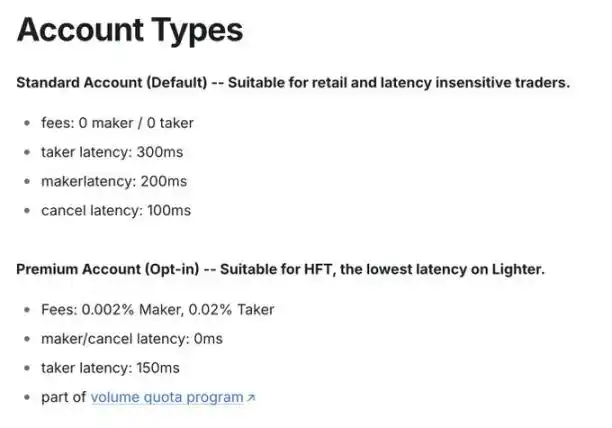
Lighter offers two account types: once you understand how the toll structure works, you'll realize that the 0% fee is actually the most expensive tier on the platform.
That 200-300 millisecond delay is the crux of their business model.
What Does 300 Milliseconds Really Mean?
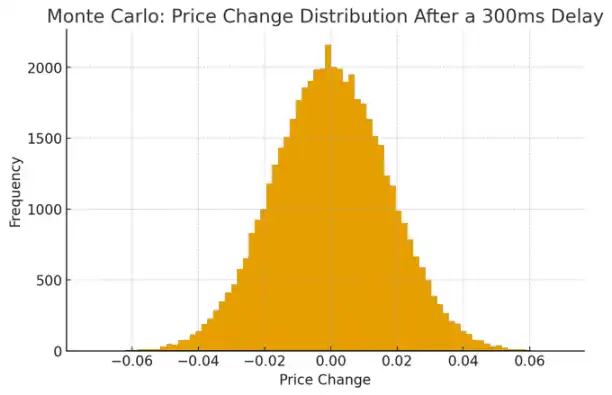
An average human blink takes about 100-150 milliseconds. By the time you blink twice, faster traders have already captured price movements, adjusted positions, and engaged in a trade against you.
The crypto market is highly volatile, with typical volatility levels (50-80% annualized), causing prices to move about 0.5 to 1 basis point per second.
This means that within 300 milliseconds, market noise alone can cause prices to move on average 0.15-0.30 basis points.
The True Cost of "Free"
If we quantify it:
Academic research on adverse selection costs (Glosten & Milgrom, Kyle's Lambda, etc.) indicates that the informational advantage of informed traders is usually 2-5 times the magnitude of price random walk.
If the random slippage within 300 milliseconds is about 0.2 basis points, then adverse selection would add an additional 0.4-1.0 basis points.
For active traders and liquidity providers, the actual costs are roughly as follows:
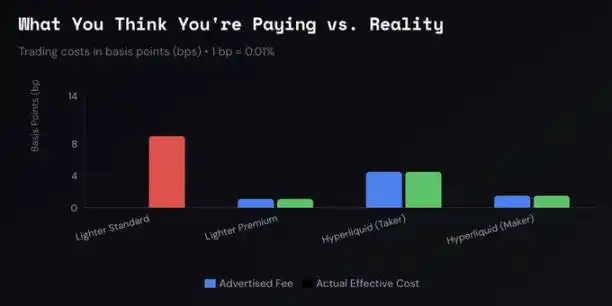
· Standard Account Actual Cost: 6–12 basis points (0.06%–0.12%) per transaction
· Advanced Account Actual Cost: 0.2–2 basis points (0.002%–0.02%) per transaction
The cost of a "free" account is 5–10 times higher than that of a paid account.
Zero transaction fee is just a marketing number; the real cost is hidden in the latency.
The advanced account is actually more cost-effective, without a doubt
In any case, the standard account (0% fee) is not the preferable choice.
It is not suitable for small retail investors, large holders, scalpers, day traders, or even passive investors. Especially not for liquidity providers, or anyone, for that matter.
"I am just a small retail investor; I don't need an advanced infrastructure."
Wrong.
Small retail investors are more vulnerable to slippage. If you trade with $1,000 and lose 10 basis points per trade, it is like losing $1 each time. After 50 trades, 5% of your account will silently disappear.
"I don't trade frequently; latency doesn't affect me."
Also wrong.
If you don't trade frequently, the cost of an advanced account is negligible anyway.
Yet even in a few trades, the execution price you receive is still worse. Since the cost of avoiding such losses is almost zero, why accept any disadvantage?
Directly upgrade to an advanced account.
This model has a precedent
The traditional financial markets have long witnessed this tactic, known as payment for order flow.
@RobinhoodApp once attracted retail investors with "commission-free trading," then routed orders to liquidity providers, allowing them to profit by trading against the uninformed orders of retail investors, thus popularizing this model.
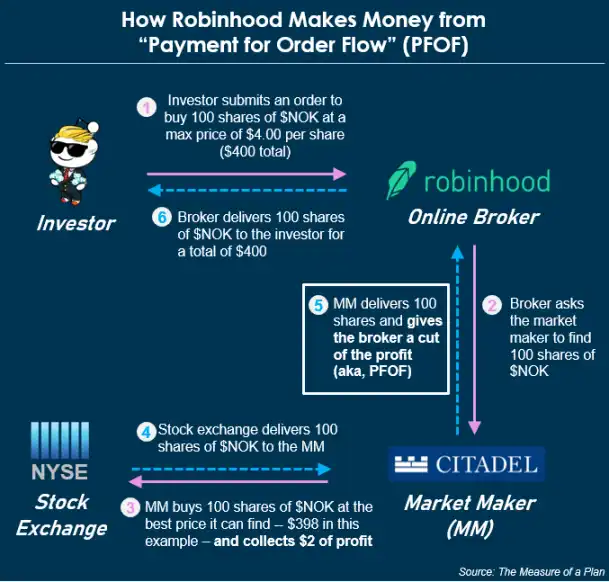
Lighter's model is structurally similar to this. Standard accounts do not receive free trades; they receive slower trades. This latency is transformed into profit by faster participants.
The trading platform does not need to charge you a fee because you are actually paying with execution quality.
What Lighter Did Right and Wrong
Lighter did not conceal latency data, as it was clearly stated in the documentation.
However, transparency does not equal clarity.
By highlighting "0% Fee" in the headline but burying "300ms Latency" in the fine print, Lighter employed a strategy focused on registration conversion rates rather than user understanding.
Most retail traders do not understand the implications of latency, are unaware of adverse selection, and naturally cannot calculate the equivalent actual cost.
Lighter is clear about this.
Advanced accounts are more cost-effective in every way compared to the standard "zero-fee" account—there is no debate about this.
You may also like

The other side of Musk's trillion-dollar fortune: 85% cannot be sold

The U.S. government prohibits foreigners from using Fable 5, Anthropic issues a rebuttal

Citibank releases "2030 Asset Tokenization Market Outlook": 6 major trends may create a $8.2 trillion market

The trillion-dollar valuation test: Are the three major super IPOs a celebration for tech stocks or a nightmare for the crypto market?

Morning Report | Digital Asset completes $355 million financing led by a16z Crypto; Meta completes operational separation from Manus

a16z Crypto Partner: Cash flow is the moat

Cryptocurrency market makers collectively seek change as it becomes increasingly difficult to make money

How TradeXYZ, xStocks, and Alpaca break down the SpaceX IPO into three different strategies
$75 billion in risk asset redistribution: How will SpaceX's IPO affect U.S. stocks and Bitcoin?

Why Is BlackRock Investing $5 Billion in the SpaceX IPO?
Morning News | CME Group launches Nasdaq Cryptocurrency Index futures; Asset management giant Janus Henderson strategically invests in Ethena

Bitcoin Layer 2 Network Botanix: Why Did We Choose to Dissolve?

Why did Oracle deliver the strongest financial report in history, yet its stock price fell?
When the P2P illicit funds from ten years ago turned into 60,000 bitcoins
Dialogue with OmenX Founder: Why does the prediction market need an evolution from "spot" to "derivatives"?
Galaxy in-depth report: Is Solana still worth paying attention to?
Young people in South Korea make a "final effort" in the epic bull market
The pricing controversy of Trade.xyz exposes the fatal weakness of Pre-IPO perpetual contracts
The other side of Musk's trillion-dollar fortune: 85% cannot be sold
The U.S. government prohibits foreigners from using Fable 5, Anthropic issues a rebuttal
Citibank releases "2030 Asset Tokenization Market Outlook": 6 major trends may create a $8.2 trillion market
The trillion-dollar valuation test: Are the three major super IPOs a celebration for tech stocks or a nightmare for the crypto market?
Morning Report | Digital Asset completes $355 million financing led by a16z Crypto; Meta completes operational separation from Manus
a16z Crypto Partner: Cash flow is the moat


